









- bhavya gada
- No Comments
Across the U.S., pool owners are moving away from chlorine due to health concerns, rising costs, and maintenance challenges. Options like saltwater, UV sanitizers, mineral systems, bromine, ozone, and AOP (Advanced Oxidation Process) systems offer safer, cost-effective, and lower-maintenance solutions. Here’s a quick breakdown:
- Saltwater Systems: Automates chlorine production, reduces maintenance, and softens water. Installation costs $500–$2,500, with annual savings of $200–$600.
- UV Sanitizers: Kills 99.9% of bacteria but requires a secondary sanitizer. Costs $350–$2,000 and reduces chlorine use by up to 95%.
- Mineral Systems: Uses silver and copper ions to sanitize. Affordable ($300–$400 annually) but works slower and needs pH monitoring.
- Bromine: Gentler on skin but degrades in sunlight. Costs more than chlorine and works better in spas or indoor pools.
- Ozone Systems: Powerful oxidizer that eliminates harmful bacteria. Costs $700–$4,000 but needs pairing with another sanitizer.
- AOP Systems: Most effective at killing pathogens, with low chlorine needs. Installation ranges from $1,000–$3,000, but pumps must run continuously.
Each system has pros and cons, so your choice should depend on your budget, pool size, and maintenance preferences. For Maryland’s rainy climate, systems with residual protection, like saltwater or mineral, work best.
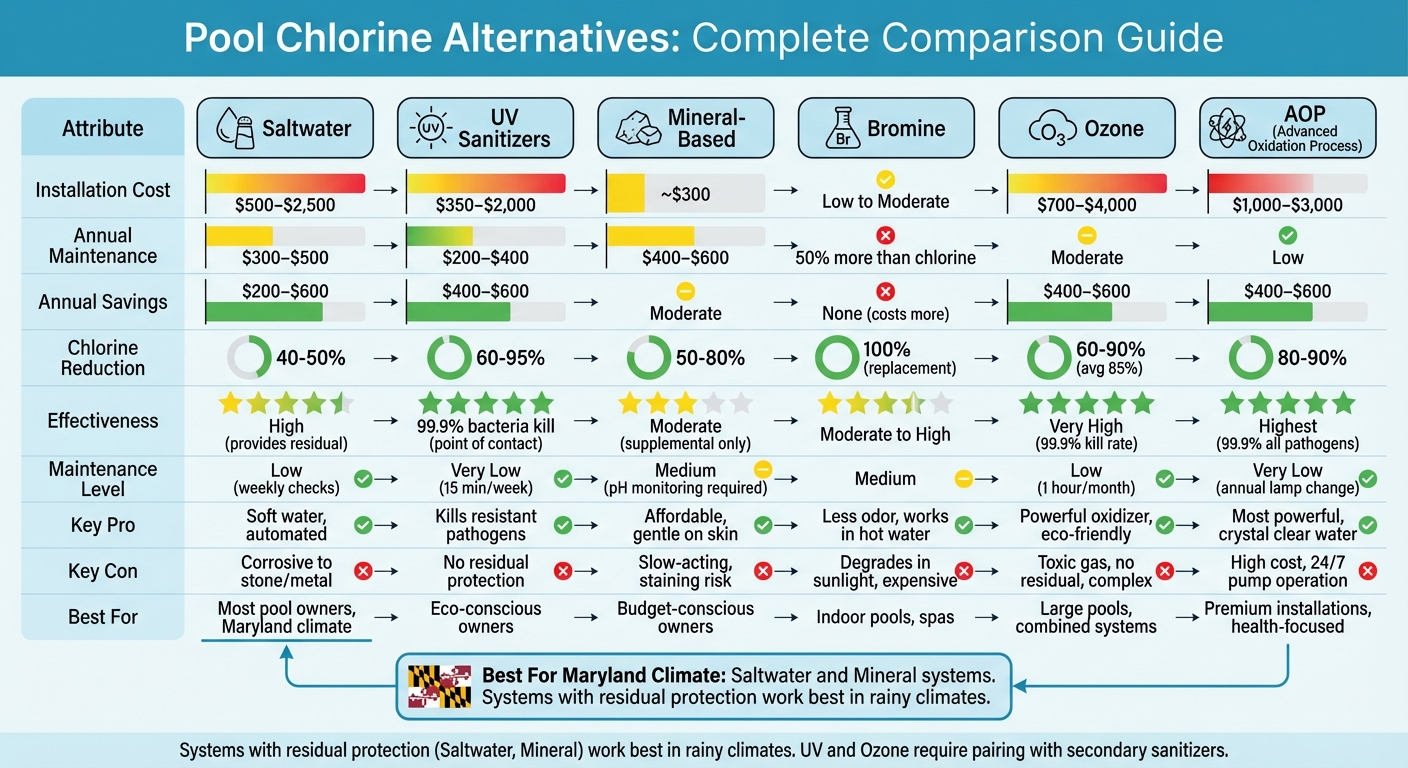
Pool Chlorine Alternatives Comparison: Costs, Effectiveness & Maintenance
A Complete Guide To Pool Chlorine Alternatives (Ozone, UV, Ionizers, Chlorine Generators & more)
sbb-itb-843f8be
1. Saltwater Pool Systems
Saltwater pool systems use a salt chlorine generator to convert salt into chlorine through electrolysis, offering continuous sanitization while reducing waste [3].
Cost
Installing a saltwater system typically costs between $500 and $2,500, with most setups falling in the $700 to $1,400 range [3]. Though the upfront cost may seem steep, it often pays off within a season or two. Annual maintenance expenses drop to $300–$500, compared to the $1,000–$1,200 required for traditional chlorine pools [1]. Over time, owners can save $200–$600 per season on pool chemicals [3].
"Pool owners with salt pool systems cut maintenance costs by as much as 50% annually – anywhere between $200-$600 per season."
– John Uhle, Pool Expert, Discount Salt Pool [3]
This affordability, combined with easier upkeep, makes saltwater systems a popular choice.
Maintenance
Saltwater systems simplify pool maintenance. Instead of daily testing and frequent chemical adjustments, you only need to check pH, total alkalinity, and chlorine levels weekly. Cleaning the salt cell every three to four months prevents scale buildup [3]. The system’s automated nature ensures consistent chlorine levels, reducing the risk of algae and bacteria growth.
Environmental Impact
Saltwater systems are more energy-efficient, consuming about 50% less electricity than traditional setups [1]. This translates to monthly savings of $30–$40 on power bills. Additionally, they eliminate the need for handling and storing concentrated chlorine chemicals [4]. By continuously breaking down chloramines – the culprits behind strong odors and skin irritation – these systems create a safer and more pleasant swimming experience [3].
Effectiveness
Saltwater systems provide consistent "whole-pool" residual protection, even when the pump is off [3]. This stability prevents the fluctuations that allow algae and bacteria to thrive. Moreover, 92% of saltwater pool owners report that the water feels noticeably softer on the skin compared to traditional chlorine pools [1].
This detailed overview of saltwater systems highlights their advantages. Next, we’ll explore other advanced pool sanitization options offering comparable benefits.
2. UV Sanitizers
UV sanitizers offer a way to maintain pool cleanliness while cutting down on chemical use and waste. These systems use ultraviolet light to neutralize pathogens as water flows through a specialized chamber, killing up to 99.9% of harmful bacteria without relying heavily on traditional chemicals [1]. The system operates continuously whenever the pump is running, sanitizing the water after it has been filtered.
Cost
The annual cost of maintaining a UV system, including electricity and upkeep, typically falls between $200 and $400. Compared to traditional chlorine pools, which can cost $1,000 to $1,200 annually, this can save pool owners $400 to $600 every year [1]. Additionally, UV systems can be retrofitted into existing pump setups, making installation simple and avoiding the need for a complete system overhaul [2].
Maintenance
UV sanitizers are low-maintenance. Most owners spend about 15 minutes per week on upkeep [1]. The main tasks include checking the UV bulb every few months and replacing it every two years to ensure it maintains the proper intensity [1]. While the UV system effectively sanitizes water passing through the chamber, maintaining a small chlorine residual of 0.5 to 1 ppm in the pool is still necessary to prevent algae growth [2][4].
Environmental Impact
By reducing chlorine usage by 60% to 95% [1][2], UV systems significantly lower the environmental impact of pool maintenance. They also eliminate chloramines – the byproducts responsible for unpleasant odors and respiratory irritation – leaving no chemical residues in the water [3]. As UV light is non-corrosive, it helps extend the life of pool equipment by avoiding the wear and tear often caused by high chlorine levels [2][5]. Notably, around 89% of users report achieving crystal-clear water after switching to UV technology [1].
Effectiveness
UV sanitizers excel at eliminating chlorine-resistant pathogens, such as Cryptosporidium, which are notoriously difficult to kill [2][4]. Because the system operates continuously alongside the pump, it provides steady sanitation without the need for daily testing or frequent shocking [1][3]. However, since UV systems only treat water that flows through the light chamber, they don’t offer whole-pool protection. Pairing a UV system with a saltwater generator can address this limitation by combining targeted sanitation with a consistent residual defense [3]. Up next, we’ll dive into another cutting-edge option: mineral-based treatments.
3. Mineral-Based Treatments
Mineral-based systems use silver and copper ions to sanitize pool water. Silver acts as a bactericide, targeting harmful microorganisms, while copper serves as an algaecide, keeping algae growth in check [6]. These ions are introduced into the water either through a mineral-filled cartridge in the filtration system or an electronic ionizer that uses low-voltage DC current to disperse metal ions [6].
Cost
The initial cost of an ionizer for pools up to 40,000 gallons is approximately $300 [6]. Annual maintenance, including replacement cartridges and additional chemicals, typically ranges between $400 and $600 [6]. Replacement mineral cartridges or electrodes cost about $129 per season, with most systems requiring a new cartridge once per swimming season or every six months [6].
Maintenance
Day-to-day upkeep is straightforward, but keeping an eye on pH levels is crucial. If pH levels climb too high, copper ions can form deposits, leading to blue-green stains on pool liners and plaster [4]. Electronic ionizers need the pump to run continuously to maintain adequate ion levels [6]. Since minerals don’t oxidize organic debris like sweat or body oils, it’s recommended to use a small amount of chlorine or bromine alongside the mineral system [6]. As aquatic specialist Alison Osinski explains:
"Chlorine and an ionizer work together better than chlorine alone" [6].
Environmental Impact
Mineral systems can reduce chlorine use by up to 50%, cutting down on chemical discharge [7]. The non-corrosive nature of the ions also helps extend the lifespan of pool equipment [4]. Some advanced systems even use magnesium and potassium chloride, creating water that’s gentler on the skin and may help with muscle relaxation [5]. However, poor pH management can result in copper buildup and staining on pool surfaces [4].
Effectiveness
Copper ions offer a natural flocculation effect, binding fine particles together to deliver crystal-clear water [3]. While effective against bacteria and algae, mineral systems work more slowly than chlorine and don’t provide rapid oxidation [4]. To ensure thorough sanitization, these systems are best paired with supplemental sanitizers like chlorine, which can reduce chlorine demand by 50% to 80% [8]. Next, we’ll explore bromine systems for comparison.
4. Bromine Systems
Bromine systems stand out as an alternative to chlorine, offering a different approach to pool sanitization. Bromine, like chlorine, is a halogen and effectively sanitizes water, but it has a lower oxidation strength compared to chlorine[6]. To counterbalance this, many pool owners use BCDMH tablets, which combine 66% bromine and 27% chlorine, or add oxygen-based shock treatments to maintain water clarity and sanitation[6].
Cost
Switching to bromine can be a pricier choice. Bromine chemicals cost about 50% more than chlorine, and the overall system expenses may even double[3][6]. If you’re moving from a chlorine system to bromine, it’s crucial to replace your chemical feeder entirely. This prevents potential hazardous reactions between leftover chlorine and the new bromine chemicals[9].
Maintenance
Bromine offers some maintenance perks, especially for indoor pools and spas, as it remains stable at higher temperatures. However, it breaks down quickly in sunlight, making it less cost-effective for outdoor use[9][3]. One advantage is that bromine works efficiently across a broader pH range (7.5 to 8.0), which can reduce the need for frequent pH adjustments[5]. On the flip side, bromine’s weaker oxidation power can lead to issues like green, foamy water if not properly managed. Regular shocking is often necessary to maintain water clarity and cleanliness[6].
Environmental Impact
From an environmental perspective, bromine systems have their drawbacks. They produce brominated organic compounds that are not biodegradable, requiring diligent upkeep[5]. Additionally, the CDC warns that bromine, like chlorine, can cause respiratory irritation and skin sensitivity in some individuals[2].
Effectiveness
One of bromine’s standout benefits is its byproducts. Unlike chlorine, which creates chloramines that can irritate the skin and eyes, bromine produces bromamines. These bromamines are gentler on swimmers and continue to sanitize the water without the strong chemical odor often associated with chlorine[6][3]. For individuals allergic to chlorine – about 5% of the population – bromine offers a viable alternative[6]. However, bromine’s tendency to degrade under sunlight often necessitates additional chemicals, such as potassium peroxymonosulfate, to maintain its effectiveness[4].
While bromine systems provide a gentler experience for some swimmers and perform well in specific conditions, their limitations – like higher costs and sensitivity to sunlight – make them less universal. As we continue, we’ll explore ozone systems to uncover more options for pool sanitation.
5. Ozone Pool Systems
Ozone pool systems work by generating ozone gas (O3) and injecting it into your pool’s circulation system. Ozone is a powerful oxidizer that effectively destroys bacteria, viruses, and organic waste on contact. These systems typically use either corona discharge (CD), which utilizes an electric field to convert oxygen into ozone, or ultraviolet (UV) light. What sets ozone apart is its ability to eliminate 99.9% of harmful bacteria, viruses, and even chlorine-resistant parasites like Cryptosporidium [1][5][3].
Cost
The initial cost of an ozone system is higher compared to traditional chlorine setups. Most homeowners spend between $800 and $1,200 on a standard system, though prices can range from $700 to $4,000, depending on pool size and system complexity [3]. However, ozone systems significantly cut down on chlorine use – by as much as 60% to 90% [10]. On average, users report an 85% reduction in chemical usage, translating into annual savings of about $400 to $600 [1]. Additionally, ozone cells are built to last, with a lifespan of up to five years before replacement is needed [10].
Maintenance
Maintaining an ozone system is straightforward, requiring about an hour per month to ensure components like air dryers or oxygen concentrators are working properly [1]. Ozone is pH neutral, which helps stabilize water chemistry and minimizes the need for pH-balancing chemicals [10]. It also acts as a micro-flocculant, clumping fine particles together so they can be easily filtered out, resulting in clearer water [3]. Since ozone breaks down almost instantly, a small chlorine residual (0.5 to 1.0 ppm) is recommended for complete sanitation [3][4].
Environmental Impact
Ozone systems are environmentally friendly because they decompose into pure oxygen, leaving no toxic residues behind [4][5]. Their pH-neutral properties reduce the need for additional balancing chemicals, and they eliminate chloramines – the harmful byproducts of chlorine that release toxic gases [4][3][10]. Ozone is also gentler on pool equipment, as it is less corrosive than high chlorine levels. This helps prevent rusting pipes and deteriorating pool liners, reducing waste from frequent replacements [2]. The result? Water that is odorless, gentle on the skin and eyes, and of near-drinking quality [2][5].
Effectiveness
Ozone is incredibly effective at oxidizing contaminants, making it a fast-acting disinfectant. However, because it doesn’t provide long-term residual protection, it’s most effective when paired with a secondary sanitizer. Many pool owners combine ozone generators with saltwater chlorinators, where the ozone handles heavy-duty oxidation, and the salt system maintains a steady chlorine level. High-quality systems often include degas vessels or ozone destruct chambers to prevent ozone gas from escaping into the pool area, where it could pose risks to humans and damage pool surfaces. Proper sizing is crucial – underpowered systems may take days to sanitize the water fully and fail to deliver the expected chemical reduction [2]. This combination of immediate action and supplemental treatment opens the door to advanced options like Advanced Oxidation Process systems.
6. Advanced Oxidation Process (AOP) Systems
AOP systems rely on hydroxyl radicals – extremely reactive oxidizers – to sanitize pool water with greater effectiveness than chlorine or ozone alone [4][1]. These radicals are generated either by combining UV light with ozone or through the direct injection of excited atomic oxygen. AOP systems are particularly effective, capable of killing up to 99.9% of harmful bacteria and even eliminating chlorine-resistant parasites like Cryptosporidium [1].
Cost
The installation of an AOP system typically ranges from $1,000 to $3,000, depending on the size of the pool and the specific technology used [1]. While this upfront cost might feel steep, the savings on chemicals can be substantial. By reducing chemical usage by as much as 80% to 90%, pool owners can save between $400 and $600 annually on maintenance. For instance, in 2023, the Miami Beach Resort reported a 70% decrease in annual chemical costs after adopting an AOP system, alongside noticeable improvements in water clarity [1].
Maintenance
Compared to traditional pool systems, AOP systems require relatively little maintenance. The main task involves replacing the UV lamp annually to maintain peak performance [1]. For systems that combine UV and ozone, occasional servicing of the ozone components may be necessary. On the other hand, hydroxyl-based direct injection models simplify upkeep by eliminating additional parts like ozone generators [4]. To ensure efficient treatment, it’s important to run a variable-speed pump continuously for point-of-contact sanitization [4][3].
Environmental Impact
AOP systems are environmentally friendly, leaving no toxic residues behind. The hydroxyl radicals effectively break down chloramines and other harmful compounds, reducing both odors and respiratory irritants [4][3]. Additionally, AOP systems are non-corrosive, which helps protect pool equipment and surfaces, extending their lifespan. They also act as micro-flocculants, improving filtration by allowing filters to capture organic materials more effectively [4].
Effectiveness
Hydroxyl radicals provide rapid and powerful oxidation, making AOP systems highly effective. However, because AOP systems don’t maintain residual protection, it’s essential to keep a small amount of chlorine (0.5–1 ppm) in the water when the pump is off [4]. This approach results in water that feels soft and looks crystal clear, with no harsh odors. Common chlorine-related issues like red eyes and itchy skin are significantly reduced, leaving water quality that rivals tap water [4]. Next, we’ll explore the broader pros and cons of these chlorine alternatives.
Advantages and Disadvantages
This section gives you a side-by-side comparison of the most important factors for each system, focusing on upfront costs, ongoing expenses, and overall performance.
Saltwater systems stand out for their ability to produce soft water and automate chlorine generation, cutting annual maintenance costs by 40% to 50% compared to traditional chlorination[3]. On the flip side, they can be corrosive to stone and metal surfaces, and the salt cell needs cleaning every 3–4 months[1].
UV sanitizers effectively kill 99.9% of bacteria and viruses at the point of contact, reducing chlorine usage by approximately 60%[2]. However, they don’t provide any residual protection once the water leaves the UV chamber, meaning you’ll still need a secondary sanitizer.
Ozone systems are highly effective, offering double the strength of chlorine in eliminating chlorine-resistant parasites like Cryptosporidium[5]. The downside? Ozone gas can be toxic at high levels, dissipates quickly, and requires complex containment measures[3].
Mineral-based treatments use silver and copper ions, making them affordable to install and gentle on the skin. But they work slowly and can cause blue-green stains if pH levels aren’t carefully managed[4].
AOP systems (Advanced Oxidation Processes) deliver the most powerful oxidation, eliminating 99.9% of bacteria and allowing chlorine levels as low as 0.5 to 1 ppm. The trade-off is their higher upfront cost and the need for continuous pump operation to maintain performance[1][4].
Here’s a quick comparison of the pros, cons, and costs for each system:
| Alternative | Pros | Cons | Cost (Installation) | Effectiveness |
|---|---|---|---|---|
| Saltwater | Soft water; reduces chemical costs; automated | Corrosive to stone/metal; requires cell cleaning | $500–$2,500 | High (provides residual) |
| UV Sanitizer | Kills chlorine-resistant pathogens; eco-friendly | No residual protection; lamp replacement every 1–2 years | $350–$2,000 | High at point of contact |
| Mineral-Based | Affordable; gentle on skin; lowers chlorine use | Slow-acting; potential for staining; needs pH monitoring | Low | Moderate (supplemental only) |
| Bromine | Works in hot water; less odor; stable at high pH | More expensive than chlorine; slower; needs more product | Low to Moderate | Moderate to High |
| Ozone | Strong oxidizer; destroys chloramines; clarifies | Toxic gas; no residual; complex setup; corrosive | $700–$4,000 | Very High (oxidizer only) |
| AOP | Most powerful; destroys Cryptosporidium; low chlorine | High upfront cost; requires 24/7 pump operation | $1,000–$3,000 | Highest (oxidizes & disinfects) |
For many pool owners, combining systems – like pairing a UV or ozone system with a saltwater generator – can offer the best of both worlds. This approach ensures thorough disinfection while keeping chlorine levels stable and maintenance minimal[3].
Conclusion
Choosing the right chlorine alternative depends on your pool size, budget, and how much time you can dedicate to maintenance. For those in Maryland, there’s an extra factor to consider – our climate’s frequent rainfall. Heavy storms can dilute your pool water, so it’s important to pick a system that keeps its sanitizing power intact even after a downpour[1]. Here’s a quick overview of the top options suited to Maryland’s weather.
- Saltwater systems strike a good balance for many pool owners. They automate chlorine production, soften water, and can save money over time[3].
- If you’re looking for an option that’s gentle on skin and the environment, pairing a UV system with a saltwater generator is a smart choice. This combo can cut chemical use by up to 90% while keeping your entire pool sanitized between pump cycles[1].
- For the cleanest water and the ability to handle tough parasites like Cryptosporidium, AOP systems stand out. However, they come with higher costs ($1,000–$3,000) and need your pump to run continuously[4].
- If you’re working within a budget, mineral-based treatments or a basic saltwater system offer reliable performance without breaking the bank.
For Maryland’s humid summers and unpredictable weather, systems that offer residual protection – like saltwater or mineral systems – are especially effective. On the other hand, UV and ozone systems need to be paired with another sanitizer to handle the dilution caused by heavy rain[3]. Tailoring your choice to these factors ensures your pool stays clean, safe, and ready for use.
FAQs
Do I still need chlorine with UV, ozone, or AOP?
Yes, UV, ozone, and advanced oxidation process (AOP) systems can help lower the reliance on chlorine in pools. However, most pools still need a small amount of residual sanitizer, such as chlorine, to maintain ongoing disinfection and ensure swimmer safety.
What is the best chlorine alternative for an outdoor pool in rainy Maryland?
For outdoor pools in rainy Maryland, saltwater systems stand out as a popular choice. These systems use electrolysis to produce small amounts of chlorine, resulting in water that’s easier on the skin and eyes while cutting down on the need for chemical upkeep. Another effective option is UV-ozone technology, which uses ultraviolet light to disinfect the water, keeping it clear and reducing the reliance on chemicals. Pairing saltwater systems with UV sanitation can provide an efficient and eco-conscious way to handle Maryland’s unpredictable weather.
Can saltwater or mineral systems damage pool surfaces or cause stains?
Saltwater systems can harm pool surfaces and lead to stains because of salt’s corrosive properties. Over time, high salt levels can wear down materials like cement, plaster, stone, and even decking. While mineral systems tend to be gentler, they can still cause staining if not maintained correctly.
Chat with Us