









- bhavya gada
- No Comments
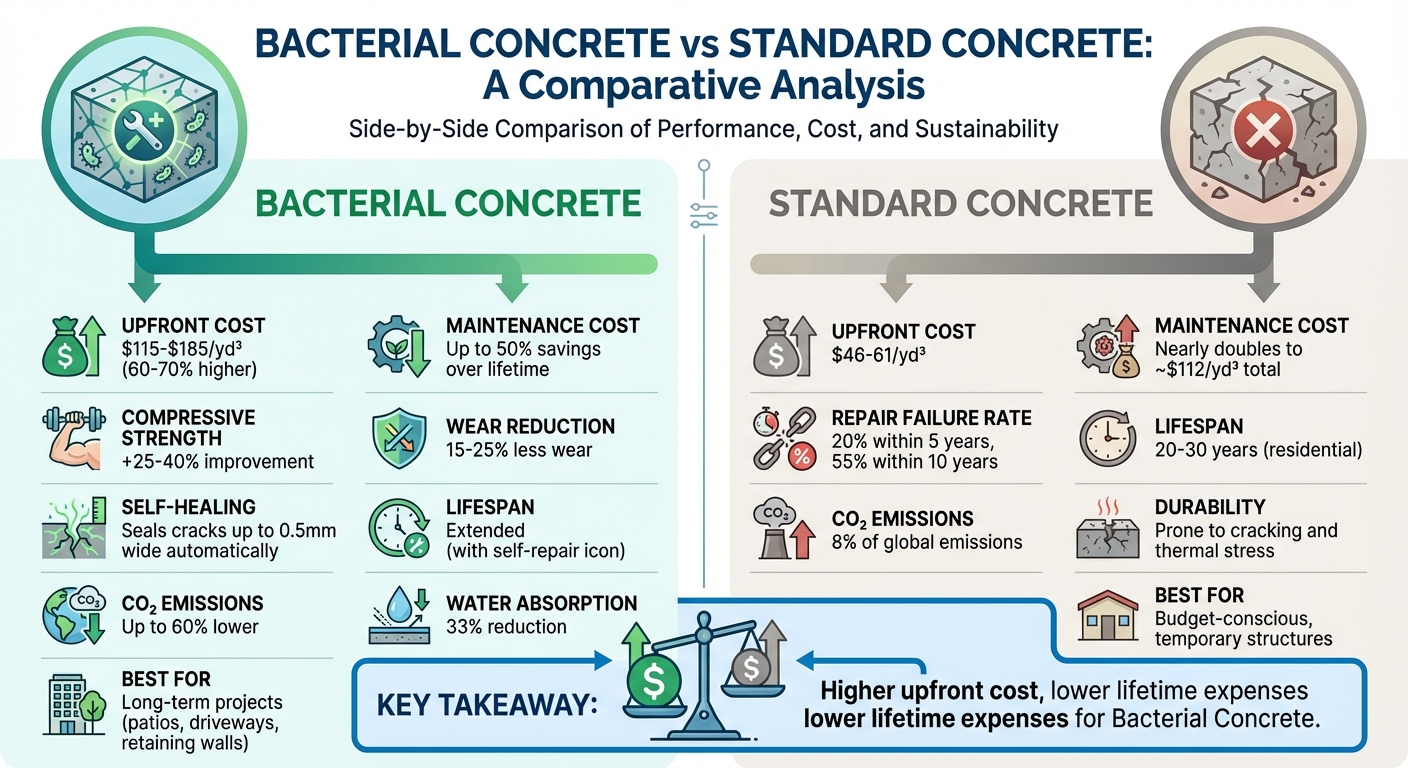
Bacterial concrete costs more upfront but can save money over time. While standard concrete costs around $115 per cubic yard, bacterial concrete is 3–4x more expensive, reaching up to $4,585 per cubic yard. However, it self-heals cracks up to 0.5 mm wide, reducing maintenance costs by up to 50%. Standard concrete, on the other hand, is cheaper initially but prone to cracking, doubling lifetime costs due to repairs. Bacterial concrete also lasts longer, improves strength by 25–40%, and reduces CO₂ emissions by up to 60%, making it a durable and eco-friendly option for long-term projects like patios, driveways, and retaining walls. If upfront cost is less of a concern, bacterial concrete offers better durability and lower lifetime expenses.
Bacterial Concrete vs Standard Concrete Cost and Performance Comparison
1. Bacterial Concrete
Upfront Costs
Bacterial concrete comes with a hefty price tag – about 60% to 70% more upfront than traditional concrete [2]. While standard concrete typically costs between $60 and $80 per cubic meter (roughly $46 to $61 per cubic yard) [4], the specialized components of bacterial concrete significantly increase its cost.
This higher price is due to the inclusion of bacterial cultures, such as Bacillus subtilis, along with specific nutrients and the intricate encapsulation processes required [2] [5]. Although the initial investment is steep, the potential for long-term savings through reduced maintenance costs makes it a compelling option for certain projects.
Maintenance Costs
When it comes to maintenance, standard concrete can end up costing almost twice its initial price over time, reaching around $147 per cubic meter [4]. Repairs for traditional concrete often fail, with a 20% failure rate within 5 years and 55% within 10 years [4].
Bacterial concrete, however, has a self-healing mechanism that automatically seals cracks up to 0.5 mm wide, eliminating the need for manual repairs [2] [5]. This feature is especially useful for areas that are hard to access, where repair work can be both difficult and expensive. These maintenance savings help balance out the higher initial costs, making bacterial concrete a more attractive option in the long run.
Lifespan and Durability
The durability of bacterial concrete adds to its appeal. Its self-healing properties not only reduce maintenance but also enhance the material’s strength and resilience. The compressive strength of bacterial concrete can improve by 25% to 40%, while wear and tear are reduced by 15% to 25%, making it a great choice for high-traffic areas like driveways and walkways [2].
Additionally, bacterial concrete holds up well under extreme conditions, maintaining its structural integrity at temperatures as high as 572°F (300°C) [2]. The calcite precipitation process densifies the concrete, cutting water absorption by about 33% and reducing moisture penetration by 8.5% to 98.7%, depending on the bacterial strain used [3]. This densification also protects steel reinforcement from corrosion, a major factor in the deterioration of conventional concrete.
Environmental Impact
Bacterial concrete doesn’t just save money and improve durability – it also offers environmental advantages. Traditional cement production is responsible for about 8% of global CO2 emissions [3]. Bacterial concrete, through Microbial-Induced Calcite Precipitation (MICP), can reduce these emissions by up to 60% [5]. The bacteria involved in the process capture carbon dioxide and transform it into solid calcite [5].
The technology also promotes sustainability by utilizing organic waste products like glycerol or molasses as bacterial nutrients [5]. By extending the lifespan of structures, bacterial concrete reduces the need for frequent replacements, which helps cut down on construction and demolition waste. This type of waste currently makes up 59% of global waste, with 40% ending up in landfills [4]. While the bacterial urease process can release ammonia as a byproduct, ongoing research is working to minimize this issue by developing improved bacterial strains [3] [5].
sbb-itb-843f8be
2. Standard Concrete
Upfront Costs
Standard concrete is often chosen for outdoor surfaces due to its lower initial cost. Production costs typically range between $60 and $80 per cubic meter (around $46 to $61 per cubic yard) [4]. However, while the upfront price seems affordable, it doesn’t account for the long-term expenses tied to repairs and maintenance, which can significantly inflate the overall cost [4].
Maintenance Costs
Once installed, maintenance and repair costs can nearly double the effective price of standard concrete. For example, the initial $80/m³ can increase to approximately $147/m³ when repairs are factored in [4]. Unfortunately, repairs tend to have a high failure rate – 20% fail within 5 years, and this rate rises to 55% by the 10-year mark [4]. Unlike bacterial concrete, which can self-heal, standard concrete requires manual repairs for every crack or damaged area. In regions with freeze-thaw cycles, cracks and chipping are almost unavoidable, often leading to expensive resurfacing or complete replacement [6].
Lifespan and Durability
Standard concrete used in residential landscaping generally lasts 20 to 30 years [6]. In commercial applications, its lifespan can extend to 50 years or more, but only with diligent maintenance [4]. Its brittle nature and low tensile strength make it prone to cracking due to thermal stress, shrinkage, or moisture exposure [5][4]. Extreme temperatures can cause thermal cracking and reduce its compressive strength, making it less durable than self-healing options [2]. Additionally, moisture penetration can lead to corrosion of steel reinforcements, further weakening the structure over time [4].
Environmental Impact
The environmental cost of standard concrete is significant. Portland cement production alone contributes about 8% of global CO2 emissions [3]. The extraction of aggregates disrupts ecosystems and depletes natural resources [5]. On top of that, construction and demolition waste – much of it concrete – accounts for 59% of global waste, with 40% ending up in landfills [4]. In the U.S., a large portion of construction budgets is spent on repairing aging concrete infrastructure rather than building new projects [4]. These environmental and financial burdens highlight the limitations of standard concrete, especially when compared to self-healing alternatives.
Hendrik Marius Jonkers – Self-healing concrete containing bacteria
Pros and Cons
When comparing bacterial concrete to standard concrete, it’s clear that the choice boils down to balancing initial costs against long-term benefits. While bacterial concrete requires a higher upfront investment, its self-healing properties and durability can lead to considerable savings over time. On the other hand, standard concrete is more budget-friendly at first but tends to rack up maintenance costs due to its susceptibility to cracking.
Bacterial Concrete
Bacterial concrete is a standout for its self-healing capability. When cracks form, it produces calcium carbonate to seal damages up to 0.5 mm wide [1][4]. This feature drastically reduces the need for manual repairs and extends its lifespan. It’s also stronger, offering 25–40% more compressive strength and 15–25% less wear and tear compared to standard concrete [2]. Another bonus? It’s environmentally friendlier, with production emissions up to 60% lower [5].
Standard Concrete
Standard concrete, priced between $46–$61 per cubic yard [4], is more affordable initially and widely accessible. Its compatibility with traditional construction methods makes it a go-to material for many projects. However, its tendency to crack means higher maintenance costs over its lifetime, which can nearly double to around $112 per cubic yard [4]. Repairs are not always reliable, with 20% failing within 5 years and 55% within 10 years. Additionally, it has a significant environmental impact, contributing roughly 8% of global CO₂ emissions [3].
Comparison Table
| Feature | Standard Concrete | Bacterial Concrete |
|---|---|---|
| Upfront Cost | ~$46–$61/yd³ [4] | 60–70% higher [2] |
| Maintenance Cost | High (≈$112/yd³ total) [4] | Saves up to 50% of lifetime costs [4] |
| Durability | Prone to cracking; shorter lifespan | Self-heals cracks; extended lifespan [1] |
| Environmental Impact | 8% of global CO₂ emissions [3] | Up to 60% lower production emissions [5] |
Practical Applications
For projects where durability is critical – like patios, retaining walls, or driveways – bacterial concrete’s higher initial cost can pay off in the long run with fewer repairs and a longer lifespan. Conversely, standard concrete may be a better fit for temporary structures or budget-conscious projects where regular maintenance is acceptable.
Conclusion
Bacterial concrete stands out as a smart long-term choice for landscaping and hardscaping trends. Yes, the upfront cost is about 60–70% higher than standard concrete [2], but its self-healing properties can slash maintenance needs and lifetime expenses by as much as 50% [4].
It’s also a win for the environment. Bacterial concrete can potentially cut carbon emissions by up to 60% compared to traditional cement production [5]. Research from Morgan State University in Baltimore highlights the effectiveness of Bacillus subtilis in restoring structural integrity and improving freeze-thaw durability – key benefits for Maryland’s climate [4]. These environmental perks pair seamlessly with its technical strengths, making it ideal for outdoor applications.
For projects like patios, retaining walls, driveways, and walkways, bacterial concrete offers greater durability and fewer weather-related issues over time.
When you weigh its performance and sustainability, bacterial concrete is a forward-thinking investment. It balances higher upfront costs with long-term value and a reduced environmental footprint – perfect for Maryland homeowners and property managers who want eco-friendly, resilient outdoor spaces.
At Pro Landscapes MD, we’re dedicated to using sustainable, cutting-edge solutions to design outdoor spaces that last and impress. Visit Pro Landscapes MD for expert advice on incorporating bacterial concrete into your next project.
FAQs
How long does bacterial concrete take to self-heal a crack?
Bacterial concrete has the ability to self-heal cracks in approximately 21 days. This timeframe can vary based on factors such as the curing period – commonly 14 or 28 days – and the specific bacterial strain employed. For example, Bacillus subtilis has shown success in sealing cracks within this period.
Will bacterial concrete still work in Maryland freeze-thaw weather?
Bacterial concrete has the potential to work in Maryland’s freeze-thaw climate, though its durability could face challenges. When water gets trapped within the concrete, it may expand and contract as temperatures fluctuate, leading to possible surface cracks. While this type of concrete has its advantages, it’s crucial to account for these weather conditions when deciding whether to use it in regions with frequent freeze-thaw cycles.
Is bacterial concrete worth it for patios, driveways, or retaining walls?
Bacterial concrete provides a 25–40% boost in strength and delivers outstanding durability, making it a smart choice for projects like patios, driveways, or retaining walls. Over time, it offers long-term advantages such as better resistance to high temperatures and lower maintenance demands, potentially increasing the overall value of your investment.
Chat with Us