









- bhavya gada
- No Comments
Organic soil amendments improve soil health and plant growth by gradually releasing nutrients, retaining water, enhancing structure, supporting microorganisms, and strengthening plant resilience. Unlike synthetic fertilizers, these natural materials – like compost, manure, and crop residues – work over time to build long-term soil quality.
Key Benefits:
- Improves Fertility: Gradual nutrient release through mineralization supports sustained plant growth.
- Increases Water Retention: Organic matter can hold up to 90% of its weight in water, reducing the need for frequent watering.
- Enhances Soil Structure: Creates porous soil that promotes root growth, aeration, and water movement.
- Supports Microorganisms: Fuels beneficial microbes that decompose organic matter and suppress harmful pathogens.
- Strengthens Plant Health: Boosts resilience against pests, diseases, and environmental stress.
For best results, apply at least 1 inch of compost annually to maintain soil organic matter levels.
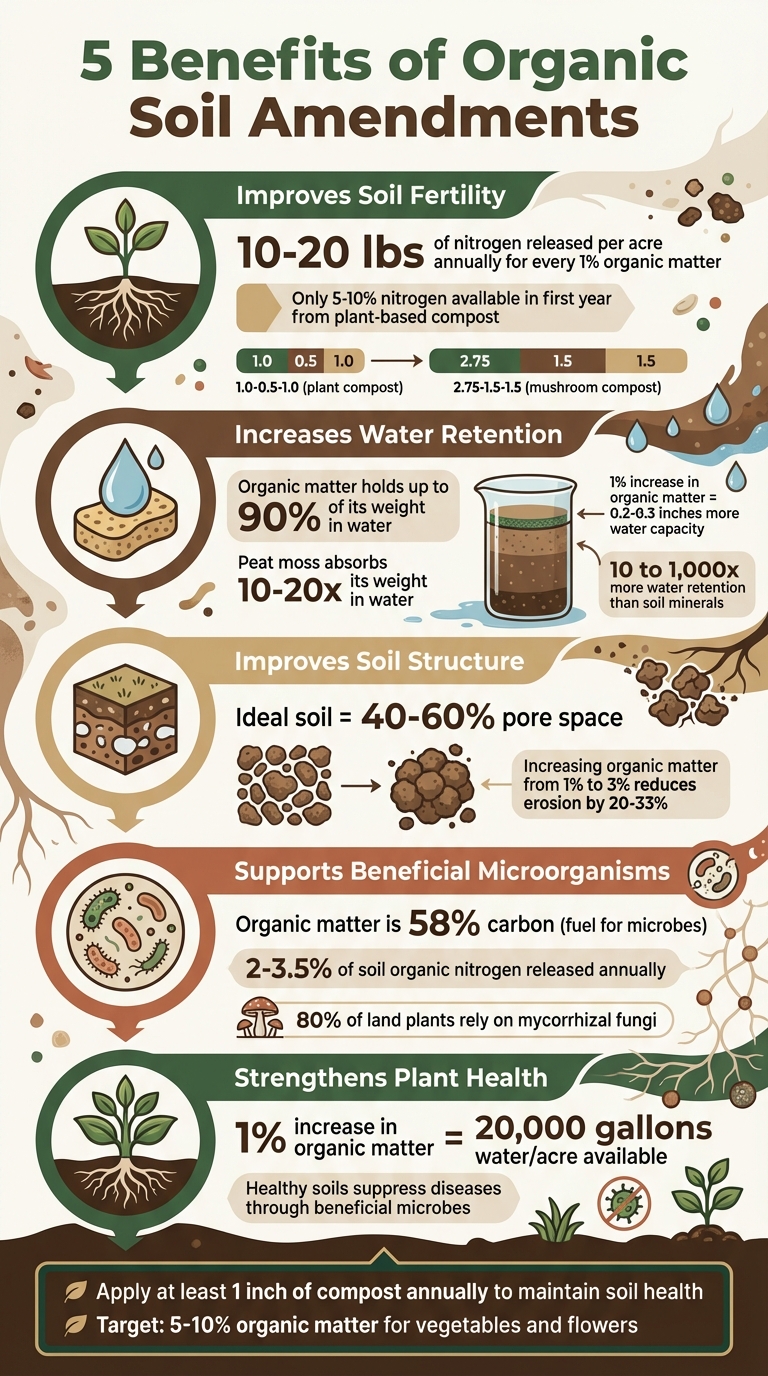
5 Key Benefits of Organic Soil Amendments with Statistics
The BEST Organic Soil Amendments For Your Garden!
sbb-itb-843f8be
1. Improves Soil Fertility
Organic amendments like compost, manure, and bone meal work differently from synthetic fertilizers. Instead of delivering a quick nutrient boost, they release nutrients gradually through a process called mineralization. During this process, soil microorganisms break down organic matter, converting it into forms like nitrogen, phosphorus, potassium, and calcium that plants can absorb. This steady release of nutrients helps maintain soil fertility over time.
For example, plant-based composts often have an N-P-K ratio of 1.0-0.5-1.0, with only about 5%–10% of the nitrogen becoming available in the first year [1]. For every 1% of organic matter in the top 6 inches of medium-textured soil, around 10–20 lbs of nitrogen, 1–2 lbs of phosphorus, and 0.4–0.8 lbs of sulfur are released per acre each year [2]. This shows how organic matter contributes to long-term soil health.
Another benefit of organic matter is its ability to increase the soil’s Cation Exchange Capacity (CEC). This means the soil can hold onto essential nutrients like potassium, calcium, and magnesium, preventing them from washing away during heavy rains – something Maryland soils often face. Additionally, as organic matter decomposes, it forms chelates that keep micronutrients like iron and zinc available to plant roots.
If you’re using manure-based composts, such as those from poultry, sheep, or rabbits, you’ll find they contain higher nutrient concentrations and more readily available nitrogen and phosphorus compared to plant-based composts [1]. Bone meal is an excellent source of phosphorus, while mushroom compost provides a balanced N-P-K profile of 2.75-1.5-1.5 [1]. For established garden beds, applying at least 1 inch of compost each year is recommended to maintain organic matter levels [1].
2. Increases Water Retention
Organic matter acts like a sponge, soaking up and holding moisture that plants can use during dry periods. Here’s a striking fact: organic matter can hold up to 90% of its weight in water [2]. The Natural Resources Conservation Service also notes that soil organic matter retains 10 to 1,000 times more water and nutrients than the same amount of soil minerals [4]. Even in home gardens, increasing organic matter in the top six inches of soil by just 1% can boost available water capacity by about 0.2 to 0.3 inches [2]. These stats highlight how choosing the right organic amendments can make a big difference in water retention.
Different organic materials contribute in unique ways. For example, peat moss can absorb 10 to 20 times its weight in water [1]. Compost and pine bark fines also play a role in improving moisture storage. Adding 1–2 inches of compost to garden beds annually creates a moisture reservoir, helping cut down on how often you need to water [5].
Organic amendments do more than just store water – they improve soil structure too. They help bind soil particles into stable aggregates, creating a network of pores that hold moisture while ensuring proper drainage. This reduces runoff during heavy rains [4]. On top of that, using organic mulches like shredded leaves or wood chips shields the soil from direct sunlight and wind, slowing evaporation [5]. Together, these practices help manage moisture effectively while supporting long-term soil health and plant growth.
For personalized advice on improving your soil’s water retention and boosting plant resilience, reach out to Pro Landscapes MD.
3. Improves Soil Structure
Organic amendments do more than boost fertility and water retention – they also play a key role in improving soil structure. A healthy soil structure is the backbone of any thriving garden. By transforming compacted soil into a porous environment, organic amendments make it easier for roots to grow and access essential nutrients. This transformation happens as soil microorganisms break down organic matter, releasing substances that bind soil particles into stable aggregates.
These aggregates create networks of pores that improve aeration, water movement, and moisture retention. Ideally, productive soil should have 40%–60% pore space[5]. This condition, often called "good tilth", is critical for deep root penetration and overall plant health.
"The most desirable structure for a topsoil is a granular structure (small ‘pebbles’ or ‘crumbs’ of soil)… This kind of ideal soil condition is often referred to as ‘good tilth’."
– Neil Bell et al., OSU Extension[5]
Different organic materials can fine-tune soil performance even further. For example, compost adds a crumbly texture that can withstand foot traffic or heavy equipment, while cover crops like legumes and grasses protect the soil surface and create channels for air and water. Even a simple 1–2 inch layer of leaf mulch applied in the fall can shield vegetable gardens from winter erosion. When tilled into the soil in spring, this mulch enhances the structure even more.
Studies show that increasing soil organic matter from 1% to 3% can cut soil erosion by 20% to 33%, thanks to better water infiltration and more stable aggregates[2]. In clay soils, organic matter prevents particles from compacting into tight layers, leaving room for air and water. In sandy soils, it helps bind loose particles, reducing the risk of washout. To keep these benefits going, it’s a good idea to add at least 1 inch of compost annually, as organic matter naturally breaks down over time.
Pro Landscapes MD can guide you in choosing and applying the best organic amendments to create durable, healthy soil for your Maryland garden.
4. Supports Beneficial Microorganisms
Adding organic amendments to your soil does more than just improve its structure – it fosters a thriving underground ecosystem. By incorporating materials like compost or manure into your garden, you’re essentially feeding billions of microorganisms, such as bacteria, fungi, and other decomposers. These tiny helpers play a crucial role in keeping your soil lively and productive, driving processes that directly support plant growth.
Organic matter, which is about 58% carbon[2], fuels the metabolism of these microorganisms. Through their activity, complex compounds are broken down, releasing essential nutrients like nitrogen, phosphorus, and sulfur. For example, around 2–3.5% of soil organic nitrogen is made available annually[3], translating to roughly 20–35 pounds of plant-available nitrogen per acre for every 1% of organic matter.
"Fresh organic matter is the main feed source for soil organisms. These organisms are responsible for the decomposition of organic inputs, making nutrients available to the plants as well as improving soil structure and quality."
– Leandro Vieira (Leo) Castro and Saulo Castro, LSU AgCenter[3]
But the benefits don’t stop there. Many soil microbes form critical partnerships with plants. Mycorrhizal fungi, for instance, connect with plant roots and extend their reach, helping them access water and nutrients in exchange for sugars produced by the plant. It’s estimated that about 80% of all land plants rely on these fungi[1]. Similarly, nitrogen-fixing bacteria associated with legume cover crops convert atmospheric nitrogen into forms plants can absorb. On top of that, a diverse microbial community helps suppress harmful pathogens by outcompeting them, acting as a natural defense system.
To keep this microbial workforce thriving, apply at least 1 inch of compost to your flower and vegetable beds each year[1]. Also, aim to maintain moist, well-aerated soil and avoid excessive tillage to protect fragile fungal networks. If you’re in central Maryland, Pro Landscapes MD can assist in creating a soil management plan tailored to support this hidden but vital ecosystem.
5. Strengthens Plant Health and Resilience
Adding organic matter to your soil can do wonders for your plants’ ability to withstand challenges. Well-fed plants grow strong roots, which help them bounce back from pests, diseases, and harsh weather conditions more effectively.
Healthy soils packed with beneficial microorganisms play a key role in suppressing diseases. These microbes outcompete harmful pathogens, produce antibiotic-like substances, or even act as hyperparasites to protect your plants[7].
"Healthy soil and healthy crops work together to improve disease resistance. If you support beneficial bacteria and fungi in your soil, they will go to work protecting your crops from soil-borne diseases."
– PhycoTerra[7]
Beyond fighting off diseases, organic amendments improve water retention and regulate soil temperature. For instance, increasing soil organic matter by just 1% can make up to 20,000 gallons of water per acre available to plants. It also helps buffer against extreme temperatures and reduces salt stress (try applying ½ lb of gypsum per square foot)[1][2][3].
Organic practices like mulching and composting do more than just suppress weeds; they also disrupt pest habitats. Additionally, cover crops like mustard and radish act as natural controls for nematodes, further protecting your plants[6].
Pro Landscapes MD can create a tailored soil amendment plan to enhance the resilience of your central Maryland landscape. These strategies highlight the lasting benefits of organic amendments for maintaining a thriving, sustainable garden.
Conclusion
Organic amendments play a key role in creating healthier, more productive soil. They nurture your garden by gradually releasing nutrients, improving water retention during dry periods, enhancing soil structure for optimal root development, and fostering beneficial microorganisms that help protect plants from diseases. These natural benefits lay the groundwork for a thriving, sustainable garden.
By turning kitchen scraps and yard waste into nutrient-rich compost, organic amendments create a self-sustaining cycle that enriches soil over time. Unlike synthetic fertilizers, which can harm soil health, these amendments build long-term fertility. They also contribute to environmental health by storing carbon – healthy soils can hold up to three times more carbon than all the vegetation on Earth combined [3].
"Organic matter is the cornerstone for healthy, fertile soils."
– Leandro Vieira (Leo) Castro, LSU AgCenter [3]
Achieving and maintaining the right level of organic matter takes patience and consistent effort. While garden plants generally thrive with at least 2% organic matter, vegetables and flowers flourish best with levels between 5% and 10% [1]. Regularly adding compost is essential to replenish what’s lost to decomposition, ensuring your soil remains rich and productive [1].
FAQs
How long do organic amendments take to work?
Organic soil amendments typically begin releasing nutrients and improving soil health over a period of 3 to 5 months. This slow-release process supports lasting benefits, enhancing both soil fertility and structure over time.
How much compost should I add each year?
The amount of compost you should add each year largely depends on your soil’s characteristics and what it needs. As a general rule, applying a couple of inches of compost annually can work wonders – especially for sandy soils, helping them hold onto water better and boosting their overall health. Ideally, aim to keep organic matter levels in your soil between 3-5%. Even increasing organic matter by just 1% can make a noticeable difference in improving soil quality and its ability to retain water.
Which amendment is best for my soil type?
The type of soil amendment you need depends on the characteristics of your soil. If you have clay soil, look for amendments that boost aeration and improve its structure. For sandy soil, prioritize options that help retain water and nutrients. Organic materials like compost or manure are great choices for nearly all soil types, as they enhance fertility and promote healthier soil overall.
Chat with Us