









- bhavya gada
- No Comments
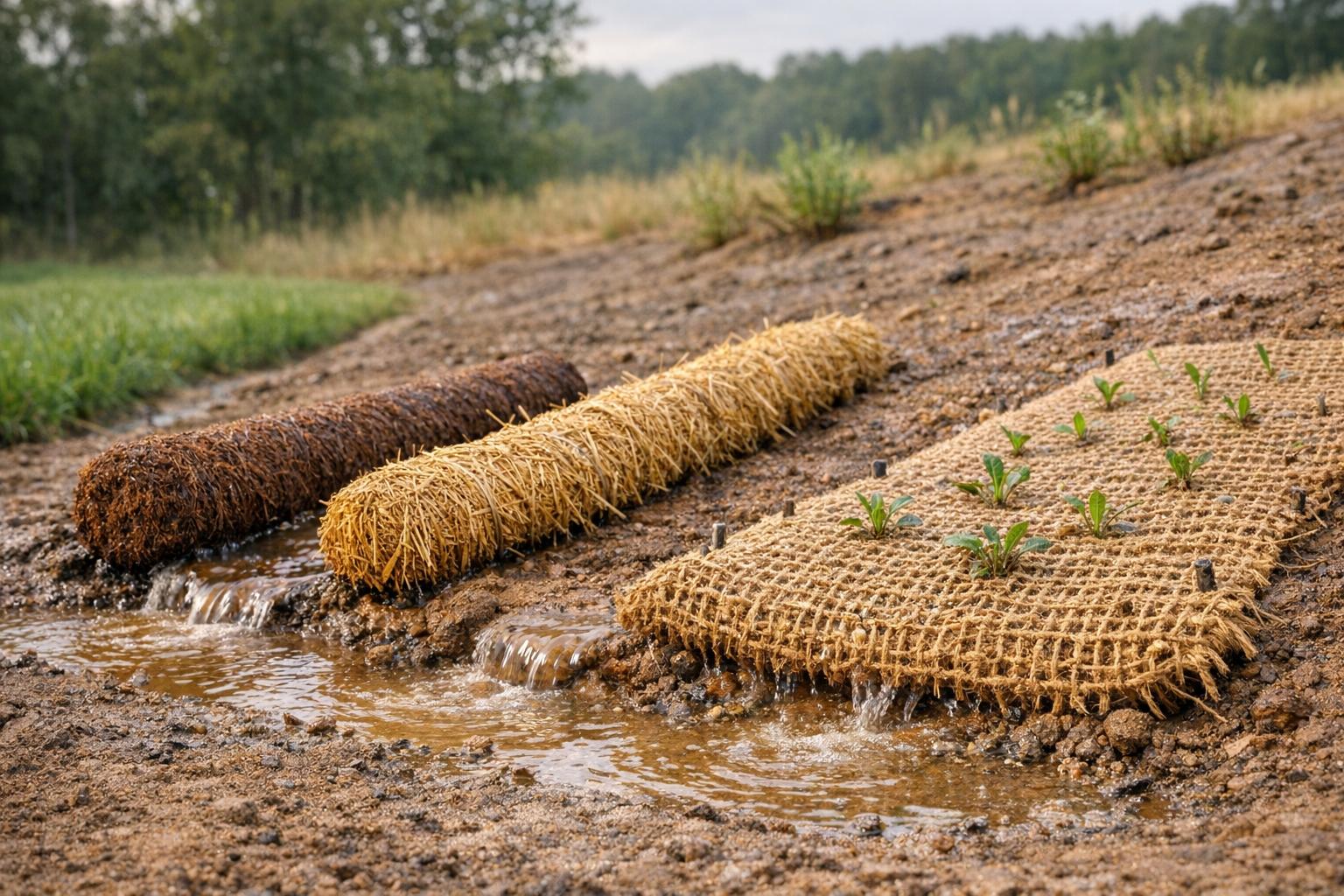
When dealing with runoff and erosion, using the right products can save time, money, and effort. For Maryland property owners, biodegradable options like coconut coir logs, straw wattles, and erosion control blankets offer effective, temporary solutions that also improve soil health as they decompose. These products help manage water flow, reduce sediment loss, and support vegetation growth, making them ideal for landscaping and construction projects.
- Coconut Coir Logs: Absorb up to 10× their weight in water, reduce runoff by 85%, and last 2–3 years. Cost: $15–$20/foot.
- Straw Wattles: Affordable and easy to install, they reduce erosion by 70–85% and last up to 2 years. Cost: ~$75.99 for a 9"×12′ wattle.
- Erosion Control Blankets: Vary by material (straw, straw-coconut, or coir) and lifespan (3 months to 5 years). Costs range from $39.95 to $114.47+.
These products are essential for controlling runoff on slopes, protecting perimeters, and stabilizing soil. Proper installation, such as aligning with water flow and securing with stakes, ensures their effectiveness. For steep slopes or high-flow areas, coir logs and stronger blankets are preferred, while straw wattles suit gentler terrains.
| Product | Lifespan | Best For | Cost |
|---|---|---|---|
| Coconut Coir Logs | 2–3 years | Steep slopes, water flow | $15–$20/foot |
| Straw Wattles | 1–2 years | Perimeters, gentle slopes | ~$75.99 (9"×12′) |
| Erosion Control Blankets | 3 months–5 years | Slopes, seed growth | $39.95–$114.47+ |
Choosing the right product depends on slope steepness, water flow, and project duration. For tailored solutions, Maryland-based services like Pro Landscapes MD can help with installation and long-term planning.
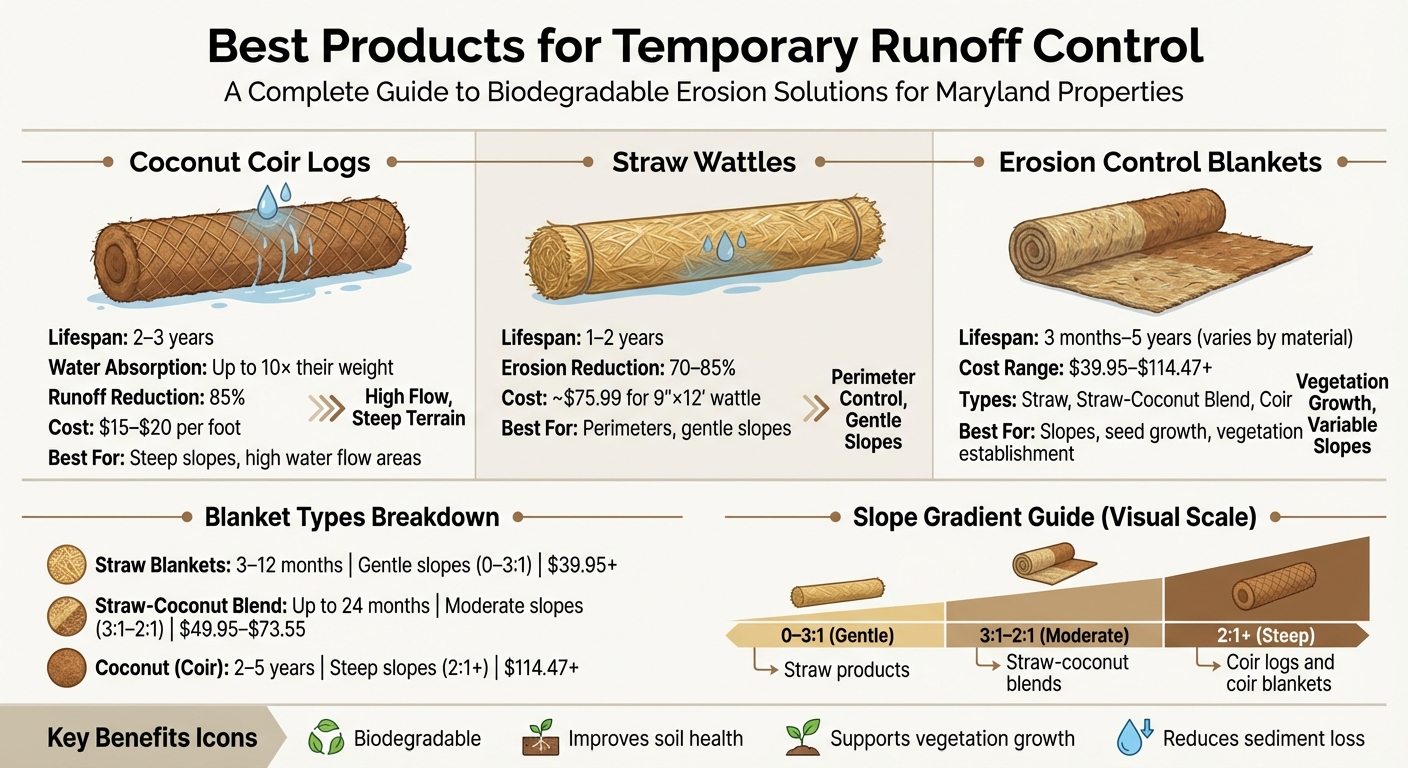
Temporary Runoff Control Products Comparison: Lifespan, Cost, and Best Applications
How to Install Erosion Control Blanket
sbb-itb-843f8be
Coir Logs for Slope Stabilization
Coconut coir logs are dense, biodegradable tubes made from coconut fibers, enclosed in a sturdy mesh casing. They serve as physical barriers that immediately slow down surface runoff, while their moisture-absorbing fibers encourage deep and lasting vegetation growth [2]. These logs are particularly effective for slope interruption – breaking the momentum of water flowing downhill. They’re often used in delicate areas like pond edges and garden borders, as they’re environmentally friendly and even help support local wildlife by creating small habitat corridors. Their unique features make them stand out in erosion control solutions.
Key Features of Coir Logs
Coir logs can absorb up to 10 times their weight in water, reducing runoff by as much as 85%. They remain effective for 2–3 years and naturally decompose over 3–5 years. While their cost ranges from $15–$20 per linear foot – compared to $8–$12 for jute alternatives – coir logs offer better durability and water absorption, making them a worthwhile investment [2]. As they decompose, they enrich the soil with organic matter, improving its structure and ability to retain water. These benefits, combined with their longevity, make them a standout choice in erosion control.
Applications in Landscaping
To install coir logs effectively, place them perpendicular to the water flow, aligning them with the slope’s natural contours. Use wooden stakes spaced every 3–4 feet to secure the logs firmly against the soil. Once installed, they require minimal upkeep – occasional inspections of the stakes are usually enough [2]. Over time, the logs transition from a temporary barrier to a natural soil enhancer, making them a great option for both residential gardens and large-scale commercial landscaping projects.
Straw Wattles for Perimeter Protection
Straw wattles are long, cylindrical tubes filled with wheat straw, wrapped in biodegradable jute or photodegradable netting. Think of them as nature’s "speed bumps" for water – they slow down runoff and trap sediment before it reaches storm drains, streams, or other sensitive areas [1]. Their porous design allows water to flow through while capturing soil particles, making them a practical choice for perimeter control and inlet protection in construction or landscaping projects where vegetation hasn’t fully developed.
Benefits of Straw Wattles
One of the standout features of straw wattles is their ease of installation. You don’t need heavy machinery or large crews, which makes them a great option for smaller projects. They come in standard sizes, with diameters of 9", 12", and 18", and lengths ranging from 6 to 20 feet [4][5]. For reference, a 9" x 12′ straw wattle typically costs about $75.99, providing an affordable, temporary solution.
These wattles are designed to last for 1 to 2 years – roughly two construction seasons – before decomposing naturally. As they break down, they enrich the soil and improve moisture retention, adding long-term benefits to the area [1][6][7].
Common Use Cases
Straw wattles are versatile and can be used in various scenarios:
- Perimeter control: Installed along contour lines, they reduce the energy of sheet flow and break up slope lengths [5].
- Steep terrain: On slopes, placing multiple rows closer together improves their effectiveness.
- Inlet protection: They help keep sediment out of storm drains during construction or landscaping activities.
- Slope reinforcement: By reducing erosion, they create a better environment for vegetation to take root.
To install, embed the wattles in trenches 3 to 5 inches deep, perpendicular to the water flow. Secure them with wooden stakes (18 to 24 inches long) placed every 2 to 4 feet, leaving 2–3 inches of the stake exposed. After heavy rain, check for any displacement and clear away sediment buildup to keep them working efficiently [1][5].
Next, we’ll dive into erosion control blankets and how they can complement straw wattles for managing runoff more effectively.
Erosion Control Blankets
Erosion control blankets are rolled panels made from natural fibers like straw or coconut. They are a go-to temporary solution in Maryland for managing soil erosion, alongside tools like coir logs and straw wattles. These blankets help by absorbing the impact of rain, holding soil in place, and creating a stable environment that retains moisture, reduces temperature fluctuations, and encourages seed germination during storms.
Types of Erosion Control Blankets
Straw blankets are the most economical option, offering protection for 3 to 12 months. They work best on gentle slopes (up to a 3:1 gradient) in areas with low rainfall or where quick-growing grass is needed. For instance, a standard American Excelsior Straw Erosion Blanket, covering about 200 square feet, costs around $39.95 [3].
Straw-coconut blend blankets combine approximately 70% straw with 30% coconut fiber, striking a balance between cost and durability. These blankets provide medium-term protection – lasting up to 24 months – and are ideal for moderate slopes (3:1 to 2:1) and regions with varying rainfall. They are particularly useful for native plants or wildflowers that need more time to establish strong root systems.
Photodegradable options feature synthetic netting that breaks down under UV light, making them perfect for hard-to-access areas. For example, a DeWitt Photodegradable Single Layer Blanket, measuring 4 feet by 112.5 feet, costs about $73.55 [3].
| Blanket Type | Lifespan | Best Slope | Cost Range |
|---|---|---|---|
| Straw | 3–12 months | Gentle (0–3:1) | $39.95+ |
| Straw-Coconut Blend | Up to 24 months | Moderate (3:1–2:1) | $49.95–$73.55 |
| Coconut (Coir) | 2–5 years | Steep (2:1+) | $114.47+ |
Installing Erosion Control Blankets
Start by clearing the area of rocks, debris, and vegetation to ensure the blanket makes full contact with the soil. Before rolling out the blanket, apply seed and fertilizer to trap the seeds beneath the protective layer.
Dig a 6-inch trench at the top of the slope to anchor the blanket’s leading edge, preventing water from flowing underneath. Unroll the blanket downslope, keeping it aligned with the water flow, and apply slight tension to remove air pockets. Overlap edges by 3–6 inches to maintain continuous coverage.
Secure the blanket using U-shaped staples or pins, spaced 1 to 3 feet apart. On steeper slopes, reduce the spacing to prevent slippage. Once installed, water the area lightly to help the blanket settle and encourage seed germination. After heavy rain, inspect the blanket for any signs of lifting or water channels beneath it, and secure any loose sections promptly.
Geotextiles and Erosion Control Mats
Geotextiles and erosion control mats act as protective layers, shielding exposed soil from the damaging effects of wind and water erosion. By absorbing the impact of raindrops, they prevent soil particles from being dislodged. Their mesh or fiber structure slows water runoff, reducing the loss of topsoil. These materials also create a favorable environment by retaining moisture and stabilizing soil temperatures – key factors for seed germination and the growth of vegetation [3].
Temporary Geotextile Options
Woven Geotextiles
Woven geotextiles are crafted by interlacing polypropylene or polyester yarns on a loom to form a grid-like structure. Known for their high tensile strength and low elongation (5% to 25%), they excel in applications requiring structural reinforcement, such as stabilizing driveways or parking lots. However, their semi-impermeable nature makes them less suitable for projects that rely on water flow [9][10].
Non-Woven Geotextiles
Non-woven geotextiles are created by bonding fibers through needle-punching, thermal bonding, or chemical processes, resulting in a felt-like material. These fabrics have a much higher elongation (greater than 50%) and are highly permeable, making them ideal for drainage and filtration tasks, such as wrapping French drains. Sold by weight (e.g., 4, 8, or 10 oz/yd²), they cater to various project needs [9].
As highlighted by industry professionals:
"Woven geotextiles are an excellent choice for reinforcement and stabilization applications, while nonwoven geotextiles are great for filtration, separation, and drainage applications."
Natural Fiber Mats
Natural fiber mats, including jute, wood fiber, and coconut fiber (coir) mats, offer biodegradable options for erosion control. Jute mats decompose within a few months and cost roughly $89.95 for a 48-inch by 20-yard roll. Wood fiber (excelsior) blankets last 1 to 2 years, while coconut fiber mats provide protection for 2–5 years, absorbing up to 10 times their weight in water and reducing runoff by as much as 85% compared to bare soil. For instance, a standard 4-foot by 30-foot coir mat costs about $114.47, while heavy-duty versions (6 feet by 164 feet) are priced around $479.99 [2][3].
Best Practices for Use
The choice of material depends on the project’s requirements. For heavy load capacity and long-term reinforcement, woven geotextiles are a solid option. Non-woven fabrics, on the other hand, are better suited for managing moisture, as they allow water to flow freely [9][10]. On slopes, the mat type should match the grade. For moderate slopes (up to 30%), straw or jute works well, while wood fiber (excelsior) or synthetic-reinforced biomesh is better for steeper conditions (exceeding a 3:1 slope) [2].
Proper installation is key. Dig shallow trenches (4–6 inches) at the uphill edge and secure the mats with hardwood stakes driven 18 inches deep. Space the stakes 3–4 feet apart for heavy materials and 4 feet apart for lighter ones to ensure the mats maintain continuous soil contact. This prevents issues like piping or rill erosion [2].
For best results, install mats in the fall to allow them to settle before winter rains or in early spring to encourage rapid germination. Pre-seeded erosion control systems can boost vegetation establishment success by 40% to 60% compared to traditional seeding, with most seed mixes germinating within 7 to 14 days under ideal conditions [2].
A reminder from an expert emphasizes the importance of selecting the right material:
"Using the wrong geotextile can cause poor drainage, erosion, or structural failure."
- Palmetto Industries [10]
Product Comparison
When choosing erosion control materials, performance factors play a key role. The main difference lies in the materials themselves – natural fibers like straw and coir break down over time, while synthetic geotextiles are made to last indefinitely [8].
Here’s a quick breakdown of lifespans: straw lasts around 12 months, straw-coconut blends hold up for about 24 months, coir logs remain effective for 2–3 years, and synthetic geotextiles are permanent [8]. As for slope suitability, straw works well on gentle slopes (0–3:1), straw-coconut blends handle moderate slopes (3:1–2:1), and coir or synthetic options are ideal for very steep slopes (2:1 or greater) [8].
Environmental considerations also come into play. In areas like wetlands or near waterways, biodegradable materials are often required. While synthetic options offer durability, their non-biodegradable nature makes them less environmentally friendly [8].
Comparison Table
| Product Material | Lifespan | Best Slope Type | Cost Comparison | Eco-Friendliness |
|---|---|---|---|---|
| Straw | Up to 12 months | Gentle (0–3:1) | Low/Affordable | Biodegradable |
| Straw-Coconut Blend | Up to 24 months | Moderate (3:1–2:1) | Moderate | Biodegradable |
| Coir (Coconut) | 2–3 years | Steep (2:1 or greater) | Moderate/High | Biodegradable |
| Synthetic (Geotextile) | Indefinite | Very Steep/High Traffic | High | Non-biodegradable |
Data source: [8]
This table simplifies the decision-making process, helping you identify the right material for your project’s needs. Next, we’ll explore how Pro Landscapes MD integrates these materials into cutting-edge drainage solutions.
Pro Landscapes MD‘s Drainage Solutions

Temporary runoff control products are most effective when they’re part of a well-thought-out system. Pro Landscapes MD combines tools like coir logs, straw wattles, and geotextiles to create drainage solutions for properties across central Maryland, including areas like Howard and Baltimore Counties.
Water often finds ways to bypass barriers on uneven surfaces, but Pro Landscapes MD tackles this challenge head-on. They start by preparing debris-free surfaces and digging 4–6 inch trenches to anchor straw wattles securely. This method helps prevent water from flowing around the barriers. Hardwood stakes, driven 18 inches deep and spaced every 4 feet, keep the materials firmly in place, even during intense spring rains. These grading techniques form the backbone of their effective runoff management.
Their strategy combines temporary fixes with more durable solutions. For example, coir logs are placed along natural contour lines to guide water toward systems like French drains or dry riverbeds. In areas with high water flow, excelsior logs are used for their strength and ability to handle extreme water velocity [2].
Beyond controlling runoff, Pro Landscapes MD prioritizes improving soil health. Compost filter socks not only trap sediment but also enhance soil structure [2]. Seed-infused bio-logs offer a dual benefit: they act as an immediate barrier while promoting the growth of permanent vegetation, reducing the chances of establishment failure by 40–60% [2].
Choosing the Right Product
Selecting the right erosion control product depends on your site’s unique conditions. For gentle slopes (0–3:1), straw wattles are often the best fit. However, steeper grades (2:1 or greater) usually call for sturdier options like coir logs or synthetic materials. In areas with fast-moving water, such as drainage channels, heavier-duty materials like excelsior or synthetic options are typically recommended [2][8].
Another key consideration is the project’s duration. Straw wattles provide effective stabilization for up to 12 months, making them ideal for short-term needs. Jute logs offer medium-term protection, lasting 2–3 years, while excelsior and synthetic options can provide stability for 4–10 years [2][8]. Soil type also plays a role – sandy soils often need heavier blankets to prevent wind displacement, while compacted clay may require specialized anchoring to avoid undercutting.
In environmentally sensitive areas, such as wetlands, regulations often require the use of 100% biodegradable fibers [8]. Additionally, the type of vegetation you plan to grow can influence your choice of materials, emphasizing the importance of a tailored approach to erosion control.
For Maryland property owners, Pro Landscapes MD takes the guesswork out of this process. They assess site-specific factors like slope gradients, water flow patterns, and soil conditions across areas such as Howard County, Montgomery County, and nearby communities. From precise trenching and staking to carefully timed installations – whether in spring for immediate growth or fall to allow materials to settle before winter rains – they ensure that temporary solutions effectively pave the way for long-term landscape stability.
FAQs
Which runoff control product is best for my slope?
For sloped areas, erosion control blankets or mats made from natural fibers such as straw or coir work well to stabilize the soil and promote vegetation growth. You can also use coir logs or straw wattles, which serve as physical barriers to slow down runoff and minimize erosion during heavy rainfall. To ensure lasting stabilization, pair these methods with native deep-rooted grasses like switchgrass or big bluestem.
Do I need straw wattles, coir logs, or both?
You don’t always need to use both straw wattles and coir logs. The right choice depends on your specific erosion control needs and the conditions of the site. Straw wattles are a great option for managing lighter erosion and stabilizing gentle slopes. On the other hand, coir logs are tougher and better suited for steeper slopes or areas with heavier erosion. While combining the two can provide immediate stabilization along with long-term support, smaller projects often only require one of these solutions.
Can I install these myself or hire Pro Landscapes MD?
If you’re dealing with minor runoff issues, tasks like mulching or setting up silt fences can be handled on your own. But when it comes to more serious erosion problems or larger-scale projects, it’s best to bring in experts like Pro Landscapes MD. They have the skills and tools needed to handle the job correctly while ensuring everything aligns with local regulations. Working with professionals not only ensures the project is done right but also helps avoid complications that can arise with more complex erosion control challenges.
Chat with Us