









- bhavya gada
- No Comments
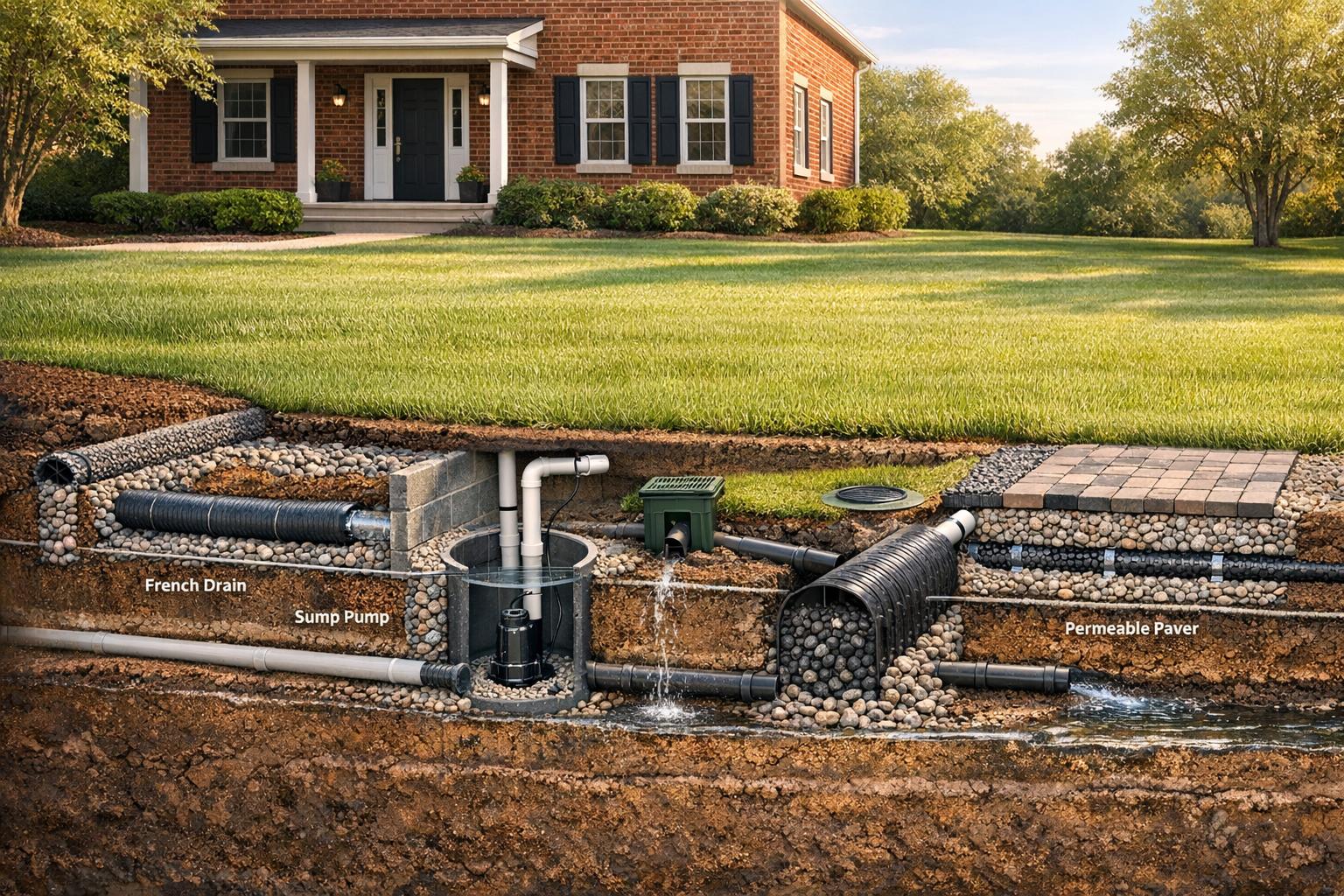
Maryland homeowners face serious drainage problems due to clay-heavy soil, frequent storms, and uneven terrain. These issues can lead to water pooling, foundation damage, basement leaks, and soggy lawns. Subsurface drainage systems are an effective way to manage water by redirecting it underground before it causes harm. Here’s a quick overview of the best options:
- French Drains: Redirect water underground using perforated pipes and gravel. Ideal for clay soil. Costs range from $2,983–$4,300.
- Curtain Drains: Shallow systems that intercept water flow. Effective for slopes. Costs range from $3,200–$5,500.
- Exterior Drain Tiles: Installed next to foundations to manage hydrostatic pressure. Costs range from $6,000–$15,000.
- Sump Pumps: Mechanically pump water from low spots or basements. Often paired with French drains. Costs range from $6,000–$15,000+.
- Regrading: Reshapes the yard to guide water away from the home. Costs range from $1,500–$3,000.
- Downspout Extensions: Connect gutters to underground pipes to move roof runoff away from foundations. Costs range from $700–$2,500.
- Permeable Pavers: Allow water to seep through while directing excess to subsurface drains. Costs range from $9,000–$18,000+.
Each system has unique benefits and costs, making it crucial to choose the right one based on your property’s specific needs. For Maryland’s clay soil, combining multiple solutions often provides the best results. Always ensure proper installation and maintenance to prevent issues like clogs or water backups.
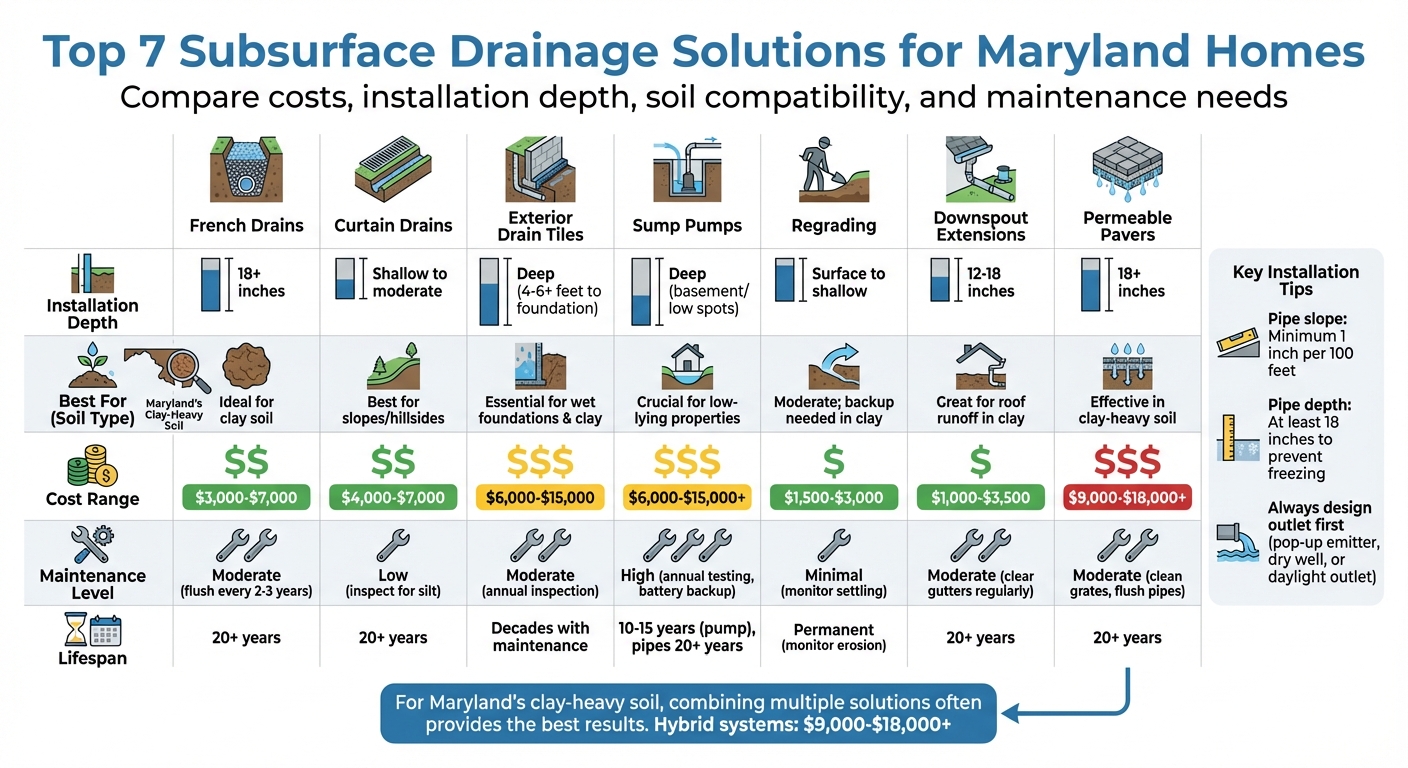
Maryland Subsurface Drainage Solutions Comparison: Costs, Depth, and Maintenance
Yard Drain, French Drain, Gravel collects Subsurface water, DIY
sbb-itb-843f8be
1. French Drains
French drains are a practical solution for managing Maryland’s challenging clay soil. These systems are designed to collect and redirect water underground, preventing issues like surface puddles or water seeping into your foundation. As Hawkins Landscaping explains:
French drains are one of the most effective drainage solutions for Maryland homes with clay soil [1].
The setup includes a perforated pipe surrounded by gravel, buried beneath the surface. This design ensures water is efficiently collected and diverted before it becomes a problem.
Placement Options
French drains can be installed in various locations to address specific drainage issues. Common spots include near foundations, along soggy lawn edges, and at the base of slopes – areas where Maryland homeowners often encounter water accumulation. Plus, because they’re hidden underground, these drains blend seamlessly into your yard’s design, keeping your landscaping intact while solving water problems.
Installation Depth
The depth of a French drain depends on its purpose. Exterior systems are typically buried 2–3 feet deep to handle surface water, while interior systems, often paired with sump pumps, go deeper – around 5–6 feet – to tackle basement flooding [4].
Ideal for Clay Soil
Maryland’s clay soil doesn’t absorb water well, which is where French drains shine. The gravel-wrapped pipe creates a clear path for water to flow, bypassing the soil’s natural absorption limitations.
Costs to Consider
Understanding the costs involved is key. In Glen Burnie, Maryland, French drain installation typically ranges from $2,983 to $4,300, depending on the complexity of the project. However, prices can vary widely, from $1,010 to $6,768 [4]. For exterior systems, expect to pay $10 to $15 per linear foot, while interior systems are more expensive, costing $50 to $60 per linear foot [4]. Factors like rocky or dense clay soil can increase labor costs [5].
Maintenance Tips
Maintenance needs depend on the drain’s depth. Shallow exterior systems may require occasional flushing with a hose to clear debris. On the other hand, deeper foundation drains are generally low-maintenance. Regularly check the discharge point to ensure water flows freely and prevent blockages [4].
2. Curtain Drains
Curtain drains, much like French drains, are designed to intercept and redirect subsurface water. They work as an underground barrier, stopping water before it reaches areas like your home’s foundation or persistently soggy parts of your yard. These systems are particularly effective in Maryland, where clay-heavy soil often leads to water pooling and slow drainage.
The key to a successful curtain drain installation lies in its discharge outlet. Without a proper outlet – such as a pop-up emitter or a dry well – the system won’t function as intended. For example, in December 2025, TLC Incorporated tackled a severe water pooling issue near a home’s foundation in Anne Arundel County, Maryland. They installed a curtain drain alongside yard grading and a pop-up emitter. The $5,800 project turned a yard that previously took days to drain into one that cleared water within hours [2]. Here’s a closer look at soil compatibility, costs, and maintenance for curtain drains.
Best Soil Type
Curtain drains perform best in clay-heavy soils. Clay’s poor drainage properties cause water to move slowly, making it easier for the system to intercept and redirect this subsurface flow. Before installation, it’s a good idea to test your soil’s drainage speed to ensure the system will work effectively.
Cost Range
For a standard 50–75-foot curtain drain, you can expect to pay between $3,200 and $5,500. Larger systems, spanning 100 feet or more, typically range from $6,000 to $9,000. If the installation includes hybrid solutions, costs can climb to $9,000–$18,000. Factors like trench length, soil conditions, and the type of discharge outlet (e.g., dry wells, which add $1,200–$3,000) will influence the final price [2].
Maintenance Needs
Curtain drains are designed for longevity, often lasting over 20 years with little upkeep. Their underground setup protects them from debris and the effects of Maryland’s freeze-thaw cycles. To keep the system running smoothly, occasional checks of the discharge outlet are recommended to ensure water is flowing as it should.
3. Exterior Drain Tiles
Exterior drain tiles are a key part of subsurface drainage systems, installed next to your foundation’s footing – usually 4 to 6 feet or more below ground. This depth makes them highly effective at managing hydrostatic pressure, a common cause of basement leaks and foundation damage. In Maryland, where clay soils dominate, these systems are especially important for protecting homes from water-related structural issues [6].
Installing these tiles involves excavating down to the foundation footer, a process that requires significant effort but is crucial for long-term effectiveness. When done correctly, these systems can last for decades with proper upkeep [7]. For example, in late 2025, TLC Incorporated revamped the drainage system of a new home in Howard County. The builder had neglected to address the slope, leading to water problems. The $12,600 solution combined a French drain, catch basins, and extended downspouts, successfully safeguarding the foundation and improving the lawn’s usability [2]. This approach works well with other drainage systems, tackling water at its deepest entry points.
Installation Depth and Soil Considerations
For slab foundations, exterior drain tiles should be installed at least 2 feet deep, while full basements require depths of 6 feet or more [7]. This is particularly critical in Maryland’s clay-heavy soils, which are notorious for poor drainage. When water accumulates around a home’s foundation, it can lead to serious structural issues. Proper installation depth is essential to keep water out and protect your foundation [6].
Cost Breakdown
The cost of a full exterior drain tile system typically ranges from $6,000 to $15,000 [7]. Installation costs vary between $30 and $90 per linear foot, with excavation adding another $4 to $16 per linear foot [8]. For a single side of a house, the price usually falls between $1,500 and $4,000, plus permit fees ranging from $100 to $375 [7]. While this is a significant investment, it plays a critical role in preserving your home’s structural integrity.
Maintenance Requirements
Maintenance for exterior drain tiles is relatively straightforward. Even though the pipes are buried, annual inspections are recommended. Flushing the pipes with a hose helps maintain clear water flow [7]. To prevent sediment buildup, the system should be backfilled with 6 inches of clean gravel or crushed stone and wrapped in filter fabric (geotextile) [7]. With these precautions, your system can remain efficient for years to come.
4. Sump Pumps with Subsurface Drains
Sump pumps offer mechanical assistance when gravity alone isn’t enough to move water away from your home. Like other underground drainage systems, they actively redirect water to designated discharge points. These pumps are typically installed at the lowest part of your property – either in a deep basin inside your basement or in an outdoor basin where water naturally pools [1][2]. For Maryland homeowners dealing with clay-rich soil that retains water like a sponge, sump pumps are essential for protecting the foundation [1].
The system operates by collecting water through subsurface lines, such as French drains or downspout extensions, and pumping it to a safe discharge location like a daylight outlet or a pop-up emitter [1]. This setup is especially important in low-lying areas where proper grading alone won’t solve drainage issues. In Maryland, professional drainage specialists use a 6-point checklist to evaluate the need for a sump pump, including testing soil drainage rates and assessing the foundation’s condition [2]. These pumps work seamlessly with other subsurface solutions, capturing water at its source and directing it away effectively.
Installation Depth
For basements, sump pumps should be installed deep enough to intercept subsurface water before it reaches the foundation. For exterior basins, a moderate depth is sufficient [1]. To prevent clogs, the basin should be surrounded by gravel or filtering fabric, which helps keep fine particles out of the pump system [1].
Best Soil Type
In areas with clay-heavy soil, sump pumps are often essential. Clay holds water, making it difficult for passive systems to work effectively. In sandy soil, these systems are generally less critical unless the water table is unusually high [1].
Cost Range
Integrating a sump pump into your drainage system increases its efficiency but comes with higher costs due to the mechanical and electrical components involved. Individual surface drains or catch basins that connect to sump pump lines typically cost between $700 and $2,500 each [2]. For Maryland yards ranging from 0.25 to 0.5 acres, comprehensive drainage plans – including sump pumps, French drains, and grading – can cost anywhere from $9,000 to over $18,000 [2].
Maintenance Needs
Regular maintenance is key to keeping your sump pump system running smoothly. Ensure the discharge outlet stays clear by designing the system with the outlet in mind [2]. After heavy rainfall, check discharge points for debris to prevent blockages [1][2]. Cleaning surface drains regularly helps avoid clogs that could strain the pump [1]. Annual professional inspections are recommended to catch mechanical problems early and avoid costly repairs [2].
5. Regrading for Subsurface Flow
Regrading adjusts the slope of your yard to guide water away from your home’s foundation toward safe discharge points like swales, rain gardens, or subsurface drains [1]. In Maryland, where clay-heavy soil is common, this process is especially useful. Clay soil tends to absorb water slowly and retain it, which can lead to pooling and increased pressure against basement walls [1]. By reshaping the yard, regrading reduces the amount of water that reaches subsurface systems, improving overall drainage efficiency.
This method works by eliminating low spots where water tends to gather. To identify problem areas, inspect your yard after a heavy rain [1]. While regrading addresses surface-level issues, it plays a critical role in preventing soil oversaturation near your foundation and hardscapes. For proper drainage, ensure that graded channels slope downward at a minimum of 1 inch per 100 feet [3].
"Design the end of the system first. That’s how you make sure everything upstream works." – TLC Incorporated [2]
Installation Depth
Regrading is considered a surface-level to medium-depth solution since it focuses on reshaping topsoil and subsoil rather than deep excavation [1][3]. If the project includes subsurface pipes or other drainage components, these should be buried at least 18 inches deep. This depth helps prevent freezing during Maryland winters and protects the system from damage during routine lawn care, ensuring it integrates smoothly with the overall drainage setup [3].
Best Soil Type
Clay soil often makes regrading a necessary step for Maryland homeowners. Unlike sandy or loamy soils that drain more easily, clay holds water, which can lead to pooling [1]. While regrading doesn’t change your soil type, pairing it with aeration and compost topdressing can help reduce compaction and improve water movement through the soil [1].
Cost Range
Regrading is generally a moderate-cost solution. Basic grading or re-sloping in Maryland typically costs between $1,500 and $3,000 [2]. Installing surface swales measuring 20 to 40 feet can cost between $1,800 and $2,800 [2]. For larger, more comprehensive projects – such as those combining grading with French drains and downspout extensions on properties ranging from 0.25 to 0.5 acres – the cost can range from $9,000 to $18,000 [2].
Maintenance Needs
Once completed, regrading requires minimal maintenance. However, it’s important to keep an eye out for soil settling, erosion, or bare patches that could disrupt water flow. Always ensure that water is directed to a clear and functional outlet [1][3].
6. Downspout Extensions to Subsurface Lines
Downspout extensions are a practical addition to subsurface drainage systems, especially when managing roof runoff. By connecting downspouts to buried drainage lines, these extensions help redirect water away from your foundation, reducing the risk of water pooling and damage. This is particularly important in Maryland, where clay-heavy soil tends to hold moisture, increasing pressure on basement walls [1][6]. Subsurface extensions use PVC pipes to transport water to discharge points, keeping the area around your foundation dry [3].
The system is designed to capture water from your gutters and channel it underground. This prevents soil erosion, eliminates muddy areas near the house, and protects your landscaping [1][6]. Since the pipes are buried, they remain out of sight and can integrate with features like dry wells or rain gardens for a more environmentally friendly solution [1][6].
"A French drain, surface drain, or even swale is useless if the water has nowhere to go. That’s why we ALWAYS design outlet-first." – TLC Incorporated [2]
Installation Depth
For proper functionality, subsurface downspout lines should be buried at least 18 inches deep. This depth prevents freezing during Maryland’s colder months and avoids accidental damage from lawn equipment [3]. Solid PVC pipes are recommended to transport water efficiently without leakage [3]. To ensure proper drainage, the pipes need a slope of at least 1 inch per 100 feet, allowing gravity to move the water toward the outlet [3]. These extensions are a critical part of an overall drainage plan, complementing systems like French drains.
Best Soil Type
These systems work particularly well in areas with clay-heavy soil, which tends to drain slowly. Because surface water doesn’t naturally seep into clay, it can lead to pooling and potential foundation issues [1][6]. Subsurface extensions address this problem by quickly moving large amounts of roof runoff away from the house before the ground becomes oversaturated.
Cost Range
The cost of installing downspout drain zones ranges from $700 to $2,500 [2]. For systems that cover 1 to 2 zones with multiple downspouts and catch basins, the price typically falls between $1,000 and $3,500 [2]. For larger projects, such as a comprehensive drainage plan for a 0.25 to 0.5-acre yard, costs can range from $9,000 to $18,000 or more [2].
Maintenance Needs
Maintaining these systems involves moderate effort, primarily focusing on keeping gutters clean and ensuring discharge outlets remain clear. Clogged gutters can render the entire system ineffective, so it’s essential to remove debris at least twice a year, especially in the fall [1][2]. After heavy rain, check the discharge outlets to make sure they aren’t blocked by mulch, leaves, or grass [2][3]. Flushing the underground pipes every 2 to 3 years helps prevent sediment buildup and keeps water flowing efficiently [3].
This approach, combined with other drainage solutions, ensures water is safely directed away from your home. Regular inspections and maintenance keep the entire network, including downspout extensions, running smoothly, protecting your property from water damage.
7. Permeable Pavers over Subsurface Drains
Permeable pavers combine functionality with style, making them a smart choice for effective water management. In areas like Maryland, where clay-heavy soil tends to retain water, this system is particularly useful. The design allows water to seep through the joints between pavers, while underground drainage pipes carry excess water away from the property. This helps protect foundations and hardscapes from the damage caused by freeze-thaw cycles[2].
By capturing water at the surface and directing it underground, permeable pavers work to prevent pooling, safeguard foundations, and reduce the risk of freeze-thaw damage[1][6]. Much like French and curtain drains, these systems integrate seamlessly with other subsurface drainage solutions, creating a layered approach to managing water.
Installation Depth
To ensure the system functions properly, subsurface pipes beneath permeable pavers should be installed at a depth of at least 18 inches. This depth helps prevent freezing and protects the pipes from damage caused by lawn equipment[3]. The pipes should also have a slope of at least 1 inch per 100 feet to maintain water flow and minimize debris accumulation[3]. For durability, perforated PVC is recommended over thinner corrugated pipes, which are prone to collapsing under the weight of soil and pavers[3]. When designing the system, start from the outlet – whether it’s a pop-up emitter, dry well, or daylight outlet – to ensure efficient water discharge[2].
Best Soil Type
This drainage method works particularly well in clay-heavy soil[2][3][6]. Clay soil tends to retain water, increasing pressure on foundations and hardscapes. The combination of subsurface drainage and permeable pavers effectively manages both groundwater and surface runoff.
Cost Range
Installing permeable pavers with an integrated drainage system is a significant investment. French drains, often placed under or near the pavers, typically cost between $3,000 and $7,000[2][3]. For larger hardscaping projects that incorporate multiple drainage systems across a 0.25- to 0.5-acre yard, costs can range from $9,000 to $18,000 or more[2]. Adding surface drains like catch basins for patios or driveways can increase expenses by $700 to $2,500 per zone[2]. In Maryland, the labor and excavation required for clay-heavy soil may further raise costs[3].
Maintenance Needs
This system requires moderate upkeep to stay effective. Subsurface pipes should be flushed every 2 to 3 years to remove sediment and ensure smooth water flow[3]. After heavy storms, inspect discharge outlets to clear any blockages caused by mulch, leaves, or grass[3]. Keeping the paver joints free of debris through regular sweeping will help maintain their permeability[1][3]. Using filter fabric during installation can prevent soil particles from clogging the gravel and pipes[3]. Lastly, watch for signs of soft or sinking ground, as these could indicate issues like a collapsed pipe beneath the pavers[3].
Comparison Table
Here’s a breakdown of seven subsurface drainage solutions commonly used in Maryland homes. Each option is evaluated based on installation depth, soil compatibility, cost, and maintenance needs.
| Drainage Solution | Installation Depth | Soil Compatibility | Cost Range | Maintenance Requirements |
|---|---|---|---|---|
| French Drains | 18+ inches | Ideal for clay soil | $3,000–$7,000 | Flush pipes every 2–3 years; clear outlets regularly |
| Curtain Drains | Shallow to moderate trench | Best for slopes and hillsides | $4,000–$7,000 | Inspect for silt buildup; flush periodically |
| Exterior Drain Tiles | Deep (to foundation footing) | Essential for wet foundations and clay | $6,000–$15,000 | Check sump pump function; inspect for pipe damage |
| Sump Pumps with Subsurface Drains | Deep (basement or low spots); discharge lines 18+ inches | Crucial for low-lying properties | $6,000–$15,000+ | Annual pump testing; ensure battery backup is functional |
| Regrading for Subsurface Flow | Surface to shallow (soil reshaping) | Moderate; may need backup in clay areas | $1,500–$3,000 | Minimal; monitor for soil settling or erosion |
| Downspout Extensions to Subsurface Lines | 12–18 inches | Great for roof runoff; works well in clay | $1,000–$3,500 | Clear gutters, grates, and emitters regularly |
| Permeable Pavers over Subsurface Drains | 18+ inches (pipes beneath pavers) | Effective in clay-heavy soil | $9,000–$18,000+ (full system) | Clean surface grates and filter fabric to prevent blockages |
For clay-heavy soils, hybrid solutions – like combining French drains, regrading, and downspout extensions – can provide extra protection. However, these larger projects can range from $9,000 to $18,000+ [2].
Key Installation Tips:
- Pipe Slope: Ensure all subsurface pipes slope at least 1 inch per 100 feet for proper drainage.
- Pipe Depth: Bury pipes at least 18 inches deep to avoid damage and maintain functionality [3].
When planning your system, always start with the outlet – whether it’s a pop-up emitter, dry well, or daylight outlet. A clear exit path for water is essential to prevent backups and ensure your drainage system works efficiently [2][3].
Pro Landscapes MD Drainage Services

Pro Landscapes MD specializes in subsurface drainage systems designed to tackle the challenges of Maryland’s notoriously clay-heavy soils. Their service area includes Howard County, Montgomery County, Carroll County, Frederick County, Prince George’s County, and Baltimore County, reaching communities like Annapolis, Baltimore, Bethesda, Ellicott City, Gaithersburg, and even Washington, D.C.
Maryland’s clay soil struggles to absorb water, making effective drainage a must. Pro Landscapes MD offers solutions like French drains, grading and re-sloping, dry creek beds, and stormwater management systems to move water underground efficiently [2][6]. Plus, their systems are built to handle Maryland’s harsh winters, minimizing the risk of ground shifts and cracks caused by freeze-thaw cycles.
What truly sets Pro Landscapes MD apart is their detailed evaluation process. Before starting any project, they perform soil testing, slope assessments, and runoff path analyses. This ensures every drainage system is tailored to the property’s unique needs. Areas like Columbia, Towson, and Silver Spring, with their varying soil and terrain, particularly benefit from this custom approach [2].
Homeowners across central Maryland rely on their expertise in combining multiple techniques to create durable solutions. For instance, they often integrate French drains with regrading and downspout extensions to tackle everything from minor pooling to major foundation risks. Their services also include drain pipe placement, drainage repairs, land leveling, yard leveling, and yard repair.
With extensive local knowledge, Pro Landscapes MD designs systems that relieve foundation pressure and eliminate soggy lawns, offering peace of mind to homeowners throughout the region [1][2].
Conclusion
Picking the right subsurface drainage system for your Maryland home means taking a customized approach. The state’s clay-heavy soil tends to drain slowly and retains water long after storms, while frequent freeze-thaw cycles can push moisture toward foundations and crack hardscapes [1][2]. To find the best solution, assess your yard’s slope, infiltration rate, and runoff patterns. This groundwork will help you develop an effective drainage plan.
One key element is ensuring your system includes a clear discharge point. As TLC Incorporated explains, "A French drain, surface drain, or even swale is useless if the water has nowhere to go" [2]. Without a proper outlet – like a pop-up emitter or dry well – your drainage system simply won’t work.
Before making any decisions, observe your property during heavy rain. Look for trouble spots, test the soil’s ability to absorb water, and trace runoff paths [2]. This step can prevent costly mistakes, helping you decide between options like grading, French drains, dry wells, or even a combination of methods.
It’s also wise to consult professionals. Poor installation can direct water toward your foundation, and Maryland’s building codes and stormwater management rules can be tricky to navigate [1]. When properly installed, systems like French drains can provide over 20 years of protection [2]. They’re a long-term investment that shields your home from water damage, foundation issues, and soggy yards – common problems in central Maryland. By pairing thorough preparation with expert installation, you can ensure your home stays protected for years to come.
FAQs
How do I choose the right drainage solution for my yard?
To choose the best drainage solution, start by pinpointing the specific water problems you’re dealing with – whether it’s pooling water, soil erosion, or basement flooding. Then, evaluate your yard’s unique features, like the slope, soil type, and how water naturally flows through the area.
For areas prone to heavy rain, solutions like French drains, swales, or permeable pavers can be effective. If you’re looking for an eco-friendly approach, consider options like rain gardens or bioswales, which can manage water while adding to your yard’s beauty.
When in doubt, reaching out to a professional can help you design a system that not only solves the problem but also complements your landscape.
Where can drained water legally discharge in Maryland?
In Maryland, it’s legally permissible for drained water to flow into local stormwater management systems. These include storm drains, swales, and dry riverbeds, all of which are designed to handle runoff effectively. Their primary purpose is to manage water flow and reduce problems like erosion and flooding in the area.
Do I need a sump pump or will gravity drainage work?
If your property has the right slope and grading, a gravity drainage system can handle water runoff effectively. But if you’re dealing with constant water problems – especially in basements or areas prone to flooding – a sump pump is a smart choice for managing excess water. Evaluating your property’s drainage requirements is crucial to avoid potential long-term damage.
Chat with Us