









- bhavya gada
- No Comments
Stone veneer costs in Maryland are rising in 2026, driven by labor shortages and material choices. Here’s what you need to know:
- Labor Costs: Labor accounts for 50–75% of project costs. Skilled masons are in high demand, with rates ranging from $2–$24 per square foot. Natural stone labor costs 75% more than manufactured options.
- Material Options:
- Manufactured stone: $2–$6/sq ft for labor; requires sealing every 1–3 years ($1–$3/sq ft).
- Sawn-back natural stone: $8–$15/sq ft for labor; faster to install.
- Natural thin stone veneer: $11–$24/sq ft for labor; boosts home resale value by 5–15%.
- Regional Costs: Prices vary by location. For a 215 sq ft project:
- Marriottsville: $13.29–$15.94/sq ft.
- Princess Anne: $12.71–$15.26/sq ft.
- Glen Echo: $9.72–$17.84/sq ft.
- Complex Projects: Multi-story walls or intricate designs can increase costs by 25–35%. Architectural features might add $15,000–$30,000.
Key Savings Tips:
- Choose cost-effective materials like manufactured or sawn-back stone.
- Schedule projects during off-peak times.
- Bundle services with other hardscaping projects to reduce costs.
While natural stone is pricier, its durability and low maintenance make it a worthwhile investment. For accuracy, get multiple quotes and ensure contractors are licensed and insured.
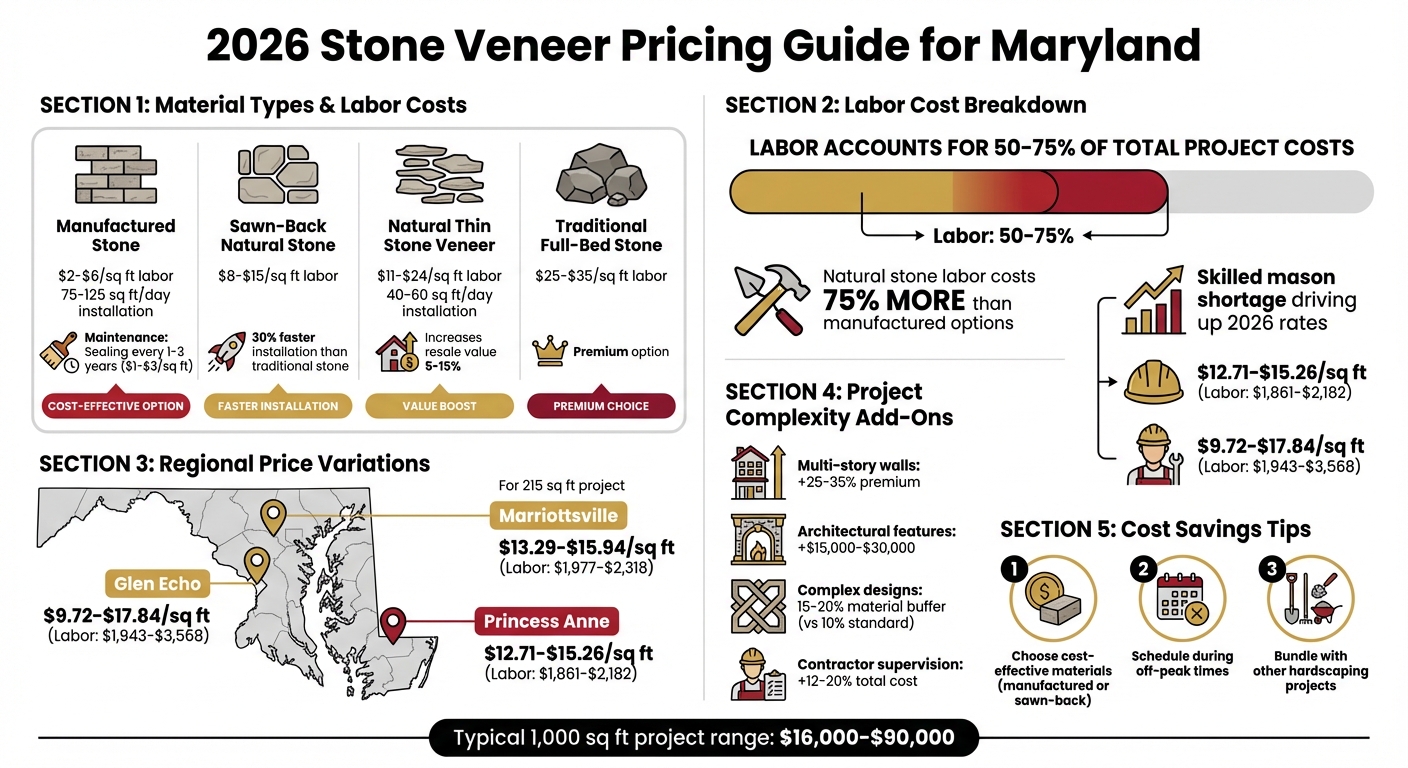
2026 Maryland Stone Veneer Costs: Material Types, Labor Rates & Regional Pricing Comparison
Real Stone Veneer Cost: Everything You Need to Know
sbb-itb-843f8be
What Affects Stone Veneer Pricing in Maryland
When it comes to stone veneer pricing in Maryland, several factors come into play, ranging from the type of material you choose to labor requirements and even regional differences. Let’s break it down.
Material Types and Their Impact on Pricing
The type of stone veneer you select plays a big role in determining costs. Here’s how different materials stack up:
- Natural thin stone veneer: This option is at the higher end of the price range. Labor costs for installation range between $11 and $24 per square foot. Why the premium? Each piece of stone is carefully assessed for color and texture consistency, which slows down the process. A skilled mason can only install about 40–60 square feet in a full workday[1].
- Sawn-back natural stone: A more affordable alternative, this material features a flat, precision-cut surface that speeds up adhesion by 30% compared to traditional natural stone. Labor costs for sawn-back stone typically fall between $8 and $15 per square foot[1].
- Manufactured (faux) stone: The most budget-friendly option, manufactured stone is made from concrete-based patterns and is much easier to install. General laborers can handle this material at a cost of $2–$6 per square foot, with a daily installation range of 75–125 square feet. However, it does require regular maintenance, including sealing every 1–3 years at $1–$3 per square foot to prevent fading[1].
Your material choice sets the stage for understanding labor and installation costs.
Labor and Installation Costs
Labor is a major expense, accounting for 50%–75% of total project costs in Maryland. A shortage of skilled masons, expected to continue through 2026, is driving up wages – especially for projects involving natural stone, which requires expertise in weight management and precision. According to Coco Yang, Sales Director at Top Source Stone, labor for natural stone carries a 75% premium compared to manufactured stone[1].
Project complexity also plays a big role. For example:
- Multi-story walls can add 25%–35% to labor costs due to scaffolding and safety requirements.
- Architectural features like vaulted ceilings or intricate corners can increase your bill by $15,000 to $30,000.
- Even small details, like curved surfaces or layouts with multiple outlets, can result in higher costs. These require a 15% waste buffer instead of the standard 10%, which impacts both material and labor hours[1].
But that’s not all – where you’re located in Maryland can also influence your overall costs.
Regional Market Variations
Stone veneer pricing isn’t uniform across Maryland. Here’s how costs vary by region for a 215-square-foot natural stone project:
- Marriottsville: Prices range from $13.29 to $15.94 per square foot, with labor costs between $1,977.82 and $2,318.15[2].
- Princess Anne: Slightly lower costs, with prices averaging $12.71 to $15.26 per square foot and labor ranging from $1,861.93 to $2,182.33[3].
- Glen Echo: A wider price range, from $9.72 to $17.84 per square foot[4].
Urban areas generally see higher prices due to strong demand and a limited supply of skilled masons. In contrast, rural areas benefit from lower overhead costs and reduced competition for labor. Accessibility to suppliers also factors in. Major brands like Nicolock, Hanover, Techo-Bloc, and Champlain Stone serve counties such as Carroll, Anne Arundel, Frederick, Howard, Baltimore, and Montgomery, though delivery fees and transit times can affect costs[5].
Finally, hiring a general contractor to oversee your project can increase total costs by 12%–20%[2][3][4]. These regional differences highlight the importance of gathering detailed local estimates before starting your project.
Stone Veneer Cost Ranges in Maryland
Getting a clear picture of stone veneer costs can help you plan your budget effectively. Here’s a breakdown of what to expect for projects in Maryland in 2026.
Material Costs by Type
The type of stone veneer you choose plays a big role in overall expenses. Manufactured (faux) stone is the most economical option, with labor costs ranging from $2–$6 per square foot. While it’s easy to install, it may need professional sealing every 1–3 years, which adds $1–$3 per square foot for maintenance.
Sawn-back natural stone is a mid-range option, with labor costs between $8–$15 per square foot. Its flat, precision-cut backing speeds up installation by about 30% compared to traditional natural stone. At the higher end, natural thin stone veneer comes with labor costs of $11–$24 per square foot, while traditional full-bed stone is the most expensive, costing $25–$35 per square foot for labor. Keep in mind that delivery fees and supplier transit times can also affect final material costs [1][5].
Total Project Costs Based on Scope
The size and complexity of your project will significantly influence final expenses. For 2026, installing 1,000 square feet of stone veneer typically costs between $16,000 and $90,000 [1].
For smaller projects, costs vary by location. For example:
- Marriottsville: A standard 215-square-foot project costs between $2,657 and $3,186, with labor making up $1,977–$2,318 of that total [2].
- Princess Anne: Costs range from $2,541 to $3,051, with labor accounting for $1,861–$2,182 [3].
- Glen Echo: Project costs can fall between $1,943 and $3,568, depending on materials and other details [4].
If you’re adding architectural features, expect an additional $15,000–$30,000. Multi-story work often comes with a 25%–35% premium due to the need for scaffolding. Standard walls usually require a 10% material buffer to account for waste, but intricate designs with corners or trim may need 15–20% extra material [1].
Other costs to consider include general contractor supervision, permits, site preparation, and debris removal, which can add 12%–20% to the total project cost [2][3][4].
How to Save on Stone Veneer Projects
Planning wisely can help Maryland homeowners stretch their budgets for stone veneer projects in 2026. With labor costs on the rise and materials becoming more intricate, a few smart strategies can make a big difference.
Choosing Cost-Effective Materials
If you’re looking to save, manufactured stone is a great option. It’s less expensive, easier to work with, and only needs occasional sealing. For something sturdier but still efficient, sawn-back natural stone is a good middle-ground choice. It offers the durability of real stone and can cut installation time by about 30% compared to traditional fieldstone [1].
Natural thin stone veneer is another smart pick. It eliminates the need for costly footings, requires less maintenance, and has labor costs ranging from $11–$24 per square foot. Plus, it can increase your home’s resale value by 5%–15% [1]. Prefabricated L-shaped corner wraps can also help by reducing labor costs by 15%–25% [1].
To avoid wasting money, apply a "10% waste rule" for standard walls or a "15% rule" for complex designs. Using digital tools to plan your cuts can also save materials by repurposing off-cuts as starter pieces for new rows [1].
Once you’ve chosen your materials, the next step is to schedule your project strategically to save even more.
Timing Your Project for Savings
Timing is everything, especially with the skilled labor shortages expected in 2026. These shortages have pushed hourly wages higher, so scheduling your project during off-peak times can help you secure better rates, especially in urban areas [1]. Multi-story installations, which often require scaffolding, can add a 25%–35% premium to your costs. Planning these projects when contractors are less busy could lead to more favorable pricing [1].
Keeping your design simple is another way to manage costs. Avoiding frequent obstructions like electrical outlets or intricate curves can keep labor costs within the standard range for natural stone installations [1].
Bundling Services with Pro Landscapes MD

Another way to save is by bundling your stone veneer project with other hardscaping services. This approach can reduce overhead costs like site preparation, equipment delivery, and labor mobilization [2][3]. For example, by combining your stone veneer installation with projects like paver patios, retaining walls, or natural stone steps, you can take advantage of shared equipment and streamlined debris removal [2][3].
Pro Landscapes MD also offers access to bulk pricing on materials. When contractors order stone veneer alongside other supplies like pavers or retaining wall blocks, they can often secure large-quantity discounts [5]. If scaffolding is needed for multi-story work, coordinating other masonry tasks at the same time can help you avoid paying for the scaffolding setup twice [1].
Serving Howard County, Montgomery County, Carroll County, Frederick County, Prince George’s County, and Baltimore County, Pro Landscapes MD provides a wide range of hardscaping services across central Maryland, making it easier to achieve your project goals while keeping costs in check.
Working with Professionals for Quality Installation
Benefits of Hiring Pro Landscapes MD
With rising labor costs and increasingly intricate projects, working with seasoned professionals has never been more important. Installing stone veneer isn’t just about placing stones – it’s about understanding the nuances of stone grain, weight distribution, and structural integrity. That’s where the team at Pro Landscapes MD shines. Their skilled masons bring the technical know-how needed to deliver top-tier installations. They go the extra mile, hand-sorting each stone to create a custom, random-lay pattern that adds real value to your property [1].
On average, experienced masons can install 40–60 square feet of natural thin stone veneer in an 8-hour workday. While this is slower compared to the 75–125 square feet possible with manufactured systems, the result is unmatched precision and durability. Pro Landscapes MD also manages complex and high-risk tasks, like working on scaffolding for multi-story facades, using specialized equipment to ensure safety and efficiency. Their expertise guarantees not only a polished finish but also a project built to last.
Evaluating Contractor Quotes
When it comes to contractor quotes, clarity is key. A detailed estimate should include everything – worksite preparation, material delivery, equipment usage, and debris removal. It’s equally important to identify what’s not included, such as permits, inspection fees, sales tax, or contractor supervision. These hidden costs can quickly add 12–20% to your overall budget if overlooked.
To get a better sense of pricing, aim to collect at least three estimates. Make sure your contractor is licensed, bonded, and insured in Maryland. Don’t skip checking references or online reviews – they’re invaluable for gauging reliability. Look for quotes that clearly outline waste buffers and contingency allowances. Additionally, any premiums for multi-story installations or unique architectural features should be itemized to avoid surprises [2][3].
Conclusion
When it comes to stone veneer pricing in Maryland for 2026, three main factors play a pivotal role: material selection, labor costs, and project complexity. Natural stone typically costs 75% more than manufactured options, and skilled installation adds another layer of expense, reflecting its value and precision work[1]. Residential projects generally fall between $16,000 and $90,000, with variations influenced by project scope, intricate designs, and additional costs like a 12–20% premium for contractor supervision[1][2][4].
Choosing high-quality materials is essential for long-term benefits. Natural stone, for instance, requires almost no maintenance and can increase property resale values by 5% to 15% compared to traditional siding[1]. On the other hand, manufactured stone might need professional sealing every one to three years, adding $1 to $3 per square foot to ongoing costs[1]. While the upfront cost of premium materials and skilled labor may seem steep, they ensure durability and add significant value over time.
The importance of expert installation cannot be overstated. As Coco Yang, Sales Director at Top Source Stone, emphasizes:
"Accurate stone veneer cost & labor projections represent the slim margin between a profitable masonry contract and a significant financial deficit"[1].
Pro Landscapes MD exemplifies this precision, managing projects across central Maryland with meticulous attention to detail. From applying a 10% waste rule during material procurement to handling multi-story installations with specialized scaffolding and safety protocols, their expertise minimizes costly mistakes and ensures structural soundness.
It’s also vital to account for hidden costs like contractor supervision and layout challenges[2][4]. Complex designs with numerous corners or utility penetrations can increase labor costs by 25% to 35%[1]. To avoid surprises, secure at least three detailed quotes and confirm that contractors are licensed, bonded, and insured to meet Maryland’s regulations.
FAQs
What’s the best stone veneer option for my budget and maintenance needs?
The right stone veneer for your project comes down to your budget and how much maintenance you’re willing to take on. Natural stone veneer delivers a high-end, durable aesthetic, though it requires moderate upkeep and typically costs between $10 and $85 per square foot. On the other hand, manufactured or concrete veneers are a more budget-friendly choice, priced at $6.71 to $8.76 per square foot. They offer a stylish look with less maintenance, making them a practical alternative.
How can I estimate my total installed cost before getting quotes?
To figure out the installed cost of stone veneer, you’ll need to think about a few important details. These include the size, thickness, and total area to be covered (measured in square feet). Material costs typically fall between $6.71 and $8.76 per square foot, while labor costs in Maryland range from $20 to $60 per square foot.
Additionally, don’t overlook expenses for site preparation, drainage, and any custom features you might want. Bringing in professionals can help ensure accurate estimates and a proper installation that stands the test of time.
What should I look for in a Maryland stone veneer contractor quote?
When looking over a quote from a Maryland stone veneer contractor, make sure it breaks down material costs clearly. Details like the type and size of the stone should be listed since these significantly affect the price. Pay attention to labor costs – whether they’re charged hourly or based on square footage – and consider any site-specific factors, such as how easy the site is to access or the complexity of the job.
Don’t overlook additional expenses like permits, site preparation, and post-project cleanup. It’s also important to confirm that drainage and foundation preparation are part of the plan. Finally, take a moment to review the contractor’s reputation, experience, and any warranty options they offer to ensure you’re making a well-informed decision.
Chat with Us