









- bhavya gada
- No Comments
The article breaks down how Maryland property owners can tackle stormwater issues like erosion, flooding, and pollution through green stormwater infrastructure and rebate programs. These programs make eco-friendly upgrades – like rain gardens, permeable pavement, and rain barrels – more affordable. Key highlights include:
- Montgomery County RainScapes Program: Offers up to $7,500 for residential properties and $20,000 for commercial projects. Applications are reviewed twice a year, and pre-approval is required before starting work.
- Prince George’s County Rain Check Rebate Program: Provides up to $6,000 for residential and $20,000 for commercial properties. Rebates cover practices like cisterns, tree planting, and green roofs, with rolling applications.
- Baltimore Environmental Offset Grants: Grants range from $5,000 to $75,000, focusing on projects that improve water quality and reduce runoff in urban areas.
These programs aim to reduce stormwater runoff, improve water quality, and protect properties from water damage. They also offer financial incentives to encourage participation, making green infrastructure more accessible. To qualify, property owners must follow strict guidelines, including pre-approvals and inspections. Working with certified contractors ensures compliance and maximizes rebate potential.
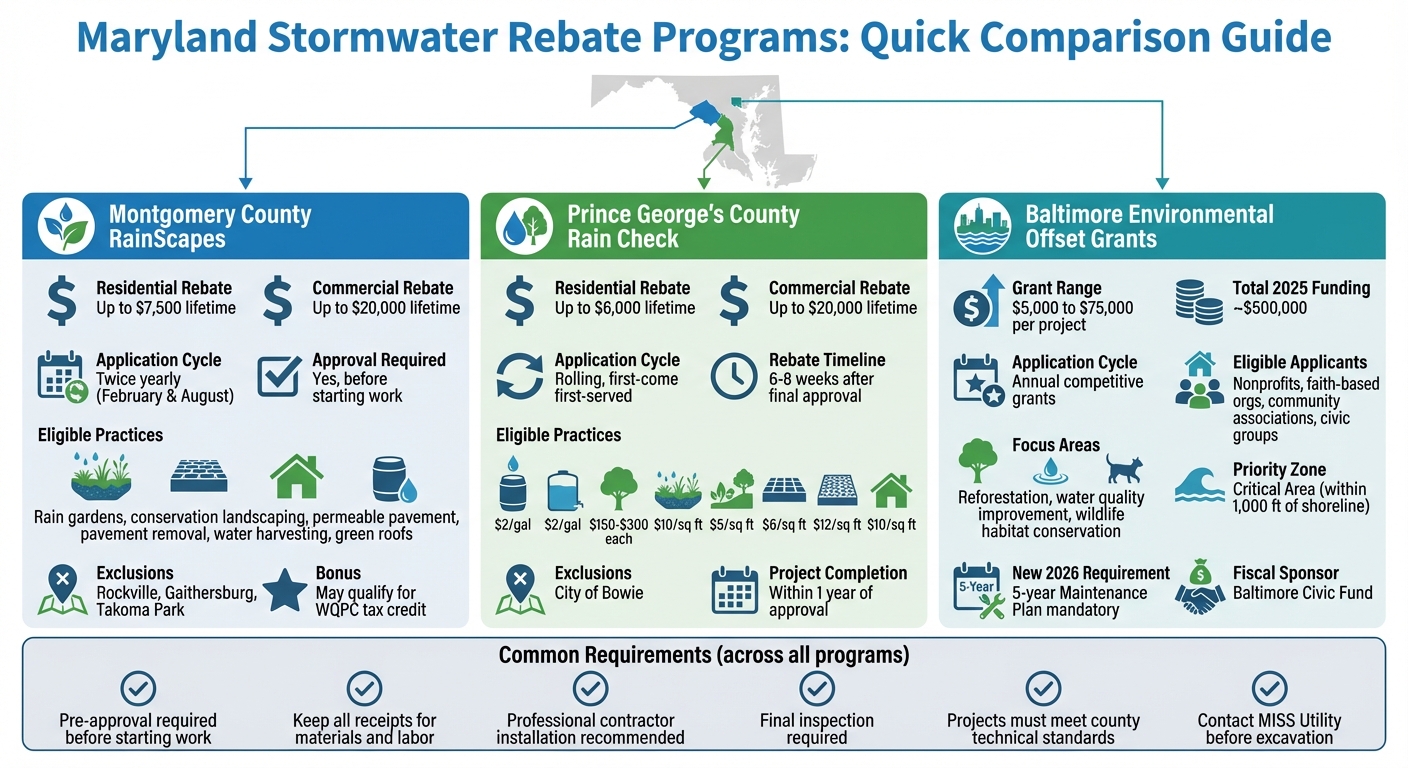
Maryland Stormwater Rebate Programs Comparison: Montgomery, Prince George’s, and Baltimore Counties
Montgomery County RainScapes Program
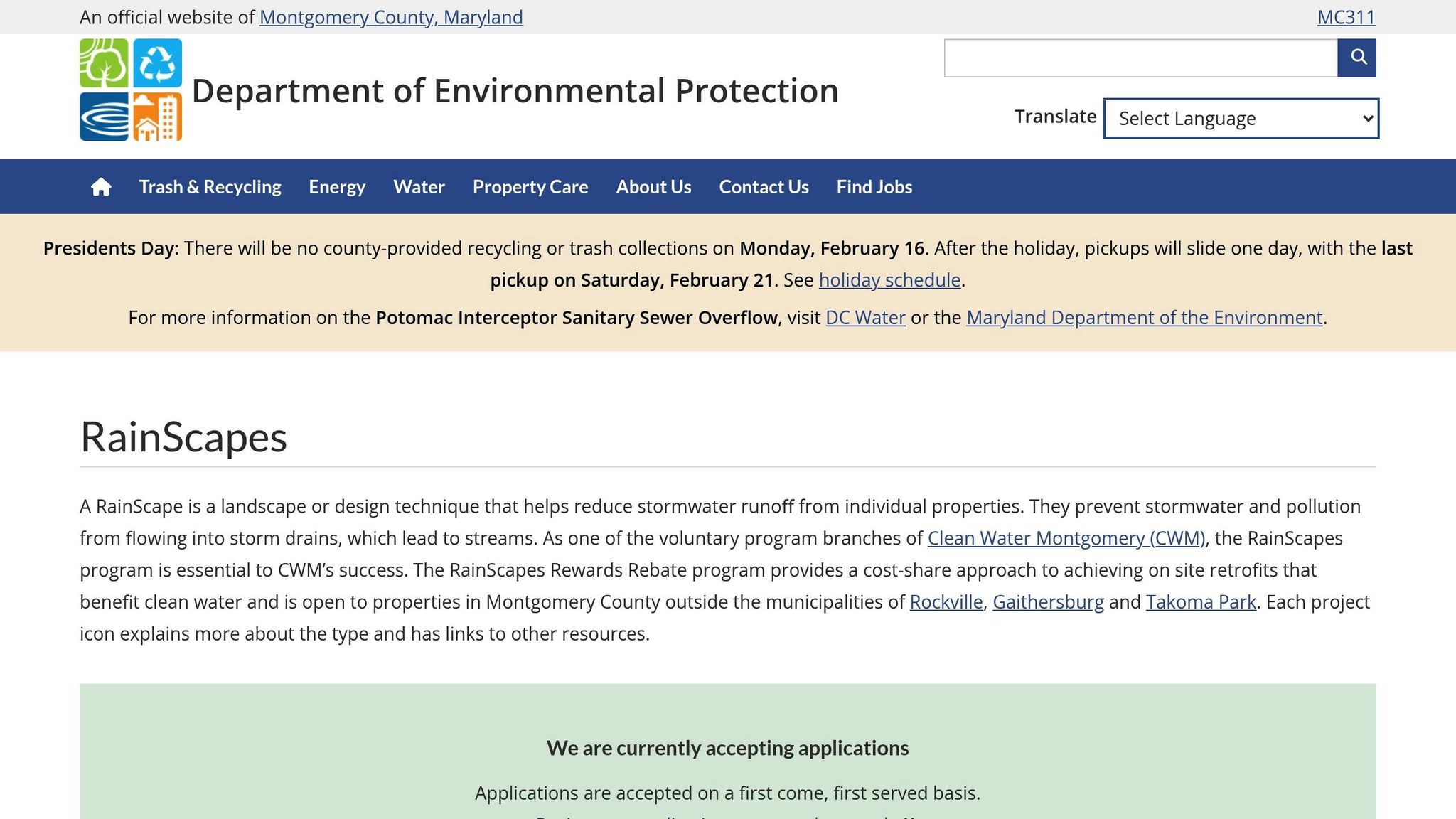
The Montgomery County Department of Environmental Protection (DEP) offers the RainScapes Rewards Rebate program, a cost-sharing initiative for property owners in Montgomery County. However, residents in Rockville, Gaithersburg, and Takoma Park are not eligible to participate.
Local leaders emphasize the program’s benefits:
RainScapes are a powerful way to improve the health of our local environment while addressing the growing impacts of climate change [7].
County Executive Marc Elrich underscores this point, while DEP Director Jon Monger adds:
RainScapes improve the health of streams, lower energy costs, and increase property values. Property owners can beautify their landscape while protecting it from water damage [7].
Eligible Practices and Rebate Amounts
The program supports six main types of eco-friendly infrastructure projects:
- Rain gardens: Shallow areas designed to collect and absorb runoff within 24–48 hours [8].
- Conservation landscaping: Replacing traditional grass with native plants to slow and soak up rainwater [8].
- Permeable pavement: Surfaces like porous pavers that let water seep into the ground [8].
- Pavement removal: Transforming asphalt or concrete into green spaces, gardens, or sod [8].
- Water harvesting: Installing rain barrels or cisterns to collect and store rainwater [8].
- Green roofs: Vegetated roof systems that absorb rainfall and cut down on runoff [7].
Residential properties can qualify for up to $7,500 in lifetime rebates per parcel. Commercial, HOA, multi-family, and institutional properties are eligible for up to $20,000 per parcel [4][5][7]. Rebates are based on receipts for materials and labor, up to the approved maximum. Additionally, completed projects may qualify for a Water Quality Protection Charge (WQPC) credit, reducing annual property taxes [5][9].
These projects not only help manage stormwater but also boost property values and contribute to a healthier environment.
Application Process and Funding Limits
Applications open twice a year, usually in early February and August, and are reviewed on a first-come, first-served basis [7]. To apply, property owners must submit their Property Tax ID through the RainScapes Rewards portal. Projects must not begin until after formal approval – any work completed beforehand will not qualify for rebates [5].
Once an application is approved, a planner is assigned within 2–4 weeks to perform a site assessment. Applicants then have three months to submit a project plan and six months from the approval date to complete the installation. After finishing the project, a final inspection is conducted, and rebate checks are typically issued within 8 to 12 weeks after verifying receipts.
Before starting any excavation, remember to contact MISS Utility, and keep all receipts for materials and labor to ensure a smooth process [5].
sbb-itb-843f8be
Prince George’s County Rain Check Rebate Program
Prince George’s County, through the Chesapeake Bay Trust, offers the Rain Check Rebate Program to help property owners manage the costs of installing green stormwater infrastructure. Reinstated for FY2026 on July 3, 2025, the program is open to homeowners, businesses, and nonprofit organizations, including faith-based groups and housing cooperatives [10].
The program is available countywide, except for properties within the City of Bowie, which runs its own stormwater program [10]. Additionally, residents in Cheverly, University Park, and College Park should use their local municipal programs for urban tree canopy rebates [11][12].
Applications are accepted on a rolling, first-come, first-served basis, with processing typically completed within two weeks [10].
Approved Practices and Rebate Rates
The Rain Check Rebate Program supports eight types of green infrastructure projects, with specific rebate rates and requirements. Residential properties can receive up to $6,000 in lifetime rebates, while commercial, industrial, and institutional properties can qualify for up to $20,000 [10][11][12].
| Practice | Rebate Rate | Minimum Requirement |
|---|---|---|
| Rain Barrels | $2 per gallon | 50 gallons (residential); 100 gallons (commercial) |
| Cisterns | $2 per gallon | 250 gallons |
| Urban Tree Canopy | $150 per tree | Native species; minimum 5 feet tall |
| Rain Gardens | $10 per square foot | 100 square feet |
| Conservation Landscaping | $5 per square foot | 250–1,000 square feet (depending on track) |
| Pavement Removal | $6 per square foot | No minimum (residential); 400 square feet (commercial) |
| Permeable Pavement | $12 per square foot | Must be installed by a qualified contractor |
| Green Roof | $10 per square foot | Minimum 1/4 roof retrofit; requires structural load analysis |
For underserved communities, urban tree canopy rebates increase to $300 per tree under the Five Million Maryland Trees for Climate Progress initiative. Eligible trees must be native, at least 5 feet tall, and planted between October and May [10].
Examples of successful projects include the Windsor Green Homeowner’s Association in Greenbelt, which removed 12,812 square feet of pavement to create a green space, earning the maximum institutional rebate of $20,000 [10]. A Hyattsville resident received $2,250 for planting 15 native trees, while a Fort Washington homeowner installed a 303-square-foot permeable pavement patio and earned $3,703.50 in rebates [10].
Eligibility Requirements and Application Steps
Before starting a project, confirm eligibility. Applicants must own the property; renters can only participate if the property owner applies on their behalf [10]. Projects required by permits for new construction or renovations are generally ineligible for rebates [10].
Pre-approval is required for all practices except rain barrels. Starting a project without pre-approval disqualifies it from rebates. For properties in an HOA, a letter of approval from the association must accompany the application [12].
The application process is simple and takes about 5 to 10 minutes online [10]. After submission, a coordinator schedules a site visit to assess the property and project plan. Once approved, applicants receive a formal pre-approval letter.
After approval, projects must be completed within one year. Post-installation, upload all invoices and receipts; rebates are based on actual costs or the program’s maximum allowance, whichever is lower [10]. A final inspection ensures the project meets program standards before being sent to the Department of the Environment for sign-off. Rebate checks are issued within 6 to 8 weeks after final approval [10].
A program participant, Frances, shared her experience:
We did not have to use our outside water faucets to water plants the whole growing season! …the Rain Check Rebate program… covered over half [of the expenses] [10].
Keep all receipts and documentation throughout the process. For projects disturbing over 5,000 square feet of ground or involving more than 100 cubic yards of earth, check with the County permitting office about additional requirements [10]. Only costs directly tied to stormwater management are eligible – decorative elements like benches or walkways that don’t address stormwater are not reimbursed [10]. This program underscores the county’s dedication to advancing green stormwater solutions.
Baltimore Environmental Offset Grants
Baltimore City, through its Office of Sustainability, provides Environmental Offset Grants aimed at improving water quality and managing stormwater. These grants are funded by fees collected from developers who cannot meet Forest Conservation or Critical Area Management Program requirements on-site [13]. In 2025, the program distributed approximately $500,000 in total funding [15].
The grants focus on supporting green infrastructure projects such as rain gardens, green roofs, and rain barrels, which help reduce polluted runoff in urban areas [2]. Projects must meet at least one of three goals: increasing reforestation and urban tree canopy, improving water quality by reducing stormwater pollution, or conserving wildlife habitats [13]. While priority is given to projects within the Critical Area – within 1,000 feet of the shoreline – applications from anywhere in Baltimore City are encouraged [13][14]. These grants align with Maryland’s broader efforts to make green stormwater solutions more accessible to communities.
Grant Purpose and Community Benefits
The program funds sustainable stormwater retrofit projects designed to manage polluted runoff, protecting waterways from the effects of urban development [2]. By focusing on community-led initiatives, the grants bring green stormwater infrastructure to neighborhoods that often lack the resources for such improvements. This complements city and county-wide efforts to address urban environmental challenges directly.
Grant amounts range from $5,000 to $75,000 per project [14][15]. The Baltimore Civic Fund acts as the fiscal sponsor, working alongside the Baltimore Office of Sustainability to support community organizations throughout the city [14][15]. Projects that align with city plans like the 2019 Sustainability Plan, Baltimore Green Network, or INSPIRE are more likely to receive approval [13].
Funding Eligibility Requirements
Eligible applicants include nonprofits, faith-based organizations, community associations, and civic groups that serve Baltimore City residents [13][14]. Applicants must be in "Good Standing" with the Maryland State Department of Assessments and Taxation and adhere to non-discrimination policies [13].
Starting in 2026, new requirements will make the application process more rigorous. Applicants will need to complete an Eligibility Survey before accessing the full application form [14][15]. Additionally, a detailed 5-year Maintenance Plan, based on a provided template, is now required. As noted by the Baltimore Civic Fund:
We are now requiring a Maintenance Plan (template provided) to ensure that all projects have a clear idea of how they will care for their projects once implemented [14].
A budget narrative must clearly link each expense to specific environmental benefits.
For projects involving "Adopt-a-Lots", prior approval from the Department of Housing and Community Development is mandatory before applying [14]. Certain costs, such as volunteer snacks, t-shirts, printed educational materials, and activities required to meet existing development regulations, are not eligible for funding [14]. Applicants are encouraged to contact Rachel Whiteheart or Grace Hansen from the Office of Sustainability for clarification before submission. A review panel often prioritizes projects in Community Development Impact Investment Areas [13][14][15]. These updated requirements aim to ensure effective collaboration with professional drainage and stormwater management services and long-term project success.
Working with Professional Stormwater Management Services
Teaming up with experienced professionals is key to taking full advantage of stormwater incentive programs.
Pro Landscapes MD Stormwater Solutions
In Montgomery County, Prince George’s County, and Baltimore County, property owners must navigate strict technical requirements to qualify for stormwater incentive programs. Pro Landscapes MD specializes in providing drainage and stormwater solutions that meet these county standards. Their services include drainage installation, French drains, dry riverbeds, grading, and land leveling, all designed to align with Maryland’s green guidelines.
Contractors trained through programs like the Montgomery County RainScapes initiative or the Prince George’s County Rain Check Rebate program are specifically prepared to handle these requirements. Pro Landscapes MD extends its services to communities across central Maryland – covering areas like Bethesda, Columbia, Ellicott City, Gaithersburg, Silver Spring, and Towson – bringing local knowledge to every project. Their expertise in environmental pavers and eco-friendly landscaping ensures that projects not only meet eligibility standards but also deliver sustainable results.
This level of expertise is essential to ensure projects perform effectively over the long term.
Professional Installation for Long-Term Performance
Working with trained contractors minimizes the risk of costly errors that could disqualify a project from receiving rebates. As the Alliance for the Bay points out:
A trained contractor has the skills and equipment to design and install the practice correctly and efficiently [6].
Without professional guidance, even a single mistake can compromise the performance of Best Management Practices (BMPs), lead to extra expenses, and damage the project’s reputation [6].
Professionals also help property owners meet strict deadlines. They coordinate with county planners, handle utility notifications, and create detailed project plans [5][6]. For example, Prince George’s County’s Alternative Compliance program requires property owners to work with landscaping companies certified by the Maryland Department of Agriculture in proper fertilizer application to qualify for a 25% fee reduction [16].
Hiring professionals also boosts the chances of success for competitive grants. Properly designed projects are more likely to meet evaluation criteria like sustainability [3]. Additionally, projects installed by trained contractors undergo final inspections to verify that all measurements and performance standards are met. Many programs also require re-inspections every three years to maintain eligibility for Water Quality Protection Charge credits [5]. This oversight ensures continued rebate eligibility and delivers lasting benefits, such as groundwater recharge and erosion control.
Conclusion
Maryland’s community-focused stormwater incentive programs provide both financial relief and environmental improvements for property owners who invest in green infrastructure. Take Montgomery County’s RainScapes program as an example: it has issued 987 rebates, totaling $511,481.63 since its inception[17]. These programs offer enticing rebates for residential and commercial projects alike, making green upgrades more accessible[5].
The environmental impact goes far beyond individual properties. These initiatives help Maryland meet Clean Water Act requirements while tackling common problems like basement flooding, soil erosion, and standing water. On a broader scale, green infrastructure supports groundwater replenishment and fosters habitats for pollinators[1][4]. As Patty Bubar, Interim Director of Montgomery County’s Department of Environmental Protection, explained:
The increased rebates will allow more property owners to take advantage of the benefits of RainScapes and help their communities[17].
However, these benefits come with responsibilities. Following program guidelines is essential. Property owners must complete site assessments and obtain plan approvals before starting any installation to qualify for rebates[5]. Certified contractors play a critical role in ensuring that projects meet technical standards and pass inspections.
Pro Landscapes MD specializes in stormwater management projects across Montgomery County, Prince George’s County, and Baltimore County. Their expertise in drainage systems, French drains, grading, and environmental pavers aligns with Maryland’s green infrastructure standards. By guiding property owners through the application and inspection processes, they ensure compliance with county requirements while delivering high-performing solutions.
Additionally, combining rebates with other financial incentives, like tax credits and fee reductions, can significantly enhance returns. For instance, Anne Arundel County offers a credit that covers 10% of project costs annually, up to $10,000[2]. Keeping these projects in good working condition secures long-term savings and helps sustain Maryland’s watersheds for years to come.
FAQs
Which stormwater incentive program applies to my address?
The availability of stormwater incentive programs varies depending on where you live. For instance, Prince George’s County has the Stormwater Stewardship Grant Program, while Montgomery County offers RainScapes Rewards Rebates. Additionally, cities such as Rockville and Gaithersburg run their own rebate initiatives. These programs aim to provide financial support for adopting stormwater management practices.
What costs do these rebates and grants cover?
Rebates and grants often help offset the costs of stormwater management projects. These can include expenses for green infrastructure, septic upgrades, rain gardens, permeable pavers, and other measures designed to control stormwater. Funding may also cover aspects like project planning, design, and implementation, making it easier to tackle these initiatives effectively.
What can disqualify my project from payment?
Projects can be disqualified if they don’t meet specific program requirements. Common reasons include skipping pre-approval, missing deadlines, or failing to submit the necessary receipts and documentation correctly. To avoid these pitfalls, follow the guidelines provided by programs like the Prince George’s County Rain Check Rebate and Montgomery County RainScapes closely. Compliance is key to keeping your project on track.
Chat with Us