









- bhavya gada
- No Comments
Composting is one of the easiest ways to improve soil health. It turns organic waste like kitchen scraps and yard clippings into nutrient-rich material that boosts soil structure, increases nutrient availability, and supports microorganisms. Here’s why it works:
- Improves soil structure: Compost binds particles, loosens compacted soil, and increases water retention and aeration.
- Provides nutrients naturally: Gradual nutrient release reduces the need for synthetic fertilizers.
- Supports soil life: Microbes and earthworms thrive, enriching the soil ecosystem.
- Manages water better: Helps prevent erosion during heavy rains and stores moisture during dry periods.
Whether you’re dealing with clay-heavy or sandy soil, adding compost annually can transform your garden or lawn. In Maryland, composting is particularly helpful for managing weather extremes like heavy rains and droughts. Start with a 1-inch layer of compost each year to see lasting improvements in your soil’s health and resilience.
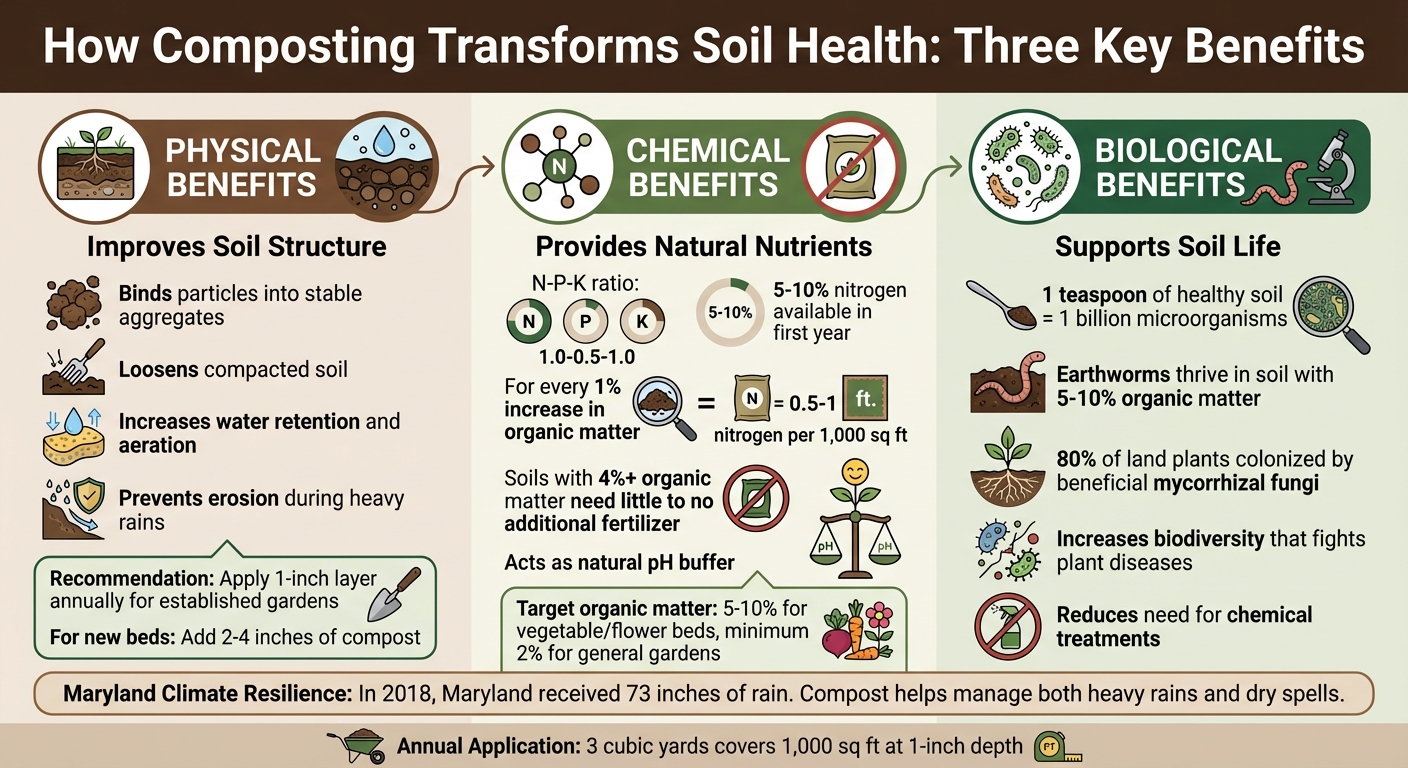
How Compost Improves Soil: Physical, Chemical, and Biological Benefits
Composting for Soil Health
sbb-itb-843f8be
How Composting Improves Soil Structure
Compost works wonders for soil structure by binding particles into stable clusters, creating a loose, crumbly texture that makes planting easier. These clusters allow roots to penetrate the soil more effectively, improving oxygen flow and water access [4].
For most garden and landscape plants, soil organic matter should be at least 2%. Vegetable and flower beds thrive best with organic matter levels between 5% and 10% [2]. If you’re working with heavy clay or thin topsoil in a new bed, adding 2 to 4 inches of compost can make an immediate difference. For established gardens, applying 1 inch of compost annually helps replenish organic matter lost through natural decomposition [2].
These changes address common challenges like compaction, water management, and aeration.
Loosening Compacted Soil
Compacted soil is a plant’s worst enemy, as it blocks root growth and limits oxygen. Compost helps break up dense clay, creating air pockets that roots can navigate. It also supports the activity of earthworms and microbes, which further loosen the soil. Just a teaspoon of healthy soil contains a bustling microbial community [2]. Their movement contributes significantly to breaking up compacted layers [1][2][3].
For mature trees and shrubs, you can improve soil structure without disturbing their roots. Remove existing mulch, spread a 1-inch layer of compost over the root zone, and then replace the mulch [2]. This simple annual process helps roots grow deeper, boosting plant health and establishment.
Better Water Absorption and Storage
Compost transforms how soil interacts with water. It improves infiltration, allowing rain to soak in rather than running off, and enhances the soil’s ability to retain moisture during dry periods [4]. This not only strengthens drought tolerance but also reduces erosion risks [4].
Improved Air Circulation in Soil
Roots need oxygen just as much as they need water and nutrients. Compost creates a porous soil structure, allowing air to flow freely through the ground [2]. This improved aeration benefits mycorrhizal fungi, which extend plant root systems and enhance nutrient and water uptake [2]. Better aeration supports these fungi and contributes to stronger, more resilient plants.
In July 2024, a University of Maryland study led by Jennifer Morash highlighted the impact of compost on disturbed soil. By increasing organic matter by 2% using composted yard waste, the study showed significant improvements in turfgrass growth and nutrient retention compared to other amendments like mulched wood waste. Supported by the Maryland Department of Transportation State Highway Administration, this research demonstrated how even small increases in organic matter can dramatically enhance soil structure and plant performance [5].
How Composting Increases Soil Nutrients
Composting works wonders for soil by gradually enriching its nutrient profile. Unlike synthetic fertilizers, which provide a quick nutrient boost, compost takes a slower, more natural approach. Through a process called mineralization, bacteria and fungi break down complex organic materials into simpler forms that plants can easily absorb. This steady release ensures nutrients are available when plants need them, while also reducing the risk of nutrient runoff [1][5].
Providing Nutrients Over Time
One of compost’s key strengths is its ability to release nutrients gradually. For instance, organic compost typically has an N-P-K ratio of about 1.0-0.5-1.0. In the first year, only 5%–10% of its nitrogen becomes available, while potassium is released more immediately, and phosphorus becomes accessible over time [2]. Additionally, for every 1% increase in soil organic matter, about 0.5–1 pound of nitrogen is supplied per 1,000 square feet [4]. This consistent nutrient release supports steady plant growth, avoiding the boom-and-bust cycles often caused by chemical fertilizers.
Plant roots also play an active role, exuding sugars that encourage microbes to recycle nutrients. Meanwhile, the curing phase of composting, which can last months to a year, stabilizes the compost for long-term soil health [1][4].
Balancing Soil pH Levels
Soil pH is crucial for nutrient availability. When pH levels are too high or low, nutrients can become "locked" in the soil, making them inaccessible to plants [4][2]. Compost acts as a natural buffer for soil pH. For example, mushroom compost, which contains lime, can raise pH levels, while pine bark fines can lower them [2]. Conducting a professional soil test can help determine your soil’s pH and organic matter levels, guiding you in choosing the right compost or amendments [4]. This balancing effect is especially important in regions like Maryland, where weather extremes can impact soil health. Compost’s ability to stabilize pH further reduces the need for synthetic fertilizers.
Reducing the Need for Chemical Fertilizers
Soils with more than 4% organic matter often require little to no additional fertilizer [4]. Jon Traunfeld, an Extension Specialist at the University of Maryland Extension, explains, "Increasing a soil’s organic matter content in flower, fruit, and vegetable beds will reduce the need for supplemental fertilizers" [4]. This reduction not only lowers production costs but also helps cut carbon emissions [4]. By applying a 1-inch layer of compost annually to flower and vegetable beds, you can maintain healthy plant growth while building long-term soil fertility [2][4].
How Composting Supports Soil Organisms
Composting is a natural process where microbes break down organic waste into nutrient-packed humus [1]. This process does more than just nourish plants – it creates a vibrant ecosystem by supporting soil life and boosting microbial diversity. When you add compost to your Maryland garden, you’re essentially laying the groundwork for healthier soil and stronger plants.
Nourishing Microbial Life and Earthworms
Compost acts as both food and shelter for countless soil organisms. Just one teaspoon of healthy compost can contain up to 1 billion microorganisms [2]. Each plays a specific role: bacteria handle fresh organic matter, fungi tackle tougher, woody materials, and actinomycetes produce that classic earthy smell of healthy soil. Earthworms, which thrive in soil with 5% to 10% organic matter [2], burrow through the ground, improving aeration and water flow while leaving behind nutrient-rich castings.
To keep this underground community thriving, try adding a 1-inch layer of compost to your garden beds every year [4]. Avoid heavy tilling – it disrupts the "soil food web" and destroys the habitats that microbes and earthworms rely on. Instead, opt for no-till methods. Spread compost as a top layer and let it naturally work its way into the soil. Planting cover crops year-round can also help by releasing root sugars that sustain beneficial microbes [4].
But compost does more than just feed soil organisms – it also builds a diverse microbial community, which plays a major role in fighting plant diseases.
Increasing Soil Biodiversity and Fighting Plant Diseases
A healthy, diverse soil ecosystem can naturally reduce the risk of plant diseases. For example, beneficial fungi called mycorrhizae are naturally found in Maryland soils. These fungi form partnerships with plant roots, extending their reach to access water and nutrients while also protecting against harmful pathogens [2]. In fact, about 80% of all land plants are colonized by these fungi [2].
"Increasing plant diversity aboveground will increase microbial activity and biodiversity underground as well as increasing carbon storage." – Jon Traunfeld, Extension Specialist, University of Maryland Extension [4]
This underground biodiversity thrives in Maryland’s varied climates, creating competition among soil organisms. This competition helps suppress disease-causing pathogens, reducing the need for chemicals. To maintain these favorable conditions, focus on keeping the soil pH balanced, minimizing disturbance, and regularly adding organic matter like compost [4].
Using Compost in Maryland Landscapes
Maryland’s climate comes with its own set of challenges when it comes to maintaining healthy landscapes. For instance, in 2018, the state experienced an average of 73 inches of rain[4]. This kind of weather can lead to severe erosion, while periodic dry spells put additional stress on the land. These conditions highlight the need for compost, which can improve both moisture management and soil stability, making it a valuable tool for combating Maryland’s unpredictable climate.
Preventing Erosion and Managing Dry Spells
Compost plays a key role in keeping soil where it belongs. By binding soil particles into stable aggregates[4][1], it helps prevent topsoil from washing away during heavy rains. If you have sloped areas or spots prone to runoff, mixing 2 to 4 inches of compost into new planting beds can help anchor the soil[2].
But compost isn’t just about erosion control – it also enhances how soil handles water. Adding organic matter improves both water infiltration and retention[4][2]. For established trees and shrubs, the process is simple: remove the mulch, spread a 1-inch layer of compost over the root zone, and then replace the mulch[2].
Using Compost in Gardens and Lawns
Compost isn’t just for erosion and water management; it also works wonders for gardens and lawns by enriching soil fertility and structure. For flower and vegetable beds, applying a 1-inch layer of compost annually can keep them thriving[4][2]. If you’re covering 1,000 square feet to this depth, you’ll need about 3 cubic yards of compost[2]. In areas with Maryland’s dense clay soils, new beds benefit greatly from incorporating 2 to 4 inches of compost before planting[2].
Lawns also see significant benefits from compost topdressing, especially when aiming to boost the soil’s organic matter to 5%–10%[2]. A widely available option in Maryland is LeafGro®, a commercial compost made from recycled yard waste and food scraps[2]. For no-till gardening, you can smother weeds with cardboard or newspaper, then cover them with a mix of soil and compost. This approach not only builds fertility from the surface down but also preserves the soil’s natural structure as plant roots grow through the decomposing organic matter[4].
Research and Local Resources
Recent studies have provided strong evidence supporting compost’s role in improving soil health, particularly in Maryland. The University of Maryland Extension has been at the forefront of this research, emphasizing the importance of soil organic matter in enhancing soil structure and biological activity. This applies to both clay-heavy and sandy soils, making compost a versatile tool for soil improvement [2].
University of Maryland Extension Research
In July 2024, Jennifer Morash, a postdoctoral associate in the Department of Environmental Science and Technology, published a study in Science of the Total Environment examining how recycled organic materials affect Maryland’s landscapes. The study tested the impact of increasing organic matter by 2% in disturbed soil samples using various recycled products. The results were telling: composted yard waste promoted better grass growth, maintained healthy nutrient levels, and reduced environmental runoff. On the other hand, biosolids caused excessive nutrient leaching, while mulched wood waste made nutrients less accessible to plants [5].
"In order to have an effective strategy to manage organic waste, and put organic materials back into natural systems, you have to think about how to market and use the products that are made from recycled organic goods without creating unintended consequences." – Jennifer Morash, Postdoctoral Associate [5]
Further research from the Extension highlights the benefits of maintaining organic matter levels above 4%, which can significantly cut down on the need for synthetic fertilizers. For home gardeners in Maryland, the recommended organic matter content for vegetable and flower beds is between 5% and 10%. Homeowners can access detailed composting guides and personalized advice through the University of Maryland Extension’s "Ask Extension" service [2].
Maryland Department of Environment Reports

State-level reports also emphasize the value of compost in soil management. Maryland has taken a leading role in organic waste management, passing legislation around 2014 to encourage organic recycling. This effort has delivered long-term benefits in reducing landfill waste and promoting soil health [5].
The Maryland Department of Transportation has also explored the use of recycled organic materials for managing disturbed soils along highways and other state lands. These projects have provided valuable data on compost’s effectiveness, reinforcing its role in sustainable soil management.
"As other states begin to set policies to meet the national strategies, they’re going to be looking to Maryland to see what we’ve been doing." – Jennifer Morash, Postdoctoral Associate [5]
Local recycling programs across Maryland contribute to this effort by producing and selling compost for residential use. A well-known example is LeafGro®, a commercial compost made from recycled yard waste and food scraps, which is widely available throughout the state. These programs not only improve soil health but also help divert organic waste from landfills, supporting broader environmental goals [2].
Conclusion
Composting transforms Maryland soil in three powerful ways. Physically, it strengthens soil structure by binding sandy particles and improving clay, forming stable aggregates that resist erosion during heavy rains while enhancing water infiltration and storage. Chemically, it acts as a slow-release nutrient source. For every 1% increase in soil organic matter, around 0.5 to 1 pound of nitrogen becomes available per 1,000 square feet, cutting down on the need for synthetic fertilizers [4]. Biologically, compost supports a rich soil ecosystem – just a teaspoon of healthy soil contains billions of microorganisms that help plants grow stronger roots and fend off diseases [2].
These benefits make composting a practical step for Maryland homeowners and landscapers aiming to boost climate resilience. As Jon Traunfeld, Extension Specialist at the University of Maryland Extension, explains:
"Many experts believe that improving soil health is the most important thing we can do to make our farms and gardens more climate-resilient" [4].
Applying compost annually helps maintain organic matter, making soil more resistant to both drought and flooding.
The advantages don’t stop at individual properties. Composting also has broader environmental benefits. It diverts organic waste away from landfills, reducing methane emissions, and contributes to Maryland’s circular bioeconomy. With resources like LeafGro® and municipal compost programs, sourcing quality compost is convenient and helps minimize transportation-related emissions [2].
Whether you’re creating new garden beds, maintaining a lawn, or addressing erosion-prone areas, compost lays the groundwork for healthier outdoor spaces. Start with a soil test to measure your current organic matter levels, then commit to regular compost applications. Not only will your soil thrive, but the Chesapeake Bay watershed will also gain from your efforts.
For tailored advice on incorporating sustainable practices into your landscape, reach out to Pro Landscapes MD.
FAQs
How do I know if my compost is finished and safe to use?
Your compost is ready to use when it looks dark, has a crumbly texture, and gives off a rich, earthy smell. It should feel cool or just slightly warm to the touch and have a consistent appearance without any noticeable food scraps or yard waste. A lack of unpleasant odors is another good sign – it means the compost is free of harmful pathogens and unwanted seeds, making it ideal for your garden or landscaping needs.
Can compost cause weed seeds or plant diseases in my garden?
If compost doesn’t get hot enough during the process, it can hold onto weed seeds or even plant diseases. To prevent this, it’s important to follow proper composting techniques. Keeping the pile at the right temperature and ensuring good aeration are key steps. A well-managed composting process reduces these risks and results in a safer, healthier material for your garden.
What’s the best way to add compost without tilling or harming roots?
Using compost as a top dressing is a highly effective approach. Simply spread an even layer, about 1–3 inches thick, over the soil surrounding your plants. Be sure to leave a few inches of space around stems or trunks to prevent rot. Once applied, water the area thoroughly to help the compost settle and blend into the soil naturally. This technique not only boosts soil health but also safeguards existing roots without causing any disturbance.
Chat with Us