









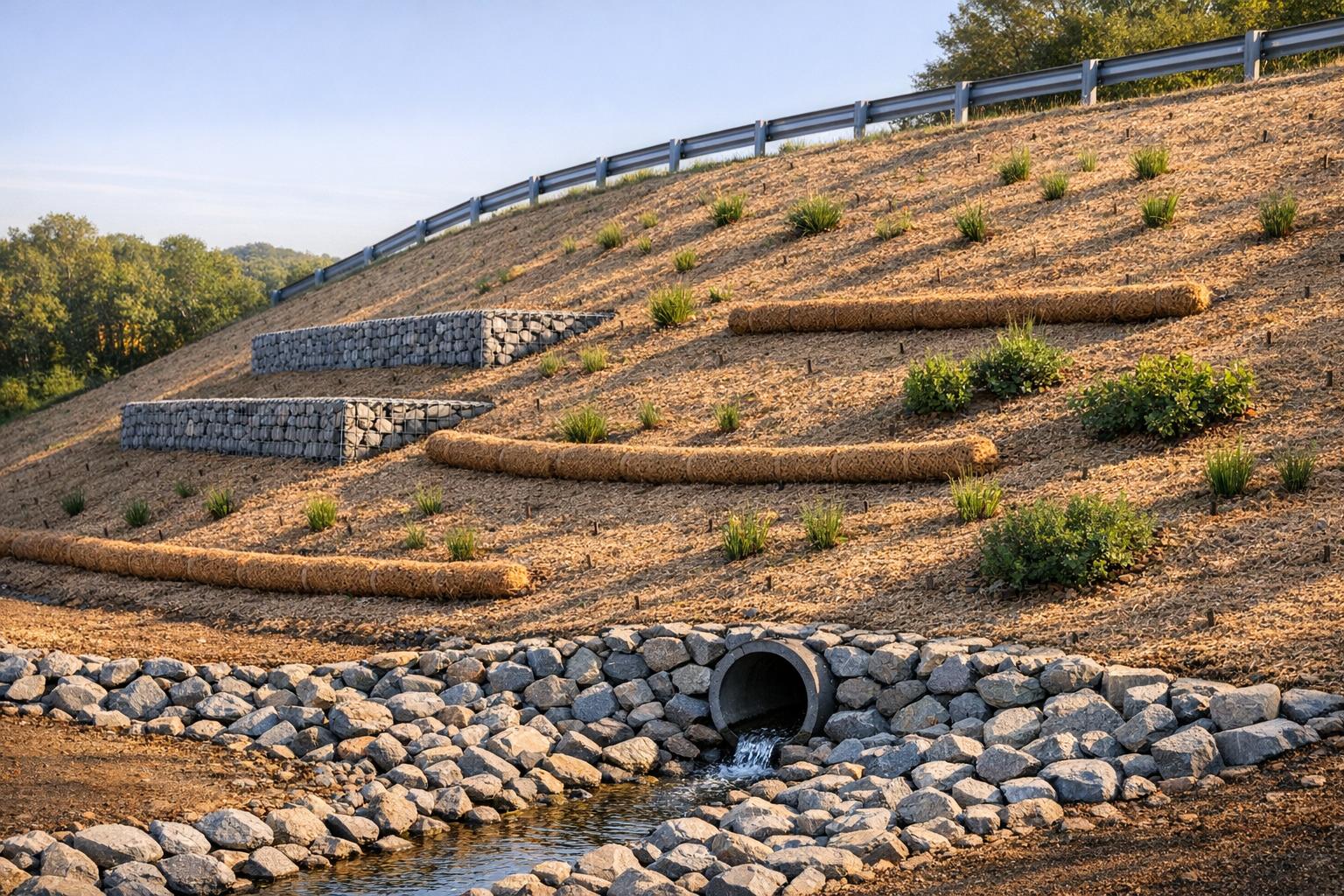
- bhavya gada
- No Comments
Steep embankments are prone to soil erosion, especially in areas with heavy rainfall, snowmelt, or storms. This can lead to property damage, unstable foundations, and poor water drainage. The good news? There are effective ways to manage erosion using plants, physical structures, and water management systems.
Key solutions include:
- Plant-Based Methods: Use deep-rooted native plants (e.g., Switchgrass, Little Bluestem) or hydroseeding for quick vegetation growth.
- Physical Structures: Install retaining walls, terracing, or gabions to stabilize slopes and control runoff.
- Water Management: Incorporate systems like French drains, berms, or silt fences to redirect water and reduce sediment flow.
These strategies help protect your property and prevent erosion from causing long-term damage. Keep reading for practical tips and insights tailored to steep slopes.
Stop Hillside Erosion WITHOUT a Retaining Wall (Step-by-Step)
sbb-itb-843f8be
Plant-Based Erosion Control Methods
Using vegetation to combat erosion is an effective and natural solution. Plants create root networks that stabilize soil, and unlike structural methods that can deteriorate over time, these systems actually improve as they mature. According to the University of Maryland Extension, tree roots in shaded forest areas often provide strong soil support, meaning you don’t need to cover every inch to combat erosion [5]. However, sunny slopes lack this natural root network, so denser plantings are necessary. Techniques like hydroseeding and planting native species are particularly useful in these scenarios, often as part of a broader landscape design and restoration plan.
Hydroseeding for Fast Vegetation Establishment
Hydroseeding is a go-to method for quickly establishing vegetation, especially on steep embankments. This process involves spraying a mixture of seeds, mulch, fertilizer, and a tackifier onto bare soil using specialized hydraulic equipment. It’s most effective on slopes with a gradient of 2:1 or flatter and works best for areas larger than 0.5 acres [7]. The tackifier helps bind the mulch to the soil, reducing the risk of washout during heavy rains.
Wood fiber mulch is a better option than cellulose mulch (made from recycled paper) for steep slopes because its longer fibers interlock, offering more stability [8]. For extremely steep areas, advanced products like Bonded Fiber Matrix (BFM) include synthetic fibers and binders that form strong mechanical bonds instantly, without waiting for curing. Application rates depend on the slope’s steepness – 2,000 pounds per acre is sufficient for most 3:1 slopes, while steeper, longer embankments may require up to 3,000 pounds per acre [8].
Before hydroseeding, it’s important to prepare the slope. Techniques like "directional tracking" (driving tracked vehicles up and down the slope) or grooving the surface can slow water runoff and improve seed penetration [8]. Experts Jim Uthe and James Devig from Dallas County emphasize that:
"an important factor that can get overlooked when dealing with sheet erosion is the additional overland flow that may be coming from the roadway. This can really affect hydroseeded areas, and increased rates of hydromulch may be needed" [8].
It’s worth noting that hydroseeding primarily addresses the surface layer and may need additional measures for deeper soil stability [7].
Native Plants for Long-Term Slope Stability
Native plants are a powerful tool for erosion control, especially since their root systems are deeper and more effective than turf grass. Deep-rooted grasses like Switchgrass and Little Bluestem, along with spreading shrubs like Fragrant Sumac ‘Gro-Low,’ create strong, interlocking root networks that anchor soil effectively [5][6]. For shaded areas, species such as Wild Hydrangea (Hydrangea arborescens) and Christmas Fern (Polystichum acrostichoides) thrive naturally on steep terrain, offering reliable, year-round soil protection [5].
Rhizomatous plants are particularly effective because they form dense mats that resist erosion. Species like White Wood Aster and Woodland Sunflower require little maintenance once established and are excellent for creating quick ground cover [5]. In wetter conditions, Willow (Salix) cuttings are ideal for bioengineering projects like live staking. To improve their survival rates, soak the cuttings in cold water for at least 24 hours before planting; a survival rate of 75% to 80% is considered highly successful [4].
While deer can be a problem for Maryland property owners, slopes offer a natural advantage since deer tend to avoid these areas to prevent injury. This allows vulnerable species like Eastern Columbine and Wreath Goldenrod to establish without interference [9]. When planting on slopes with existing trees, use small potted plants (plugs or quarts) to minimize disturbance to the root systems [5]. Before planting, it’s crucial to eliminate persistent weeds like Canada Thistle using systemic herbicides, as these weeds are nearly impossible to remove once they mix with desirable plants [6]. For mulching, opt for shredded cedar or arborist wood chips instead of pine bark nuggets. These materials naturally "knit" together as they decompose, helping them stay in place on slopes [6].
Physical Structures for Erosion Control
When dealing with areas where immediate stabilization is crucial, physical structures often become the go-to solution. These engineered systems are especially useful for steep slopes where plants alone can’t do the job. They help manage water flow and keep soil in place, making them essential for erosion prevention.
Retaining Walls and Terracing
Retaining walls are designed to hold back soil on unstable slopes, protecting both the land and nearby structures [1]. But the wall itself isn’t the only factor in its success – proper drainage is just as critical. Adding a French drain uphill, complete with perforated PVC pipe, gravel, and filter fabric, can help redirect water and reduce pressure buildup behind the wall [1].
Terracing, on the other hand, reshapes a sloping hillside into a series of flat steps, which slows water runoff and reduces erosion [1][2]. Each step typically includes a small berm, about 6 to 12 inches high, at its edge to further slow down water flow. These flat areas not only make it easier to grow plants but also transform steep, unusable land into functional spaces.
If retaining walls or terracing aren’t practical, other systems like gabions and geocells can provide effective alternatives that integrate structural support with natural aesthetics.
Riprap, Gabions, and Geocells
Riprap, which consists of layers of angular rock, offers instant protection against fast-moving water [1]. These rocks absorb the energy of flowing water and prevent soil from washing away. However, as FEMA points out, riprap can sometimes increase water velocity downstream, leading to additional erosion [1]. To avoid this, always install a woven geotextile fabric beneath the riprap. This fabric prevents soil from washing through the rocks and should have a tensile strength of 150 lbs, 200 lbs, or 315 lbs, depending on the slope’s steepness [12]. Overlap the fabric edges by at least 12 inches and secure them with staples to keep it in place.
For a more adaptable and eco-friendly option, gabions and geocells are worth considering. Gabions are wire cages filled with rocks, while geocells are grid-like structures that look like a honeycomb. These systems allow water to pass through, reducing the pressure buildup that solid barriers can face. Landscape expert Kristin Guy explains their appeal:
"Unlike solid concrete walls, these semi permeable hardscapes add beauty and ecological value to your landscape" [11].
Gabions and geocells are particularly useful for steep slopes, especially those steeper than 2:1, where regular maintenance like mowing isn’t feasible [1]. For added versatility, geocells can be filled with soil and planted with vegetation, creating a solution that combines immediate erosion control with the long-term benefits of plant roots.
Sediment Control and Water Management Techniques
Sediment control and water management are crucial components in stabilizing slopes, complementing both vegetation and structural measures. Together, they create a comprehensive approach to erosion control by slowing water runoff, capturing displaced soil, and redirecting water away from vulnerable areas before it can cause significant damage.
Silt Fencing and Sediment Barriers
Silt fences act as temporary barriers designed to trap sediment while allowing water to flow through at a slower pace [14]. During a single storm, a construction site can lose enormous amounts of soil, making these barriers essential for protecting both the property and nearby waterways [14].
To ensure proper installation, posts should be driven at least 16 inches into the ground and spaced no more than 6.5 feet apart [14]. The geotextile fabric must be trenched into the soil to stop water from flowing underneath, and it should be secured to hardwood stakes using wide staples instead of zip ties [14]. On slopes, adding "J-hooks" perpendicular to the main fence helps prevent water from bypassing the barrier [14].
For longer slopes, biodegradable options like contour wattles or straw wattles are effective at slowing water flow and trapping sediment. Landscape expert Kristin Guy from Sunset Magazine highlights their benefits:
"Laying contour logs or straw wattles across a slope is an excellent way to interrupt water flow. These barriers slow down rainwater, giving it time to soak into the soil and deposit sediment" [11].
When placing wattles on cut or fill slopes, always start at the bottom and work your way up the slope [4]. Secure them firmly to prevent movement during heavy rainfall [11]. To further stabilize slopes, pair these sediment barriers with efficient drainage systems.
Drainage Systems and Stormwater Management
Managing water effectively is key to preventing erosion. Broad, shallow swales covered with grass or groundcover guide water to safe outlets while reducing its speed [11]. Unlike deep channels that can erode the landscape, swales follow natural contours, allowing water to flow predictably.
French drains are another option, designed to intercept and redirect subsurface water to prevent soil saturation [15]. For effective gravity-fed drainage, the discharge lines should have a slope of at least 1%, with 2% being ideal [10]. Around building foundations, ensure a 5- to 6-inch drop over the first 10 feet to keep rainwater and snowmelt from pooling near the structure [13].
Berms – raised ridges about 3 feet wide and 6 to 12 inches high – help intercept surface water and direct it to vegetated areas. To maintain their function, cover berms with sod, plantings, or erosion control fabric [10]. For concentrated water flows, such as from driveways or steep slopes, channel drains with grates are effective at capturing runoff and reducing scouring at the base.
Consider this: a 1,000-square-foot roof can produce approximately 623 gallons of water during just one inch of rain [10]. Directing this water into discharge lines or catch basins prevents barriers from being overwhelmed and minimizes localized erosion. After heavy storms, inspect these systems for sediment buildup, bulging in retaining walls, or early signs of erosion to address problems before they escalate.
Research Findings and Method Comparisons
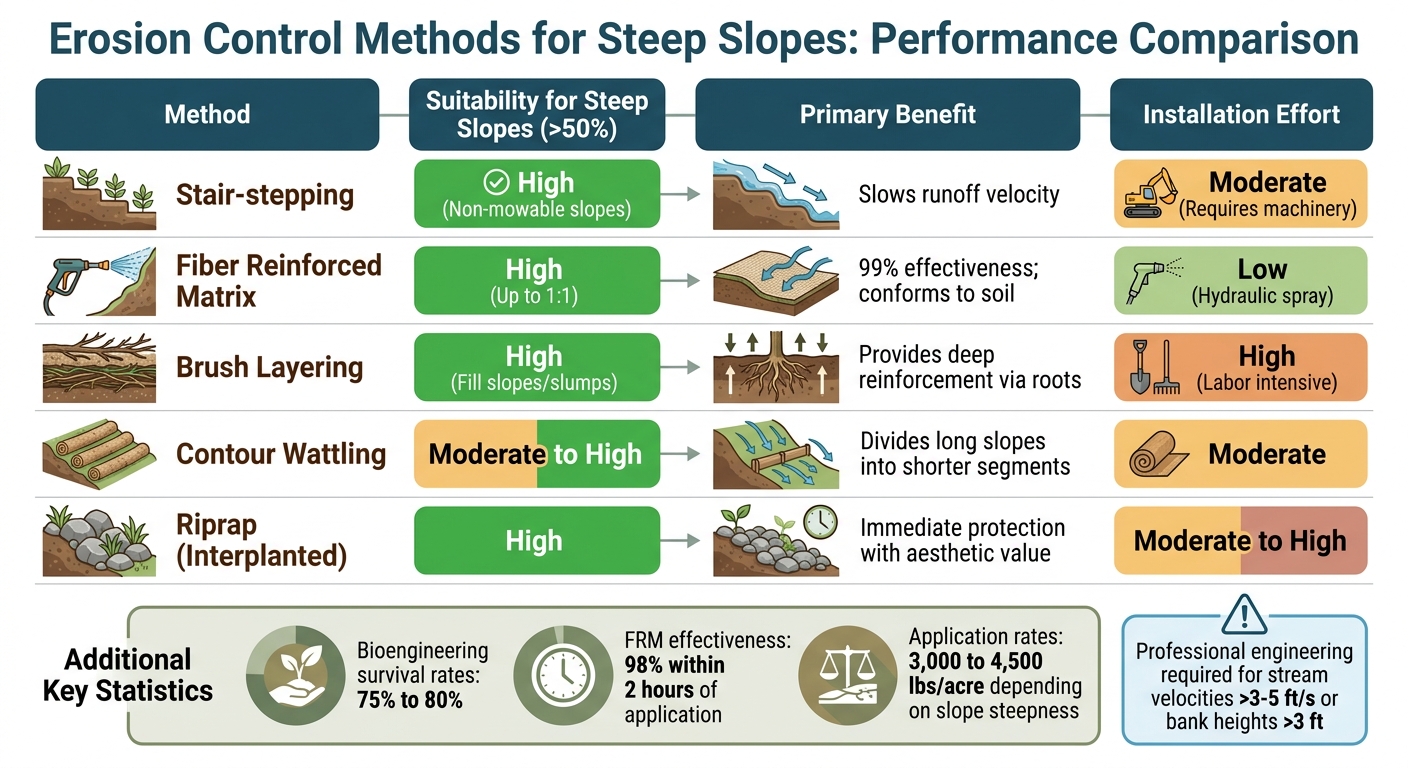
Erosion Control Methods Comparison for Steep Slopes
Case Studies in Erosion Control
Bioengineering, which blends live plants with structural reinforcements, has been a go-to solution for stabilizing slopes and roads for decades [4]. This method is not only more affordable and easier to maintain than traditional options like riprap or concrete, but it also gains strength over time as plant root systems grow and stabilize the soil [4]. Thomas G. Franti, an Extension Surface Water Management Specialist, highlights the teamwork required for success in this field:
"Bioengineering is a diverse and multidisciplinary field, requiring the knowledge of engineers, botanists, horticulturalists, hydrologists, soil scientists, and construction contractors" [4].
With survival rates of 75% to 80%, bioengineering has proven its effectiveness [4]. However, wildlife such as deer, waterfowl, and muskrats can cause significant damage, especially during the early stages. Protective fencing is crucial to safeguard these projects during the establishment phase [4]. For Maryland properties, using native plants suited to local conditions is key. Since some wetland or native species may need custom propagation, it’s a good idea to consult local nurseries 12 to 18 months in advance [4].
Fiber Reinforced Matrix (FRM) is another standout option, especially for steep slopes where grass struggles to grow. FRM delivers 99% effectiveness, even bonding to rough seedbeds. Application rates range from 3,000 to 4,500 lbs/acre depending on slope steepness, and it achieves 98% effectiveness within just two hours of application [2]. Unlike erosion control blankets, which require smooth surfaces, FRM adapts to uneven terrain and retains moisture by bonding directly to the soil [2]. These findings underscore the importance of selecting methods tailored to specific site conditions, as previously discussed.
Comparing Erosion Control Methods
Based on the case studies, the table below compares the performance of various erosion control methods on slopes steeper than 50%. Each technique offers unique advantages and challenges:
| Method | Suitability for Steep Slopes (>50%) | Primary Benefit | Installation Effort |
|---|---|---|---|
| Stair-stepping | High (Non-mowable slopes) | Slows runoff velocity | Moderate (Requires machinery) |
| Fiber Reinforced Matrix | High (Up to 1:1) | 99% effectiveness; conforms to soil | Low (Hydraulic spray) |
| Brush Layering | High (Fill slopes/slumps) | Provides deep reinforcement via roots | High (Labor intensive) |
| Contour Wattling | Moderate to High | Divides long slopes into shorter segments | Moderate |
| Riprap (Interplanted) | High | Immediate protection with aesthetic value | Moderate to High |
For areas with extreme conditions, such as stream velocities exceeding 3 to 5 feet per second or bank heights greater than 3 feet, professional engineering expertise is essential. These scenarios often demand advanced solutions that go beyond standard bioengineering practices [4]. Additionally, always consult state and federal regulatory agencies before making any modifications to slopes near wetlands or shorelines in Maryland, as permits are required [4].
Conclusion and Recommendations
Custom Solutions for Maryland Properties
Maryland’s diverse landscapes – from coastal plains to steep inland slopes – require tailored erosion control approaches instead of generic fixes. For instance, slopes steeper than 25% (a 1:4 ratio) often benefit from vegetative plantings, while those exceeding 50% (a 1:2 ratio) might need low-maintenance plants to minimize frequent mowing demands [1]. To determine your slope, use tools like a laser level or clinometer, and test soil drainage with a shovel or auger to identify clay-heavy areas that may require improved drainage [3].
For situations involving stream velocities over 3–5 ft/s, bank heights above 3 ft, or slopes close to foundations, it’s wise to consult professionals [4]. Pro Landscapes MD offers specialized services in drainage systems – such as French drains, grading, land leveling, and stormwater management – serving central Maryland areas like Ellicott City, Columbia, Gaithersburg, and Bethesda. Their expertise in retaining walls, terracing, and native plantings ensures erosion control solutions that align with local conditions. Before making any changes near wetlands or shorelines, remember to check with state and federal agencies, as permits are often required [4]. These customized strategies aim to provide practical and lasting erosion control.
Key Takeaways
Research-backed methods can deliver affordable and effective solutions for managing erosion on Maryland slopes. Bioengineering techniques – including contour wattling, brush layering, and coir fascines – offer long-term, self-sustaining protection as plant root systems establish themselves, with survival rates of 75% to 80% considered highly effective [4]. These methods are often more economical and easier to maintain compared to traditional options like riprap or concrete.
Retaining walls and terracing are excellent for dividing steep slopes, which helps slow water flow and reduce erosion risks. When building retaining walls, use materials like free-draining gravel backfill, perforated drain pipes, and filter fabric to manage hydrostatic pressure effectively [15]. Proper grading is also critical – ensure at least a 5% slope (about 6 inches over 10 feet) away from foundations to prevent water pooling and potential structural damage [3]. To put it into perspective, a single inch of rain on a 2,000-square-foot roof can generate around 1,250 gallons of runoff, highlighting the importance of directing water safely [3].
Regular upkeep is vital for ensuring long-term performance. Inspections after storms, particularly during the first rainy season, can help identify problems like standing water, erosion rills, or clogged drainage outlets [3]. Protecting new plantings with fencing can also safeguard them from deer and other wildlife during their critical early growth stages [4]. By combining well-planned vegetation, structural solutions, and efficient drainage, Maryland property owners can build resilience against heavy rains and seasonal freeze-thaw cycles.
FAQs
How do I figure out how steep my slope is?
To determine the slope, start by measuring the elevation change (rise) and the horizontal distance (run). Then, calculate the slope percentage by dividing the rise by the run and multiplying the result by 100. If you prefer, you can express the slope as a ratio (e.g., 1:2) or calculate the angle using the arctangent of the rise divided by the run. Tools such as a tape measure, level, or protractor can help make these measurements more accurate.
When should I use plants vs a retaining wall or riprap?
Plants work wonderfully for stabilizing soil over time on hillslopes, streambanks, or lakeshores, particularly in places where the structural risk is minimal. They help control runoff while also fostering natural habitats. However, for steep embankments or areas at high risk – where soil movement or wave action is a major concern – retaining walls or riprap provide the immediate, strong stabilization needed. Think of plants as a natural, long-term solution, while walls and riprap are better suited for urgent, heavy-duty structural demands.
What drainage fixes stop runoff from eroding a steep hill?
To tackle runoff erosion on steep hills, effective drainage solutions include grading, surface roughening, and structural drainage systems. Grading helps redirect the flow of water, slowing it down to minimize erosion. Surface roughening works by enhancing water infiltration and capturing sediment, making it harder for soil to wash away. Structural options, such as French drains, channels, or retaining walls, provide a controlled way to guide water safely away from the slope. Using a combination of these methods can safeguard the soil and keep the hillside stable.
Chat with Us