









- bhavya gada
- No Comments
Thinking of adding a fire pit or outdoor fireplace in Maryland? Here’s what you need to know:
- Permits depend on size and type: Small recreational fire pits (e.g., under 1 cubic yard in Anne Arundel County) often don’t need permits, but larger features or open burns do.
- Follow safety rules: Keep fire features at least 20 feet from structures, clear the area of debris, and avoid burning on poor air quality days.
- Local variations matter: Permit rules differ by county. For example, Montgomery County exempts portable fire pits from permits but enforces strict air quality and safety standards.
- Prepare documents: You may need a site sketch, property details, and manufacturer guidelines.
- Fines for violations: Penalties range from $500 to $750 for breaking air quality or safety laws.
Start by contacting your local permitting office (e.g., Montgomery County’s DPS or DEP) to confirm specific requirements. Following these steps ensures safety, compliance, and peace of mind for your fire feature project.
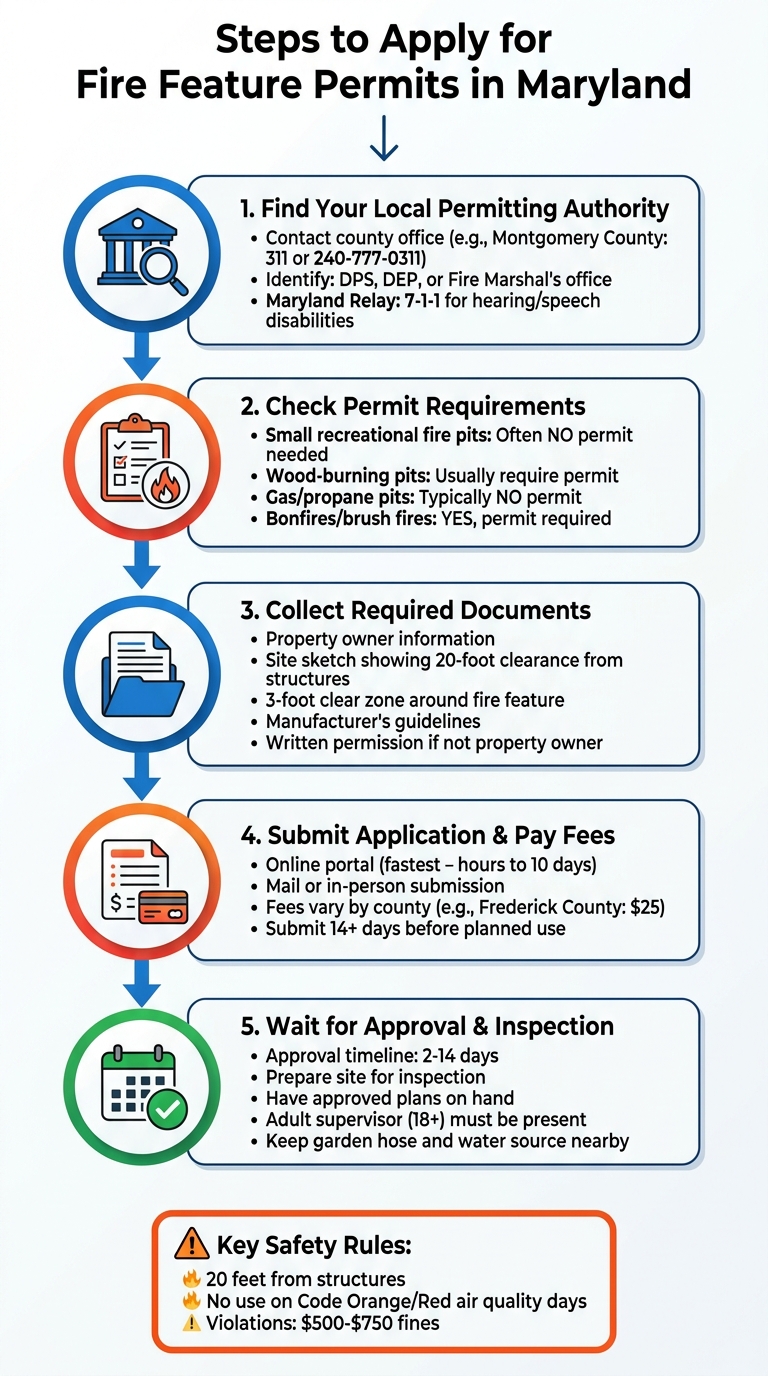
5-Step Process for Applying for Fire Feature Permits in Maryland
Find Your Local Permitting Authority
Locate Your County or City Office
The first step in getting a fire feature permit is finding the right local office. Permit procedures can vary widely depending on your county or city, so reaching out to the correct department will save you time and hassle. For example, in Montgomery County, both the Department of Permitting Services (DPS) and the Department of Environmental Protection (DEP) oversee fire-related regulations [2][3]. In other areas, the Fire Marshal’s office might handle these requests.
If you’re unsure where to start, try calling your county’s main information line. Montgomery County residents can dial 311 (or 240-777-0311 if you’re outside the county) to get connected to the right department [3]. If you have hearing or speech disabilities, you can use Maryland Relay (7-1-1) for access to county offices.
Once you’ve identified the right office, make sure to check the specific permit requirements for your area.
Check for Local Differences in Requirements
Permit rules aren’t one-size-fits-all – they can change depending on where you live. For instance, in Montgomery County, homeowners with one- and two-family homes don’t need a permit from the Fire Marshal or DEP to use portable fire pits, fire bowls, or chimineas. However, these devices must be kept at least 20 feet away from any building or structure to meet local safety regulations [2].
Another key point is understanding the difference between "recreational fires" and "open burning." Recreational fires – like using a fire pit or residential fireplace – are often exempt from air quality laws that require permits for open burning [3]. Even if a permit isn’t required, it’s important to follow the manufacturer’s guidelines and avoid using these devices on poor air quality days [2]. For complete clarity, contact your local Fire Marshal’s office to confirm the safety rules that apply to your fire feature.
Being aware of these local variations will make the permit process much smoother.
sbb-itb-843f8be
Check Permit Requirements and Restrictions
Determine If Your Fire Feature Needs a Permit
Once you’ve done some research on local permitting rules, it’s time to dig deeper into the specific requirements for your fire feature. Whether or not you need a permit often depends on the type of fuel your fire feature uses, which can save you from unnecessary fines or delays.
For example, gas and propane fire pits usually don’t require permits because their flames are controlled and produce very little smoke [4]. However, wood-burning fire pits are often categorized as "open burning" under Maryland regulations, meaning they typically require a permit [4].
In Montgomery County, if you own a one- or two-family residence, you may have fewer hoops to jump through. According to the Montgomery County Department of Permitting Services:
A permit from the Fire Marshal or the Department of Environmental Protection is not required
for residential fire pits, fire bowls, and chimineas [2]. That said, bonfires, brush fires, and agricultural burning almost always need approval from either your Fire Marshal or the Department of Environmental Protection (DEP) [4][3].
Here’s a quick breakdown of fire features and their permit requirements in Montgomery County:
| Feature Type | Permit Required (Montgomery Co.) | Primary Restrictions |
|---|---|---|
| Residential Fire Pit / Bowl | No | 20 feet from structures; 3-foot clear zone [2] |
| Chiminea | No | 20 feet from structures; No use on balconies/decks [2] |
| Gas / Propane Fire Pit | No | Must follow manufacturer guidelines [4][2] |
| Open Burning (Brush/Debris) | Yes | Requires Fire Marshal or DEP approval [4][3] |
| Bonfires | Yes | Classified as regulated open burning [4] |
Once you’ve confirmed whether you need a permit, make sure to review local safety and environmental guidelines to ensure proper setup and usage.
Review Rules for Your Location
Strict safety and environmental rules apply when using fire features. One key rule is distance: your fire feature must be at least 20 feet away from any building or structure, and there should be a 3-foot clear zone around the area, free of mulch, leaves, or anything else that could catch fire [2].
Air quality regulations can also limit when you can use your fire feature. For instance, you can’t operate it on Code Orange or Code Red air quality days [2]. Maryland law additionally prohibits smoke from crossing property lines. If it does, you could face civil penalties – $500 for a first offense and $750 for repeat violations [3]. As the Montgomery County Department of Environmental Protection explains:
The law… prohibits air pollution from crossing property lines or leaseholds
[3].
Fuel restrictions are another critical factor. Stick to aged, dried wood – never use treated wood, construction materials, or trash [2]. Safety equipment is also a must: keep a garden hose attached to a constant water source nearby, and ensure an adult (18 or older) is present to supervise the fire at all times [2]. When you’re done, wait at least 24 hours before disposing of ashes in a metal container specifically designed for this purpose [2].
Collect Required Documents and Information
Gather Property and Owner Information
Start by gathering key details about the property and owner. Use your tax bill or online records to find the property address and owner contact information. You’ll also need to provide your full name, phone number, and email address.
If you’re not the property owner, make sure to get written permission from the landowner. This step is critical to avoid delays or potential disqualification [2]. Additionally, designate at least one responsible adult – aged 18 or older – to oversee the fire feature during its use [2].
Once you have these basics covered, move on to creating a detailed site sketch that clearly shows the placement and clearances for your fire feature.
Create Site Sketches and Additional Documents
An accurate site sketch is a must. This simple drawing should map out the location of your fire feature in relation to your home and any nearby structures. Use measurements to ensure accuracy and confirm that the fire pit is at least 20 feet away from any building or structure [2]. Also, mark a 3-foot diameter clear area around the fire feature, free of combustible materials like mulch, leaves, or overhanging branches [2].
The sketch doesn’t need to be professionally done, but it should be neat and easy to understand. Be sure to label key elements such as your home, garage, shed, fences, and hardscaping and landscaping features. If you’re planning a specific type of burn, like a leaf fire, you’ll need to show a much larger buffer zone of 300 feet from any dwellings or businesses [1]. Also, note the type of surface where the fire feature will be placed – balconies or decks are generally not allowed [2].
In addition to your site sketch, keep a copy of the manufacturer’s guidelines for your fire feature. Montgomery County requires that fire pits, fire bowls, and chimineas be used according to these instructions, so store them safely for future reference [2]. For larger burns in Anne Arundel County – those involving more than 1 cubic yard of material – you’ll need to submit an open burning application to the Housing and Food Protection Services Program. This application must be filed at least 14 days before the event at 3 Harry S. Truman Parkway in Annapolis [1].
Fill Out and Submit Your Application
Complete the Application Form
Once your documents are ready, the next step is to fill out the appropriate application form. The type of form you’ll need depends on your planned fire feature. For larger burns or woodland activities, you’ll require the open-air burning permit. For fixed installations, you’ll need to submit Fire & Life Safety Review applications, and if the burn area exceeds 1 acre, make sure to include a formal burn plan [5][7].
Your application must include essential details like property information, contact details, and the name of an adult (18 or older) who will supervise the fire feature [2]. Be sure to attach the manufacturer’s guidelines as part of your submission [2]. Double-check all the information for accuracy and completeness – missing or incorrect details are a common cause of delays. A thorough review before submission can save you time and hassle.
Once you’ve filled out the form, it’s time to choose how you’ll submit it and take care of the required fees.
Choose a Submission Method and Pay Fees
There are several ways to submit your application. The quickest option is to use online portals. For example, Frederick County processes applications within two business days, and you’ll typically receive your permit via email just hours after payment is completed [8]. The Maryland Forest Service also offers online submissions through Maryland OneStop, with approvals taking about 10 days. Better yet, there’s no fee for this service [7].
If online submission isn’t for you, traditional methods are still available. You can mail your application along with a check or drop it off in person. Some counties, like Queen Anne’s County, require physical copies of applications [6]. Payments can be made during standard business hours.
Fees depend on your location. For instance, Frederick County charges $25.00 for an open burning permit as of September 1, 2025 [8]. Meanwhile, Montgomery County doesn’t require permits (or fees) for residential fire pits, fire bowls, or chimineas at single-family or two-family homes [2]. If this is your first time applying, it’s a good idea to call your local office to confirm property eligibility before submitting forms or payments [8].
Wait for Approval and Schedule Inspections
Know the Approval Timeline
Once you’ve submitted your application, the waiting game begins. In Annapolis, the review process for fire-related permits usually takes up to two weeks [9]. For an open burning license in Anne Arundel County, plan for at least 14 days before your event [1]. If you’re in Montgomery County, commercial fire code compliance permits are handled through the ePlans portal, so processing times can vary [10].
After the review, you’ll be notified by phone or email [9]. Double-check that your contact details are up to date to avoid any unnecessary delays.
When your permit is approved, it’s time to shift gears and get the site ready for inspection.
Prepare for and Pass Inspections
To pass your inspection, make sure the work is finished, the site is accessible, and all safety measures are in place [9]. Have your approved plans on hand because inspectors will want to review them [9].
It’s important to either be present or assign someone responsible to represent you during the inspection. Failing to do so in Annapolis could result in an automatic failure and a $150 re-inspection fee [9].
Additionally, ensure your fire feature meets all clearance and safety standards [2]. Keep a garden hose connected to a constant water source nearby, and have the manufacturer’s guidelines ready for reference [2]. In Montgomery County, ignoring fire code requirements after receiving a violation notice can lead to a $500 civil citation if not resolved within 30 days [10].
Conclusion
Taking the time to follow each step – from reaching out to your local authority to completing final inspections – ensures your fire feature is both safe and compliant. Applying for fire feature permits in Maryland requires careful attention to detail, but doing so helps you avoid hefty penalties and reduces the risk of hazards like accidental fires.
Pete Piringer, spokesperson for Montgomery County Fire and Rescue Service, highlights the importance of staying compliant: "Please make sure you’re doing it safely & following guidelines from the manufacturer and the Department of Permitting Services, as well as fire safety best practice" [2]. His advice underscores the importance of adhering to every step of the process.
By following these procedures, you not only ensure safety but also maintain positive relationships within your community by avoiding complaints that could lead to enforcement actions. Regulations also play a role in public health by restricting fire feature use on Code Orange or Code Red Air Quality days [2].
Once your application is approved and inspections are complete, you can enjoy your fire feature with peace of mind. Keep a checklist handy to ensure you’ve covered all bases – follow manufacturer guidelines, maintain proper clearances, keep a water source nearby, and let ashes cool for at least 24 hours before disposal [2].
FAQs
Does my fire pit need a permit where I live?
In Montgomery County, Maryland, you usually don’t need a permit for small outdoor fire pits meant for recreational use – as long as they follow the county’s safety distance rules and regulations. However, local guidelines can vary, so it’s always a good idea to double-check to make sure you’re in compliance.
What documents should I have ready to apply?
To apply for a fire feature permit, make sure you have the following documents ready:
- Completed permit application form: This should be specific to your jurisdiction, such as a Fire Protection System Permit Application or a general building permit application.
- Supporting documents: Include plans, drawings, hydraulic calculations, manufacturer specifications, and design reports if they’re required.
- Property details: Provide information about the project location and the property owner.
Having these prepared in advance can make the application process much smoother.
What happens if smoke or safety rules are violated?
Violating smoke or safety rules in Montgomery County, MD, can lead to fines of up to $500 per day. Beyond the financial penalties, breaking these rules can pose safety risks and increase the chance of fires. The county enforces these regulations strictly to prevent open burning and promote the safe use of fire features.
Chat with Us