









- bhavya gada
- No Comments
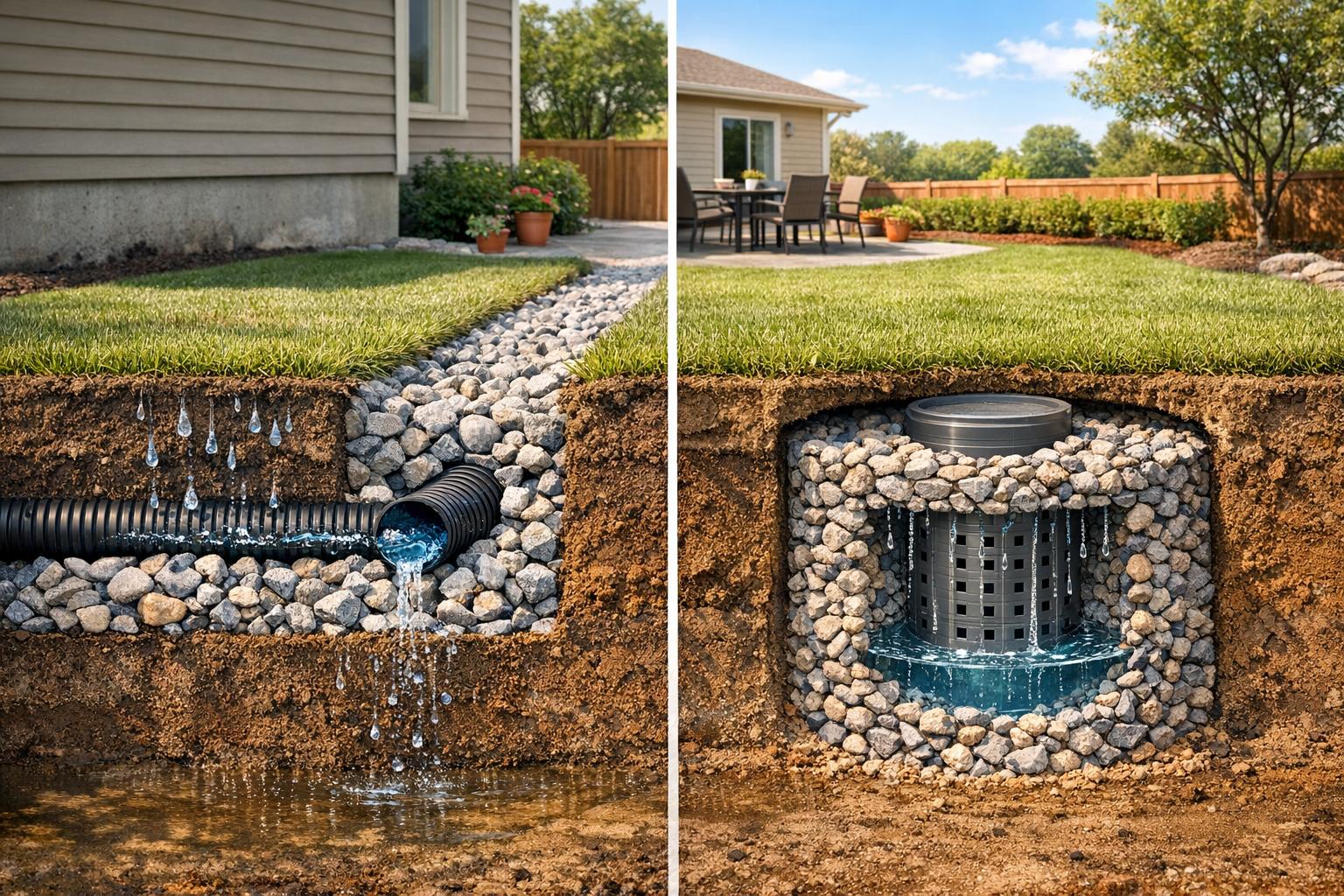
When managing water issues on your property, French drains and dry wells are two effective options, but they serve different purposes. French drains redirect water horizontally using perforated pipes in a gravel trench, ideal for sloped areas or foundation protection. Dry wells store water vertically in an underground chamber, allowing it to gradually seep into the soil, making them better for flat terrains or managing stormwater runoff.
Key considerations include:
- Cost: French drains average $6,000; dry wells are more affordable at $3,000.
- Lifespan: French drains last 10–15 years, while dry wells can last up to 30 years.
- Soil Type: French drains work in most soils but struggle with heavy clay; dry wells require sandy or loamy soil.
- Maintenance: Both require regular upkeep to prevent clogs.
Quick Comparison
| Feature | French Drain | Dry Well |
|---|---|---|
| Function | Redirects water away | Stores and infiltrates water |
| Design | Horizontal trench | Vertical pit or tank |
| Best for | Sloped areas, foundations | Flat areas, stormwater runoff |
| Average Cost | $6,000 | $3,000 |
| Lifespan | 10–15 years | Up to 30 years |
| Soil Compatibility | Most soils, except clay | Sandy or loamy soil |
Choosing the right system depends on your property’s layout, soil, and water issues. In some cases, combining both systems can offer the most effective solution.
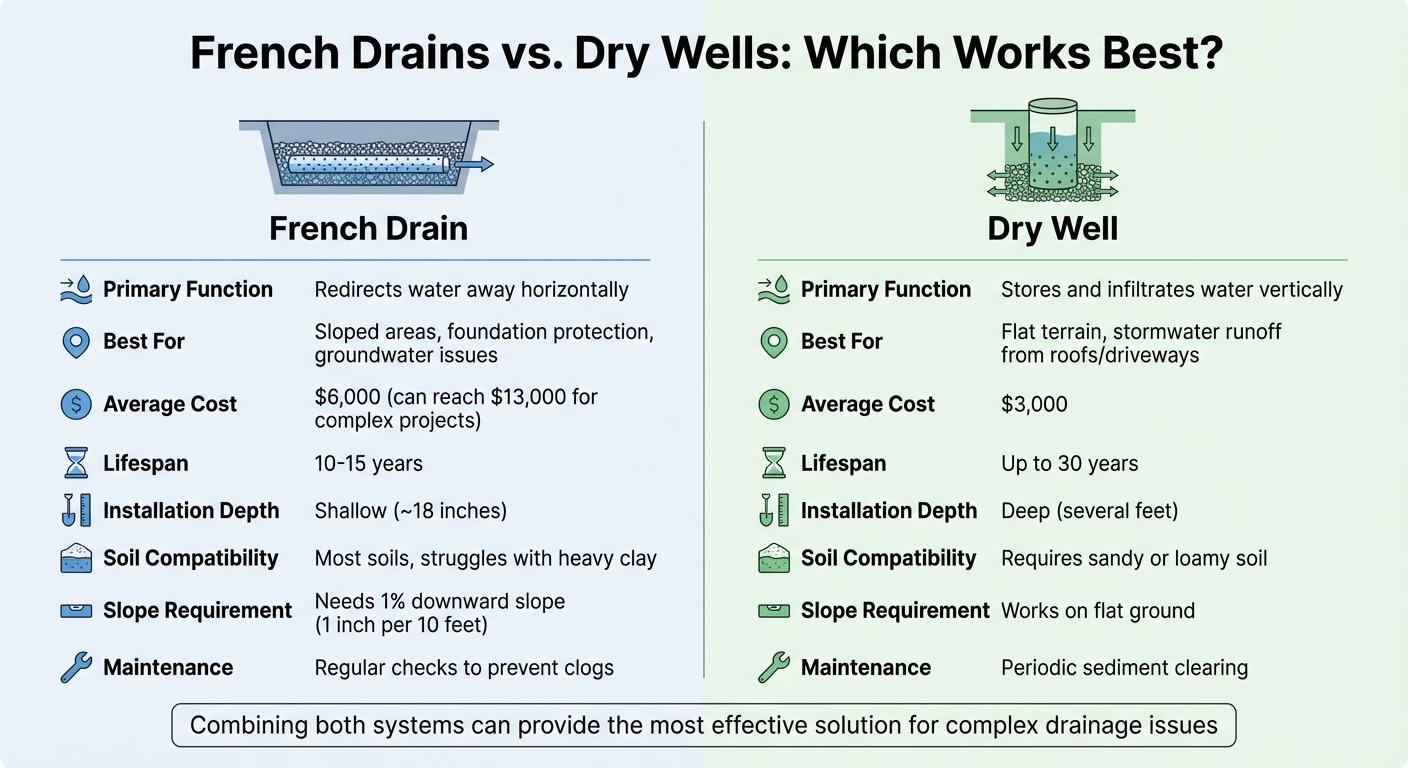
French Drains vs Dry Wells: Cost, Lifespan, and Performance Comparison
Why a French Drain is Better Than a Dry Well
What is a French Drain?
A French drain is a type of underground drainage system designed to redirect water away from your property using gravity. It consists of a sloped trench, typically 12 inches wide and 18 to 24 inches deep [1]. The trench is filled with coarse gravel and contains a perforated pipe – commonly called a "weeping tile" – which is lined with filter fabric to prevent clogs. The pipe can be made from rigid PVC with pre-drilled holes or flexible corrugated tubing with slits. To keep the system running smoothly, a 4- to 6-ounce non-woven geotextile fabric is placed in the trench to block silt, dirt, and roots from clogging the pipe. The gravel, which should be at least 3/4 inch in size, helps filter water and allows it to flow more easily than it would through soil. Contractors often recommend durable materials like granite or river gravel and advise against using limestone or pea gravel, as these can break down or impede water flow over time.
How French Drains Work
Water naturally moves along the path of least resistance, and this is exactly how a French drain operates. As water seeps through the gravel, it enters the perforated pipe. To ensure efficient drainage, the pipe is installed with the holes facing downward to capture water from below.
Once inside the pipe, gravity does the rest, guiding the water to a safe discharge point. This could be a storm drain, a dry well, or a lower area on your property. For the system to work effectively, the trench must have a downward slope of at least 1%, which means a drop of 1 inch for every 10 feet of length [4]. Some contractors suggest a steeper slope of 1 inch per 8 feet for even better water flow.
Now, let’s explore the situations where French drains are most beneficial.
Common Uses for French Drains
French drains are a reliable way to protect your home’s foundation from hydrostatic pressure, which can lead to structural damage and cracks [1]. They are often installed around the perimeter of homes to intercept groundwater before it can reach the foundation walls.
For basement waterproofing, interior French drains are placed along the edges of basement floors. These systems collect water that seeps inside and direct it to a sump pump for removal. Professional installation of interior French drains typically costs between $10,000 and $20,000 [4].
In residential yards, French drains are an effective solution for eliminating standing water, which can cause problems like root rot, fungal growth, and mosquito breeding. They work particularly well on sloped properties, where gravity helps move water to lower areas. Additionally, they can manage runoff from overflowing gutters or higher-ground areas, preventing water from pooling near your home.
What is a Dry Well?
A dry well is a simple underground system designed to manage stormwater by collecting it and gradually releasing it into the surrounding soil. It typically consists of either a gravel-filled pit or a specially made container with perforations to allow water to disperse into the ground. Unlike French drains, which move water horizontally along a slope, a dry well acts as a temporary holding area, allowing water to slowly seep into the soil below [2].
The basic setup includes an excavated pit lined with a perforated container, which is connected to gutters or downspouts via pipes. Surrounding the container is a layer of loose gravel that aids in drainage [3]. On average, installing a dry well costs around $3,000 [2], making it a more budget-friendly option compared to many French drain systems. However, it’s important to note that the system relies on highly permeable soil – like sandy soil – for proper drainage. In areas with heavy clay soil, a dry well may not perform as intended [2]. When maintained correctly, these systems can last up to 30 years, providing a reliable and cost-effective solution for managing excess water.
Let’s dive into how dry wells actually work to handle water efficiently.
How Dry Wells Work
Stormwater is funneled into the dry well through connected downspouts or drainage pipes. Once inside the perforated container, the water slowly seeps into the surrounding soil, eventually filtering deeper into the ground. This process helps prevent yard flooding and contributes to groundwater replenishment [2] [3].
"Dry wells are often used when you tend to have excessive water in the yard. If you notice water standing after rainfall or snow melts, a dry well can help soak up the water and drain it out of your yard to much deeper levels of the substrate soil." – Drycrete Waterproofing [3]
Unlike systems that rely on gravity to move water along a slope, dry wells depend on the soil’s ability to absorb water, making them especially useful in flat areas. Before installation, it’s crucial to have the soil tested for permeability by a professional to ensure the system will work effectively [2] [3].
Understanding how dry wells function sheds light on their effectiveness in specific scenarios.
Common Uses for Dry Wells
Dry wells are particularly effective at managing large amounts of stormwater from hard surfaces like roofs and driveways [2]. They are often connected to downspouts to handle runoff during heavy rain or snowmelt, making them an excellent choice for flat terrains. By reducing the amount of water flowing into municipal and local sewer systems, they help ease the strain on public infrastructure.
Additionally, dry wells are great for eliminating standing water in low-lying areas where natural drainage is poor. They can also serve as the endpoint for a French drain system, acting as the final destination for collected water [1]. To ensure proper function, dry wells should be installed away from building foundations – typically in the corners of a yard – and maintained regularly to avoid clogs [2].
Key Differences Between French Drains and Dry Wells
Let’s dive into what sets French drains and dry wells apart in terms of design, function, and performance. While both systems aim to manage excess water, they do so in very different ways. Picture a French drain as a water highway, channeling water horizontally to a discharge point like a storm drain or pond. On the other hand, a dry well acts more like a reservoir, storing water vertically in an underground chamber and letting it seep slowly into the surrounding soil.
Design and Installation Differences
French drains are relatively shallow systems, typically involving a trench about 12 inches wide and 18 inches deep. These trenches are lined with gravel and include a perforated pipe wrapped in filter fabric to keep debris out. The key to their success? A consistent downward slope that allows gravity to do the heavy lifting, directing water away from problem areas [1].
Dry wells, in contrast, require deeper excavation to reach soil that can absorb water effectively. These systems are often constructed as gravel-filled pits or use prefabricated containers with drainage openings. Because they store water vertically, dry wells are ideal for flat areas where creating a slope for drainage would be a challenge [2]. These structural differences make each system better suited to specific conditions.
Performance Factors
The type of soil in your yard plays a massive role in how well each system performs. French drains work well in most soils but can struggle in heavy clay, which slows water flow. Still, they’re great for quickly redirecting water from areas prone to pooling [2]. Dry wells, however, absolutely need sandy or loamy soils to function properly since their effectiveness depends on the ground’s ability to absorb water.
Maintenance is another important consideration. French drains require regular upkeep to prevent clogs in the pipe or gravel, while dry wells need periodic sediment removal to maintain capacity. With proper care, French drains can last 10–15 years, whereas dry wells can remain effective for up to 30 years [2].
Comparison Table: French Drains vs. Dry Wells
| Feature | French Drain | Dry Well |
|---|---|---|
| Primary Function | Redirects water away from problem areas | Stores water and allows gradual infiltration |
| Structure | Horizontal trench with a perforated pipe | Vertical pit or prefabricated tank |
| Installation Depth | Shallow (~18 inches) | Deep (several feet) |
| Slope Requirement | Requires a downward slope | Works in flat areas |
| Best Soil Type | Works in most soils; less effective in clay | Needs sandy or loamy soils |
| Water Source | Groundwater and surface water | Stormwater runoff (e.g., roofs, driveways) |
| Average Cost | Around $6,000 (up to $13,000 for complex projects) | Around $3,000 |
| Lifespan | 10–15 years | Up to 30 years |
| Maintenance | Regular checks to prevent clogs | Periodic sediment clearing |
Pros and Cons of French Drains
Advantages of French Drains
French drains are a practical solution for protecting your home’s foundation by redirecting water and reducing hydrostatic pressure, which can lead to cracks and basement flooding [1][5][4]. They also help prevent soil erosion and eliminate standing water, which often attracts mosquitoes and other pests [1][2].
One of their standout features is their versatility. French drains can be installed around a home’s perimeter, on slopes, or even indoors, depending on your needs [1][2]. They are capable of managing heavy water flow when equipped with larger pipe diameters, and since they are buried underground, they remain out of sight [5][2].
"When compared to other permanent solutions like sump pumps or a retaining wall, French drains are more affordable and less invasive."
– MD Sewer and Plumbing [1]
By addressing water damage, erosion, and mold risks, French drains can enhance your home’s long-term value and make it more appealing to potential buyers [1]. As mentioned earlier, effective water management is crucial for maintaining your home’s structural integrity. Professional exterior installation typically costs between $25 and $40 per linear foot, offering a cost-efficient, permanent solution [5][4][2].
Still, these advantages come with a few challenges.
Disadvantages of French Drains
Despite their effectiveness, French drains do have their downsides. They tend to be more expensive than dry wells and require a consistent downward slope of at least 1% to function properly, which can limit their use in flat areas [2][5][4]. Additionally, a specific discharge point – such as a storm drain, pond, or lake – is necessary, and local regulations may restrict where you can route the water [1][3][5].
Regular upkeep is essential to keep the system working efficiently. Annual cleaning with tools like a pressure washer or sewer snake is recommended to prevent clogs [4]. However, their average lifespan of 10 to 15 years falls short compared to dry wells, which can last up to 30 years [2].
"If you notice water pooling in the area again, it may indicate that the pipe or gravel is clogged and requires professional cleaning."
– MD Sewer and Plumbing [1]
sbb-itb-843f8be
Pros and Cons of Dry Wells
Advantages of Dry Wells
Dry wells, much like French drains, offer a practical solution for managing excess water around your property. One of their standout features is affordability. At an average cost of about $3,000, they provide a budget-friendly option for handling runoff from roofs and driveways. With proper care, they can last up to 30 years, making them a durable choice for homeowners [2].
Another plus? They’re completely out of sight. Since dry wells are installed underground, they don’t interfere with your landscaping or curb appeal [2]. Unlike French drains, which require a steady slope to function, dry wells work just as well on flat ground [2]. They also eliminate the need for an external discharge point by dispersing water directly into the soil, making them a self-contained and efficient system [3].
"Dry wells… have a more direct environmental benefit by promoting groundwater recharge and reducing the burden on local sewer systems."
– Michaelangelo’s [2]
While these benefits are impressive, they do come with certain trade-offs.
Disadvantages of Dry Wells
Dry wells aren’t without their challenges. Their performance hinges on soil conditions, as they work best in sandy or loamy soils. Clay-heavy soil, on the other hand, can significantly reduce their effectiveness [2][6]. This makes soil testing crucial before installation to ensure the system can handle the expected water load.
Heavy rainstorms can also push dry wells to their limits. When runoff exceeds the system’s capacity, it can lead to surface flooding [2]. Regular upkeep is another necessity. Sediment, leaves, and other debris can clog the system, so keeping gutters, downspouts, and the dry well itself clear is key to maintaining proper drainage. Lastly, placement matters – installing the system too close to your home’s foundation could lead to soil saturation, which can cause structural issues over time [2].
Cost Comparison: French Drains vs. Dry Wells
When deciding on the best drainage solution for your Maryland property, understanding the costs involved is crucial. On average, French drains tend to be more expensive than dry wells, primarily because they require more extensive excavation during installation.
Here’s a closer look at the costs for each system in Maryland.
French Drain Costs
French drains are known for their effectiveness, but that comes with a higher installation price due to the labor-intensive digging process. In Maryland, the cost for installing French drains in 2026 is expected to range between $20 and $60 per linear foot. For example, a 50-foot French drain could cost anywhere from $1,000 to $3,000. Total project costs typically average around $6,000, but for more complex installations – like those involving steep slopes or challenging soil conditions – costs can climb as high as $13,000 [2].
Dry Well Costs
Dry wells, on the other hand, are generally more budget-friendly. Each unit costs between $300 and $1,200. For properties requiring a three-unit system to handle significant stormwater runoff, the units alone could range from $900 to $3,600, with labor costs on top of that. A full dry well installation typically totals around $3,000 [2].
"French drains are definitely the more expensive option as they require extensive excavation and labor."
– Michaelangelo’s [2]
Before starting any drainage project, it’s a good idea to check with your local Maryland building department. Some drainage systems may require permits, which could add to your overall expenses [2].
Choosing the Right Solution for Your Property
Deciding between French drains and dry wells comes down to factors like your property’s soil type, slope, and water flow patterns. As discussed earlier, soil composition and terrain play a major role in how well these systems perform.
Here’s a closer look at when to opt for each system and how they can complement each other.
When to Choose French Drains
French drains are ideal for tackling groundwater issues and safeguarding your home’s foundation. If your property has clay-heavy soil, a French drain works by channeling water away rather than trying to absorb it. These systems are particularly effective on sloped properties, as they use gravity to direct water downhill.
"French drains take the cake [for groundwater issues]. They redirect water away from the problem area fast." – Michaelangelo’s [2]
Consider French drains if your property deals with high water tables, basement moisture problems, or persistent standing water in your yard. They are designed to efficiently move water away from your foundation and typically function best with a natural downward slope. On average, French drains last between 10 and 15 years [2].
When to Choose Dry Wells
Dry wells are excellent for managing large amounts of stormwater runoff from roofs, driveways, and gutters. They’re particularly useful on flat properties where creating a sloped trench for drainage isn’t feasible. These systems shine in sandy or gravelly soil, where water can gradually seep into the ground.
Dry wells are a cost-effective option with low maintenance needs and can last up to 30 years [2]. Plus, they provide the added benefit of replenishing groundwater rather than directing runoff into municipal drainage systems.
Combining French Drains and Dry Wells
For properties with more complex drainage challenges, combining French drains and dry wells can offer a well-rounded solution. In this setup, a French drain collects surface water near your foundation or waterlogged areas in your yard and channels it to a dry well. The dry well then disperses the water deep into the ground, avoiding the need for an external discharge point.
"Using a combination of a french drain and a dry well can be an effective solution for properties with complex drainage issues. This approach can help manage both surface water and stormwater runoff, preventing flooding and water damage on all fronts." – Michaelangelo’s [2]
Before starting any installation, check local building codes to ensure compliance. This combined method can provide a tailored and efficient drainage solution for your Maryland property.
Pro Landscapes MD: Expert Drainage Solutions in Maryland

Pro Landscapes MD specializes in tackling the unique drainage challenges faced by homeowners across central Maryland. By combining the benefits of French drains and dry wells, they provide effective solutions tailored to the region’s specific needs.
Their process begins with a thorough evaluation of your property’s drainage issues. For properties with clay-heavy soils, they design systems that divert groundwater away from foundations to prevent water damage. In areas with sandy or gravelly soils, where water drains more easily, they install dry wells – underground structures that collect and gradually release stormwater from roofs and driveways.
The company offers a variety of services, including interior French drain systems to manage basement or crawl space seepage and exterior systems to redirect surface runoff away from your home’s foundation. Additional services include drainage repair, grading, land leveling, and yard repair to resolve water-related problems.
Pro Landscapes MD takes a comprehensive approach, addressing every stage of the process – from identifying the problem to routine maintenance. Their team evaluates factors like soil type, property slope, water table levels, and water volume to recommend the best solution for your property, whether it’s a French drain, a dry well, or a combination of both. This proactive approach helps prevent serious issues like foundation damage, basement flooding, soil erosion, and even pest infestations.
Serving communities such as Ellicott City, Columbia, Bethesda, and Silver Spring, Pro Landscapes MD ensures year-round protection through their tailored drainage solutions. From initial assessments to installation and ongoing maintenance, including inspections and debris removal, they provide reliable service designed to meet Maryland’s specific drainage needs.
Conclusion
Choosing between a French drain and a dry well comes down to factors like your property’s soil type, water source, slope, and the volume of water you need to manage. French drains are ideal for channeling groundwater and surface water away from your foundation, while dry wells are designed to handle substantial amounts of stormwater from areas like roofs and driveways. Both systems offer clear benefits depending on your specific needs and conditions[2].
Before deciding, take the time to assess your soil’s permeability and check local regulations regarding drainage installations. Refer back to the earlier discussion on soil suitability to help determine the best option for your property. In some situations, a combination of a French drain and a dry well can deliver the most effective solution for comprehensive drainage management[2].
Pro Landscapes MD specializes in creating tailored drainage solutions that address these challenges. Their team combines expert landscaping knowledge with customized designs to resolve your drainage issues while blending seamlessly with your outdoor space.
"Proper drainage is essential to maintaining the health and stability of your landscape."[7]
Avoid costly water damage by scheduling a site visit today. Pro Landscapes MD’s full-service approach includes evaluation, installation, and maintenance, ensuring your drainage system protects your property for years to come[7].
Whether you go with a French drain, a dry well, or a combination of both, expert advice is crucial to safeguarding your home and preserving its structural integrity.
FAQs
How do I choose between a French drain and a dry well for my drainage needs?
When deciding between a French drain and a dry well, it’s essential to weigh a few key factors:
- Soil type: If your soil is clay-heavy and drains slowly, a French drain is a solid choice. On the other hand, dry wells are more effective in sandy or loamy soils that naturally allow water to flow through easily.
- Water volume: French drains are designed to manage larger, continuous water flow, such as heavy rainfall or roof runoff. Dry wells, however, are better suited for handling moderate, occasional water flow.
- Space and installation: French drains require a trench and are ideal for placement along foundations or walls. Dry wells, by contrast, need a deeper pit and sufficient vertical space for proper installation.
Take into account your soil type, the volume of water you need to manage, the available space, and your budget to decide which system fits your property’s needs. Both options can help improve drainage and safeguard your landscape from potential water damage.
How does soil type impact the effectiveness of French drains and dry wells?
Soil type is a key factor in deciding whether a French drain or a dry well is the right choice for your yard. In Maryland, where clay-heavy soils are common, French drains tend to be the go-to solution. These systems use a combination of gravel and a perforated pipe to redirect water away from your property. By bypassing the dense, slow-draining clay, French drains help prevent problems like water pooling or basement leaks.
Dry wells, on the other hand, depend on the soil’s ability to absorb water. They work best in sandy or loamy soils, which naturally drain faster and allow water to soak into the ground efficiently. In areas with clay-rich soil, though, dry wells can struggle to keep up, often filling too quickly and overflowing during heavy rainstorms.
Given Maryland’s diverse landscape, Pro Landscapes MD takes a customized approach by assessing your soil type before making a recommendation. For areas with clay-heavy soils, French drains are often installed to manage water effectively. In sandy regions, dry wells may be the better option, as they take advantage of the soil’s natural drainage capabilities. This tailored strategy ensures proper water management and helps protect your home from potential water damage.
Can I use a French drain and a dry well together to improve drainage?
Yes, pairing a French drain with a dry well can be an excellent way to manage water drainage. The French drain gathers and redirects excess water, sending it to the dry well. From there, the dry well gradually disperses the water into the surrounding soil. This setup is especially effective in handling heavy rain or areas with poor drainage, offering solid protection for your yard and foundation against water-related issues.
Chat with Us