









- bhavya gada
- No Comments
Green roofs are an effective solution for managing stormwater in urban areas. By combining vegetation, engineered soil, and drainage layers, they absorb rainfall, reduce runoff, and alleviate pressure on drainage systems. Here’s what you need to know:
- Rainwater Retention: Green roofs can retain 60–100% of annual rainfall, reducing runoff and preventing flooding.
- Peak Flow Reduction: They slow water flow during storms, easing the strain on municipal sewers.
- Runoff Delay: Green roofs release water gradually, improving control over water flow.
- Pollutant Filtration: They filter out contaminants like heavy metals and particulates, improving water quality.
- Cost Savings: Green roofs help meet stormwater regulations, lower discharge fees, and qualify for tax credits.
These systems are especially useful in densely developed areas and can be installed on most buildings with sufficient structural capacity. While the upfront cost ranges from $8–$15 per square foot, the long-term savings and benefits make them a smart investment for property owners.
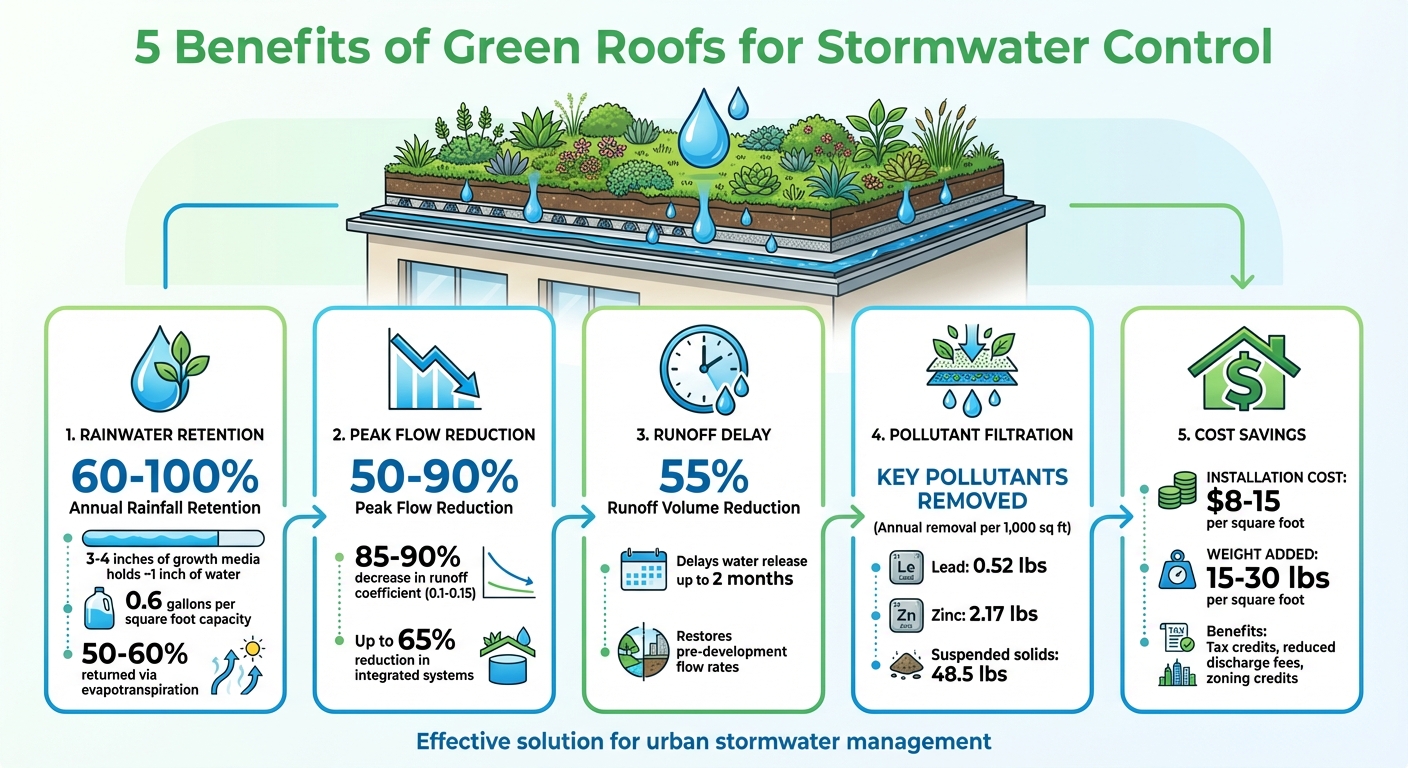
Green Roof Stormwater Management Statistics and Benefits
1. Absorbs and Retains Large Amounts of Rainwater
Rainwater Retention Capacity
Green roofs are like natural sponges for urban buildings, soaking up rainwater that might otherwise flood storm drains. For example, an extensive green roof with 3 to 4 inches of growth media can hold about 1 inch of water, which translates to approximately 0.6 gallons per square foot [8]. Over a year, these roofs can cut stormwater runoff by anywhere from 60% to 100% [9].
The ability of a green roof to retain water depends largely on the depth and makeup of its growth media. Most engineered soils are made up of 80-95% lightweight aggregate and 5-10% organic matter, with a porosity range of 40-65% [8]. Deeper media layers hold more water; for instance, a 3.5-inch media depth can reduce runoff by around 55%, with retention improving as the depth increases [8].
Green roofs also help by returning 50% to 60% of rainwater back into the atmosphere through evaporation and plant transpiration [8]. This process not only eases the load on municipal drainage systems but also contributes to a healthier local environment. A key metric here is Plant Available Water (PAW), which is calculated at 0.25 inches per inch of media depth [8]. Understanding PAW is essential for optimizing a green roof’s ability to handle peak water flows and reduce flooding risks.
"The green roof is essentially a living filter." – LiveRoof Global, LLC [9]
For property owners in Maryland thinking about installing a green roof, Pro Landscapes MD offers assessments to determine your building’s structural capacity and recommend suitable media depths. Most extensive green roof systems add only 15 to 30 pounds per square foot to a building’s weight [8], making them feasible for many structures without requiring significant reinforcement. This efficient rainwater retention not only helps prevent flooding but also lays the groundwork for better runoff management overall.
sbb-itb-843f8be
2. Reduces Peak Flows and Prevents Flooding
How Green Roofs Help Manage Stormwater
Green roofs do more than just retain rainwater – they also play a crucial role in reducing peak stormwater flows during heavy rain events.
When storms hit, one of the biggest challenges is the rapid surge of water flowing into storm drains. This sudden influx, known as peak flow, can overwhelm drainage systems and lead to flooding. Green roofs serve as a natural buffer, slowing down this process and reducing the strain on municipal sewers.
Unlike traditional roofs, which immediately channel rainwater into drains, green roofs are designed to absorb and hold water. Their layers of vegetation and specially engineered growing medium act like a sponge, soaking up rainwater and releasing it slowly over time [6]. This gradual release helps prevent the sharp spikes in water flow that can cause urban flooding. In cities with limited drainage capacity, this feature is especially critical.
"Living roofs act as a sponge to absorb much of this runoff and keep waterways cleaner." – LiveRoof [9]
Real-World Examples and Local Considerations
Toronto, Canada, provides a great example of how green roofs can address urban flooding. The city celebrated the 15th anniversary of its Green Roof Bylaw in late 2024, which incorporates a "Sponge City" approach to improve flood management and boost climate resilience [9]. This method is particularly effective in urban areas where space for traditional stormwater infrastructure is limited [6].
The effectiveness of green roofs in reducing peak flows depends on factors like local weather patterns, soil composition, and the roof’s slope [9]. For instance, in Kansas City, Missouri, a 2018 study by the US EPA analyzed how green roofs contribute to stormwater runoff reduction and the associated public health benefits [6]. This research offers valuable insights for urban planners and policymakers.
If you’re considering a green roof in Maryland, Pro Landscapes MD can evaluate whether your building can support the weight of a fully saturated green roof. They also provide advice on how local climate conditions might affect its performance [6]. Tailoring green roof designs to specific environments ensures maximum effectiveness in managing peak flows and preventing flooding.
Green Roofs for Stormwater Management: Learning the Basics & Benefits from Philadelphia Green Roofs
3. Delays Runoff and Improves Water Flow Control
Green roofs go beyond just retaining water and reducing peak flow – they also slow down runoff, which helps alleviate pressure on outdated stormwater systems.
How Green Roofs Delay Runoff
Green roofs don’t just absorb rainwater; they temporarily store it. Thanks to the combined efforts of the vegetation, substrate, and engineered drainage layers, these roofs hold water and release it gradually through evaporation and transpiration [1][4]. This process increases the "time of concentration", meaning the rainwater takes much longer to reach storm drains compared to traditional roofing. Instead of water pouring off the roof immediately during a storm, green roofs slow the release significantly. In some cases, like in Germany, water release from green roofs has been delayed by as much as two months [4].
A study by Penn State University highlighted the effectiveness of green roofs in managing runoff. A 3.5-inch extensive green roof in central Pennsylvania was shown to reduce runoff volume by 55%, even restoring peak flow rates to pre-development levels for storms ranging from 2-year to 100-year events [1]. This demonstrates how green roofs can play a key role in reducing the total volume of runoff during heavy rains.
Reducing Peak Stormwater Flow
By delaying runoff, green roofs also lower peak flow rates, easing the burden on stormwater systems. Gradual water release means less strain on pipes, drains, and treatment facilities. Research shows that green roofs can cut peak flow rates by 50–90% compared to conventional roofs [2]. In some cases, reductions of up to 65% have been observed when green roofs are part of larger stormwater management plans [7]. Findings from the University of Toronto’s GRIT Lab further support this, with civil engineer Jenny Hill reporting that green roofs can reduce the peak runoff coefficient to as low as 0.1–0.15 – an 85–90% decrease compared to impermeable surfaces [3].
4. Filters Pollutants and Captures First Flush
Pollutant Filtration Performance
Green roofs play a key role in cleaning stormwater by filtering out airborne pollutants like particulate matter, nitrogen oxides, sulfur dioxide, and carbon monoxide. This process happens through a combination of mechanisms, including adsorption, plant uptake, microbial degradation, and sedimentation [1][2][10].
Interestingly, the filtration performance of green roofs tends to reach its peak about five years after installation. To get the best results, experts recommend using 100% mineral substrates and stopping fertilization after the first 18 months. This strategy reduces nutrient leaching while improving the roof’s ability to remove pollutants from stormwater. Beyond just purifying water, this process also eases the burden on municipal water treatment systems.
Capturing the First Flush
The "first flush" refers to the early runoff in a storm, which typically carries the highest concentration of pollutants like heavy metals, nutrients, and dust [1][5][10]. Green roofs are particularly effective at capturing this initial surge, absorbing the early rainfall and allowing cleaner water to flow off afterward.
A great example of this comes from the green roof on Chicago’s City Hall, installed in 2000. Monitoring conducted by the U.S. Forest Service between 2001 and 2003 revealed that this green roof annually removed 0.52 lbs/1,000 sq ft of lead, 2.17 lbs/1,000 sq ft of zinc, and 48.5 lbs/1,000 sq ft of suspended solids [6]. By capturing these pollutants, green roofs not only reduce nonpoint source pollution but also ease the strain on municipal water treatment facilities [1][5].
5. Saves Money Through Local Incentives and Compliance
Cost Savings and Compliance Benefits
Beyond enhancing water management, green roofs come with notable financial perks. They provide property owners with a practical solution to meet stormwater regulations while cutting costs. Recognized as Stormwater Best Management Practices (BMPs) in resources like the Pennsylvania Stormwater Manual, green roofs help properties comply with runoff volume and peak discharge standards, leading to long-term savings [8].
Green roofs can lower municipal discharge fees and earn zoning credits, saving both time and money. As LiveRoof Global, LLC highlights:
"Green roofs typically qualify for credits for green space and onsite stormwater management in many municipal zoning ordinances; often equating to time and money savings in the zoning process or financial rewards from tax credits and other incentives and avoidance of stormwater discharge fees." [9]
In dense urban areas, where space for traditional stormwater systems is limited, green roofs provide a way to meet regulations without expanding beyond the building’s footprint [6].
While the upfront costs for extensive green roofs range from $8 to $15 per square foot, the savings from reduced energy use and longer roof lifespan help offset the initial expense [8]. Moreover, property owners may benefit from tax credits and other local incentives by adopting this eco-friendly infrastructure. Pro Landscapes MD, for instance, assists Maryland property owners in taking advantage of these incentives while ensuring effective stormwater management [9].
Conclusion
Green roofs are a powerful tool for stormwater management, capable of absorbing 50–60% of rainfall and reducing peak flows by as much as 50–90% [1][2]. This makes them an effective option for flood control while helping properties meet regulatory requirements. By retaining water, filtering pollutants, and slowing discharge, green roofs address stormwater challenges right at the source.
These benefits also come with financial perks. In urban areas like Maryland, green roofs can meet stormwater regulations without the need for additional ground-based infrastructure. Property owners often recover the initial investment through lower discharge fees, extended roof lifespans, and energy savings.
But the advantages don’t stop at stormwater control. Green roofs contribute to better air quality, combat urban heat islands, and provide habitats in crowded city environments. They also excel at managing frequent, smaller storms typical of the mid-Atlantic region through continuous evapotranspiration.
Installing a green roof requires thoughtful planning, including selecting drought-tolerant plants and ensuring proper drainage. Pro Landscapes MD specializes in designing and implementing these systems, offering services such as drainage installation, French drains, grading, and eco-friendly pavers. Their expertise ensures green roofs work seamlessly with other stormwater solutions, providing comprehensive protection for your property.
FAQs
Will my roof need structural reinforcement for a green roof?
Your roof might need extra support to bear the weight of a green roof. Extensive green roofs usually add about 15 to 30 pounds per square foot (psf). It’s a good idea to have a professional evaluate your roof’s strength and recommend any adjustments needed to safely accommodate the load.
How much maintenance does a green roof require over time?
Green roofs require regular upkeep, particularly in the first two years when plants are settling in. During this period, tasks such as watering, applying fertilizer, and removing weeds are essential to promote healthy plant growth and ensure the roof functions as intended.
Do green roofs work well during big storms and winter weather?
Green roofs play a key role in handling stormwater during heavy storms and winter weather. They work by filtering and regulating runoff, helping to manage water flow more effectively. While their efficiency can depend on factors such as the roof’s design and the specific weather conditions, they consistently help mitigate water-related challenges in these situations.
Chat with Us