









- bhavya gada
- No Comments
When building a retaining wall, the soil type beneath it determines its stability and longevity. Here’s what you need to know:
- Clay soils: Retain water, expand and contract, causing pressure changes that can crack or shift walls.
- Sandy soils: Drain water well but lack cohesion, leading to risks of sliding or settling without proper compaction.
- Silty soils: Moderate drainage but prone to erosion and uneven settlement, requiring reinforcement and careful water management.
Key factors to consider:
- Soil’s load-bearing capacity, drainage, and plasticity.
- Proper geotechnical testing to measure soil properties like weight, friction, and cohesion.
- Effective drainage systems (e.g., French drains, weep holes) to prevent water buildup and hydrostatic pressure.
- Reinforcements like geogrid, tiebacks, or gravel backfill depending on the soil type.
Ignoring soil characteristics can lead to wall failures like cracking, leaning, or collapse. Proper testing, design, and drainage systems are critical to ensure stability.
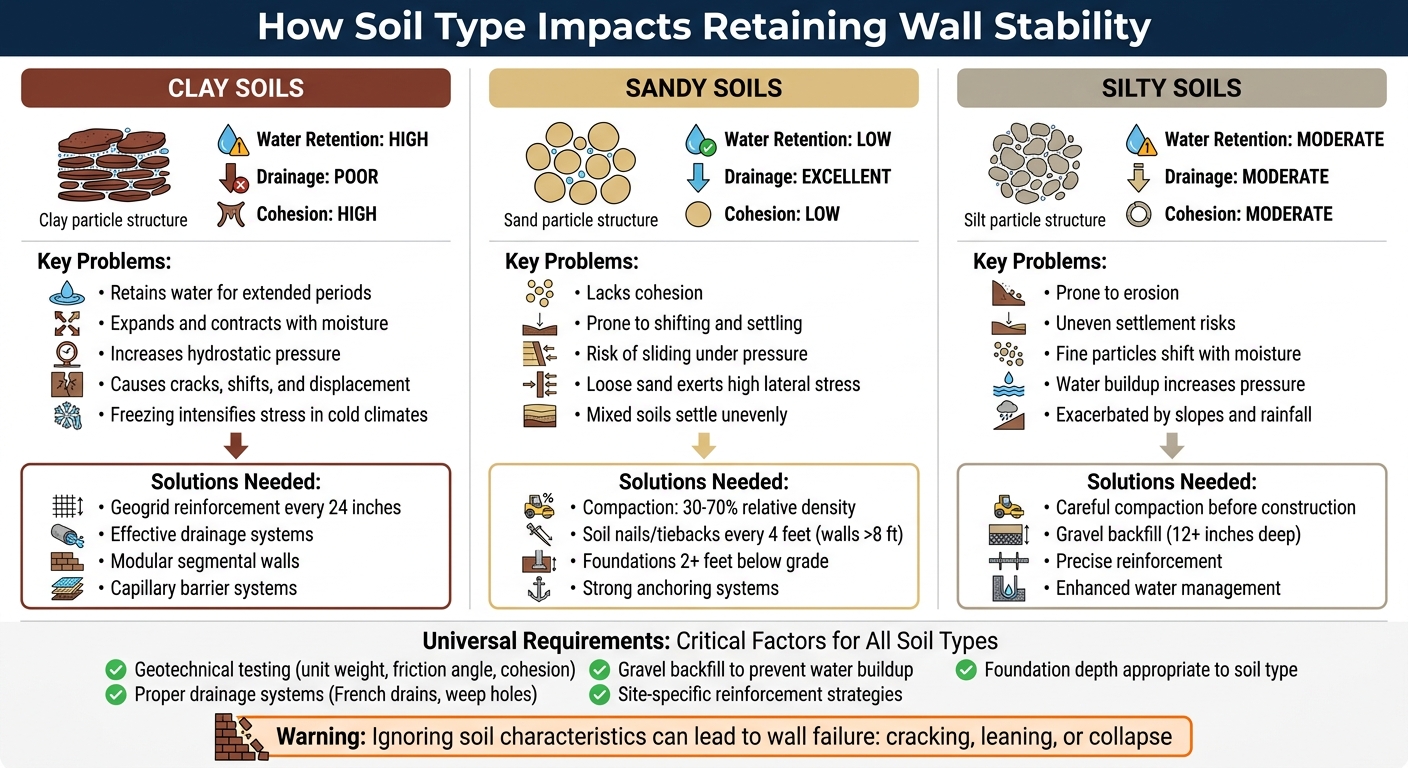
Comparison of Soil Types and Their Impact on Retaining Wall Stability
Understanding the Dynamics of How Retaining Walls Work to Ensure Stability
sbb-itb-843f8be
Problems Caused by Different Soil Types
Different soil types can create unique challenges for retaining walls, potentially jeopardizing their stability. Recognizing these issues is essential to prevent costly failures and to ensure the wall’s long-term durability. Each type of soil requires specific measures to address its risks effectively.
Clay Soils: Water Retention and Expansion Challenges
Clay soils are particularly troublesome because they hold water for extended periods due to their fine particles and low permeability [3][1]. This retained water increases hydrostatic pressure, putting significant lateral force on the wall [3].
What makes clay even more problematic is its tendency to expand and contract. These cycles of swelling and shrinking can cause cracks, shifts, or even displacement in the retaining wall [1]. In colder climates, the issue intensifies as the moisture in clay freezes and expands, adding even more stress. Over time, these repeated pressure changes can lead to leaning, cracking, or complete failure of the wall.
Sandy Soils: Drainage Strengths but Stability Weaknesses
Sandy soils, on the other hand, drain water efficiently due to their coarse, permeable structure. This reduces hydrostatic pressure compared to clay [1]. However, sandy soils lack cohesion, making them prone to shifting, settling, or sliding under pressure [1].
Compaction plays a critical role in addressing these issues. Higher compaction levels, ranging from 30% to 70% relative density, significantly lower lateral stress [4]. Loose sand, by contrast, exerts much higher lateral stress than well-compacted sand. Mixed soils, such as silty sand, are particularly problematic as they can settle unevenly, affecting the wall’s alignment and overall stability [1]. These challenges highlight the importance of properly compacting sandy soils and designing retaining walls with these characteristics in mind.
Silty and Loamy Soils: Prone to Erosion and Moisture Problems
Silty soils fall somewhere in the middle, with moderate drainage capabilities but significant risks of erosion and settlement. Their fine particles are prone to shifting when exposed to moisture, and poor drainage and water management can lead to water buildup behind the wall, increasing hydrostatic pressure [1]. This pressure is a leading cause of structural issues, such as leaning, cracking, or even collapse.
"Silty sand can settle unevenly, so walls built on these soils often require careful compaction and reinforcement." – Colinwell [1]
Unlike the more predictable behavior of compacted sandy soils or the water retention of clay, silty soils demand precise reinforcement to prevent uneven settlement. Factors like steep slopes and heavy rainfall can exacerbate these issues, making careful planning and construction techniques critical in these environments.
Geotechnical Testing for Soil Assessment
Geotechnical testing provides essential data to design retaining walls that can handle specific soil conditions. This eliminates guesswork and helps prevent costly structural failures. The results from these tests are the foundation for accurate engineering calculations.
Standard Soil Testing Methods
To calculate lateral earth pressure, engineers rely on tests that measure unit weight, angle of friction, and cohesion [2].
"A geotechnical engineer must determine the magnitude of the lateral earth pressures, which depend on the unit weight, angle of friction, and cohesiveness of the soil contained behind the wall." – O. Ajayi, O.C. Okeke, S.I. Okonkwo, V.I. Fagorite, and C.C. Amadi [2]
The Mohr-Coulomb criterion is a standard tool for identifying earth pressures – whether at rest, active, or passive [2]. For existing walls, engineers use monitoring tools like earth pressure sensors, laser displacement transducers, inclinometers, and strain gauges to evaluate performance [2].
Using Test Results to Guide Wall Design
The information gathered from soil tests helps engineers design retaining walls that match the soil’s unique properties. For example:
- Clay soils: Require effective drainage systems to reduce hydrostatic pressure [1].
- Sandy soils: Need strong foundations to prevent sliding or settling [1].
- Steep slopes: Call for deeper footings or stepped wall designs to handle higher lateral pressures [1].
Test results also influence backfill choices. Gravel is often preferred because it minimizes water buildup [1]. For areas with unstable or shifting soils, modular segmental walls are sometimes used, as they can adapt to minor ground movements [1]. These insights shape everything from drainage solutions to the depth of the wall’s footings, ensuring the structure performs effectively under specific conditions.
Solutions for Improving Retaining Wall Stability
Design Modifications for Different Soil Types
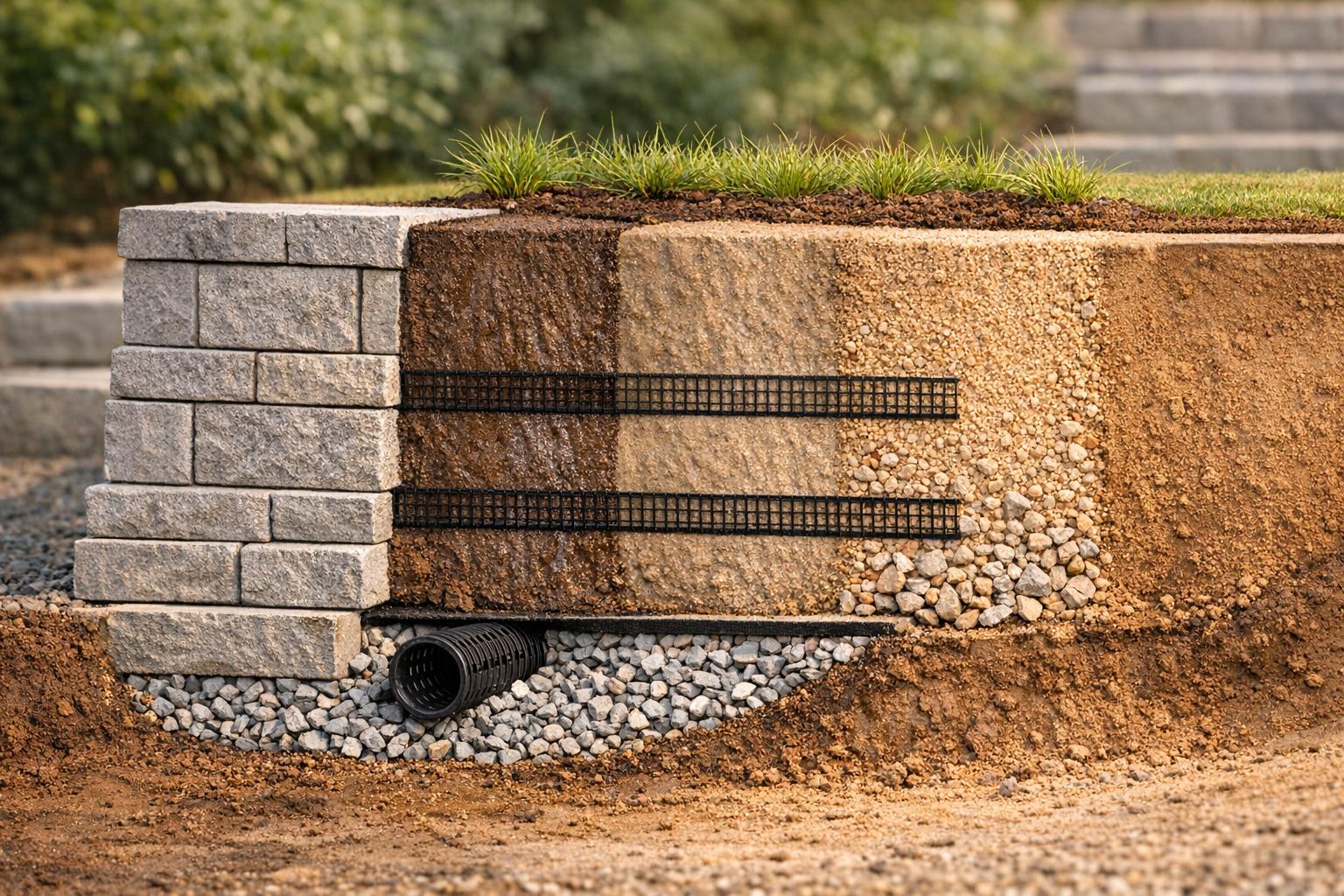
Adapting the design of a retaining wall to match the soil type is essential for long-term stability. For clay soils, which tend to expand and contract significantly, adding geogrid reinforcement every 24 inches can improve tensile strength[5]. Modular segmental walls are particularly effective here, as they can handle minor soil movement without cracking[1][5].
In contrast, sandy and gravel soils drain well but are more likely to slide or overturn due to their loose structure. For walls taller than 8 feet, installing soil nails or tiebacks every 4 feet provides the anchoring strength needed to stabilize the structure[5]. Foundations in sandy soil should also be extended at least 2 feet below the natural grade to minimize settling risks[7].
With silty soils, uneven settlement is a common concern. Proper compaction is critical before construction begins to create a stable base. Adding gravel backfill (at least 12 inches deep) behind the wall helps prevent water buildup, reducing pressure on the structure[1][5]. These adjustments not only strengthen the wall but also help manage water effectively.
Drainage Systems and Erosion Prevention
Effective drainage is crucial to counteract the pressure caused by water buildup behind retaining walls. When water accumulates, lateral pressure increases, often leading to failure. For example, a 27-foot cantilever wall in Texas collapsed due to clogged weep holes, while a 24-foot segmental wall in Seoul failed during heavy monsoon rains when its drainage system became overwhelmed[6].
"The retaining wall fails when the accumulated water behind it reaches a critical threshold over time."
– Journal of Umm Al-Qura University for Engineering and Architecture[6]
To prevent such issues, install French drains along the wall for continuous water removal. Pair these with weep holes to create multiple escape routes for water. Using permeable materials like gravel or clean sand as backfill ensures that water flows away from the wall instead of pooling against it[1]. For clay soils, where water permeability is low, a capillary barrier system – which includes layers of fine-grained soil, nonwoven geotextile, and coarse-grained soil – can help limit water infiltration during heavy rains[6]. If the wall is on a slope, adding a shear key under the footing provides extra resistance to sliding, especially when safety factors drop below 1.5[7].
Pro Landscapes MD‘s Retaining Wall Services

Pro Landscapes MD applies these engineering principles to deliver tailored retaining wall solutions for Maryland’s varied soil conditions. Their team evaluates the specific soil type to determine the best wall design, reinforcement, and drainage strategies for each project.
Their installations incorporate features like geogrid reinforcement for clay soils, carefully engineered foundations for sandy soils, and robust drainage systems that include French drains, weep holes, and gravel backfill[1][7]. For properties with steep slopes or challenging terrain, they implement deeper footings or stepped wall designs to handle higher lateral pressures. Pro Landscapes MD proudly serves communities across Howard County, Montgomery County, Carroll County, Frederick County, Prince George’s County, Baltimore County, and neighboring areas, ensuring every project is built to last.
Conclusion
What Homeowners and Property Managers Should Know
The type of soil beneath a retaining wall plays a pivotal role at every stage – from initial planning to final installation. For instance, clay soils expand and contract, exerting significant lateral pressure, sandy soils drain well but need proper anchoring to prevent sliding, and silty soils can settle unevenly under weight. Each scenario demands tailored solutions, such as the right foundation depth and effective drainage measures, as outlined earlier.
Geotechnical testing is essential to uncover critical soil properties like friction angle and cohesion. These parameters guide engineers in creating designs that meet safety standards [6][7]. Skipping this step turns retaining wall design into a risky guessing game.
"Retaining wall failure primarily results from uncertainties in soil characteristics, groundwater conditions, site investigations, and the analytical methods employed in the design." – Journal of Umm Al-Qura University for Engineering and Architecture [6]
Water management is another cornerstone of retaining wall stability. Accumulated water can create hydrostatic pressure, a leading cause of wall failure. Even well-constructed walls can fail if drainage systems malfunction. A real-world example is the Texas cantilever wall collapse, where clogged weep holes allowed pressure to build up, leading to structural failure [6]. Incorporating features like French drains, weep holes, and gravel backfill can prevent such outcomes.
In Maryland, with its diverse soil conditions, customized designs and expert installations are essential. Pro Landscapes MD excels in this area by performing detailed site assessments, utilizing effective reinforcement techniques, and installing drainage systems tailored to the local climate and groundwater challenges. Their proactive approach addresses key failure risks – overturning, sliding, and bearing capacity – before construction even begins.
"Soil is the primary factor that influences the design and longevity of a retaining wall." – Colinwell [1]
Overlooking soil characteristics and site conditions can lead to unsafe structures and expensive repairs. By prioritizing proper testing, precise engineering, and high-quality installation from the start, you ensure your retaining wall remains stable and your property safe.
FAQs
How do I determine my soil type before building a retaining wall?
Figuring out your soil type is crucial when planning a retaining wall. You can start by conducting a soil test or inspecting the site. One option is to collect soil samples and send them to a local soil testing lab for analysis. This provides detailed insights into your soil’s composition.
If you’d prefer a quick at-home method, try feeling the soil’s texture. Does it feel gritty like sand, smooth like silt, sticky like clay, or a mix of these, known as loam? While this method is less precise, it can give you a general idea of your soil type.
For the most accurate results, consider consulting a professional. They can ensure your retaining wall is built to handle the unique characteristics of your soil.
What are the warning signs that soil or drainage issues are causing my retaining wall to fail?
Common signs to watch for include visible cracks, leaning or bulging, water pooling behind the wall, soil erosion, and efflorescence (a white, powdery residue caused by moisture). You might also notice widening gaps, which could point to movement or settlement. These problems often stem from soil instability or poor drainage, both of which can weaken the wall’s structure.
When is geogrid, a tieback, or a deeper footing needed for a retaining wall?
When soil exerts high lateral pressure – like clay that swells when wet – retaining walls often need geogrid, tiebacks, or deeper footings. These measures become crucial if a stability analysis reveals potential risks, such as sliding or overturning. In such cases, additional reinforcement or deeper foundations provide the necessary support to maintain the wall’s integrity.
Chat with Us