









- bhavya gada
- No Comments
If you own property in Howard County, you may be responsible for maintaining stormwater systems like rain gardens, swales, or underground drainage. These systems prevent water pollution and protect your property from issues like erosion, standing water, and pests.
Key Takeaways:
- Homeowner Responsibility: You must maintain private stormwater facilities, keep records, and address any issues.
- Inspection Prep: Regular maintenance – clearing debris, checking for blockages, and inspecting structures – helps avoid costly repairs.
- What Inspectors Check: Structural condition, water flow, erosion control, and safety compliance.
- Records Matter: Keep site plans, maintenance logs, photos, and receipts for smoother inspections.
For more complex issues, consult professionals to ensure repairs meet county requirements. Regular upkeep not only keeps your property in compliance but also prevents long-term damage.
Stormwater University: Inspecting and Maintaining Your Control Structures
Identifying Stormwater Facilities on Your Property
Before tackling maintenance or preparing for an inspection, it’s crucial to understand what stormwater facilities are present on your property. Some are easy to spot, like a pond or a planted basin, while others, like underground dry wells, are more discreet. Take the time to inspect your property and review any related documentation to get the full picture.
Common Residential Stormwater Facilities
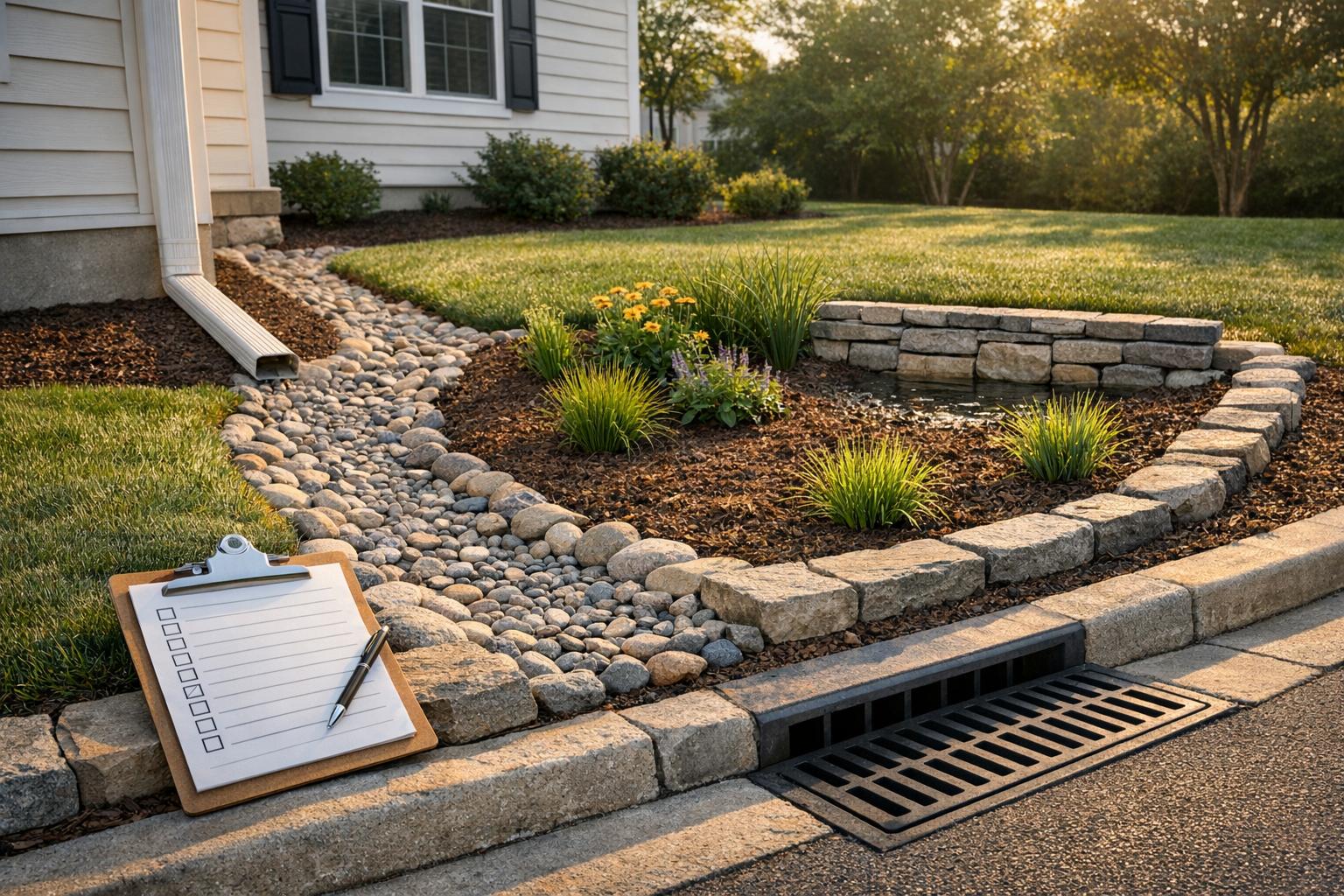
Residential stormwater features typically fall into a few categories. For instance, a rain garden is a shallow, planted depression designed to collect runoff – usually located downslope from a roof downspout. It helps water soak into the soil naturally. A dry well, on the other hand, is an underground structure that’s harder to notice. You can often trace it by following a downspout to where it disappears into the ground. Look for surface markers like a small grate, capped pipe, or gravel patch. [4]
Swales are elongated, shallow depressions in the yard, often grassed or planted, that channel water during and after rainfall. Permeable pavers, used in driveways or patios, resemble standard pavers but have joints filled with small stones instead of sand or mortar, allowing water to seep through into a gravel layer beneath. [4] Larger stormwater features, such as detention or retention areas, are usually broad, shallow basins with visible outlet structures – like a concrete box, riser pipe, or an overflow point along one edge.
Here’s a simple rule: If it drains, stores, or infiltrates water, it’s a stormwater facility. [5]
| What you see on the property | What it likely is |
|---|---|
| Shallow planted basin, lower than surrounding yard | Rain garden or bioretention area |
| Gravel patch or capped pipe where downspout ends | Dry well / infiltration feature |
| Specially spaced pavers with stone-filled joints | Permeable pavers |
| Shallow grassed depression or elongated ditch | Swale or drainage swale |
| Broad low area with outlet pipe or riser structure | Retention or detention facility |
How to Verify Your Stormwater Obligations
To confirm your responsibilities, start by reviewing your record plat, site plan, and stormwater management plan – these documents often include terms like "SWM facility", "bioretention", "infiltration trench", "drainage easement", or "BMP" (best management practice). [3] Easements shown on the plat will indicate areas where shared systems or pipes cross your property, often with specific maintenance requirements or restrictions.
If your records are incomplete or unclear, reach out to Howard County for assistance. Be prepared with your property address, parcel number, and subdivision name – this information helps the staff locate the correct records quickly. [5] County staff can provide approved stormwater plans, confirm which facilities are tied to your property, and clarify whether shared systems are the responsibility of your HOA or the county. [3]
For properties with complex grading, multiple drainage features, or signs of issues like standing water or erosion, it’s worth consulting a professional drainage contractor. A contractor, such as Pro Landscapes MD, can help identify both visible and hidden components, assess their condition, and assist in creating a maintenance plan that ensures everything is in working order before an inspection. [4]
Once you’ve identified your stormwater facilities and clarified your responsibilities, you’ll be ready to prepare for inspections.
Preparing for a Howard County Stormwater Inspection
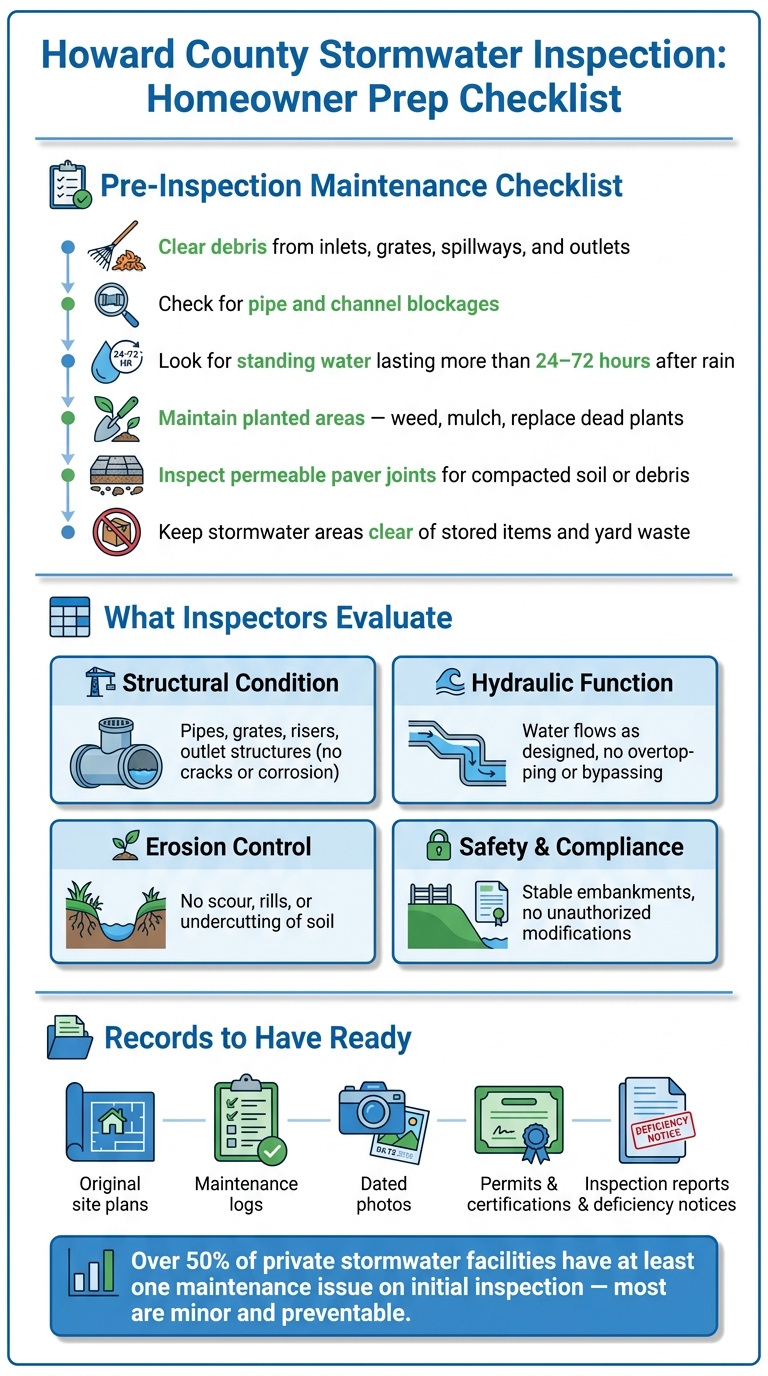
Howard County Stormwater Inspection: Homeowner Prep Checklist
Understanding the stormwater facilities on your property and knowing who is responsible for their upkeep is just the first step. The next critical task is preparing for an inspection. In Maryland counties with similar programs, data shows that over half of private stormwater facilities inspected [1] have at least one maintenance issue during the initial review. The good news? Most of these problems are minor and can be resolved with regular upkeep.
Pre-Inspection Checklist for Homeowners
After moderate rainfall, take a walk around your property to ensure that stormwater runoff is being captured, directed, and released properly – without causing backups or erosion. Then, tackle these key maintenance tasks:
- Clear debris: Remove leaves, grass clippings, and trash from inlets, grates, spillways, and outlets.
- Check for blockages: Ensure pipes and channels are open and unobstructed.
- Look for standing water: If water lingers for more than 24–72 hours after rain, it could signal a clog or an issue with the infiltration system.
- Maintain planted areas: Remove invasive weeds, add mulch as needed, and replace dead plants in rain gardens or swales.
- Inspect permeable surfaces: For paver systems, make sure the joints remain open and free of compacted soil or debris.
- Keep the area clear: Avoid storing items, placing play equipment, or dumping yard waste in or near stormwater facilities.
To stay organized, document your maintenance efforts with dated photos, receipts, and a log of completed tasks. This record can be valuable during discussions with inspectors.
Once your property is in order, it’s helpful to understand what inspectors will focus on during their evaluation.
What Inspectors Look For
Howard County inspectors typically assess four main areas during a stormwater facility inspection:
- Structural Condition: Inspectors check that pipes, grates, headwalls, risers, and outlet structures are in good shape – free from cracks, corrosion, or any noticeable shifting.
- Hydraulic Function: They ensure water flows as intended, without overtopping or bypassing the system.
- Erosion Control: Soil stability is key. Inspectors look for signs of scour, rills, or undercutting that might compromise the surrounding area.
- Safety: Embankments must be stable, access areas secure, and no unauthorized modifications (like sheds or fences) should obstruct drainage.
Inspectors also verify that the facility matches its approved design. Additions such as raised garden beds, fences, or other structures shouldn’t block or alter the drainage system.
How to Work with Inspectors During a Visit
Whether you’re present or send a representative, preparation is key. Here’s how to ensure a smooth inspection:
- Secure pets and provide clear access to all drainage areas.
- Have maintenance records, original design documents, and any prior correspondence from the county ready to share.
- Be prepared to walk the inspector through your property if requested.
When speaking with inspectors, answer questions directly and honestly. If you don’t know an answer – like the exact date of a repair – it’s better to admit uncertainty and offer to follow up than to guess. If the inspector identifies a deficiency, ask detailed questions: What caused the issue? Is it a safety or maintenance concern? What repair is needed, and will a reinspection be required? This information will help you prioritize repairs effectively.
For more complex issues, such as structural damage or persistent flooding, consider consulting a professional drainage contractor. Companies like Pro Landscapes MD specialize in stormwater management and can address these challenges before they escalate into enforcement actions.
sbb-itb-843f8be
Addressing Deficiencies and Maintaining Compliance
Reading and Understanding Inspection Reports
When you receive an inspection report, it’s crucial to review it right away. This will give you a clear understanding of what needs to be fixed and the timeline for completing those corrections. In Howard County, a stormwater inspection report will outline the specific facility on your property – such as a rear-yard swale, micro-bioretention cell, or drywell – and detail any deficiencies found. Each issue will include a description of the problem, why it matters, and the corrective action required, along with a compliance deadline. These deadlines usually range from 30 to 60 days, though urgent structural or safety concerns may have shorter timelines.
As you go through the report, break the findings into two groups: functional failures and cosmetic or maintenance issues. Functional failures, like a clogged outlet pipe, active erosion, or standing water that doesn’t drain within 72 hours after rainfall, demand immediate attention. On the other hand, cosmetic issues, such as dead vegetation or a light sediment layer in a swale, are less urgent but still need to be addressed. If you come across unfamiliar terms – like forebay, riprap, weir, or micro-bioretention – reach out to the Howard County stormwater office for clarification before starting any repairs. Misunderstanding the required work could lead to wasted time, effort, or even a failed reinspection.
To ensure compliance, document all repairs with dated photos and invoices. If anything in the report is unclear or appears to need technical evaluation, consider consulting a professional.
When to Call a Professional
While routine tasks like clearing debris from a grate, trimming vegetation, or spreading mulch in a rain garden can often be handled by homeowners, certain problems call for expert intervention.
"Drainage problems are complex and require a custom approach for each project. These issues can cause long-term damage to your property if not handled correctly, which is why hiring an experienced team is critical." – Pro Landscapes MD [1]
You should consult a professional for structural damage, persistent ponding that suggests a blockage or infiltration failure, or severe erosion that might require county-approved plans. A qualified contractor can assess the original drainage pattern, identify the root cause of the problem, and provide a solution that restores proper function rather than just covering up the issue. Pro Landscapes MD offers a range of services, including drainage repair, grading, French drain installation, yard leveling, and stormwater management, and they handle permit coordination when needed. Acting quickly on major issues not only ensures compliance but also helps avoid expensive repairs down the road.
Routine Maintenance Tasks for Stormwater Facilities
Once deficiencies are addressed and any professional repairs are completed, regular maintenance is essential to keep your stormwater facilities in good working order. Consistent upkeep can extend the life of your system by 10–20 years and save thousands of dollars in major repair costs over time.
Inspect your stormwater facilities at least twice a year – once in the spring and again in the fall – and after heavy storms. Keep a 10–15 foot buffer zone around inlets, outlets, and other key structures free of debris, yard waste, and overgrown vegetation. Avoid dumping grass clippings, leaves, or soil near the facility, as these are common culprits behind clogged systems and inspection failures. For rain gardens and bioretention areas, maintain mulch at a depth of 2–3 inches and replace any dead or invasive plants with native options like Black-eyed Susans or Butterfly Weed, which thrive in Maryland’s climate [2]. For stormwater ponds, check that the riprap around inlets and outlets is secure and that embankment grass is mowed to a height that prevents erosion.
Navigating Howard County Processes and Resources
Key County Contacts and Resources
For stormwater-related questions, your first stop should be the Howard County Department of Public Works. They can confirm whether your property includes a recorded stormwater facility, explain your maintenance responsibilities, and clarify any points from an inspection report. This step ensures you’re connecting with the right local authority for accurate guidance. If your questions involve permits or modifications to your facility, the Howard County Office of Planning and Zoning is the department to contact. Both offices are accessible via the county’s official website: howardcountymd.gov.
When your drainage concerns require expertise beyond what the county offers, consider consulting a local professional familiar with Howard County’s processes. For instance, Pro Landscapes MD serves areas like Columbia, Elkridge, Ellicott City, and Glenwood. They provide free site visits and proposals for custom drainage and stormwater solutions. You can reach them directly at 410-940-9664.
Knowing who to contact helps simplify the process of obtaining permits or making necessary modifications.
Permits and Facility Modifications
While not every repair requires a permit, larger projects often do. Activities like regrading your yard, installing underground pipe systems, or making structural changes to a stormwater facility typically need county approval before work begins. Starting such projects without the proper permits can lead to fines or failed inspections.
"In some cases, a permit may be required for extensive drainage projects. Our team will handle any necessary permits and ensure all work complies with local regulations." – Pro Landscapes MD
Hiring a contractor experienced in Howard County’s grading and erosion control standards can make the process easier. These professionals often handle permit applications for you and ensure that completed work meets all county requirements.
Once your permits and modifications are settled, staying organized with your stormwater records becomes the next priority.
Keeping Your Stormwater Records Organized
Maintaining detailed records is crucial for smoother inspections and protecting yourself in case of disputes. Keep a dedicated folder – physical or digital – that includes:
- Original site plans showing your stormwater facility’s location and type
- Inspection reports and deficiency notices issued by Howard County
- Permits and compliance certifications for any completed drainage work
- Dated photos documenting repairs and maintenance activities
- Maintenance logs noting tasks performed, dates, and any observations
"Once established, berms and swales require minimal maintenance. Regular checks for plant health and occasional trimming or replanting may be needed to keep the vegetation thriving and ensure water continues to flow properly." – Pro Landscapes MD
Always retain copies of permits and compliance documents from any contractor work. These resources and good recordkeeping practices will ensure you stay compliant and prepared for future inspections.
Conclusion: Staying Compliant and Protecting Your Property
To stay on top of Howard County’s stormwater rules, it’s essential to know your facilities, stick to a regular maintenance schedule, and address potential problems early. Stormwater runoff contributes about 16–17% of nitrogen and phosphorus entering the Chesapeake Bay watershed, so keeping up with maintenance isn’t just good for your yard – it benefits the environment too.
Look out for warning signs like standing water lasting more than 48 hours, eroded slopes, or dead vegetation in rain gardens. Tackling these issues early can save you from costly emergency repairs later. For more complex problems, especially those involving structural or underground systems, you can reach out to Pro Landscapes MD at 410-940-9664. Consistent upkeep not only protects your property but also helps maintain its value.
Stay organized by keeping detailed records. A well-maintained folder with your site plan, maintenance logs, dated photos, and receipts can be invaluable. Regular inspections, prompt repairs, and thorough documentation not only ensure compliance but also make your property more appealing to potential buyers. Buyers appreciate knowing that stormwater drainage has been properly managed.
Once you establish a routine, maintaining compliance becomes a manageable task. The rewards? A solid foundation, a thriving landscape, and a property that retains its value for years to come.
FAQs
How can I find out if my home has a recorded stormwater facility?
To find out if your home has a recorded stormwater facility, check Howard County’s property or public works records. These systems are required to meet local inspection regulations. If you’re looking for assistance with maintenance or evaluation, Pro Landscapes MD offers specialized services in drainage and stormwater management. Their offerings include custom design, installation, and erosion control to ensure your property stays efficient and meets local compliance standards.
What can cause a residential property to fail a stormwater inspection?
Failed stormwater inspections in Howard County usually stem from problems related to water management or the condition of the system. Typical issues include standing water or flooding, erosion, or neglecting regular upkeep – like cleaning filtration systems or repairing damaged features such as permeable pavers. Pro Landscapes MD provides expert evaluations and tailored solutions to help meet local stormwater compliance requirements.
Do I need a permit to repair or modify my stormwater drainage system?
When it comes to repairing or modifying stormwater drainage systems, permit requirements depend on local regulations. These systems are designed to meet strict runoff standards, so compliance is crucial. Since drainage projects often involve intricate elements like water flow, grading, and erosion control, it’s wise to get a professional evaluation. At Pro Landscapes MD, we ensure that your drainage solutions – whether it’s French drains or permeable pavers – not only meet regional standards but also protect the integrity of your property.
Chat with Us