









- bhavya gada
- No Comments
Navigating Maryland’s stormwater permitting fees can be complex due to variations by county and project type. Here’s a quick breakdown:
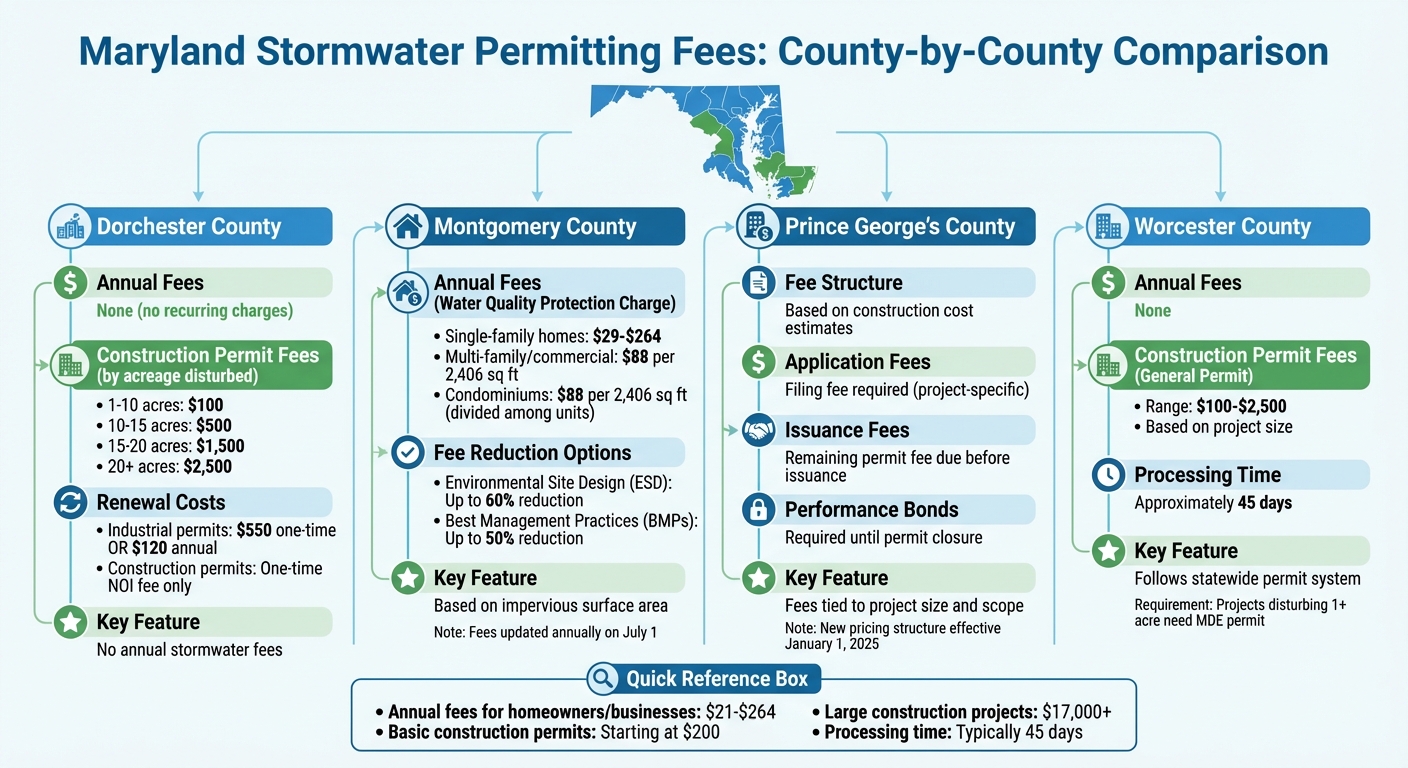
- Homeowners & Businesses: Annual fees range from $21 to $264 depending on impervious surface area.
- Construction Permits: Fees vary significantly, from $200 for basic permits to $17,000+ for larger projects.
- County Differences:
- Montgomery County charges annual fees based on impervious surfaces, with options for fee reductions through stormwater management practices.
- Dorchester County avoids annual charges but imposes one-time fees for construction permits.
- Prince George’s County ties fees to project size, using construction cost estimates.
- Worcester County follows a state-level permit system with fees ranging from $100 to $2,500.
Each county’s fee structure impacts budgeting and project planning. Understanding these differences helps property owners and developers manage costs effectively.
Maryland Stormwater Permitting Fees by County Comparison
1. Dorchester County Stormwater Fees
Dorchester County stands apart from Maryland’s urban counties by not imposing an annual stormwater fee. Unlike Montgomery, Prince George’s, and several other counties that are required to charge local stormwater utility fees[1], Dorchester avoids these recurring charges, which typically range from $21 to $264 in other parts of the state. This approach significantly impacts how projects are budgeted across Maryland.
Application Fees
When it comes to construction projects, specific application fees apply. Projects disturbing one acre or more must secure the statewide General Permit for Storm Water Associated with Construction Activity from the Maryland Department of the Environment (MDE)[3]. The fees for this permit are determined by the size of the area being disturbed:
- $100 for projects disturbing 1 to 10 acres
- $500 for projects disturbing 10 to 15 acres
- $1,500 for projects disturbing 15 to 20 acres
- $2,500 for projects exceeding 20 acres[2]
MDE typically processes these applications within 45 days[3]. Knowing these fee brackets is vital for accurately estimating both project costs and timelines.
Renewal Costs
For projects needing ongoing permits, the renewal fees vary. Industrial stormwater permits allow for either a one-time payment of $550 or an annual fee of $120. Construction permits, on the other hand, only require a one-time Notice of Intent fee, which is based on the acreage disturbed[2]. This streamlined fee structure reduces financial strain for smaller property owners not involved in large-scale construction activities.
Pro Landscapes MD provides valuable support to clients in Dorchester County, helping them navigate these permitting requirements efficiently while ensuring compliance with state regulations. Their expertise is particularly helpful for larger projects that might necessitate additional permits from MDE.
Next, we’ll take a closer look at Montgomery County’s fee structure.
sbb-itb-843f8be
2. Montgomery County Stormwater Fees
In Montgomery County, stormwater fees are handled differently than in Dorchester County. The county imposes an annual Water Quality Protection Charge (WQPC), which is based on the amount of impervious surfaces like roofs, driveways, and parking lots on a property. This fee applies to residential homes, businesses, homeowners associations, and non-profit organizations, and it funds countywide stormwater management projects[1][5].
Application Fees
When applying for permits related to new home construction, property owners are required to submit Sediment Control and Right-of-Way permits along with their building permit applications[4]. These applications come with a filing fee, and any remaining balance must be paid before the permit is issued. Fees are updated annually on July 1, using something called an Enterprise Fund Stabilization Factor[6]. To estimate costs ahead of time, applicants can use the DPS Fee Estimator[6].
Per-Acre Charges
Montgomery County takes a different approach to stormwater fees, opting out of traditional per-acre charges. Instead, the WQPC is calculated based on the amount of impervious surface area on a property:
- Residential single-family homes pay annual fees ranging from $29 to $264[1].
- Multifamily, commercial, and industrial properties are charged around $88 per 2,406 square feet of impervious area[1].
- Condominiums are billed at the same non-residential rate of $88 per 2,406 square feet, but the total fee is divided among unit owners[1].
Property owners can reduce their WQPC by implementing on-site stormwater management practices. For example, Environmental Site Design (ESD) can lead to a reduction of up to 60%, while other Best Management Practices (BMPs) can lower the fee by up to 50%[1]. This system sets Montgomery County apart from neighboring areas with its focus on impervious surface calculations.
In one notable case from 2013, a developer contested a $14,932.17 WQPC assessment for a 150-acre property, arguing that existing stormwater services already handled runoff effectively. The court sided with the developer, ruling that the charge was not applicable since the stormwater treatment in place met the necessary standards[5].
For property owners looking to navigate these fees, Pro Landscapes MD offers assistance in implementing stormwater management solutions that may qualify for WQPC credits. Their services include drainage installation, French drains, and grading to help properties meet compliance requirements while potentially lowering annual fees. Keep in mind, however, that these charges do not apply in Rockville or Takoma Park, as both cities operate their own stormwater programs[1].
3. Prince George’s County Stormwater Fees

In Prince George’s County, stormwater fees are determined using construction cost estimates managed by the Department of Permitting, Inspections and Enforcement (DPIE). Unlike some other Maryland counties that use flat per-acre rates, this approach ties your fees directly to the size and scope of your project. These costs cover all public and private storm drains and stormwater management systems located outside the public right-of-way[8].
Application Fees
When submitting a site or road permit application, you’ll need to pay a filing fee[8]. The county calculates your specific costs using a Bond and Fee Calculation Worksheet, which factors in the unique details of your project[8]. Although the Planning Department offices have been closed for in-person visits since March 9, 2026, due to construction, you can still submit applications online through the Development Activity Monitoring System (DAMS) and the Development Review and Tracking System (DARTS)[7].
Issuance Fees
Once your application is reviewed, you’ll pay the remaining permit fee to finalize and receive your permit[8]. For site and road permits, performance bonds are required and held until the permit is officially closed[8].
As of January 1, 2025, the county adopted a new pricing structure outlined in the "Site/Road Construction Price List" (Techno-gram 002-2024), replacing the older 2012 standards[8]. This updated price list is based on the county’s "Specifications and Standards for Roadways and Bridges" and is used to estimate construction costs, bonds, and fees for all permit applications[8].
For property owners tackling stormwater compliance projects, Pro Landscapes MD offers drainage solutions and stormwater management services to help navigate these requirements in Prince George’s County and nearby areas.
This fee structure offers a more tailored approach compared to the flat-rate systems used in other counties. Up next, we’ll take a closer look at Worcester County’s stormwater fees.
4. Worcester County Stormwater Fees

In Worcester County, stormwater management for construction projects follows Maryland’s statewide permitting system. If your construction project involves disturbing one acre or more of land, you’re required to obtain a General Permit for Storm Water Associated with Construction Activity through the Maryland Department of the Environment (MDE) [3]. This system ensures consistent standards across the state.
Application Fees
The cost of applying for the General Permit depends on the size and scope of your project, ranging from $100 to $2,500 [3]. Once submitted, permit processing generally takes about 45 days [3]. These regulations are rooted in the Federal Clean Water Act and Maryland’s State Environment Article, Title 9, Subtitle 3 (COMAR 26.08.04) [3], ensuring projects meet established environmental standards.
For property owners in Worcester County, Pro Landscapes MD provides services like drainage installation and stormwater management to help ensure compliance with these regulations.
This standardized approach to permitting highlights both the strengths and challenges of Maryland’s stormwater management system, which will be explored further.
Pros and Cons
Maryland’s counties use two different fee models, each with its own impact on project budgeting.
In Montgomery and Prince George’s counties, annual fees make budgeting simpler with consistent, predictable costs. However, these fees accumulate over time, even if no development takes place. On the other hand, Dorchester and Worcester counties charge fees only when construction or land disturbance happens. While this approach avoids recurring costs, it can make project expenses less predictable.
Here’s a quick breakdown of the trade-offs by county:
| County | Advantages | Disadvantages |
|---|---|---|
| Dorchester | Fees apply only during active construction; no annual charges | Project costs can be unpredictable |
| Montgomery | Predictable annual costs | Fees accumulate year after year, regardless of activity |
| Prince George’s | Consistent fee structure ensures compliance with stormwater rules | Ongoing fees continue to add up |
| Worcester | One-time permit fees charged only when land is disturbed | Costs can vary, and administrative processes may delay budgeting |
These fee structures highlight how different counties approach project funding, giving property owners the ability to align their budgets with the model that best suits their needs.
Conclusion
Examining county-specific rates highlights how local policies can significantly impact your project costs. In Maryland, stormwater permitting fees differ greatly from one county to another due to the autonomy of local jurisdictions. This makes it crucial for property owners and developers to familiarize themselves with their county’s requirements before crafting a project budget.
Take Baltimore City, for example – it charges $72 per 1,050 sq. ft. of impervious area for non-residential properties, which is far higher than Charles County‘s $32 per 3,255 sq. ft. For large commercial properties, this disparity can result in thousands of dollars in annual costs [9]. Understanding these local variations is key to effective financial planning.
To cut costs, consider implementing Best Management Practices (BMPs), which can lead to fee reductions of 45%-50% [9]. In Howard County, properties with Site Development Plans filed on or after January 1, 2003, automatically qualify for a 50% reduction in assessed impervious area [9]. Also, be sure to review how impervious surfaces are defined in your county. For instance, Montgomery County includes compacted gravel and artificial turf in its calculations, while other counties may not [9].
If your property is located in a city with its own stormwater utility, like Annapolis, Rockville, or Frederick City, you might be exempt from county fees since municipal charges apply instead [9]. Take advantage of local exemptions and credit programs to manage costs effectively and stay within your budget.
FAQs
Do I need a stormwater permit if I disturb less than 1 acre?
In Maryland, if your project disturbs less than 1 acre of land, you typically won’t need a stormwater permit. However, if your project disturbs 1 acre or more, or significantly increases impervious surfaces, permits are often required. Local regulations can vary, so it’s important to review the specific rules in your area to make sure you’re following the law.
How is impervious area measured for stormwater fees in my county?
Impervious area refers to the total surface area where water cannot penetrate the ground. This includes surfaces like roofs, driveways, and sidewalks. Measurements are usually given in square feet or acres, aligning with Maryland’s stormwater regulations and local permitting requirements.
What stormwater improvements can lower my annual fee?
Reducing hard, non-absorbent surfaces and managing stormwater runoff effectively can cut down your yearly permit fees. Consider solutions like rain gardens, permeable pavers, or other forms of green infrastructure. Not only do these options help meet regulatory requirements, but they may also lower related expenses.
Chat with Us