









- bhavya gada
- No Comments
Maryland’s stormwater zoning rules focus on managing water runoff to protect water quality and reduce flooding. The state prioritizes Environmental Site Design (ESD), which uses natural methods like rain gardens, permeable pavements, and vegetation to mimic predevelopment water absorption. Developers must apply ESD to the Maximum Extent Practicable (MEP) before considering alternatives like ponds or wetlands.
Key points include:
- ESD Practices: Designed to retain 100% of predevelopment groundwater recharge.
- Regulations: Governed by the Stormwater Management Act of 2007, requiring local governments to align ordinances with ESD standards.
- Approval Process: A three-stage review (Concept, Site Development, Final Plan) ensures compliance.
- Maintenance: Property owners must maintain stormwater systems and get approval for modifications.
- County Fees: Local fees fund stormwater programs, with stricter rules in some areas like Baltimore and Montgomery counties.
- New Legislation: Recent bills require updated regulations to address climate change and intense storms.
These rules aim to balance development with water management, using natural solutions to reduce environmental impacts and long-term costs.
MDE Stormwater Regulations and Design Manual Updates Listening Session – October 28 (2025)
sbb-itb-843f8be
Maryland’s Core Stormwater Management Policies
Maryland has established a robust framework to ensure development projects manage runoff effectively, preserving water quality. Guided by Environmental Article §4-103 and the Stormwater Management Act of 2007, the state requires that post-development runoff conditions closely resemble those before development.
Local governments, including counties and municipalities, must adopt Environmental Site Design (ESD) techniques and structural stormwater measures into their ordinances. This often involves revising zoning laws and public works codes to eliminate barriers, such as restrictions on narrow streets or the use of alternative paving materials, which could hinder ESD implementation. These policies set the stage for localized action through ESD practices and legislative oversight.
Environmental Site Design (ESD) Requirements
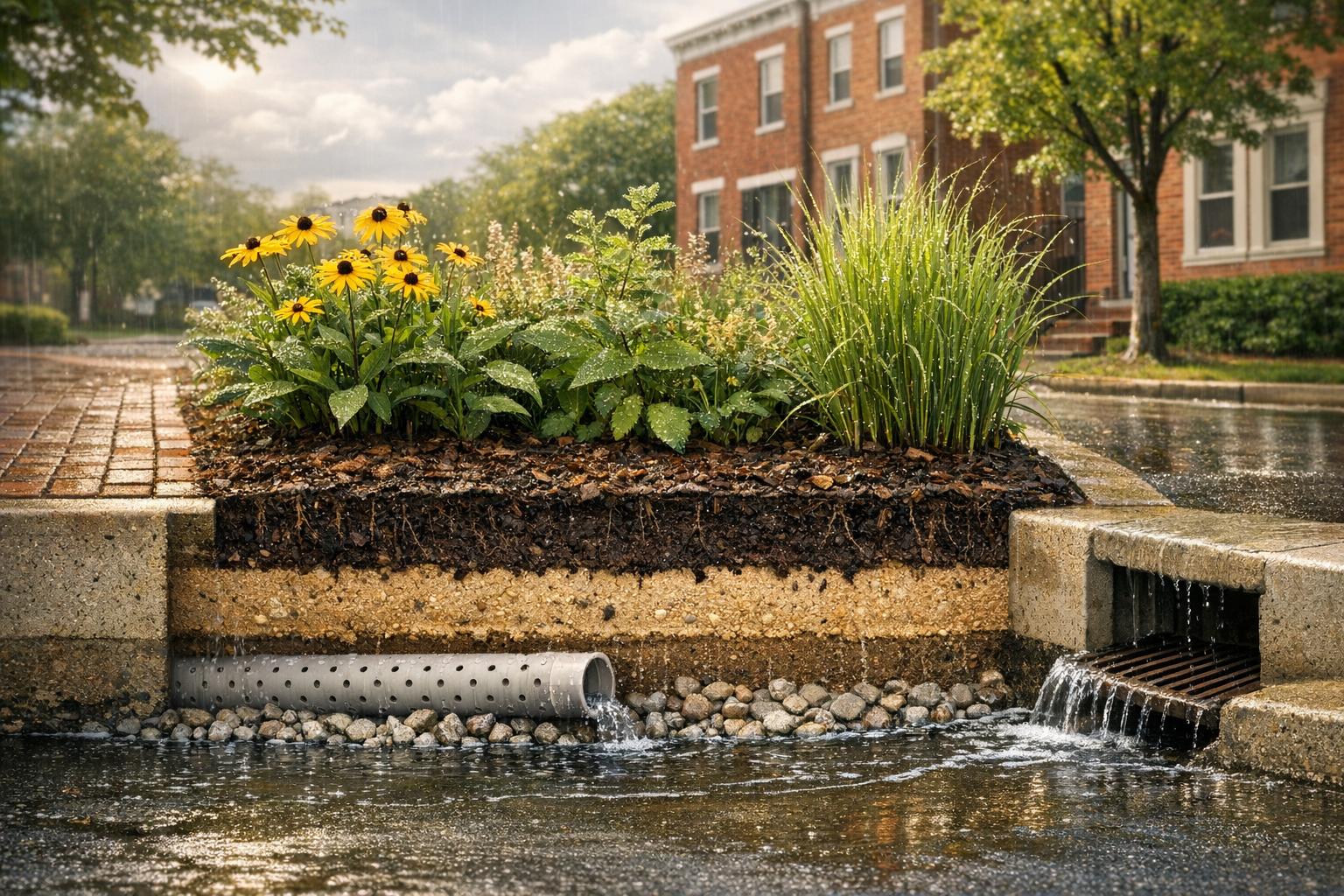
Developers in Maryland are required to prioritize ESD to the Maximum Extent Practicable (MEP) before resorting to structural solutions. ESD techniques, like rain gardens, green roofs, permeable pavement, and swales, are designed to retain 100% of a site’s annual predevelopment groundwater recharge. Structural measures, such as ponds or wetlands, are only permitted when absolutely necessary. Once implemented, these features are considered permanent and must be documented in land records. Any future modifications require prior approval from the relevant agency[1].
Stormwater Management Act of 2007
The Stormwater Management Act of 2007 reinforces the ESD framework by formally committing to its principles and requiring regular updates to address changing climate conditions. According to Maryland Environment Code § 4-203:
"The primary goal of the State and local programs will be to maintain after development, as nearly as possible, the predevelopment runoff characteristics"[2].
The Act mandates that the Department of the Environment reviews and updates stormwater regulations at least every five years. This ensures infrastructure designs incorporate the latest precipitation data and climate trends. Additionally, it emphasizes strategies for controlling runoff quantity to prevent large-scale flooding during major storm events. Local jurisdictions are also required to develop thorough approval processes to assess the cumulative impact of grading, sediment control, and stormwater management plans across multiple projects[2].
Permit and Plan Approval Process
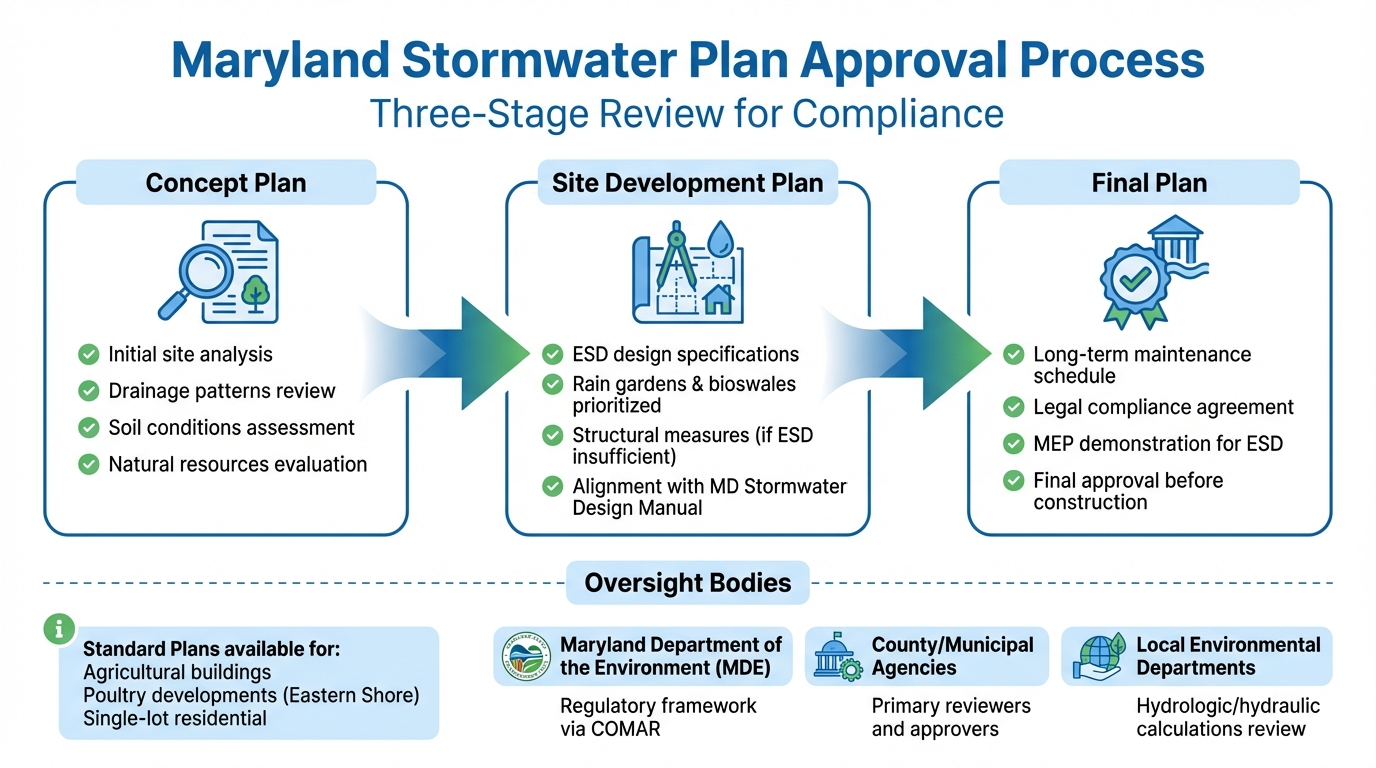
Maryland Stormwater Plan Approval Process: 3-Stage Review
Getting approval for a stormwater management plan in Maryland involves a structured three-stage review: the Concept Plan, the Site Development Plan, and the Final Stormwater Management Plan [5]. Each stage ensures compliance with state standards before construction begins. Below, you’ll find a breakdown of the key steps and requirements in this process.
Stormwater Management Plan Requirements
Every stormwater management plan must include several critical components:
- Site Analysis: This covers drainage patterns, soil conditions, and natural resources on the property.
- Design Specifications: Plans must prioritize Environmental Site Design (ESD) methods – like rain gardens or bioswales – before considering structural measures such as retention ponds. These designs must align with the Maryland Stormwater Design Manual to meet state technical standards.
- Maintenance Plan: A long-term schedule for upkeep is required, along with a legal agreement to ensure compliance.
The goal is to demonstrate that ESD has been applied to the Maximum Extent Practicable (MEP) before resorting to structural solutions [5]. For specific projects, such as agricultural buildings, poultry developments on the Eastern Shore, or single-lot residential construction, pre-approved Standard Plans may be available [1].
State and Local Oversight
Once submitted, stormwater plans are reviewed by both state and local authorities. The Maryland Department of the Environment (MDE) provides the regulatory framework through COMAR and the Stormwater Design Manual. MDE works closely with county and municipal agencies, which typically serve as the primary reviewers and approvers of these plans [1][4].
Local jurisdictions are responsible for reviewing hydrologic and hydraulic calculations to evaluate how proposed developments might impact downstream structures like dams or bridges [1]. Developers are strongly encouraged to engage with their local environmental departments early in the process. This is especially important because MDE often delegates approval authority to these local agencies [4].
In some cases, MDE also has the authority to approve alternative ESD techniques or structural measures not explicitly listed in the Stormwater Design Manual for new developments [1]. Additionally, municipalities subject to NPDES MS4 permits may impose extra requirements to align with federal and state water quality goals [6].
County-Level Stormwater Fees and Programs
Stormwater Utility Fees
In Maryland, counties address stormwater management needs through utility fees that align with local requirements, as allowed by state regulations. These fees support the state’s broader stormwater zoning framework [2].
In Montgomery County, developers must pay a non-refundable filing fee when submitting a Stormwater Management (SWM) Concept application. This fee is required at the time of application and can be paid online using credit card, check, or e-Check through the county’s eServices portal [3]. Approval of the SWM concept is essential before obtaining a Sediment Control permit and applies to most development activities, including commercial projects and group homes [3].
Private property owners are responsible for maintaining stormwater systems located on their land, such as catch basins, retention ponds, or culverts. Meanwhile, municipalities typically manage public infrastructure like street drains. Regular engineering inspections are essential to avoid blockages, structural deterioration, and expensive repairs [8].
Programs in Montgomery and Baltimore Counties
In addition to fees, counties implement specific programs to ensure compliance with stormwater management standards.
Baltimore County follows a detailed three-stage review process outlined in County Code Article 33, Title 4 [7]. Redevelopment projects in the county face stricter standards, requiring either a 50% reduction in impervious surfaces or alternative measures to manage water quality [7]. Inspections of stormwater facilities are conducted immediately after as-built plan approval, one year later, and then every three years [7].
Montgomery County customizes its stormwater management requirements based on the type and location of the project. For instance, additions or modifications affecting less than 5,000 square feet are exempt from SWM concept approval [3]. Similarly, building a single-family home on a recorded lot typically does not require a SWM concept submission [3]. However, properties located in Special Protection Areas (SPAs) must meet additional criteria, such as submitting Preliminary or Final Water Quality Plans [3].
Recent Legislative Changes
Maryland’s legislature has introduced new bills aimed at reshaping stormwater management practices to better address climate challenges and improve flood resilience.
HB 1465 and SB 687 direct the Maryland Department of the Environment (MDE) to update stormwater management regulations. These updates will incorporate climate change projections and the latest precipitation frequency data from NOAA Atlas 15. The focus is on improving flood control and making infrastructure more resilient to intense storms. As a result, property owners and developers should prepare for stricter design standards that reflect the growing intensity of rainfall events.
In addition to these updated standards, the legislation emphasizes integrating Environmental Site Design (ESD) into local planning. Developers are now required to prove that ESD has been applied to the Maximum Extent Practicable (MEP) for all projects[1]. Structural Best Management Practices (BMPs) can only be employed if ESD methods alone are insufficient to meet regulatory demands[1]. This marks a shift toward nature-based solutions, moving away from traditional engineered approaches.
Counties and municipalities in Maryland are also required to amend their planning and zoning ordinances to remove barriers to ESD implementation[1]. This means local governments must revise their regulations to support non-structural techniques, such as preserving natural features, clustering developments, and minimizing land disturbance. These changes aim to promote sustainable development while addressing environmental and climate concerns.
Combining Stormwater Compliance with Landscaping
Landscaping Techniques for Stormwater Management
Maryland’s ESD framework sets a strong foundation for stormwater compliance, and incorporating landscaping takes it a step further by blending functionality with visual appeal. The state’s ESD standards emphasize nature-based solutions that work with the environment while meeting regulatory requirements.
Techniques like rain gardens, bioswales, and permeable pavers are designed to capture and infiltrate runoff, ensuring compliance with the Maryland Stormwater Design Manual. This manual specifies that ESD features must maintain 100 percent of the average annual predevelopment groundwater recharge volume for a site [2]. Other effective methods include redirecting downspouts into landscaped areas, using micro-bioretention systems, and creating sheetflow to conservation areas that preserve natural drainage patterns [1].
These techniques highlight Maryland’s commitment to integrating landscaping into stormwater management, moving beyond traditional engineering approaches to embrace environmentally responsible solutions.
Pro Landscapes MD‘s Stormwater Management Services

Pro Landscapes MD demonstrates how landscaping can meet stormwater compliance while enhancing outdoor spaces. Their services include grading and land leveling to manage water flow, installing French drains, and designing dry riverbeds that combine drainage efficiency with natural beauty.
Their work aligns with Maryland’s ESD planning techniques by incorporating environmental pavers to reduce impervious surfaces, designing rain gardens with native plants, and creating integrated drainage systems that handle runoff while improving the landscape’s appearance. By adhering to Maryland Department of the Environment standards, Pro Landscapes MD ensures their projects not only comply with regulations but also enhance properties across Howard County, Montgomery County, Baltimore County, and other central Maryland communities.
Conclusion
Maryland’s stormwater zoning regulations lay out a framework that emphasizes Environmental Site Design (ESD) as the primary solution, only considering structural alternatives when absolutely necessary. According to state law, ESD practices must ensure that 100% of the average annual predevelopment groundwater recharge volume is maintained. This helps protect water tables, curb downstream flooding and erosion, and sustain natural drainage cycles – all vital for the health of local ecosystems and communities [1].
Compliance with these regulations comes with long-term responsibilities. Maryland law mandates that stormwater management systems remain intact, even if the property changes hands. Any alterations require approval from the relevant agencies, meaning today’s decisions about stormwater management leave a lasting imprint on your property’s legal framework [1].
Expert guidance can simplify this process. Pro Landscapes MD offers services like grading, French drains, rain gardens, and environmental pavers, blending stormwater compliance with thoughtful landscape design. Their work aligns with the Maryland Stormwater Design Manual, delivering functional yet aesthetically pleasing outdoor spaces across central Maryland, including areas like Howard County, Montgomery County, and Baltimore County.
Maryland’s focus on nature-based solutions highlights its dedication to green infrastructure over conventional concrete systems. By prioritizing ESD techniques – such as landscape infiltration and permeable surfaces – property owners not only meet regulatory standards but also minimize the need for expensive structural measures [1]. This approach protects both your property and the environment, ensuring long-term benefits.
FAQs
How can I prove ESD was used to the Maximum Extent Practicable (MEP)?
To demonstrate that Environmental Site Design (ESD) was implemented to the Maximum Extent Practicable (MEP), you need to provide evidence that all possible ESD measures were utilized. This includes steps like preserving natural resources, minimizing soil disturbance, and incorporating features such as green roofs or permeable pavements.
Additionally, ensure you clearly show compliance with all relevant regulations. The goal is to prove that no further practical actions could be taken to reduce stormwater runoff or enhance water quality. This comprehensive approach highlights a commitment to sustainable site development and environmental responsibility.
When can I use a pond or wetland instead of ESD practices?
When dealing with larger stormwater volumes or specific goals such as removing pollutants, recharging groundwater, or protecting channels, a pond or wetland can serve as an alternative to ESD (Environmental Site Design) practices. However, this approach hinges on the unique conditions of the site and must receive regulatory approval.
Will the new climate-based rules change my design storm requirements?
Yes, the updated climate-focused regulations are expected to impact your design storm requirements. These changes integrate Environmental Site Design (ESD) methods aimed at improving stormwater runoff management, lowering flooding risks, and achieving pollutant reduction targets. Consequently, you may need to adjust the sizing and application of stormwater management practices to align with these new rules.
Chat with Us