









- bhavya gada
- No Comments
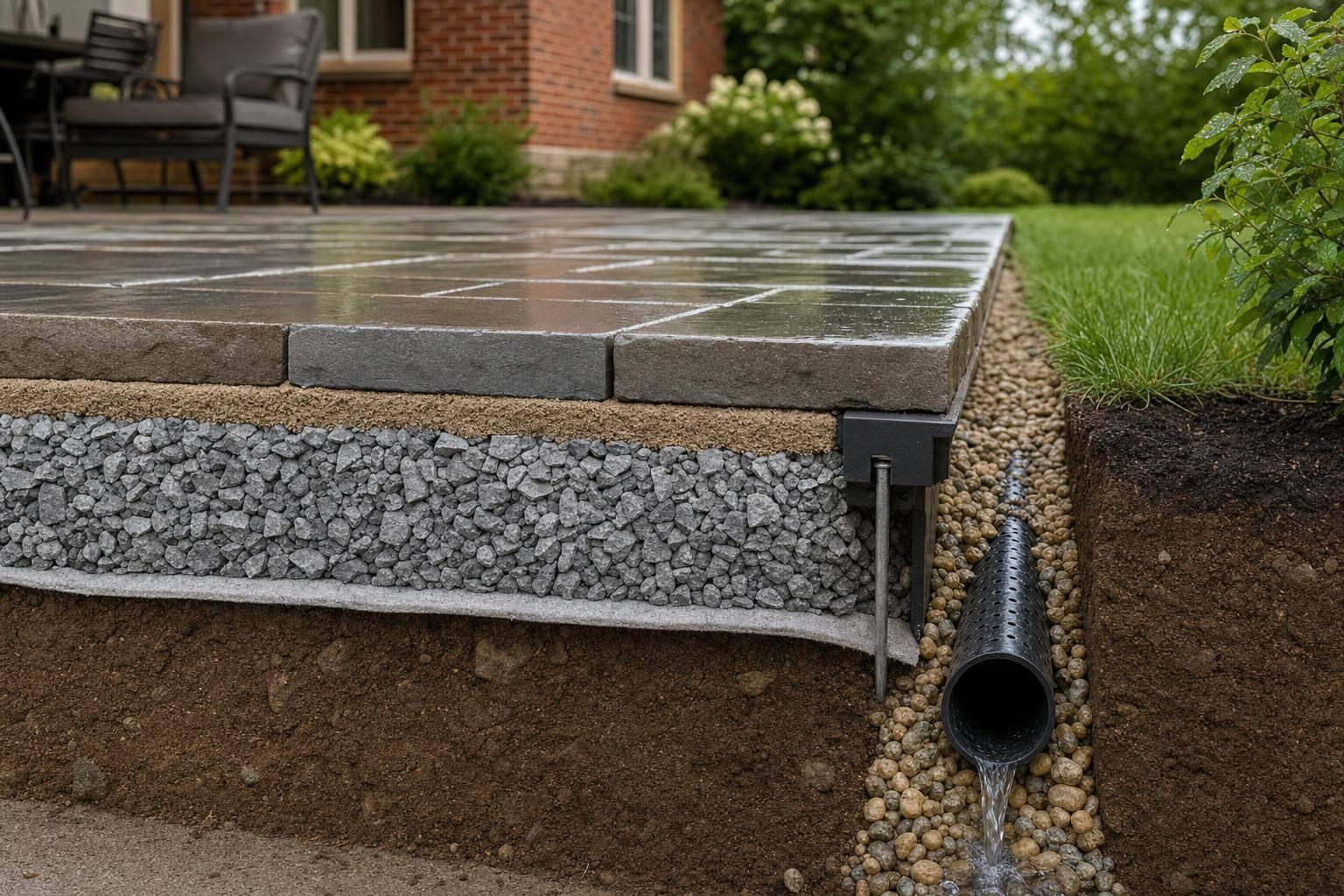
Maryland weather can wear out a patio fast. Hot, humid summers, steady rain, and winter freeze-thaw cycles put pressure on the surface, the joints, and the base all at once.
If I had to sum it up in one line, it would be this: the best patio material is the one installed on a solid base with good drainage and strong edge support. On their own, materials only tell part of the story.
Here’s the short version:
- Concrete pavers usually do best in freeze-thaw weather because each unit can move a little without the whole surface cracking.
- Natural stone can last well, but results depend a lot on the stone type, thickness, and base prep.
- Gravel joints drain fast, but they wash out more often and need more upkeep.
- Polymeric sand joints hold in place better and help cut weed growth, but repair work takes more effort.
- Edge restraints help stop spreading at the perimeter, but they won’t fix a weak base or bad grading.
A few facts matter here:
- Water expands by about 9% when it freezes, which is why freeze-thaw cycles are hard on patio systems.
- Many parts of Maryland get roughly 40 to 45 inches of rain per year, so drainage is a big deal.
- Even a strong surface can fail early if water sits under it or runs through weak edges.
Quick Comparison
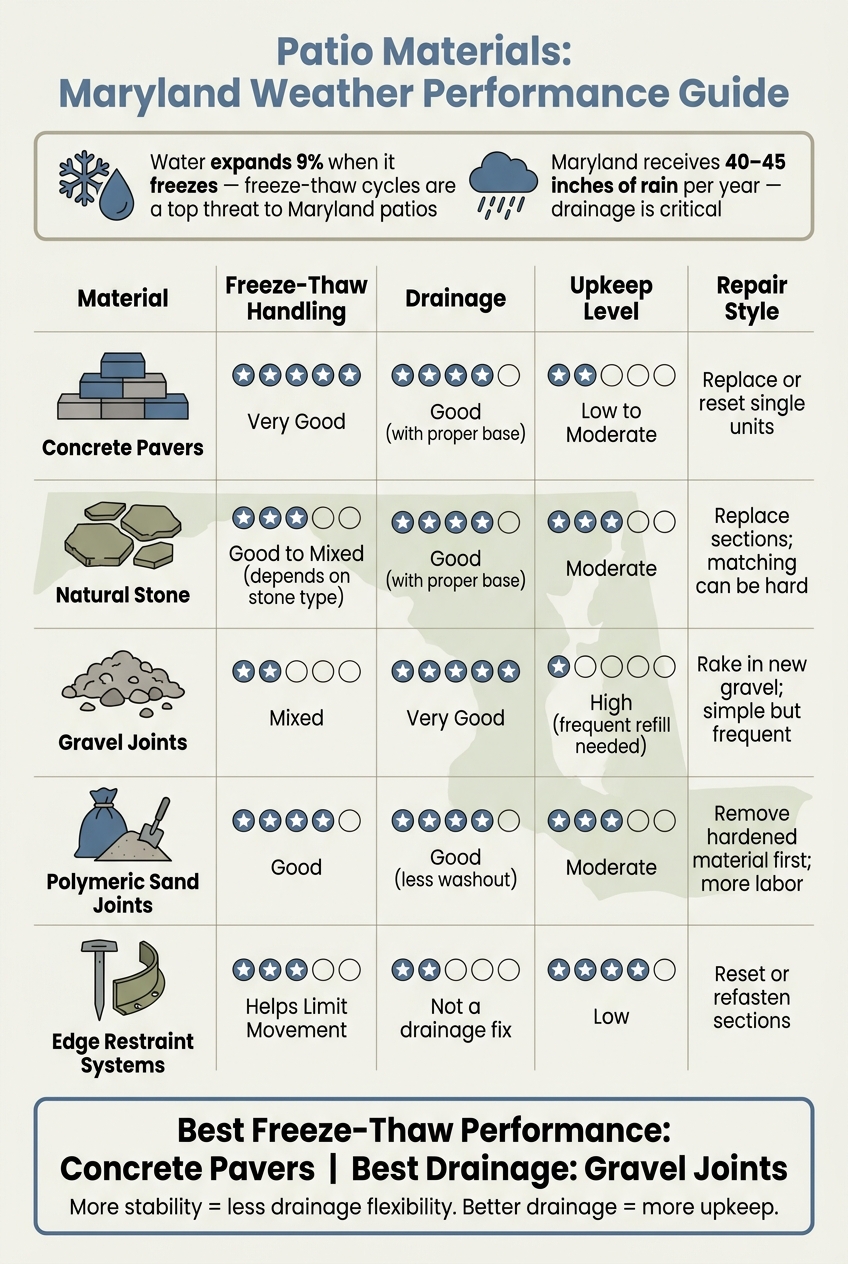
Patio Materials Compared: Maryland Weather Performance Guide
| Item | Freeze-Thaw Handling | Drainage | Upkeep | Repair Style |
|---|---|---|---|---|
| Concrete pavers | Very good | Good with proper base | Low to moderate | Replace or reset single units |
| Natural stone | Good to mixed, based on stone type | Good with proper base | Moderate | Replace sections; matching can be hard |
| Gravel joints | Mixed | Very good | High | Refill joints often |
| Polymeric sand joints | Good | Good, with less washout | Moderate | Remove old joint fill before repair |
| Edge restraints | Helps limit movement | Not a drainage fix | Low | Reset or refasten sections |
Bottom line: if you want fewer long-term problems, I’d look at drainage, joint type, and edge support just as closely as the surface material itself. That’s what shapes how a patio handles Maryland weather year after year.
sbb-itb-843f8be
1. Concrete Pavers
Concrete pavers are a strong choice for Maryland. They deal with moisture and freeze-thaw stress better than poured surfaces when they sit on a stable base. Because each paver is a separate unit, the surface can flex a bit as the ground shifts. That helps cut down on cracking during winter freeze-thaw cycles.
They also drain well when installed over a properly graded base. That matters in a place like Maryland, where humid summers and heavy spring rain can put a lot of pressure on outdoor surfaces. Their density helps them stand up to those conditions without falling apart.
Color fade can happen over time, especially on south-facing surfaces that get long hours of sun and repeated wet exposure. But the change is usually gradual and fairly even, so the surface doesn’t tend to look patchy all at once.
Maintenance is pretty simple. Occasional cleaning and joint sand replacement usually keep pavers in good shape. And if one area gets damaged, you can reset or replace individual pavers without tearing up the rest of the surface. That’s a big advantage over fixing poured concrete, which often turns into a much bigger job.
That said, the material isn’t the whole story. Joints, edging, and drainage still play a big role in how well the surface holds up over time.
2. Natural Stone
Natural stone gives a space a more organic look, but how well it holds up in the weather depends a lot on the type of stone and the base underneath it.
In Maryland, stone can stay stable through wet summers and heavy rain. That said, some types take in more moisture than others. More porous stone is more likely to stain and show surface wear over time. Winter brings a different test. Thicker stone set on a well-prepared base usually handles freeze-thaw cycles well. But if the base work is poor, the stone can shift or spall as the ground moves.
Sun exposure is usually less of a color problem with natural stone than with concrete pigments. Its natural color tends to hold up better. Still, lighter or more porous stone may show weathering in its own way. And if a section gets damaged, you can often reset or replace single stones instead of redoing the whole area. The catch? Matching older or irregular stone can be harder than swapping in a standard paver.
Its joints and edge support matter just as much as the stone itself.
3. Gravel Joints
Gravel joints don’t act like rigid joints, especially in Maryland’s mix of rain and freeze-thaw weather. The loose gravel between pavers or stones drains well by itself, which is a plus. But there’s a trade-off: heavy rain can wash that gravel out of the joints over time, and this tends to happen more on sloped surfaces.
Winter adds another issue. As the ground freezes and thaws, the gravel can shift even more. That movement leaves gaps, and those gaps make it easier for weeds to move in and for the patio edges to lose support.
The good news is that fixing gravel joints is simple. You don’t need special tools or hard-to-find materials. In most cases, it just means raking in new gravel and tamping it down. Still, this kind of upkeep comes up more often than it does with other joint materials.
Loose joint material also puts more pressure on the patio edges. That’s why edge restraint matters.
4. Polymeric Sand Joints
Compared with gravel joints, polymeric sand locks paver joints in place. It’s made to set with water, which creates a firm joint that can stand up to heavy rain without washing out.
Freeze-Thaw Durability
That firm joint stays put while still letting pavers expand and contract through freeze-thaw cycles.
Drainage and Moisture Handling
Once it fully cures, polymeric sand resists washout in a way loose gravel simply can’t. It also helps block weeds and ants. The catch? It needs to cure all the way before Maryland’s humid weather and summer storms put it to the test.
Maintenance and Repair
Repairs are tougher than with loose gravel. Since the joints harden, you have to remove the old material before adding new sand.
5. Edge Restraint Systems
Even if the joints are firm, the patio still needs support around the edges. It may seem like a small detail, but edge restraint plays a big part in how well a patio holds up over time.
Edge restraints help keep pavers and stone from spreading or shifting at the perimeter during Maryland’s freeze-thaw cycles and heavy rain. That matters because movement at the edges can lead to edge creep, joint loss, and uneven surfaces across the whole patio.
That said, edge restraint isn’t a fix for deeper problems. If the base is weak or drainage is poor, even a strong restraint system can’t fully stop movement.
How Each Material Holds Up in Maryland Weather
Maryland weather is tough on patios. You get hot summers, heavy rain, and freeze-thaw cycles that can wear down weak spots fast.
The biggest differences between these materials come down to drainage, joint stability, and edge support.
Here’s the short version, side by side.
| Material | Maryland Performance |
|---|---|
| Concrete Pavers | Best for freeze-thaw; individual units flex slightly without cracking. |
| Natural Stone | Varies by stone type; thicker, well-set stone handles freeze-thaw better than porous stone. |
| Gravel Joints | Best drainage, but joints need frequent replenishing. |
| Polymeric Sand Joints | Locks joints in place and resists washout better than loose fill. |
| Edge Restraint Systems | Helps keep pavers and stone from spreading at the perimeter. |
The tradeoff is pretty simple. More stability often means less drainage flexibility. And better drainage usually comes with more upkeep.
In this comparison, concrete pavers hold up best in freeze-thaw conditions, while gravel joints drain best.
Pros and Cons of Each Option
Repairability is the clearest long-term difference. Once weather resistance is accounted for, this becomes the day-to-day factor that often decides which option makes sense.
| Item | Main Pros | Main Cons | Repair Pattern |
|---|---|---|---|
| Concrete Pavers | Individual units can be lifted, replaced, or re-leveled without disturbing the surrounding surface | Still depends on proper base prep, drainage, and edge restraint | Lift and replace individual units with minimal visible patching |
| Natural Stone | Natural look; strong visual character | More porous types absorb moisture and show wear faster in Maryland’s wet seasons | Section-by-section replacement; exact color and texture matches are difficult after weathering |
| Gravel Joints | Drains well on its own; easy and inexpensive to replenish | Washes out in heavy rain and shifts during freeze-thaw cycles; weeds move in quickly | Rake in new gravel and tamp down; upkeep is frequent |
| Polymeric Sand Joints | Locks joints in place and resists washout better than loose fill; blocks weeds and ants | Must fully cure before rain or humidity; harder to remove and replace than loose gravel | Remove hardened material before adding new sand; repairs take more time and effort |
| Edge Restraint Systems | Prevents edge creep and joint loss during freeze-thaw cycles and heavy rain | Cannot compensate for a weak base or poor drainage | Inspect and reset fasteners or restraint sections; not a standalone fix |
The pattern is pretty clear. Concrete pavers are easier to fix because you can work on one area without tearing up the rest. Natural stone can look great, but repairs get tricky when weathering changes the color and texture over time. With gravel joints, the fix is simple, but you may end up doing it again and again. Polymeric sand joints hold better, though repairs take more labor once the material hardens. And edge restraint systems help hold everything together, but they can’t save an installation built on a weak base or poor drainage.
That’s why installation details matter just as much as the surface material.
Conclusion
In Maryland, the best patio is built as a system, not just a surface. The base, joints, and edging matter just as much as the top layer. If those parts fail, the patio usually follows. Long-term performance comes down to one thing: how well the whole system deals with water and ground movement.
For homeowners in central Maryland, it’s smart to have a specialist look at the full patio system before any build or repair work starts. That’s especially important for paver patios, flagstone patios, and drainage repairs. Pro Landscapes MD offers patio design and installation, drainage solutions, and patio repair across central Maryland, including Howard County, Montgomery County, and Baltimore County.
FAQs
Which patio material lasts longest in Maryland?
Natural stone usually lasts the longest in Maryland. In many cases, it holds up for 50 to 100 years or more.
Concrete pavers are durable too, and they tend to handle freeze-thaw cycles well. Most last about 25 to 50 years.
For both materials, lifespan comes down to the basics: proper base preparation and drainage. That matters even more in Maryland, where clay-heavy soils and frequent precipitation can put extra stress on patios, walkways, and driveways.
How do I know if my patio has drainage problems?
Look for water pooling on the patio during or after rain instead of draining away. That’s often the clearest sign something’s off.
Other red flags include:
- Soil washing away around the edges
- Pavers that shift, sink, or feel loose
- Uneven spots across the surface
- Surface heave
- Water collecting near walls or against your home’s foundation
You may also notice damp areas that never seem to dry out, or even rot nearby. When that happens, poor grading or drainage is often the cause.
Should I choose gravel joints or polymeric sand?
It comes down to your patio’s drainage needs and how the system was built.
Polymeric sand is usually the right pick for standard interlocking pavers. It helps keep the pavers locked in place, adds stability, and cuts down on weed growth. That said, installation matters a lot. If it’s not put in correctly, it may not hold up well during Maryland’s freeze-thaw cycles.
For permeable paver systems, go with specialized angular stone in the joints so water can drain the way it should. Skip standard sand and polymeric sand here, because they can clog the drainage system and lead to pooling.
Chat with Us