









- bhavya gada
- No Comments
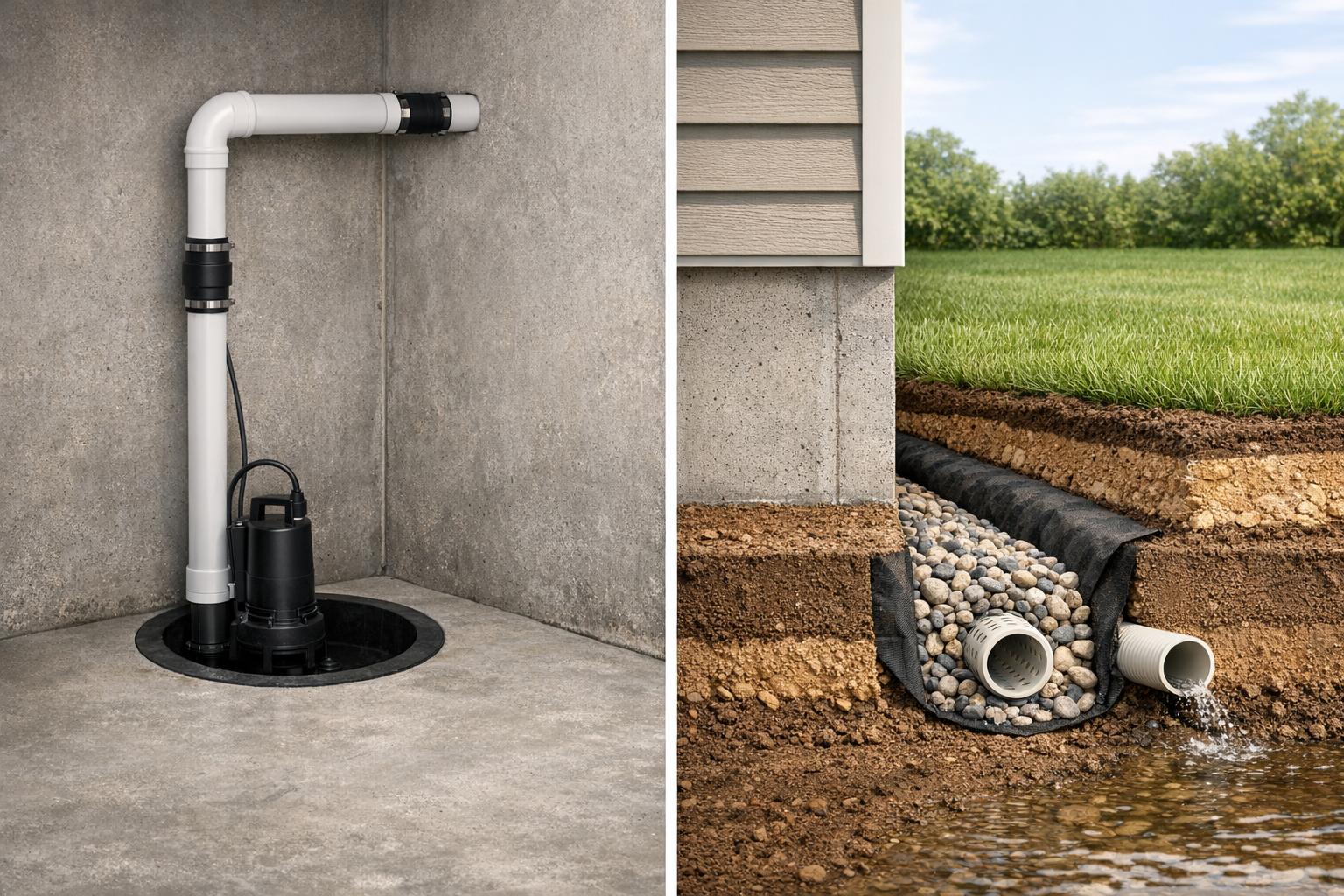
When managing water issues on your property, two common solutions are sump pumps and French drains. Here’s the key difference: sump pumps actively remove water from your basement, while French drains passively redirect groundwater away from your home. Costs vary widely:
- Sump Pump: Installation ranges from $1,200 to $3,000, with maintenance and electricity costs adding $50 to $200/year. Replacement typically costs $800 to $1,600.
- French Drain: Prices start at $2,000 and can exceed $15,000, depending on trench length, depth, and complexity. Maintenance is minimal but may require professional cleaning every 3–5 years.
Both systems have strengths. Sump pumps are ideal for high water tables and frequent basement flooding, while French drains are better for surface water and sloped landscapes. In some cases, combining both offers the best protection. Below is a quick comparison:
Quick Comparison
| Feature | Sump Pump | French Drain |
|---|---|---|
| Cost Range | $1,200–$3,000 | $2,000–$15,000+ |
| Maintenance | Annual checks required | Occasional cleaning |
| Operating Costs | $50–$200/year | $0 (gravity-powered) |
| Best For | Basement flooding | Surface water, runoff |
Choose based on your property’s needs, soil type, and budget.
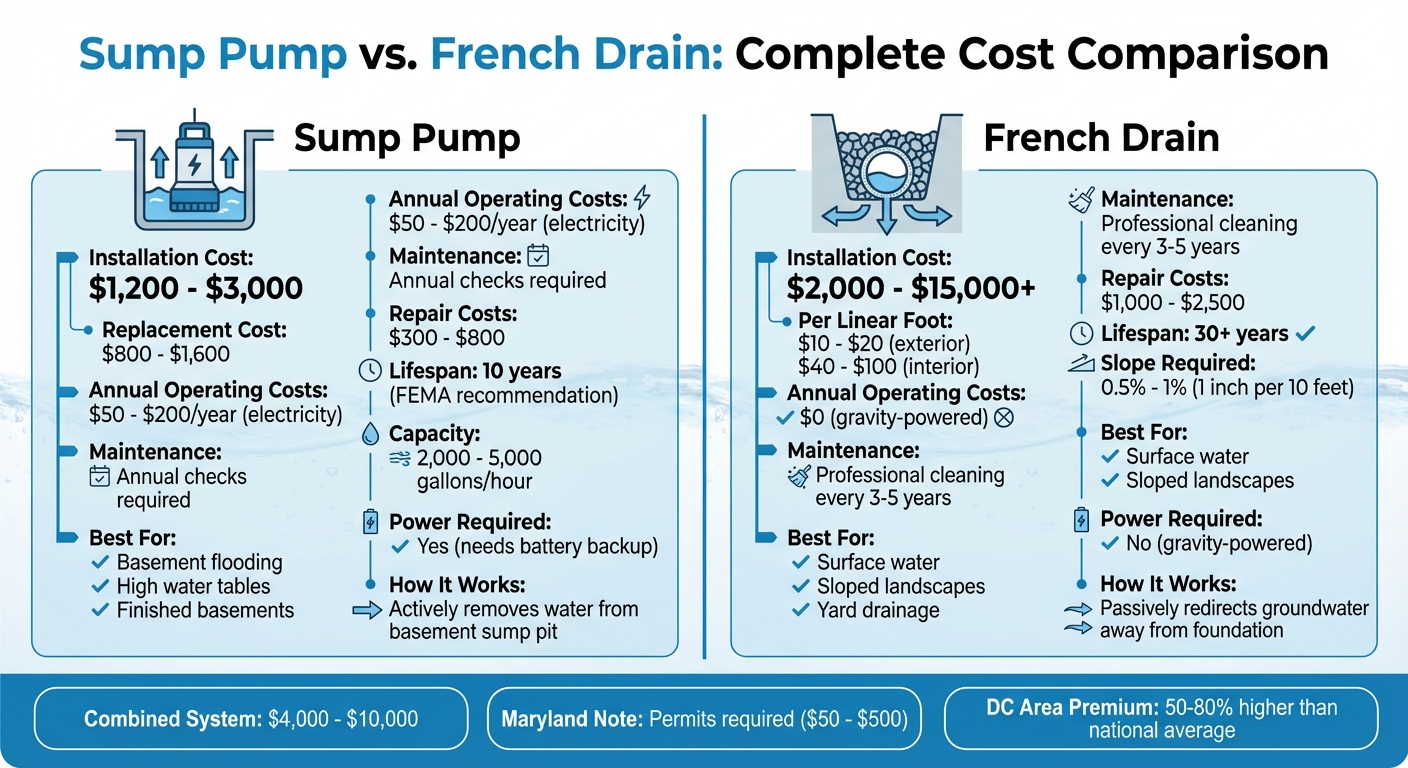
Sump Pump vs French Drain Cost Comparison Chart
Sump Pump Costs and How They Work
How Sump Pumps Work
A sump pump is designed to quickly remove water from your basement, protecting your home from flooding. Here’s how it works: water naturally seeps through the soil toward your foundation and collects in a sump pit, a specially designed basin at the lowest point of your basement or crawl space. When the water level in the pit reaches a certain height, a float switch or pressure sensor activates the pump automatically [6][7].
Once the pump kicks in, it moves water out at a rate of 2,000–5,000 gallons per hour, directing it through a discharge pipe away from your home’s foundation. This is especially critical during heavy storms [1]. As ServiceTitan puts it:
"Sump pumps handle water that has already entered your drainage system. They’re your last line of defense against flooding." [1]
Unlike preventive measures that aim to stop water from entering in the first place, sump pumps are reactive systems, stepping in when water has already infiltrated. Now, let’s break down what it costs to install one in Maryland.
Sump Pump Installation Costs in Maryland
The cost of installing a sump pump in Maryland depends on the complexity of the system. For 2026, a basic standalone installation ranges from $2,000 to $3,800. If your project involves integrating the pump with existing drainage systems or adding waterproofing measures, the price can climb to $3,800 to $7,500 [5].
Replacing an existing sump pump is significantly cheaper, costing between $800 and $1,600, since the sump pit and plumbing are already in place [5]. However, if your basement has a thick concrete floor that needs excavation, expect to add $2,000 to $5,000 to the total cost [7]. In urban areas like Baltimore, higher labor rates and stricter permitting – ranging from $50 to $200 – can further increase expenses compared to rural parts of Maryland [3][4][7].
Don’t forget the ongoing costs. FEMA suggests replacing your sump pump every 10 years to ensure it functions properly during major storms [1]. Electricity costs for running the pump average $50 to $200 annually, and repairs for issues like stuck switches or clogged pipes typically fall between $300 and $800 [1].
sbb-itb-843f8be
French Drain Costs and How They Work
How French Drains Work
French drains are designed to stop water from reaching your foundation, unlike sump pumps, which only deal with water after it has already pooled. Ark Basement Services describes them as:
"A French drain is a slightly sloped trench filled with round gravel and a pipe that diverts water away from your house." [9]
To install one, you’ll need a trench about 18–24 inches deep with a slope of 0.5%–1% (roughly 1 inch per 10 feet) [1]. Inside the trench, a perforated pipe is placed and surrounded by clean gravel. The entire system is wrapped in landscape fabric to keep sediment out and prevent clogs [2,9]. As groundwater moves toward your home, it filters through the gravel and fabric before flowing through the pipe to a safe discharge point away from the house.
What’s great about French drains is that they work without electricity or moving parts. One Call Plumbing explains:
"French drains work continuously. They don’t need electricity or moving parts. As long as water can flow downhill, the system keeps working." [1]
By redirecting groundwater, French drains help lower hydrostatic pressure, which can otherwise lead to basement leaks or even structural cracks [2,10]. This is particularly beneficial in areas like Maryland, where heavy clay soil tends to retain water, creating soggy spots that can harm foundations over time [1].
French Drain Installation Costs in Maryland
In Maryland, the cost of installing a French drain depends on the complexity of the project. For 2026, pricing falls into three general categories:
- Basic systems (simple exterior runs or small yard fixes): $2,000 to $4,000
- Medium installations (perimeter drainage with moderate excavation): $3,500 to $6,500
- Complex projects (deep trenches, hardscape removal, or dry well integration): $6,500 to $12,000+
The cost per linear foot varies widely based on the type of drain and project specifics. Exterior yard drains typically run $10 to $20 per foot, while interior basement drains, which require concrete removal, range from $40 to $100 per foot [2]. Maryland’s dense red clay soil can also increase labor costs, as additional drainage layers may be needed to handle compacted or rocky conditions [2,9].
While French drains are relatively low-maintenance, the gravel trench should be professionally cleaned every 3 to 5 years to prevent sediment buildup [1]. Grand Design Landscape emphasizes the long-term value:
"The average price of repairing water damage often exceeds the cost of installing a French drain, so it should be factored into your landscaping budget as a smart investment." [8]
These costs provide a useful baseline for comparing French drains to other water management solutions, such as sump pump systems.
Cost Comparison: Sump Pump vs. French Drain
Cost Comparison Table
When it comes to drainage solutions in Maryland, the costs for sump pumps and French drains are structured differently. Sump pumps are generally priced as a complete system, while French drains are charged per linear foot. This means the total cost for a French drain depends on how much area needs coverage.
| Feature | Sump Pump | French Drain |
|---|---|---|
| Typical Price Range | $1,200 – $3,000 [1] | $2,000 – $15,000+ [11] |
| Pricing Basis | Per Unit/System | Per Linear Foot |
| Per-Foot Cost | N/A | $10 – $100+ [11][2] |
| Maintenance Frequency | High (annual checks) [1] | Low (occasional flushing) [1] |
| Operating Costs | $50 – $200/year (electricity) [1] | $0 (gravity-powered) [1] |
| Repair Costs | $300 – $800 [1] | $1,000 – $2,500 [1] |
For homeowners looking for maximum protection, combining both systems is an option, with costs ranging from $4,000 to $10,000 [1]. However, in the Washington, D.C. area, labor premiums can inflate costs significantly – expect to pay 50–80% more than the national average due to higher local labor rates [11].
Factors That Affect Installation Costs
Several factors influence the final price tag for sump pumps and French drains, especially in Maryland. The region’s heavy clay soil, for example, requires more intensive excavation, which increases labor, permit, and restoration costs [10][8][1]. If your property has rocky soil or dense tree roots, these site challenges can also drive up expenses [2][1].
Location-specific costs further complicate pricing. Installing exterior French drains in a yard typically costs $10 to $20 per linear foot. Interior basement drains, however, are more expensive due to the need for concrete removal, ranging from $40 to $100 per linear foot [2]. If your yard is hard to access with machinery, manual digging will add to labor costs [2].
Permits are another expense to consider. Maryland’s building codes require drainage permits for systems near foundations or storm drains, with fees ranging from $50 to $500 [11][2]. After installation, you’ll also need to budget for landscaping repairs. For example, topsoil costs between $11 and $53 per cubic yard, and sod is priced at $0.90 to $1.80 per square foot [10].
Excavation depth plays a big role in the overall cost. Shallow trenches (18–24 inches) are much cheaper than deeper ones (4–6 feet) required near foundations [11][1]. Properly installed French drains also need a slope of 0.5% to 1% – roughly ½ to 1 inch per 10 feet – to ensure effective drainage flow [1].
Which System Is Right for Your Property?
When to Install a Sump Pump
A sump pump is a smart choice if your basement frequently floods, your property has a high water table, or you notice water seeping through foundation cracks. For homes with finished basements, a sump pump can be a game-changer by actively removing water. These systems are capable of pumping out between 2,000 and 5,000 gallons of water per hour, making them essential for keeping your home dry during heavy water intrusion [1].
If your property has heavy clay soil, you might want to seriously consider a sump pump. Clay tends to retain water, creating intense hydrostatic pressure against foundation walls and preventing natural drainage [1]. Additionally, if your home is located in a flat or low-lying area where gravity alone can’t direct water away, a sump pump can step in to mechanically lift and discharge the water [1].
However, keep in mind that sump pumps rely on electricity to function. To avoid issues during power outages, a battery backup system is often necessary. FEMA also suggests replacing sump pumps after 10 years, especially if they show signs of irregular operation [1].
If your main concern is surface water pooling in your yard, a French drain might be a better alternative.
When to Install a French Drain
French drains are ideal for properties with sloped landscapes or issues with surface water accumulation. If your lawn often has standing water or soggy spots after it rains, and you want to stop runoff from reaching your foundation, a French drain can redirect water before it becomes a problem.
These systems work by using gravity to guide water downhill to a designated discharge point, making them especially effective in sandy soils that drain quickly. One of their biggest advantages is that they don’t require electricity, so they’ll continue to function even during power outages. For many homeowners, combining a French drain for routine runoff with a sump pump as a backup for heavy flooding creates a well-rounded drainage solution [1].
Professional evaluation can help you decide which system – or combination of systems – will work best for your property.
Pro Landscapes MD: Professional Drainage Installation

Pro Landscapes MD specializes in custom drainage solutions across central Maryland, offering services like French drain installation, drainage repairs, grading, and land leveling. Their team assesses your property’s unique features – such as soil type, slope, and water flow patterns – to recommend the right system, whether it’s a sump pump, a French drain, or both.
Many properties in Howard, Montgomery, Carroll, Frederick, Prince George’s, and Baltimore Counties face challenges like heavy clay soils and seasonal rainfall. Pro Landscapes MD provides expert grading, excavation through tough soil conditions, and ensures proper water discharge placement. Their services also extend to stormwater management, dry riverbeds, and yard restoration, tackling both immediate drainage issues and preserving long-term landscape health.
If you’re unsure about which drainage system suits your needs, Pro Landscapes MD offers site evaluations and expert guidance to help you choose the most effective and budget-friendly solution for your property.
FRENCH DRAIN VS SUMP PUMP | WHAT’S THE DIFFERENCE? | WHY DO I NEED ONE? | CENTURY 21 PLATINUM

Conclusion
Selecting between a sump pump and a French drain depends on your specific drainage requirements and budget. Sump pumps, priced between $1,200 and $3,000 [1], are ideal for preventing basement flooding and dealing with high water tables. However, they rely on electricity and require regular maintenance. On the other hand, French drains cost $25 to $40 per linear foot for yard drainage and $80 to $150+ per linear foot for interior systems. These systems work passively to redirect water and can last over 30 years [11].
For the best protection, combining both solutions can be highly effective. A French drain manages water runoff outside your home, while a sump pump acts as a backup to handle any water that makes its way inside [1]. Understanding these differences can help you choose the most efficient and cost-effective solution for your property.
If you’re located in areas like Howard, Montgomery, Carroll, Frederick, Prince George’s, or Baltimore County, Pro Landscapes MD offers expert site evaluations and personalized drainage solutions. Their services include French drain installation, grading, stormwater management, and yard restoration, all tailored to Maryland’s unique soil and climate conditions.
Visit Pro Landscapes MD to schedule a consultation and protect your property from water damage with professional drainage solutions.
FAQs
Do I need a sump pump, a French drain, or both?
Whether you need a sump pump, a French drain, or both depends on how water affects your property. A sump pump works by actively pumping water out of basements or crawl spaces, keeping them dry. On the other hand, a French drain passively redirects water away from your home’s foundation to prevent it from pooling or seeping in.
In many cases, using both systems together provides a more comprehensive solution, tackling water issues from multiple angles. To figure out what’s best for your specific situation, it’s a good idea to consult a professional. They can assess your property and recommend the right approach.
What factors make a French drain cost more on my property?
The price of installing a French drain on your property can go up depending on several factors. The length and depth of the trench play a big role, as longer or deeper trenches require more labor and materials. Soil type and the slope of your yard can also impact costs – rocky soil or steep slopes make the installation trickier. Limited access to the site can add to the expense, as it may require specialized equipment or more manual labor. Finally, extra features like dry wells or sump pumps can increase the overall cost due to the added complexity and materials needed for these additions.
How do I protect a sump pump during power outages?
To ensure your sump pump keeps working during power outages, consider adding a backup power source. Options like a battery backup system or an uninterruptible power supply (UPS) can keep the pump running when the electricity goes out, helping to prevent flooding. Beyond that, you can reduce the pump’s workload by extending gutter downspouts further away from your home’s foundation and maintaining proper drainage around your property, especially during heavy storms.
Chat with Us