









- bhavya gada
- No Comments
Underground detention systems manage stormwater runoff by collecting and releasing rainwater gradually. These systems are mandatory in many Maryland jurisdictions when adding hard surfaces like driveways or roofs. Proper budgeting ensures compliance and functionality.
Key Steps for Budgeting:
- Calculate Storage Volume: Based on hard surface area; ranges from 3,000 to 40,000 liters.
- Evaluate Site Factors: Soil conditions, elevation, and drainage requirements.
- Select System Type: Options include pipe systems, chamber systems, concrete vaults, or modular plastic drainage cells.
Costs:
- Installation: $500–$2,500 per 1,000 liters.
- Permit & Inspection Fees: Varies by county; some areas like Montgomery County offer rebates up to $7,500 for residential projects.
Maintenance:
- Regular inspections and cleaning are essential to avoid fines or costly repairs.
Work with professionals to ensure compliance with Maryland’s stormwater regulations and avoid unexpected expenses.
Assess Site Requirements and Storage Capacity
Complete a Site Assessment
Before diving into budgeting, it’s essential to evaluate your property’s hard surfaces and slope. Start by measuring all impervious areas – like roofs, driveways, walkways, and paved patios – because these measurements are the foundation for storage calculations [1]. Next, consider the slope of your property. Most gravity-fed underground systems require a fall of 6.5 to 10 feet from the installation site to the street or drainage easement to operate effectively [1].
If you’re planning an absorption-based system, you’ll need a geotechnical engineer to test soil permeability and check for underlying rock [1]. Rocky terrain can drive up excavation costs and may limit how deep the system can be installed. Also, confirm whether your property has legal access to a drainage easement. Without one, properties that slope away from the street may face strict limits on hard surface coverage – sometimes as low as 30% to 35% of the total lot size [1].
To gather more information, consult your county’s Geographic Information Systems (GIS) maps to identify nearby storm drains, culverts, or utility lines [2]. It’s also a good idea to schedule a pre-lodgment meeting with your local engineering department early in the process. This meeting can provide written guidance on coverage limits and approved system types [1].
Once you’ve assessed these conditions, you’ll be ready to calculate the required storage volume.
Calculate Required Storage Volume
The storage volume you’ll need depends on the impervious surface area of your property. Many jurisdictions provide specific formulas based on the size of your lot and the extent of hard surface coverage. For instance, a 10,000-square-foot property might require storage capacity between 5,000 and 10,000 gallons, depending on local regulations [1]. If your hard surfaces exceed 35%–40% of the lot, detention requirements may also apply [1].
For straightforward layouts, basic formulas will usually suffice. However, properties with more complex drainage patterns might need computer modeling to ensure accurate calculations [1]. Additionally, check if your local rules allow for volume offsets. Some areas reduce detention storage requirements by up to 50% if you install rainwater harvesting tanks for on-site reuse [1]. This can lower installation costs while providing the added benefit of water conservation.
sbb-itb-843f8be
Review Local Regulations and Permit Costs
Understand Maryland Stormwater Requirements
Before diving into your stormwater management project, it’s crucial to look into Maryland’s stormwater regulations. For example, in Montgomery County, underground detention systems are inspected every three years to check for clogging and structural issues, ensuring compliance with MS4 (Municipal Separate Storm Sewer System) standards [3].
You’ll also need to determine whether your property falls under county jurisdiction or a local municipality like Rockville, Gaithersburg, or Takoma Park [4]. In most Maryland counties, property owners or homeowners associations are responsible for maintaining stormwater systems. If your system isn’t up to code, you could have as little as 30 days to fix the issues before facing potential fines [2].
Once you’ve reviewed these requirements, the next step is to look at the costs associated with permits and inspections.
Calculate Permit and Inspection Fees
After understanding the regulations, it’s time to figure out the fees you’ll need to budget for. Permit costs can vary widely depending on your county and the scope of your project, so reaching out to your local Department of Environmental Protection (DEP) or Permitting Services is a smart move [2]. In Montgomery County, inspections are funded through the Water Quality Protection Charge (WQPC), meaning there’s no per-visit fee [3]. However, failing to maintain your system could lead to hefty fines, and bringing a neglected system back into compliance might cost tens of thousands of dollars [2].
On the bright side, Montgomery County offers rebates to help offset costs. Residential projects can qualify for up to $7,500, while commercial, HOA, multifamily, or institutional properties can receive up to $20,000. These rebates are typically issued within 8–12 weeks after the final inspection, and you may also qualify for a WQPC credit to lower ongoing charges [4]. Keep in mind, though, that projects installed without prior approval usually don’t qualify for rebates or compliance certification. To ensure eligibility, submit your plans to the county planner within three months of receiving your site assessment report [4].
Mastering the Design of Underground Detention & Infiltration Systems
Compare System Options and Pricing
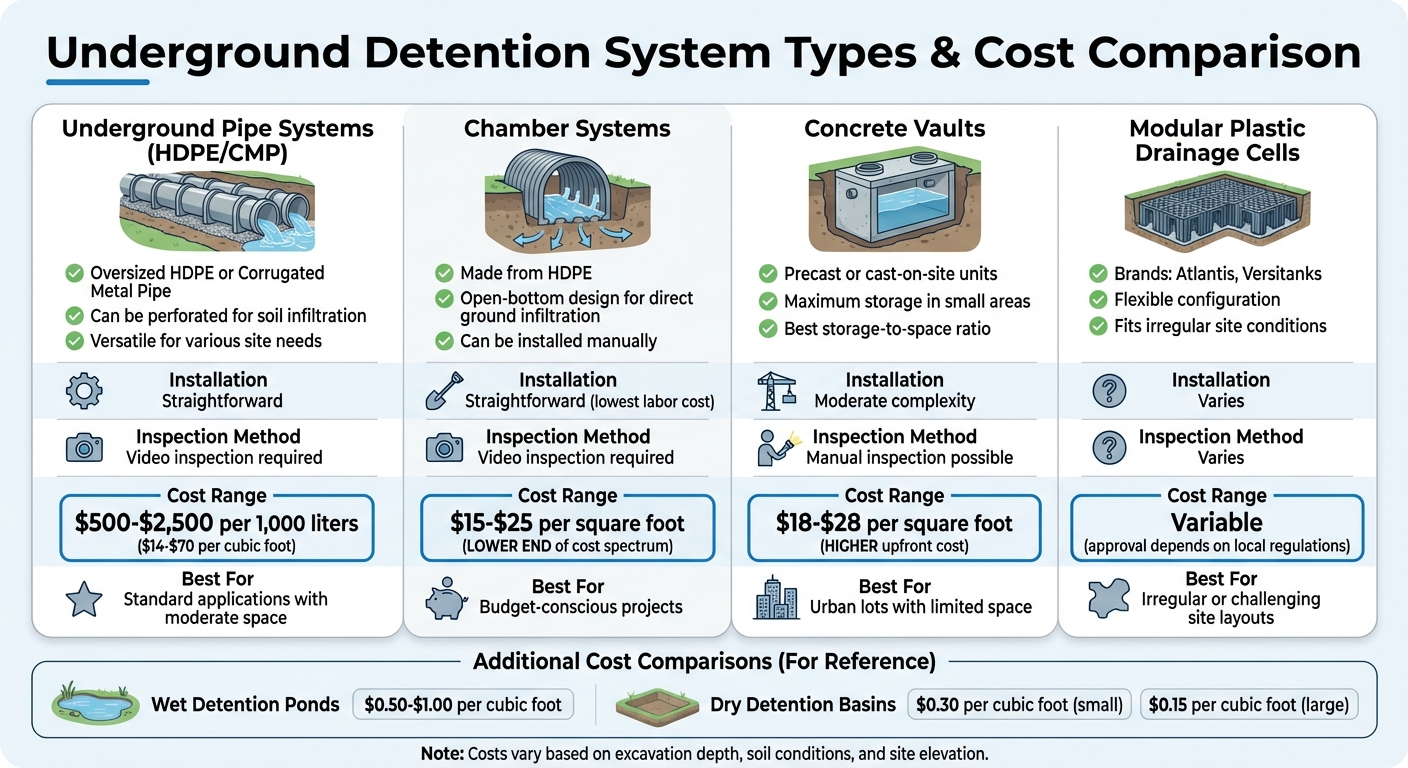
Underground Detention System Types and Costs Comparison
Types of Underground Detention Systems
There are four main types of underground detention systems to consider:
- Underground pipe systems: These use oversized High Density Polyethylene (HDPE) or Corrugated Metal Pipe (CMP) installed in series. They can also be perforated to allow water to infiltrate into the surrounding soil, making them versatile for various site needs [5].
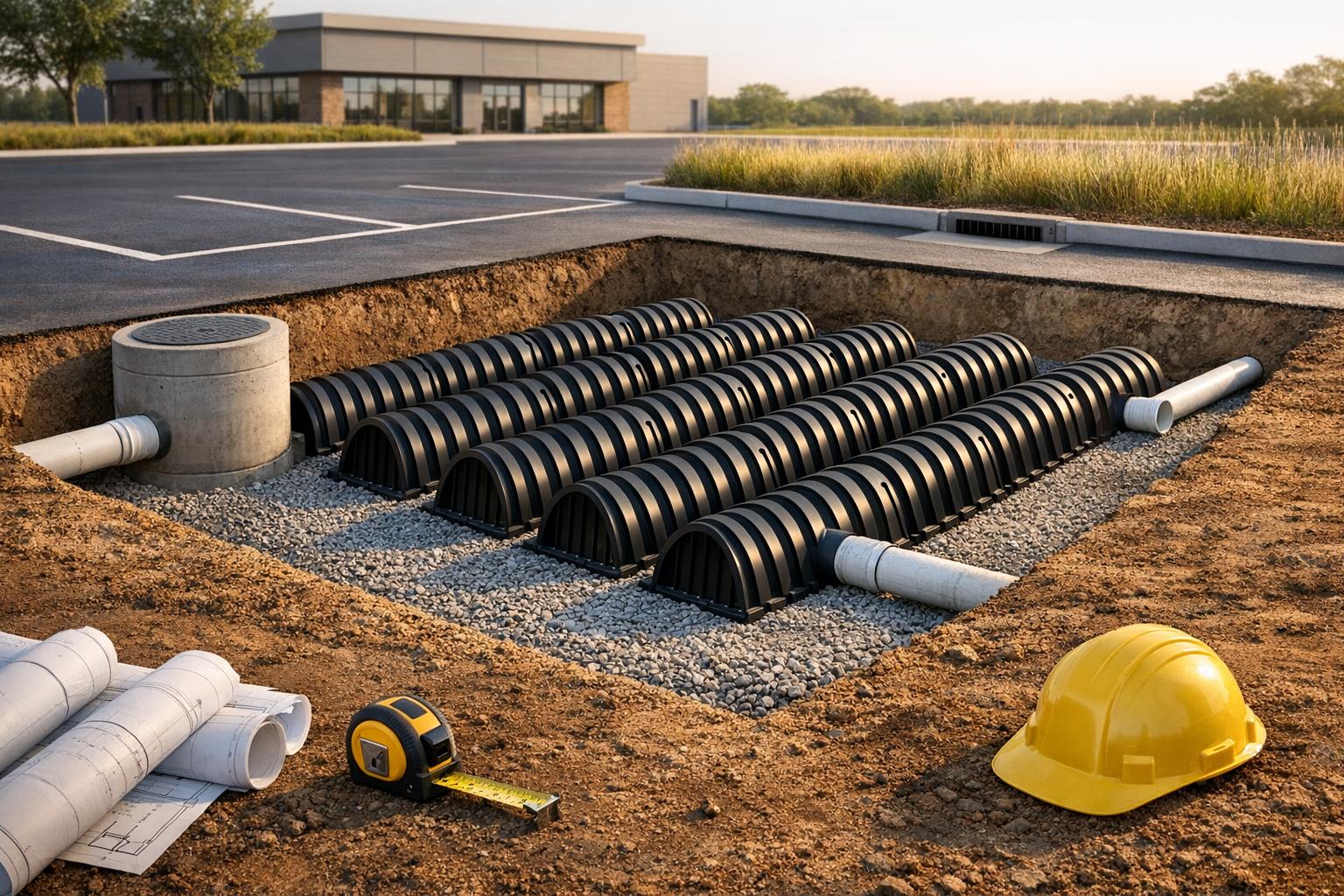
- Chamber systems: Made from HDPE, these systems feature an open-bottom design that lets water seep directly into the ground. They’re often a more budget-friendly option because they can be installed manually [5].
- Concrete vaults: Available as precast or cast-on-site units, these systems maximize storage capacity in small areas. While they come with a higher price tag, they’re perfect for urban lots where space is at a premium [5].
- Modular plastic drainage cells: Brands like Atlantis or Versitanks offer these flexible systems, which can be shaped to fit irregular site conditions. However, approval for these systems may vary depending on local regulations [1].
VERTEX notes that extending pipe runs can help reduce the expense of manifolds. Additionally, concrete vaults allow for manual inspections, whereas pipe and chamber systems typically require video inspections [5].
System Cost Comparison
The cost of installing an underground detention system depends on the type of system and site conditions. Here’s a breakdown of typical costs:
- Underground detention systems: Installation costs range from $500 to $2,500 per 1,000 liters (about $14 to $70 per cubic foot), depending on factors like excavation depth and soil conditions [1].
- Wet detention ponds: These cost around $0.50 to $1.00 per cubic foot, making them a more affordable option for larger projects [6].
- Dry detention basins: Costs are approximately $0.30 per cubic foot for smaller installations and drop to $0.15 per cubic foot for larger ones [6].
Chamber systems are usually on the lower end of the cost spectrum since they don’t always require heavy equipment for installation. On the other hand, concrete vaults have a higher upfront cost but offer the best storage-to-space ratio, making them ideal for space-constrained properties. Keep in mind, if your site has less than 6 to 10 feet of elevation change, you may face higher installation costs or need to add a pump system, which increases both initial and ongoing expenses [1].
Next, consider breaking down installation and maintenance costs to finalize your budget.
Calculate Installation and Maintenance Costs
Installation Cost Breakdown
Planning for installation costs upfront can save you from unexpected expenses later. Among these, excavation and site preparation often account for the largest portion of the budget, especially if your property has challenges like rocky soil, a high water table requiring dewatering, or contaminated soil that needs specialized disposal.
When it comes to materials, costs can vary significantly depending on the type of system you choose:
- HDPE chambers: $15–$25 per square foot
- Vault systems: $18–$28 per square foot
- Concrete boxes: $20–$35 per square foot
- Concrete tanks: $25–$45 per square foot [7]
Additionally, backfill and crushed stone are essential for proper drainage and structural support, and using clean material around detention units can add to the overall expense.
Labor costs are another factor to consider, and they often depend on the complexity of the installation. HDPE and vault systems are relatively straightforward to install, while concrete boxes require moderate effort. Concrete tanks, however, are more labor-intensive, leading to higher costs.
Once installation is complete, it’s equally important to plan for ongoing upkeep to protect your investment.
Budget for Ongoing Maintenance
After the system is installed, regular maintenance is crucial to keep it running efficiently. A key task is inspecting and cleaning the metal orifice plate in the Discharge Control Pit (DCP), which regulates water flow. Ensuring easy access for periodic cleaning and inspections is essential.
Property owners are usually responsible for maintaining the system, which often involves hiring specialized contractors for tasks like inspections and sediment removal. Maintenance needs tend to grow with system size. For example, larger systems – those with storage capacities between 3,000 and 40,000 liters – require more frequent and intensive sediment removal.
To prepare for these long-term costs, it’s smart to establish a reserve fund based on a 20-year lifecycle cost analysis. This approach helps you account for both installation and maintenance expenses, creating a more balanced and sustainable financial plan.
How Pro Landscapes MD Can Help

Stormwater Management Services
Pro Landscapes MD specializes in designing and installing underground detention systems throughout central Maryland. These systems utilize concrete tanks and modular plastic drainage cells to manage stormwater effectively. They also incorporate DCPs (Detention Control Panels) equipped with metal orifice plates and other key stormwater components like inlets and pump pits, which are particularly useful for handling water in uphill areas. To ensure accuracy, they rely on County GIS tools to pinpoint existing infrastructure and make sure your project aligns with local regulations. Since county authorities oversee permits for landscaping, tree placement, and privacy screening, Pro Landscapes MD ensures all requirements are met [2]. Their expertise in stormwater management serves as a strong foundation for enhancing your property.
Additional Landscaping and Hardscaping Options
Beyond stormwater solutions, Pro Landscapes MD offers services like installing rainwater tanks designed to collect and reuse water, helping to minimize detention needs [1]. Their hardscaping options include paver driveways, patios, walkways, and retaining walls, all crafted to improve both aesthetics and functionality. They also provide safety features like perimeter fencing and locks, ensuring runoff is managed efficiently while adhering to local codes [1].
Conclusion
Let’s recap: evaluate the site, understand the regulations, weigh your options, and plan your budget for both installation and ongoing upkeep. Each step plays a critical role in ensuring the system operates efficiently and keeps costs manageable over time.
The initial cost of stormwater systems typically falls between $500 and $2,500 per 1,000 liters, but that’s just the beginning. Ownership also involves regular inspections and maintenance. Be sure to set aside funds for annual or semi-annual checkups and cleaning to prevent debris buildup and maintain compliance.
"Routine maintenance now can save lots of money down the line!" – Bryan Saunders, Homeowner Management Services Inc. [2]
Skipping maintenance can lead to repair bills that climb into the tens of thousands. Worse yet, failing to act promptly could result in fines if repairs aren’t completed within the required timeframe [2]. Including stormwater system maintenance as a specific line item in your budget helps you stay prepared for routine needs and avoid financial surprises.
Lastly, work with professionals familiar with Maryland’s specific requirements. Their expertise can help you steer clear of expensive errors and ensure your system meets local standards.
FAQs
Do I need an underground detention system for my project?
Underground detention systems can be a smart choice depending on your specific needs, such as managing stormwater runoff, adhering to local regulations, or dealing with site limitations. These systems are particularly effective for controlling large volumes of water, minimizing flooding risks, and improving water quality – especially in areas where space is tight. To decide if this solution is right for your project, assess your drainage requirements and consult a professional to ensure it aligns with regulatory standards and project goals.
What site issues can increase the cost of my system?
Site-related challenges can push costs higher. For instance, low-lying or flood-prone areas might require adjustments in design or the use of larger tanks to handle potential issues. Similarly, debris or sediment buildup can lead to the need for more frequent maintenance, adding to ongoing expenses. Problems like poor site grading or overland flow issues can also strain the system, often necessitating more intricate or larger-scale solutions to manage the load effectively.
How often will my system need inspections and cleaning?
Underground detention systems generally need inspections and cleaning at least once a year, though certain systems might stretch this to every three years. These regular check-ups are crucial for spotting problems like clogging caused by sediment, debris, or organic material – issues that can cause the system to fail if left unaddressed. By sticking to a consistent maintenance schedule, you can keep the system working efficiently and avoid expensive repairs down the line.
Chat with Us