










- bhavya gada
- No Comments
If you’re managing a construction site disturbing an acre or more of land, you need a Construction General Permit (CGP) under the NPDES program. But what happens when your project is done, or another operator takes over? You either terminate the permit or transfer it. Here’s the difference:
- CGP Termination: Ends your permit coverage when the site is stabilized or you no longer control it. Requires a Notice of Termination (NOT).
- Permit Transfer: Shifts responsibility to a new operator while keeping the permit active. Requires the new operator to file a Notice of Intent (NOI) at least 14 days before the transfer.
Quick Overview:
- Termination: Used when construction is finished and the site is stabilized.
- Transfer: Used when ownership or control changes mid-project.
- Key Forms: NOT for termination, NOI for transfer.
- Timing: Termination happens after stabilization; transfer requires a 14-day NOI submission before the change.
Making the wrong choice or missing deadlines can lead to Clean Water Act violations and penalties. Always ensure proper documentation and follow EPA guidelines to stay compliant.
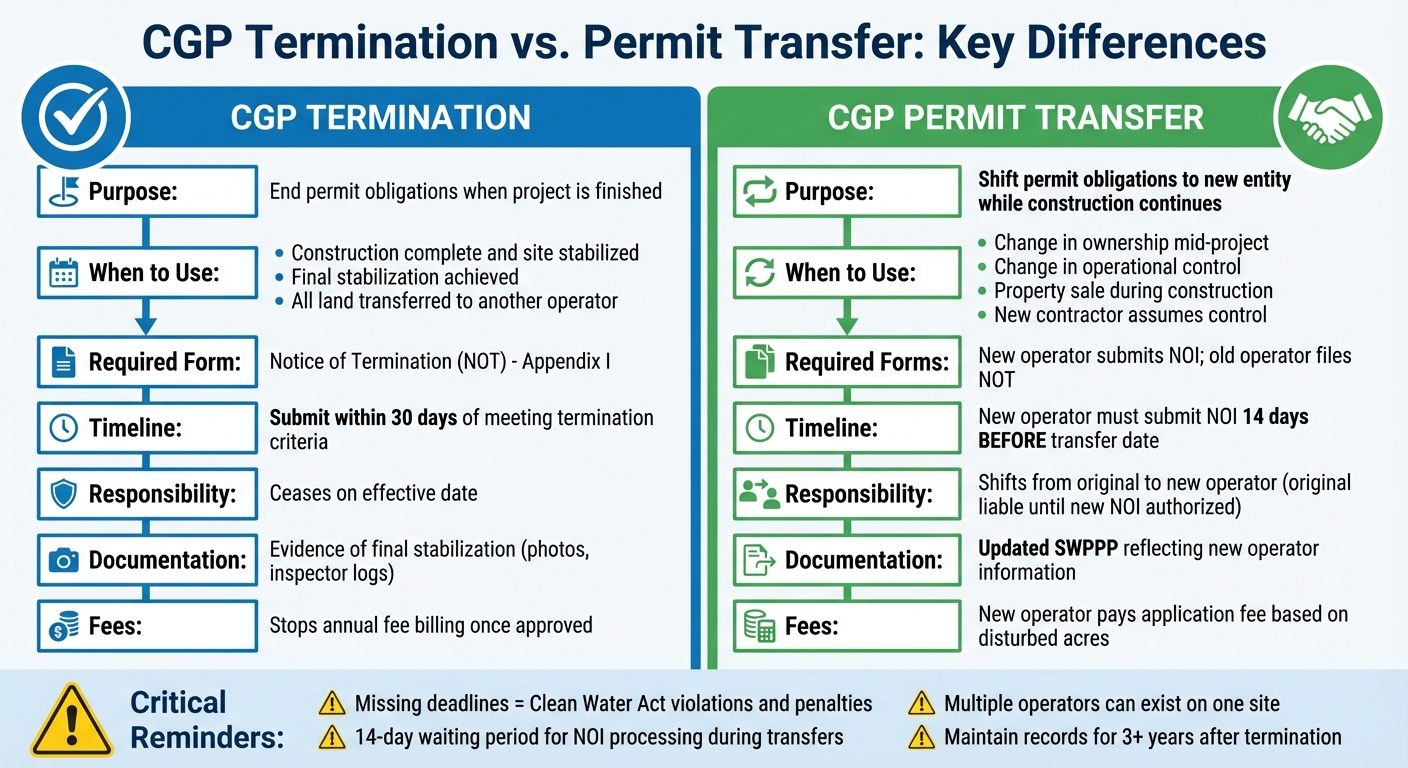
CGP Termination vs Permit Transfer: Key Differences and Requirements
What is CGP Termination?
CGP termination is the official process of ending your construction site’s coverage under the National Pollutant Discharge Elimination System (NPDES) Construction General Permit. This step marks the conclusion of your permit obligations once your project is complete and the site is stabilized [2].
The process ensures your site no longer risks discharging sediment, debris, or chemicals into nearby waterbodies, aligning with Clean Water Act requirements [2].
By terminating your CGP coverage, you end your responsibilities as an operator. This means no more site inspections, updates to your Stormwater Pollution Prevention Plan (SWPPP), or compliance monitoring. In short, you’re officially done with permit-related duties for that site.
When You Can Terminate CGP Coverage
You’re eligible to terminate CGP coverage once your site achieves "final stabilization" – a point where all earth-disturbing activities have ceased, and the ground is permanently protected from erosion. This can be achieved through uniform perennial vegetative cover or equivalent measures like pavement, riprap, or other permanent stabilization methods [2].
For projects that are part of a common plan of development, such as a residential subdivision, you can terminate coverage for your specific section once it’s stabilized, even if other parts of the site are still active [2]. For instance, if you’re a contractor who completed final grading and seeding on Lots 15-20 in a 50-lot subdivision, you can terminate your coverage for those lots as soon as they meet stabilization requirements, without waiting for the rest of the project to finish.
Additionally, if a new operator takes over control of the site, you should terminate your coverage. In this case, the new operator must submit their Notice of Intent (NOI) at least 14 days before the transfer, and you’ll file your Notice of Termination (NOT) to officially hand off responsibilities [3].
Before submitting your NOT, it’s essential to conduct a final inspection to confirm all exposed soil is stabilized and temporary erosion controls – such as silt fences or straw wattles – have been removed. This step helps prevent any violations for unauthorized discharges [2].
Documents Needed for Termination
The key document required for CGP termination is the Notice of Termination (NOT). The EPA provides a standardized NOT form in Appendix I of the 2022 CGP [1]. This form certifies that all conditions for ending permit coverage have been met.
You’ll submit the NOT electronically through the EPA’s NPDES eReporting Tool (NeT), which is the standard submission method under the 2022 CGP [2][3]. Paper submissions are allowed only if you’ve received a formal waiver from electronic reporting from an EPA Regional Office [2].
In addition to the NOT, you should keep final stabilization reports and supporting evidence in your records. This includes photos showing vegetative cover or other permanent stabilization measures, inspection logs, and documentation proving the site meets final stabilization criteria. These records must be retained for at least three years after termination to ensure compliance in case of future audits [2].
The following sections outline the steps and requirements to complete this process efficiently.
sbb-itb-843f8be
What is CGP Permit Transfer?
A CGP permit transfer allows stormwater coverage to shift to a new operator when control of a site changes hands [6]. Unlike termination, which ends the coverage, a transfer keeps the permit active under the new management.
This process is a legal requirement because discharging pollutants into U.S. waters without authorization is prohibited [5]. When a new operator takes over, they must secure coverage before continuing operations to avoid unpermitted discharges and potential violations. The new operator is also responsible for reviewing and updating the Stormwater Pollution Prevention Plan (SWPPP) to reflect ongoing activities [6][7]. This ensures compliance remains intact during the transition.
When You Need to Transfer a Permit
A permit transfer is necessary whenever operational control changes before the site reaches final stabilization [5]. Operational control involves managing construction plans and overseeing daily on-site activities to meet permit requirements.
Typical situations requiring a transfer include property sales during construction. For instance, if a developer sells individual lots within a larger subdivision to different builders, each builder must obtain their own coverage if the total disturbed area of the original project was one acre or more [2]. For example, when a developer sells Lot 8 in a 25-lot subdivision to a custom home builder, that builder becomes the new operator and must transfer permit coverage for that specific lot.
Another scenario involves a mid-project change in general contractors. If a new contractor assumes operational control, a permit transfer is required [2]. However, subcontractors working under the supervision of an authorized general contractor are not considered "operators" and typically do not need to file for a transfer [2].
Documents Needed for Permit Transfer
To ensure a smooth transfer without disrupting coverage, several documents are required:
- Notice of Intent (NOI): The incoming operator must submit this using the EPA’s NPDES eReporting Tool (NeT), including site details, operator information, and a compliance certification [2].
- Notice of Termination (NOT): The outgoing operator submits this to end their responsibility for the site. However, the NOT should only be filed after the new operator’s authorization to avoid any gaps in coverage [1]. Under the EPA CGP, permit coverage typically activates 14 days after the NOI is submitted [2].
- Permit Registration Documents (PRDs): These include the site map, risk assessment, and a signed certification statement [6][7].
- Updated Contact and LRP Information: The new operator must update the Legally Responsible Person (LRP) and contact details in the appropriate tracking system [5][7].
- Application Fee: The new owner is usually required to pay a fee, often based on the number of disturbed acres [7][8].
The transfer process involves coordination between the outgoing and incoming operators to ensure compliance is maintained throughout the transition.
Key Differences Between CGP Termination and Permit Transfer
The main difference lies in their purpose. Termination ends permit coverage permanently once construction is finished and the site achieves final stabilization [1][2]. On the other hand, transfer ensures uninterrupted permit coverage when responsibility shifts – like during a property sale or contractor change – while the project is still active [3].
The timing for each process also varies. Termination occurs after stabilization is confirmed, usually within 30 days of meeting the necessary criteria. For a transfer, the new operator must submit their Notice of Intent (NOI) at least 14 days before taking over, ensuring compliance during the transition [2][3].
Responsibility shifts differently as well. When a permit is terminated, obligations end on the effective date. During a transfer, however, the original operator remains responsible until the new operator’s NOI is authorized [3]. This makes coordination essential – the outgoing operator should only file their Notice of Termination after the incoming operator’s coverage is active. These differences can also influence financial and operational decisions going forward.
Financially, termination halts annual fee billing once it’s approved [8]. With a transfer, the new operator is typically required to pay an application fee based on the number of disturbed acres [8]. The table below highlights these critical differences.
Comparison Table
| Feature | CGP Termination | CGP Permit Transfer | Notes |
|---|---|---|---|
| Primary Purpose | End permit obligations because the project is finished or the operator is leaving | Shift permit obligations to a new entity while construction continues | Ensures SWPPP continuity |
| Eligibility Criteria | Final stabilization reached; or all land areas transferred to another operator [2] | Change in ownership or operational control of an active site | Multiple operators can exist on one site [2] |
| Required Forms | Notice of Termination (NOT) – Appendix I [1] | New operator submits an NOI; old operator then files an NOT [1][2] | No single "transfer form" exists |
| Timelines | Typically submitted within 30 days of meeting termination criteria | New operator must submit NOI 14 days before the transfer date [2][3] | 14-day waiting period for NOI processing |
| Ongoing Responsibilities | Cease upon effective date of termination | Shift from the original operator to the new operator | Original operator is liable until the new NOI is authorized [3] |
| Documentation Needs | Evidence of final stabilization (e.g., photos, inspector logs) | Updated SWPPP reflecting the new operator’s information [2] | New operators must meet all eligibility criteria [3] |
| Fees | Stops annual fee billing once approved [8] | New operator may be required to pay a new application fee [8] | Fees often billed on NOI anniversary month |
How to Terminate CGP Coverage
To terminate your CGP coverage, you’ll need to submit a Notice of Termination (NOT) through the EPA’s electronic system. Start by logging into the NPDES eReporting Tool (NeT) using your CDX account. Once logged in, locate the NOT form and input your NPDES permit tracking number from your original Notice of Intent [9][2]. This step is crucial to kick off the termination process.
Before proceeding, ensure your site meets the termination criteria. The site must be fully stabilized, meaning all exposed soil should have permanent vegetation or an equivalent form of stabilization. Alternatively, if you’ve transferred operational control to another operator, they must already have the necessary authorization in place [9][10]. Submitting an NOT too early could lead to compliance issues, so document your stabilization thoroughly with photos and inspection logs.
If you don’t have reliable Internet access, you can request a waiver from your EPA Regional Office and submit a paper NOT form (found in Appendix I) by mail. The paper form requires a signed certification to confirm that all information provided is accurate and complete [9][2].
How to Transfer a CGP Permit
If you’re looking to transfer a CGP permit, there are specific steps you need to follow. The current licensee and the new operator must register the transfer within 30 days of any change in ownership or control. During this process, only the current operator can act until the transfer is finalized. As outlined by Connecticut’s Department of Energy & Environmental Protection:
A transfer is only effective if DEEP notifies the licensee and proposed transferee that the license has been transferred [11].
Once the transfer notification is in place, you’ll need to complete the formal paperwork. This involves submitting the License Transfer Form (such as Form DEEP-APP-006 in Connecticut), paying the required transfer fee, and providing supporting documents that detail the new operator’s background and compliance history. When applicable, use the NPDES eReporting Tool (NeT) for permit documentation.
The regulatory authority will then evaluate the new operator’s ability to meet the permit’s terms, including a review of their compliance history. If everything checks out, full responsibility for the permit will be assigned for the remainder of its duration.
If the new operator intends to make any operational changes, they may need to request a permit modification or submit a new application. As a reminder:
The transferee may not conduct the activity without first receiving notice confirming the registration and acknowledging the applicability of the license [11].
The new operator must also carefully review the existing Stormwater Pollution Prevention Plan (SWPPP) to fully understand their obligations. In cases where multiple parties have operational control – like an owner and a general contractor – each entity defined as an "operator" must submit the required documentation. However, subcontractors working under a general contractor’s direction usually don’t need to file for permit transfers, as they are not classified as operators [2].
Common Mistakes and How to Avoid Them
When handling CGP termination and permit transfers, certain errors can derail the process. Let’s break down these common mistakes and how to sidestep them.
One frequent issue is incomplete or inaccurate NOIs (Notices of Intent). The US EPA warns, “An incomplete NOI delays permit coverage until such time as the NOI has been completed and the applicable waiting period has passed (i.e., 14 days for the EPA CGP)” [2]. Providing false or incorrect details can not only invalidate your permit but also expose you to Clean Water Act liabilities [2].
Another misstep is filing an NOI before completing the SWPPP (Stormwater Pollution Prevention Plan). The NOI requires certification that your SWPPP is already finalized. Filing the NOI first creates a compliance violation and can lead to delays [2].
Missing the 14-day NOI submission deadline is another common problem. New operators must file their NOI at least 14 calendar days before the transfer date. Missing this deadline can leave your site without authorized discharge coverage during the transition, which may result in enforcement actions [3].
It’s also easy to overlook required operators who need coverage. Both the property owner (responsible for operational control over plans) and the general contractor (managing daily operations) must submit their own NOIs. The EPA’s "Do I Need a Permit?" flow chart can help you confirm operator status before starting work [2].
Lastly, eligibility oversights tied to the Endangered Species Act or historic property protections can cause delays or even invalidate your NOI. Always complete the screening steps in Appendix D (Endangered Species) and Appendix E (Historic Properties) of the CGP to confirm eligibility [2]. Using the NPDES eReporting Tool (NeT) for electronic submissions is a great way to catch missing details and speed up the process, unless you qualify for a physical waiver [2].
Conclusion
Deciding between termination or permit transfer hinges on your project’s stage and status. If your construction site has reached final stabilization or another operator has obtained separate coverage for the remaining work, termination is the appropriate step [4]. On the other hand, a permit transfer is required when ownership changes or a new entity assumes responsibility as the primary operator while construction continues [4]. Understanding this distinction is essential for staying compliant.
Mistakes in terminating or transferring permits can lead to unpermitted discharges, violations of the Clean Water Act, and hefty penalties [2][5]. Beyond fines, improper permit management can harm the environment – sediment and pollutants can disrupt aquatic ecosystems, increase water treatment costs, and necessitate costly dredging efforts [5].
Accurate submissions of your NOI or NOT are legally binding, and errors could void your permit and expose you to liability [2]. To ensure compliance, maintain organized records like as-built drawings, inspection logs, and maintenance agreements, as they demonstrate your site’s stabilization [4].
New operators must file their NOI at least 14 calendar days before assuming control to prevent coverage lapses [3]. Similarly, submit your Notice of Termination within 30 days of achieving final stabilization to formally end your liability [4].
Ultimately, aligning your actions with your site’s status is key. If the site is stabilized, terminate the permit. If ownership changes mid-construction, transfer it. Taking the right steps safeguards both your operation and the environment.
FAQs
What counts as “final stabilization” for CGP termination?
Final stabilization for CGP termination happens once all disturbed areas are secured with permanent erosion controls, vegetation, or other durable solutions. This step ensures the site is stable for the long term. According to the EPA’s 2022 CGP guidelines, construction activities must also either be fully completed or temporarily halted to meet compliance requirements.
How do we avoid a coverage gap during a CGP transfer?
To ensure there’s no lapse in coverage during a Construction General Permit (CGP) transfer, it’s important to notify the permitting agency within 30 days of any change in ownership or control. This can be done by submitting a letter, email, or a transfer form, which allows the permit to transfer automatically unless it’s revoked, modified, or abandoned.
If only part of the property is being transferred, you’ll need to submit a formal request to maintain coverage for that portion. Staying on top of these notifications and submitting the correct documentation is essential to avoid any gaps in permit coverage.
Who needs to file an NOI when multiple operators are involved?
The permit holder is required to submit a Notice of Intent (NOI) to notify the agency about any transfer of ownership or control over the land where the permitted activity occurs. This process helps ensure that all regulations are followed when multiple operators are involved in a project.
Chat with Us