









- bhavya gada
- No Comments
Brick edging adds a polished finish to pathways while keeping materials in place and reducing maintenance. Here’s what you need to know:
- Why It Matters: Brick edging provides structural stability, prevents erosion, and enhances outdoor aesthetics.
- Key Factors: Choose based on pathway layout (straight or curved), functional needs (traffic, drainage), and style preferences.
- Popular Patterns: Running Bond (simple), Herringbone (durable), Basket Weave (classic), and Soldier Course (formal).
- Materials: Clay bricks offer timeless looks but may crack in harsh climates, while concrete bricks are durable and versatile.
- Costs: Installation ranges from $18–$50 per linear foot, with a lifespan of 20–50+ years depending on materials and conditions.
Brick edging is a durable, stylish choice for pathways. Select the right materials, patterns, and styles to match your landscape and ensure long-term performance.
How to Install Brick Edging with @ThriftDiving | The Home Depot
sbb-itb-843f8be
Evaluating Your Pathway and Landscape
Choosing the right brick edging starts with understanding your pathway’s layout, functionality, and how it fits into your overall landscape design.
Pathway Layout Considerations
The shape of your pathway plays a big role in selecting and installing brick edging. Straight pathways are the easiest to edge, offering a neat, defined look with minimal effort. On the other hand, curved pathways require more precision and labor to achieve a smooth, cohesive appearance compared to flexible edging options.
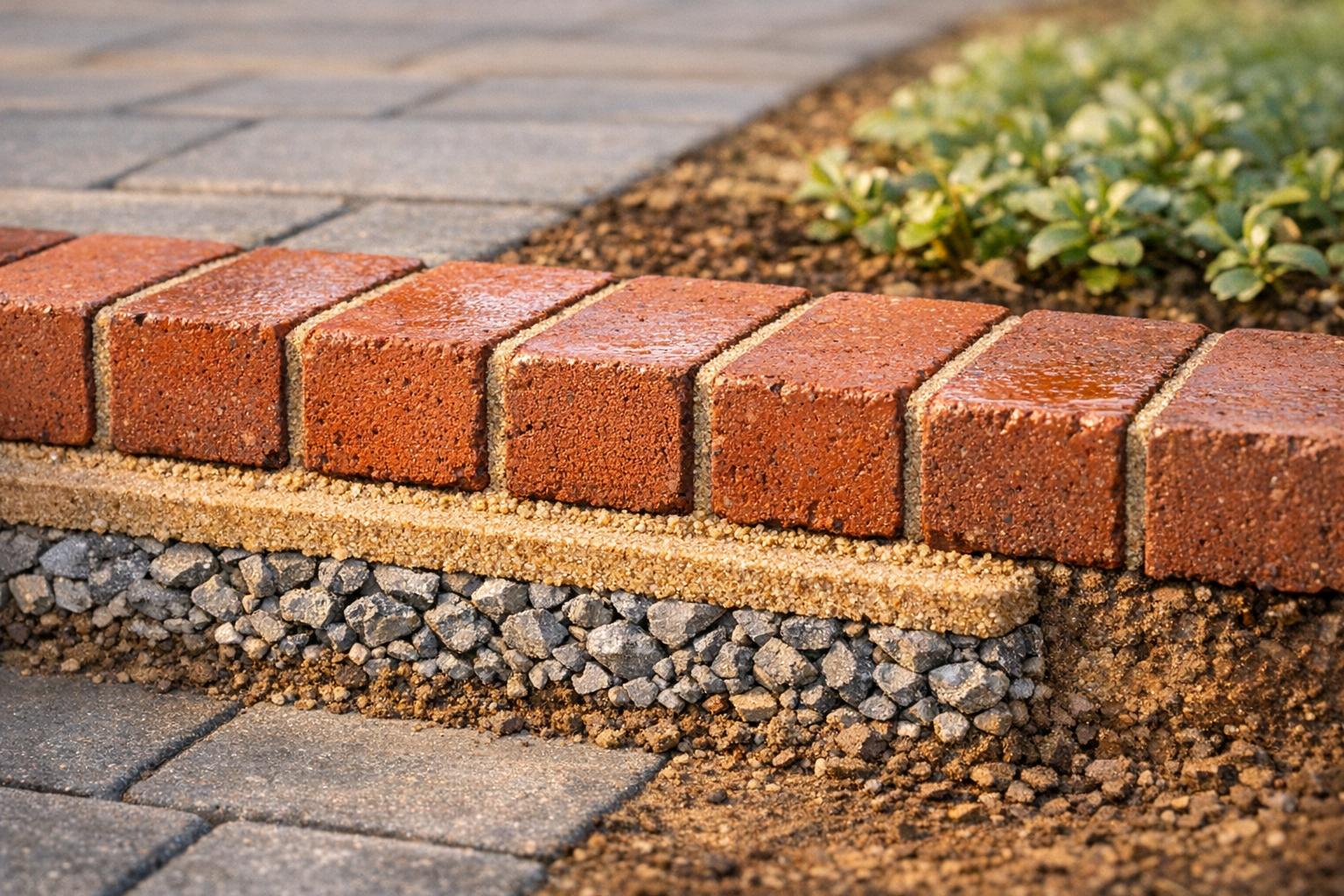
Slopes add complexity. If your pathway is on an incline, the lateral pressure increases, making stability a priority. To counteract this, stakes should be placed every 12 inches, and the base should include 4 to 6 inches of compacted aggregate to prevent shifting or frost heave [2].
Functional Requirements
The purpose of your pathway directly influences the type of edging you need. Unlike garden beds, pathways endure constant foot traffic and the occasional wear from maintenance tools like mowers and trimmers [2]. For paths with loose materials like gravel or mulch, the edging should extend 2 to 3 inches above the surface to keep everything in place [2]. For paver pathways, rigid edging is essential to prevent the pavers from spreading horizontally, which could lead to trip hazards and structural issues [2].
Another key factor is water drainage. Proper edging helps manage erosion, ensuring the pathway’s foundation remains stable [2]. In areas prone to freeze-thaw cycles, avoid rigid poured concrete edging, as it’s prone to cracking. Instead, opt for individual masonry units like bricks, which can adapt to ground movement without breaking [2].
Balancing these functional needs with your landscape’s overall design ensures both durability and aesthetic appeal.
Matching Your Landscape Style
Once you’ve addressed layout and functionality, focus on selecting an edging style that complements your landscape. Formal landscapes benefit from clean, geometric lines, making masonry edging an excellent choice for a polished, permanent look [2]. For informal or cottage gardens, natural materials like stone pair beautifully with the relaxed, organic feel of the surroundings [2]. If your style leans toward modern designs, bricks with textured surfaces and clean edges provide a sleek, updated take on traditional materials [1].
Current design trends favor mixing colors, patterns, and scales to create contrast and visual interest [1]. A bold choice in color or texture can turn your pathway into a standout feature. As Daphne Dubois from Techo-Bloc emphasizes:
"Landscape edging pavers are a step that is overlooked by many, even disregarded as an afterthought. Little do homeowners know, this step is crucial in tying a landscape design together" [1].
Brick Edging Styles and Patterns
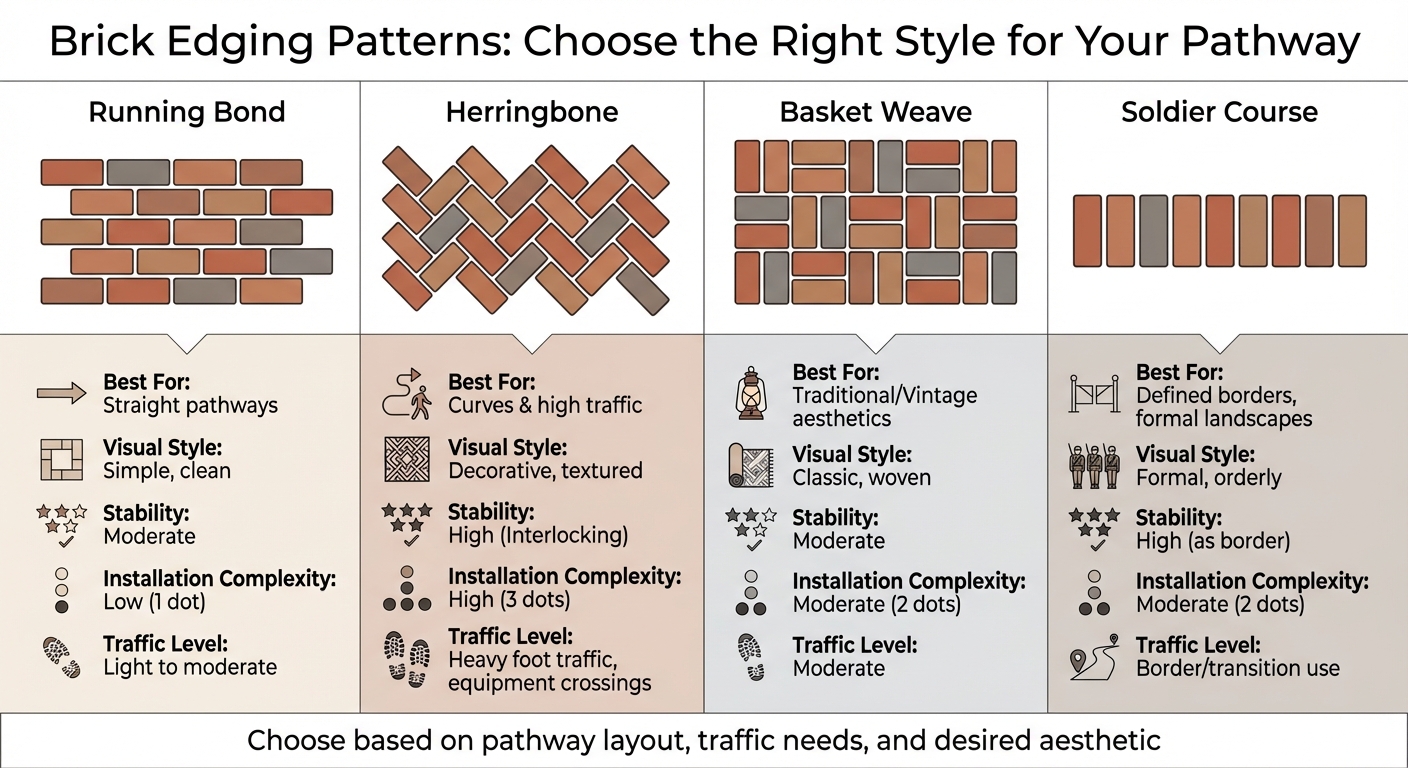
Brick Edging Pattern Comparison: Running Bond, Herringbone, Basket Weave & Soldier Course
Choosing the right brick pattern can elevate your pathway’s functionality and style. Each design offers a unique combination of visual appeal and structural benefits, so it’s important to match the pattern with your landscape’s aesthetic and the pathway’s durability needs.
Running Bond Edging
The running bond pattern is as straightforward as it gets. Each brick is offset by half its length from the one below, creating clean, horizontal lines. This simplicity makes it a great choice for straight pathways. It’s easy to install, requires minimal effort, and delivers a neat, polished look. While it offers moderate stability, it’s best suited for areas with light to moderate foot traffic. If your pathway will face heavier use, you might want to explore sturdier options like herringbone.
Herringbone Edging
Herringbone is all about strength and style. Bricks are laid at 45° or 90° angles to form a zigzag pattern, creating an interlocking design that’s incredibly durable. This makes it perfect for pathways that see heavy foot traffic or occasional equipment crossings. It works equally well for straight and curved paths but does require precise installation. The pattern’s textured look adds a decorative flair, making it both practical and visually striking.
Basket Weave Edging
For a timeless, vintage feel, the basket weave pattern is a fantastic choice. It alternates pairs of bricks to create a woven effect, adding subtle charm to pathways. While it offers moderate stability, its main appeal lies in its classic aesthetic. This pattern is ideal if you want to introduce a unique design element without the complexity of herringbone. For a more formal look, pairing it with a Soldier Course border can enhance its impact.
Soldier Course Edging
Soldier course edging is all about precision and formality. Bricks are placed vertically on their narrow edge, creating crisp, uniform rows that define the pathway’s borders. This style is especially effective in formal landscapes where clean, geometric lines are key. It also works well as a transition between different surfaces, adding a polished, orderly touch.
| Feature | Running Bond | Herringbone | Basket Weave | Soldier Course |
|---|---|---|---|---|
| Best For | Straight pathways | Curves & high traffic | Traditional/Vintage | Defined borders |
| Visual Style | Simple, clean | Decorative, textured | Classic, woven | Formal, orderly |
| Stability | Moderate | High (Interlocking) | Moderate | High (as border) |
| Complexity | Low | High | Moderate | Moderate |
When selecting a brick pattern, think about your pathway’s layout, how much traffic it will handle, and the overall look you’re aiming for. The right choice will blend seamlessly with your landscape while meeting practical needs.
Brick Colors and Materials
Selecting Brick Colors
The color of your bricks plays a big role in defining the overall look of your pathway. You can go for contrasting colors to make the edges pop – like dark gray bricks paired with a light-colored pathway or red bricks alongside a green lawn. On the other hand, coordinating colors create a more seamless and cohesive feel, making the edging blend naturally into patios or walkways.
If you’re considering natural clay bricks, you’ll typically find earthy tones like red, brown, or tan. These are classic but somewhat limited unless you choose to paint them. Concrete bricks, however, come in a much broader spectrum of colors. Options like Champlain Grey for a stone-like look, Chestnut Brown for a rustic vibe, or Hazelnut Brandy for a wood-inspired finish allow for more creativity [1]. By mixing different colors and textures, you can design borders that reflect your personal style [1].
"Mixing and matching colors, patterns, scales is trending, and it extends to patio paver edging ideas." – Daphne Dubois, Techo-Bloc [1]
When choosing a color, think about how it complements both your pathway design and the surrounding landscape. Once you’ve settled on a color scheme, it’s time to consider how the type of brick affects durability and performance.
Clay vs. Concrete Bricks
The material of your bricks matters just as much as their color. It impacts not only the look but also how well the bricks hold up over time. Picking the right material requires balancing aesthetics with durability.
Clay bricks have a timeless appearance and are resistant to fading and staining. However, they’re better suited for mild climates. In areas with heavy traffic or harsh freeze-thaw cycles, clay bricks can crack [1]. On the other hand, concrete bricks are built for strength. They resist damage from freezing and salt exposure and come in a wide variety of colors and textures [1]. With proper installation, clay bricks can last anywhere from 20 to over 50 years, while concrete bricks generally last 20 to 30+ years [2].
| Feature | Clay/Natural Brick | Concrete Bricks |
|---|---|---|
| Lifespan | 20–50+ years [2] | 20–30+ years [2] |
| Color Options | Limited to natural earth tones [1] | Wide variety of custom colors [1] |
| Durability | Prone to cracking in harsh climates [1] | High resistance to freeze-thaw and salt [1] |
| Maintenance | Low; occasional re-leveling needed [2] | Minimal; often maintenance-free [1] |
| Cost (Materials) | $8–$25 per linear foot [2] | $8–$25 per linear foot [2] |
For areas with heavy foot or vehicle traffic, or for regions with severe winters, concrete bricks are often the better choice. But if you’re in a mild climate and want a classic, refined look, clay bricks are an attractive option [1].
Brick Sizes and Dimensions
Once you’ve decided on your pathway layout and material colors, the next step is choosing the right brick sizes and orientations. These choices impact not only how the pathway looks but also its durability and stability. One popular option is the Modular brick, which measures 3-5/8 inches thick, 2-1/4 inches high, and 7-5/8 inches long [3]. Its dimensions offer a well-balanced appearance and are easy to work with in residential projects.
Matching brick size to your pattern and color choices enhances both the structure and style of your pathway. The way bricks are oriented – whether in a Stretcher, Rowlock, Soldier, or Header layout – affects how much of the brick is visible and determines the number of bricks needed per linear foot [3]. For best results, make sure the edging rises 2–3 inches above loose surfaces [2].
Curved pathways benefit from smaller bricks like Modular or Standard sizes, as they’re easier to fit along tight curves. On the other hand, for straight paths where a sleek, uninterrupted look is preferred, longer bricks such as the Roman Maximus – measuring 23-5/8 inches in length – reduce the number of joints and create a cleaner finish [3]. For those needing larger options, the Double Titan Plus – sized at 7-5/8 inches by 7-5/8 inches by 15-5/8 inches – is the biggest standard brick available [3].
In areas with heavy foot traffic or where equipment may pass over the edging, thicker and heavier bricks like Utility or Titan sizes are better at resisting pressure and staying in place [2][3]. A proper installation requires a compacted aggregate base of 4 to 6 inches, ensuring at least 2 inches of the brick remain above ground to act as an effective barrier [2].
Brick weights vary significantly, from around 3.0 pounds to as much as 40.0 pounds, which can influence shipping and labor costs [3]. For most residential projects, brick edging is measured and estimated in linear feet [4]. Choosing the right size and orientation ensures your pathway not only looks polished but also holds up well over time.
Working with Pro Landscapes MD for Brick Edging

Pro Landscapes MD has been serving central Maryland for 16 years, covering areas like Annapolis, Baltimore, Ellicott City, Gaithersburg, and Washington, DC. They specialize in brick edging solutions tailored to the region’s specific needs [6]. With a team trained in landscape design and horticulture [5], they guide homeowners through selecting the best materials – whether traditional clay bricks or modern concrete-based pavers – and help determine the right size and pattern to handle Maryland’s freeze–thaw cycles [1]. Their expertise ensures durable and attractive results, perfectly aligned with the principles of this guide.
Pro Landscapes MD takes a customized approach, factoring in Maryland’s unique climate and soil conditions. Their full-service offerings include everything from design consultations to professional installation and ongoing maintenance. They assess your pathway materials, local conditions, and maintenance requirements to recommend the most suitable edging options. By partnering with leading brands like Techo-Bloc, Allen Block, and El Dorado Stone, they deliver solutions that are both durable and visually appealing.
Proper installation is a top priority to ensure long-lasting performance. The team addresses common regional challenges like settling and frost heave, which are prevalent in the Baltimore and Washington, DC metro areas. For sloped areas, they stake the edging every 12 inches to handle added lateral pressure. This attention to detail reflects their commitment to quality, as evidenced by their 4.74-star rating from 298 online reviews [6].
"David and his guys were courteous, professional and detail oriented. They began and completed the job in a timely manner. The completed project was all that I had hoped for."
- Denise P., Verified Customer [6]
Pro Landscapes MD also offers a free proposal that includes a site visit to evaluate drainage, soil conditions, and layout needs specific to your property [5]. This thorough assessment ensures your brick edging not only enhances the look of your space but also functions effectively. With installation costs ranging from $18 to $50 per linear foot and a lifespan of 20–50+ years when properly installed, their professional guidance ensures a wise and lasting investment [2]. This meticulous process guarantees your pathway will stand the test of time.
Conclusion
Selecting the right brick edging can turn an ordinary pathway into a standout feature of your landscape. The key lies in finding the perfect balance between visual appeal and durability – choosing colors and patterns that match your home while withstanding Maryland’s challenging freeze-thaw cycles.
Properly installed brick and stone edging can last anywhere from 20 to over 50 years [2]. Though the initial cost ranges from $18 to $50 per linear foot, this upfront investment translates into decades of reliable performance [2].
At Pro Landscapes MD, we specialize in ensuring your brick edging is built to last. By installing a 4 to 6-inch compacted aggregate base, we help prevent settling and handle issues like frost heave and drainage, which are common in central Maryland [2]. From the first design consultation to the final installation, our team takes care of every detail to deliver a flawless result.
Looking to create a pathway that combines beauty with durability? Reach out to Pro Landscapes MD for a free proposal and site evaluation. Let us craft brick edging that enhances your outdoor space and performs beautifully for years to come.
FAQs
Do I need a concrete curb under brick edging?
Brick edging for pathways doesn’t always need a concrete curb. The stability of your edging largely depends on the design, the type of bricks you use, and how well it’s installed. If the bricks are placed at the right height – at least 2 inches above ground level – and firmly anchored, they can hold up well without additional support. That said, if you’re dealing with areas prone to water issues or want added durability, incorporating a concrete curb can provide extra reinforcement.
What’s the best brick edging for freeze-thaw climates?
Perma Edge paver edging is a smart option for areas with freeze-thaw cycles. It’s built to be tougher than concrete while offering the flexibility needed to withstand frost heaves and moisture, making it a durable solution for challenging climates.
How do I keep brick edging from shifting over time?
To keep brick edging stable and secure, it’s crucial to install proper edge restraints. Begin by preparing a strong foundation: dig a trench about 4-6 inches deep and add a sturdy drainage base to support the bricks. Using the right materials, ensuring the restraints are firmly in place, and performing regular upkeep will help the edging withstand wear from traffic, weather, and erosion.
Chat with Us