









- bhavya gada
- No Comments
When managing erosion, choosing the right products can save you money and protect your property. Here’s a quick guide to balancing costs and long-term effectiveness:
- Evaluate Risks: Inspect your property after rain to identify erosion-prone areas like bare soil, steep slopes, or drainage paths.
- Set a Budget: Account for material costs, permits, shipping, and tools. Include a 10–20% contingency for unexpected expenses.
- Compare Products: Match solutions like straw mulch, hydromulching, erosion blankets, or retaining walls to your site’s needs and budget.
- Consider Maintenance: Factor in upkeep like watering, re-securing materials, or sediment removal.
- Install Correctly: Proper preparation and installation are key to ensuring the solution works.
Key Tip: Low-cost options, like straw mulch, work for minor erosion, while permanent solutions, like retaining walls, are better for severe issues. Professional help may be necessary for steep or large areas.
This guide helps you find cost-effective solutions tailored to your property’s erosion challenges.
Step 1: Evaluate Your Property’s Erosion Risks
Identify Risk Factors
Take a walk around your property after a heavy rainstorm to observe how water moves and where it collects. This is the best time to spot drainage patterns and pinpoint areas most at risk for soil erosion.
Keep an eye out for rills and gullies – small channels carved into the soil by runoff. Also, check for bare soil patches where vegetation is thin or missing, as these areas are vulnerable to "splash erosion" caused by raindrop impact. Look for sediment deposits on hard surfaces like driveways or sidewalks – these indicate soil is being carried downhill. Exposed tree roots or rocks that were previously covered by soil are clear signs of significant erosion, while sliding soil on steep slopes shows that the top layer is shifting downward.
"Routine maintenance is easier than repairing and reseeding the large ruts and gullies that can form under improperly installed or maintained RECPs [Rolled Erosion Control Products]." – Tallgrass Prairie Center [1]
Pay close attention to high-scour areas – spots where water hits the ground with force, such as under downspouts, along gutter drip lines, or at culvert exits. For steep slopes, measure the incline. Slopes steeper than a 3:1 ratio are particularly at risk. You can also consult local NRCS soil surveys to find your soil’s erodibility (K) factor, which measures how easily your soil type can wash away [1][2].
Once you’ve identified the risk zones, measure the affected areas to understand the project’s scope. This will help you determine how much material you’ll need and allow for better planning and budgeting.
Determine Project Size
Figure out whether the erosion is confined to a small garden slope, scattered bare patches, or a larger area. For extensive sites with steep embankments, you might need more durable solutions, like heavy-duty wood fiber mulches or permanent turf reinforcement mats that can handle up to 4–5 inches of rain in 24 hours [1].
Also, evaluate the severity of the erosion. Minor surface-level soil loss can often be fixed with mulch and replanting. However, severe erosion – like deep gullies or areas with concentrated water flow – may call for more structural solutions, such as check dams, terraces, or tiered retaining walls. By understanding the size and severity of the problem, you can make informed decisions about materials, costs, and the level of intervention required.
sbb-itb-843f8be
Step 2: Set Your Budget
Calculate Total Budget
Start by measuring the area that needs erosion control. For silt fences, measure the perimeter instead. Don’t forget to factor in slope conditions, permit fees (ranging from $50 to $500), and soil tests (typically $15–$50 per sample to check for pH adjustments). Shipping fees can add another 10–30%, so include those in your calculations, along with the cost of installation supplies.
If your property has slopes steeper than a 3:1 ratio, you’ll likely need a professional engineer and county building permits, especially for terraces over two feet high. Shipping heavy materials like erosion blankets or retaining wall components can significantly increase costs, so account for that. You’ll also need installation items like sod staples, wooden stakes, earth anchors, and specialized adhesives. Planning to go the DIY route? Keep in mind that renting equipment such as hydroseeders or trenchers could add to your expenses.
Set aside a contingency fund – 10–20% is a good rule of thumb. This will help cover unexpected site issues, weather-related installation damage, or sudden price changes in materials. And when comparing products, always ask for "delivered" pricing to avoid surprise costs at the register.
Finally, weigh these upfront costs against ongoing expenses to find the most economical option for your needs.
Compare Upfront and Ongoing Costs
Sometimes, solutions with low initial costs can lead to higher long-term expenses. For example, vegetative options like grass seeding are cheap, costing just $0.001 to $0.02 per square foot [5]. However, you’ll need to budget for watering during the first year and possibly for soil amendments.
Erosion control blankets, on the other hand, range from $2,000 to $8,000 upfront, while retaining walls can cost anywhere from $10,000 to $50,000 [4]. Although retaining walls come with a hefty price tag, they provide immediate and lasting stability.
"It is usually more cost-effective to prevent erosion rather than repair it. Investing in erosion control measures early on can save you from spending more on costly repairs in the future."
Biodegradable options like straw blankets are cheaper initially but need replacement over time. Meanwhile, permanent solutions such as woven geotextiles or stone riprap offer decades of protection despite their higher upfront costs. Be sure to consider maintenance requirements too – vegetative solutions need regular watering and weeding, silt fences require sediment removal, and erosion blankets might need re-securing after storms. For check dams and sediment basins, regular cleaning is a must to keep them functional.
Erosion Control that Works for your Property or Farm….Prepping for the extreme!
Step 3: Compare Erosion Control Products
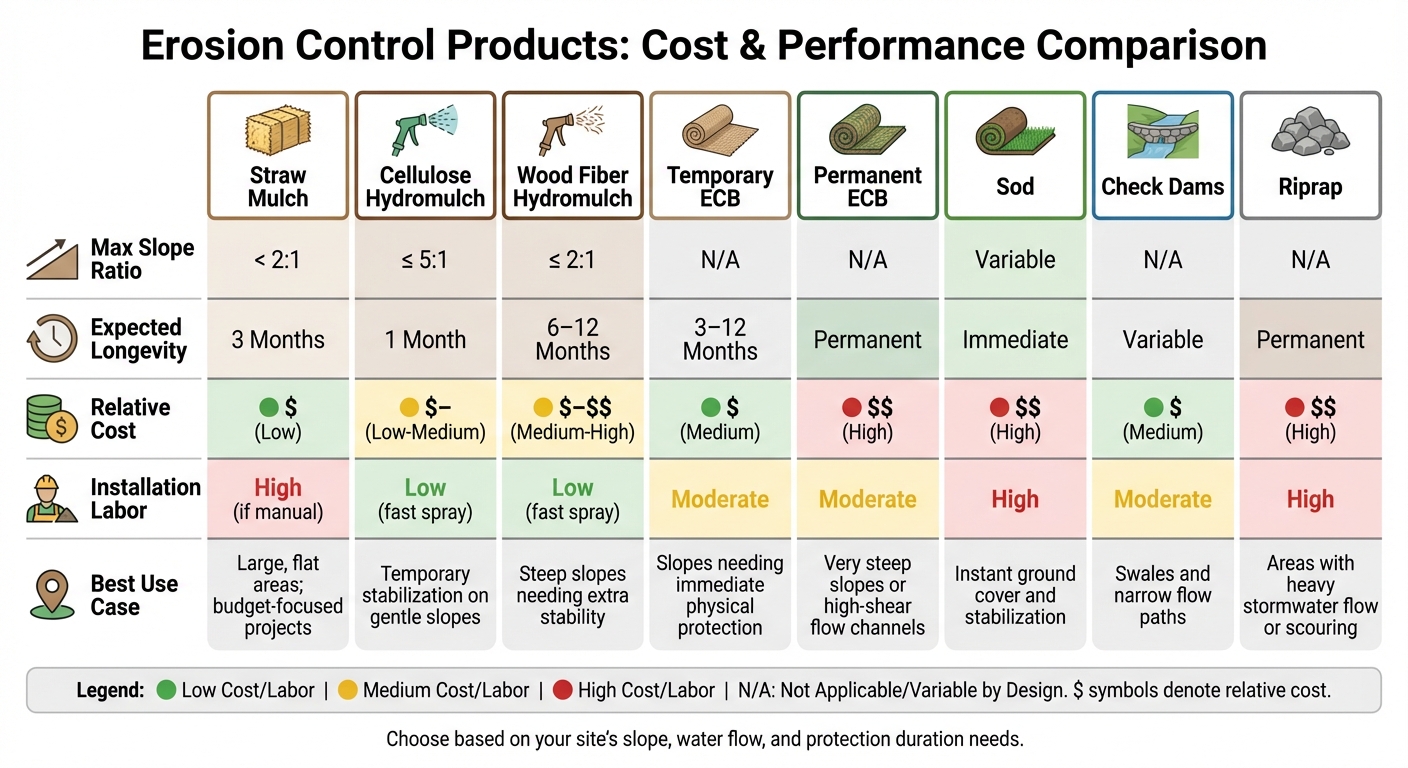
Erosion Control Products Comparison: Cost, Performance, and Best Uses
Available Product Types
Once your budget is set, it’s time to explore landscape restoration and erosion control solutions that balance cost and effectiveness. Start by reviewing options that align with your site’s conditions.
Straw mulch is one of the most budget-friendly choices, typically applied at a rate of 1–2 tons per acre[2]. It works best on flat or gently sloped areas (less than 2:1 slopes) and generally lasts about three months[2]. However, because straw is lightweight, it often needs tackifiers – like guar or starch-based products – to hold it in place, which can increase the overall cost.
Hydromulching, sometimes called hydroseeding, involves spraying a mix of water, seed, fertilizer, and mulch. According to Tim Gosnell, "Hydromulching is less labor-intensive and more economical for covering extensive terrains"[6]. Its longevity depends on the mix: basic cellulose blends last about a month, while engineered wood-fiber mixes can offer protection for up to a year[2]. Hydromulching typically requires between 5,000 and 10,000 gallons of water per acre[2].
Erosion control blankets (ECBs) are mats made from materials like straw, coconut fiber, or synthetic fibers. These blankets provide immediate soil stabilization, making them ideal for steep slopes where hydromulching might wash away. Installation typically involves using about 1.5 staples per square yard[2], with the top edge trenched about 6 inches deep to prevent water from flowing underneath. ECBs are available in both temporary and permanent varieties, depending on the site’s needs.
Sod provides instant ground cover and stabilization but comes with a higher upfront cost. When installing sod on slopes, it’s crucial to lay the strips perpendicular to water flow and secure them with sod staples to prevent water from undermining the installation.
For areas with concentrated water flow, like swales or steep grades, check dams and terraces made from materials such as stone, wood, or coir fiber biologs are effective. The Northern Virginia Soil and Water Conservation District suggests, "for heavy erosion in areas of concentrated flow, the most effective solutions are check dams or terraces"[3]. Similarly, riprap, which uses large stones to resist scouring, is a reliable option for areas with heavy stormwater flow or around obstructions. However, the cost of materials and transportation can be significant.
Product Cost and Performance Comparison
The table below highlights key details about slope capability, longevity, cost, and labor for various erosion control products:
| Product Type | Max Slope Ratio | Expected Longevity | Relative Cost | Installation Labor | Best Use Case |
|---|---|---|---|---|---|
| Straw Mulch | < 2:1 | 3 Months | Low | High (if manual) | Large, flat areas; budget-focused projects |
| Cellulose Hydromulch | ≤ 5:1 | 1 Month | Low-Medium | Low (fast spray) | Temporary stabilization on gentle slopes |
| Wood Fiber Hydromulch | ≤ 2:1 | 6–12 Months | Medium-High | Low (fast spray) | Steep slopes needing extra stability |
| Temporary ECB | N/A | 3–12 Months | Medium | Moderate | Slopes needing immediate physical protection |
| Permanent ECB | N/A | Permanent | High | Moderate | Very steep slopes or high-shear flow channels |
| Sod | Variable | Immediate | High | High | Instant ground cover and stabilization |
| Check Dams | N/A | Variable | Medium | Moderate | Swales and narrow flow paths |
| Riprap | N/A | Permanent | High | High | Areas with heavy stormwater flow or scouring |
To ensure the effectiveness of your chosen solution, mulch applications should cover at least 85% of the soil surface to prevent seed washout[2]. When deciding, consider your site’s slope, water flow, and how long protection is needed to select the best option.
Step 4: Review Performance and Environmental Impact
Check Maintenance Requirements and Lifespan
Understanding a product’s lifespan helps avoid repeated purchases and unexpected costs. The Erosion Control Technology Council (ECTC) categorizes erosion control blankets by durability: Categories 1 and 2 are temporary, breaking down within months, while Category 5 products are permanent and UV-stabilized for extended use[2].
Material choice impacts longevity. For example, straw mulch typically lasts around three months – just enough time for vegetation to establish[2]. Coir (made from coconut fiber) breaks down more slowly, offering longer protection, while UV-stabilized materials are designed for permanent installations[2]. High-performance hydromulches, when applied at rates of 3,000–4,500 lbs per acre, can protect soil for up to a year[2].
If your site experiences heavy water flow, consider the product’s shear stress rating to ensure it can handle the water’s force. For instance, permanent mats (Category 5A/5B) can withstand up to 8.0 lbs/ft² when vegetated, making them ideal for steep channels or areas with concentrated runoff[2].
Maintenance needs differ by product. During the first year, consistent watering is crucial to help roots establish and protect your initial investment[3]. Once vegetation is established, natural materials like coir biologs and compost socks require minimal upkeep, unlike synthetic options that demand frequent inspections to avoid failures or fines[3][7]. For example, synthetic silt fences must be regularly checked to ensure proper functioning[7].
After assessing maintenance requirements, it’s essential to evaluate the environmental effects of each product.
Evaluate Environmental Effects
Choosing environmentally friendly erosion control products safeguards local ecosystems while meeting stabilization goals. Some traditional tackifiers, such as emulsified asphalt, are harmful to plants and animals and are banned in national parks and certain states[2]. Opt for natural alternatives like guar or starch-based binders. These options not only protect habitats but also deliver long-term benefits – starch-based tackifiers, for example, contain 7% to 8% natural nitrogen, aiding in vegetation establishment[2].
Wildlife safety is another key factor. Netting in erosion control blankets can entangle animals, posing a risk to local fauna[2]. For areas with active wildlife, consider hydromulches or blankets that use interlocking fibers or adhesives instead of plastic netting[2]. These options offer effective erosion control without endangering animals.
Avoid woody materials in soil mixes because their decomposition depletes nutrients vital for plant growth[2]. Use wood chips only for surface landscaping where permanent vegetation isn’t planned. To improve soil quality on poor sites, apply a 1- to 2-inch layer of compost. This enhances soil properties and supports grass growth on low to moderate slopes[2].
Products like turbidity curtains, dewatering bags, and silt fences are essential for preventing sediment runoff into local waterways, helping protect aquatic ecosystems[8][7]. Match product longevity to your project: biodegradable materials like straw or coir work well for temporary stabilization (3–12 months), while UV-stabilized synthetic mats are better suited for permanent, high-shear environments like steep channels[8][2].
Step 5: Install Products Correctly
Select Products for Your Site
Start by clearing away any debris, rocks, or clumps of soil to create a smooth surface. This step ensures the erosion control blanket stays in full contact with the ground, which is crucial to prevent water from sneaking underneath and causing rill erosion[9].
Before laying down the blanket, seed the area. This allows vegetation to grow through the blanket, adding an extra layer of protection over time[9]. At the top of each slope, dig a 6×6-inch trench to anchor the blanket securely. When working with multiple blankets, overlap them in a shingle-like pattern – placing the upstream blanket over the downstream one – to stop water from flowing underneath[9].
Use 6-inch staples with a 1-inch crown, spaced about a foot apart, to secure the blanket. If the soil is rocky or loose, you may need longer staples for added stability[9]. For areas with heavy runoff, consider pairing erosion control blankets with French drains. This combination not only stabilizes the soil but also redirects water away from vulnerable spots[3].
By taking these steps and preparing the site carefully, you can ensure your erosion control solution works effectively over the long term.
Work with Pro Landscapes MD for Custom Solutions

When dealing with complex or steep slopes, professional help can save you from expensive mistakes. Pro Landscapes MD specializes in handling challenging terrains, and their expertise can help you avoid costly failures or fines tied to improper installations. For example, steep slopes often require anchoring systems like coir logs or compost socks. If these aren’t secured correctly, water can bypass them, undermining the entire system[3][10].
For slopes with a grade of 3:1 or steeper, professional engineering is often a must. These areas may also require specific permits for features like tiered walls or terraces taller than two feet, depending on local regulations[3]. Pro Landscapes MD evaluates critical factors like soil type, water flow, and slope angle – considerations that generic product guides simply can’t cover[11].
Their services include advanced drainage solutions such as French drains, grading, and stormwater management. They also install gravel or perforated pipes behind retaining walls and terraces to prevent structural issues. Operating across central Maryland, in areas like Columbia, Ellicott City, Gaithersburg, and Bethesda, Pro Landscapes MD combines erosion control with custom hardscaping to create durable, tailored solutions for your property. Proper installation not only protects your investment but also ensures it performs as intended for years to come.
Conclusion
Selecting the right erosion control products for your budget involves a few crucial steps: evaluating your property’s specific erosion risks, establishing a budget that considers both initial and long-term expenses, comparing products based on their performance and durability, and ensuring proper installation. As Wes Gibbs, Jones County Roadside Manager, aptly states: "Dollar for dollar, straw mulch is the best money spent on erosion control." [1] Aligning the right product with your site’s conditions ensures you get the best return on your investment.
However, even the most effective materials can fall short if not installed correctly. Mistakes during installation – especially on steep slopes or in areas with heavy water flow – can lead to expensive repairs and compromised results.
For complex landscapes, professional guidance can make all the difference. In Maryland, Pro Landscapes MD offers expert consultation to address unique challenges like soil composition, slope gradients, and drainage patterns – factors that generic product recommendations often overlook. Their expertise goes beyond erosion control, covering stormwater management, grading, and custom hardscaping, all aimed at providing durable, long-term protection for your property.
FAQs
How do I know if my erosion problem is minor or severe?
To figure out whether your erosion issue is minor or severe, start by evaluating the amount of soil loss and the overall condition of the site.
- Minor erosion typically affects small, confined areas with limited soil movement. This can often be addressed using straightforward fixes like applying mulch or placing straw bales.
- Severe erosion, on the other hand, involves more extensive damage, such as noticeable soil loss, large gullies, or exposed tree roots. These situations often call for more involved measures like regrading the land or installing retaining walls.
Pay close attention to signs of soil displacement and visible damage to get a clear sense of the problem’s severity.
Which erosion control option is cheapest long-term, not just upfront?
Vegetative solutions, such as erosion control blankets or mats, are often a smart long-term investment. While the upfront costs for these products might seem higher, they encourage natural plant growth, which helps stabilize soil over time. This reduces the need for repeated maintenance or replacements. On the other hand, temporary fixes like wattles or geotextiles may appear cheaper initially but often require regular upkeep, leading to higher costs in the long run.
When should I hire a pro instead of doing erosion control myself?
Hiring a professional for erosion control is crucial when your project involves specialized expertise, advanced equipment, or strict compliance with environmental regulations. This is particularly true for large-scale erosion problems, challenging site conditions, or projects requiring detailed sediment control plans. Professionals bring the know-how to select the right materials, ensure proper installation, and meet legal standards – making them indispensable for projects that go beyond basic DIY efforts or require adherence to regulatory guidelines.
Chat with Us