









- bhavya gada
- No Comments
Deer overpopulation is a growing issue in Maryland, especially in urban areas like Baltimore. This has led to challenges such as damaged ecosystems, increased vehicle collisions, and a higher risk of Lyme disease. To address this, Maryland has introduced community-based deer management programs. These involve reducing deer numbers through controlled methods like public hunting or professional sharpshooting. While these programs help restore forest health and improve safety, they also face hurdles like high costs, logistical challenges, and mixed community support.
Key Points:
- Benefits: Healthier forests, fewer vehicle collisions, reduced disease risks, and venison donations to food banks.
- Challenges: High expenses, temporary park closures, and the need for ongoing efforts.
Maryland’s approach shows progress but requires consistent funding and public engagement to succeed.
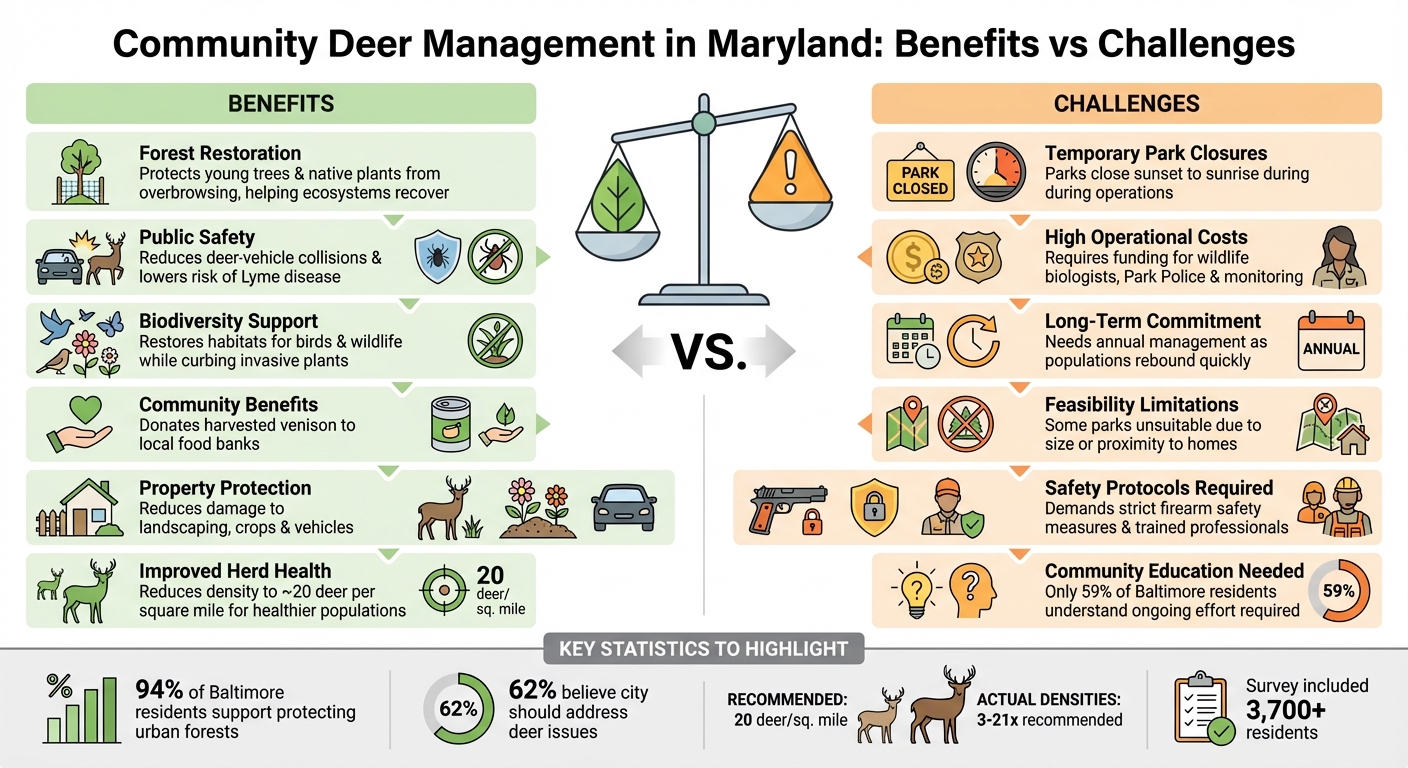
Benefits vs Challenges of Community Deer Management Programs in Maryland
1. Benefits of Community Deer Management Programs
Effects on Local Ecosystems
When deer populations grow unchecked, they can wreak havoc on local ecosystems. Overpopulated deer often consume young tree seedlings before they have a chance to grow, which disrupts forest regeneration. By managing deer density, forests can recover naturally, creating a healthier environment for native plants and animals [1][2]. This balance is crucial because overbrowsing by deer not only harms native vegetation but also creates opportunities for invasive species to take over, reducing habitat quality for birds and other wildlife [1][2].
Baltimore City Recreation & Parks highlighted the importance of addressing this issue:
"Over time, too many deer can prevent forests from growing back. This program is designed to help restore balance so forests can recover" [1].
These efforts to protect ecosystems also strengthen community involvement and support.
Community Participation
Community involvement plays a key role in the success of deer management programs. For instance, in Baltimore, a survey involving more than 3,700 residents found that 94% of participants recognized the value of urban forests and supported government action to address deer-related challenges [1]. Dr. Reginald Moore, Executive Director of Baltimore City Recreation & Parks, emphasized the collaborative nature of these efforts:
"This program is the result of extensive planning, scientific analysis and meaningful community engagement and public input" [1].
Through focus groups and meetings with local park organizations, officials pinpointed critical management areas like Gwynns Falls/Leakin Park and Herring Run Park. These decisions were driven by both ecological data and public feedback [1]. Restoring these spaces not only benefits the environment but also enhances the community’s quality of life by preserving areas for recreation and improving overall environmental health.
Cost Efficiency
Community deer management programs prioritize cost-effective solutions. One approach involves licensed public hunting, which helps control deer populations at minimal cost to local governments [2]. In cases where public hunting isn’t practical – due to safety concerns or limited park size – professional sharpshooting is used. For example, in Prince George’s County, trained Park Police officers carried out deer reduction efforts between February 1 and March 31, 2026. Key locations included Watkins Regional Park and Enterprise Golf Course [2].
An added benefit? The harvested deer were donated to local food banks, turning ecological management into a source of social good [2].
sbb-itb-843f8be
How Deer Management Helps Our Forests and Community
2. Challenges of Community Deer Management Programs
Community-based deer management programs come with hurdles that can complicate their support, funding, and execution.
Community Participation
Getting consistent backing from the community isn’t easy. A 2026 survey in Baltimore revealed that only 62% of residents believed the city should actively address deer-related issues, while just 59% understood that managing deer requires ongoing efforts instead of a one-time fix[1]. This lack of awareness can erode support, especially when people expect quick, permanent solutions.
Safety concerns also contribute to resistance. For instance, some programs close parks during certain hours, typically from sunset to sunrise, to ensure safety. While necessary, these restrictions can clash with residents’ recreational routines, causing frustration[2]. Moreover, the success of a program often hinges on logistical factors like park size, proximity to homes or businesses, and community feedback. Not all areas are suited for such efforts, even if the need is evident[2].
These challenges in community engagement can directly impact both funding and the strategies used to operate the programs.
Cost Efficiency
Safety limitations in urban settings often mean relying on trained professionals, such as Park Police officers or USDA wildlife biologists, for sharpshooting operations[1][2]. These services, coupled with the ongoing nature of deer management, lead to recurring costs that can stretch municipal budgets. The Prince George’s County Department of Parks and Recreation highlighted this issue, stating:
"The Department’s management program is not always a feasible option. Safety is the program’s top priority."[2]
Additionally, regular population surveys are essential to monitor deer density and assess the program’s effectiveness[2]. With urban deer densities sometimes reaching 3 to 21 times the recommended 20 deer per square mile[1], municipalities must commit to sustained funding rather than viewing management as a one-off expense.
Program Implementation
Regulatory requirements add another layer of complexity. Hunters participating in public programs must navigate strict rules, such as obtaining state licenses, securing permits for specific public lands, and adhering to daily reservation systems[2]. For professional operations, agencies must evaluate a range of factors before implementation. These include site access, deer population density, deer-vehicle collision data, ecological damage, and proximity to residential areas[2]. All these considerations make the planning and execution of deer management programs a detailed and demanding process.
Pros and Cons
Maryland’s deer management programs bring clear ecological benefits but come with operational hurdles. Here’s a breakdown of these trade-offs, summarizing the key points from earlier discussions:
| Benefits | Challenges |
|---|---|
| Forest Restoration: Protects young trees and native plants from overbrowsing, helping ecosystems recover [1] [2]. | Temporary Park Closures: Parks need to close during management operations, typically from sunset to sunrise [1] [2]. |
| Public Safety: Reduces deer-vehicle collisions and lowers the risk of tick-borne diseases like Lyme disease [1] [2]. | High Operational Costs: Requires funding for trained wildlife biologists, specialized Park Police, and population monitoring [1] [2]. |
| Biodiversity Support: Restores habitats for birds and other wildlife while curbing invasive plant growth [1] [2]. | Long-Term Commitment: Needs annual management, as deer populations can quickly rebound without consistent efforts [1]. |
| Community Benefits: Donates harvested venison to local food banks, providing much-needed protein to families [2]. | Feasibility Limitations: Some parks can’t participate due to size or proximity to residential areas [2]. |
| Property Protection: Reduces damage to landscaping and yard maintenance, crops, and vehicles [2]. | Safety Protocols Required: Operations demand strict firearm safety measures and oversight by trained professionals [2]. |
| Improved Herd Health: Reducing deer density to around 20 deer per square mile promotes better health and reduces competition [1]. | Community Education Needed: Only 59% of Baltimore residents understand that management requires ongoing efforts, not a one-time solution [1]. |
These trade-offs are evident in Baltimore’s recent efforts. For example, the city’s program focused on ecological recovery in parks like Gwynns Falls/Leakin Park, Herring Run Park, and Druid Hill Park. This initiative involved extensive community engagement and relied on a partnership with the USDA’s Animal and Plant Health Inspection Service to ensure professional standards. However, maintaining this level of expertise requires municipalities to budget for recurring costs annually.
Conclusion
Community-based deer management programs bring clear benefits to Maryland neighborhoods when backed by consistent effort and resources. Experiences in areas like Baltimore and Prince George’s County highlight how professional oversight, paired with active community involvement, can help restore ecological balance. However, these programs require ongoing support and yearly funding to prevent deer populations from rebounding.
In Baltimore parks where deer densities far exceed sustainable levels, population control has allowed ecosystems to recover. Some parks have reported deer densities ranging from 3 to 21 times the recommended limit of 20 deer per square mile. By reducing these numbers, young trees have a chance to grow, native plants can thrive again, and invasive species lose their edge. This progress aligns with the values of Baltimore residents – 94% of whom express a strong desire to protect their city’s forests for future generations [1]. Such ecological restoration directly contributes to the community’s quality of life.
Of course, challenges like safety and feasibility remain, but with thoughtful planning and expert guidance, these programs can succeed. Not all parks are suitable for management operations due to factors like proximity to homes or limited access. Despite these hurdles, examples such as the sharpshooting operations in Prince George’s County show that trained professionals and strict safety measures can minimize risks while achieving results [2]. Temporary park closures and operational costs are trade-offs, but they are manageable with proper oversight.
Beyond community efforts, individual property owners can play a role too. Planting deer-resistant vegetation, installing fencing, and using repellents can help protect private property while reducing pressure on local ecosystems. For tailored solutions, services like Pro Landscapes MD (https://prolandscapesmd.com) provide expert guidance to create outdoor spaces that align with broader deer management strategies.
Ultimately, the success of these programs depends on community engagement and a willingness to stay the course. Maryland communities are working toward a future where deer populations are in balance with both ecological health and human needs.
FAQs
How is success measured in deer management programs?
Success in managing deer populations hinges on keeping their numbers at levels that can be supported over the long term. This involves striking a balance between the interests of hunters, wildlife enthusiasts, and those dealing with the economic impact of deer-related issues. These programs are designed to meet the varied priorities of Maryland residents while ensuring harmony with both the environment and local communities.
Are sharpshooting operations safe near homes and parks?
Sharpshooting is a widely used method for managing deer populations in Maryland. While the search results don’t specifically discuss the safety of sharpshooting near homes or parks, they highlight that these programs are carefully planned by the Maryland Department of Natural Resources. The goal is to address concerns like overpopulation and its impact on agriculture, landscaping, and forests, all while prioritizing safety considerations.
What can homeowners do to reduce deer damage on their property?
Homeowners looking to protect their gardens and landscaping from deer can turn to non-lethal methods for effective results. Fencing is one of the most reliable options, creating a physical barrier that keeps deer out. Meanwhile, repellents, which rely on taste or scent deterrents, can discourage deer from browsing your plants.
Another smart move is to manage attractants around your property. This includes clearing fallen fruit, securing bird feeders, and ensuring garbage isn’t easily accessible. By combining these strategies, you can significantly reduce the chances of deer causing damage to your yard.
Chat with Us