









- bhavya gada
- No Comments
Companion planting can help pollinators thrive by providing them with continuous access to nectar and pollen throughout the growing season. By mixing native plants, ornamentals, and food crops, gardeners create habitats that support declining pollinator populations.
Key findings from recent studies include:
- Increased Pollinator Activity: Florida gardens saw pollinator visits rise by 108%–115% when diverse, bee-friendly plants were added.
- Boosted Biodiversity: Introducing flowering plants alongside crops led to 602 unique plant-pollinator interactions, with 85% occurring only after adding diverse flowers.
- Specific Plant Pairings: Basil with tomatoes, dill with cabbage, and borage with strawberries attract pollinators while managing pests.
- Maryland-Specific Tips and Projects: Align bloom schedules from May to November, plant native species like butterfly weed, and leave dead plant stalks in winter for nesting bees.
Companion planting not only supports pollinators but also strengthens garden ecosystems by attracting beneficial insects and improving crop yield. Tailoring plant choices and schedules to local conditions, like Maryland’s varied climate, ensures optimal results.
What Recent Studies Show About Pollinator Biodiversity
More Pollinator Species
Recent research confirms that companion planting significantly boosts both the variety and number of pollinator species. By integrating flowering plants with food crops, gardeners create a richer habitat, offering pollinators an array of resources all in one spot.
For example, a Florida study documented 602 unique plant-pollinator interactions, with 85% of these interactions occurring only after introducing a diverse mix of flowers [3]. This demonstrates how a varied floral environment can dramatically enhance biodiversity.
Another study from the University of Maryland highlighted how red clover (Trifolium pratense), used as a living mulch in sweet corn fields, attracted a wide range of pollinators. Researchers Veronica Yurchak, Anahi Espindola, and Cerruti Hooks found that the clover drew in distinct insect communities, including multiple species of bumblebees, butterflies, and honeybees. This resulted in much greater diversity compared to monoculture corn fields [5].
The findings make it clear: companion planting doesn’t just increase the number of pollinators – it also brings in a broader range of species.
Higher Pollinator Numbers
The Florida garden study also revealed some striking numbers. Bees accounted for 79.6% of all plant-pollinator interactions, followed by butterflies at 9.3%, wasps at 9.0%, and flies at 2.04% [3]. These figures highlight the dominant role bees play in pollination while also showcasing the contributions of other insects.
A large-scale analysis by the Swedish Society for Nature Conservation found similar results. Gardens that combined fruit and vegetable crops with dedicated flower plantings reported the highest levels of pollinator activity [2]. This suggests that companion planting strategies can significantly increase pollinator presence, offering substantial benefits for gardens in Maryland and beyond.
sbb-itb-843f8be
Plant Pairings That Support Pollinators
Tested Plant Combinations
Research highlights several plant pairings that offer measurable benefits for pollinators and pest control. For instance, planting basil alongside tomatoes not only helps repel pests with its essential oils but also provides nectar that attracts bees throughout the growing season [9][10]. Interestingly, even if basil doesn’t flower, it still offers pest protection, though allowing some blooms can further attract pollinators.
A study in Florida revealed that adding an eight-species mix to residential gardens significantly increased unique interactions between plants and pollinators [3].
Other effective pairings include dill and cabbage, which attract predatory wasps and hoverflies to naturally manage pests. Borage planted near strawberries is known for drawing large numbers of bees due to its abundant nectar [9][10]. Similarly, sunflowers paired with cucumbers act as a living trellis for climbing vines —a technique often integrated into custom garden walls while attracting bees and other helpful insects [9][10].
Research from Oklahoma State University by Eric J. Rebek and Janet C. Cole found that interplanting vegetables like tomatoes and cowpeas with native ornamentals boosted both beneficial arthropod populations and pollinator diversity compared to single-crop plantings [4]. Additionally, a Missouri field study conducted from 2019 to 2021 showed that milkweed (Asclepias) planted within a diverse wildflower mix led to a 22% increase in monarch egg abundance compared to milkweed grown alone [7].
These examples emphasize the importance of selecting complementary plant pairings and aligning them with the right planting schedules for maximum impact.
When to Plant in Maryland
Timing is key to maximizing the benefits of companion planting, especially in Maryland, where climates vary from the western mountains to the coastal plain [8].
To support pollinators effectively, gardeners should prioritize early-season plantings in May and June to aid migrating pollinators. Adding late-summer bloomers in July and August provides resources when breeding populations are at their peak [7][1].
In early spring, planting cool-season crops like spinach and lettuce between slower-growing summer vegetables such as tomatoes and peppers helps optimize garden space. These early crops also provide shade as the larger plants mature [11]. For example, planting borage in spring ensures its blooms align with strawberry flowering, while adding zinnias later in the summer keeps butterflies and bees active [9].
Delaying spring pruning of perennials and ornamental grasses is another helpful practice, as it preserves overwintering sites for leaf-cutter and mason bees [8]. Additionally, selecting native species through professional landscaping services suited to specific Maryland regions can reduce the need for extra watering and fertilizing while supporting local pollinators [8].
How Companion Planting Helps Pollinators and Gardens
Better Food Sources
Companion planting plays a key role in extending the availability of food for pollinators by ensuring continuous blooms throughout the growing season. By combining native and ornamental plants, gardeners can provide a steady supply of nectar and pollen from May through November [1]. This approach helps prevent "temporal gaps" – periods when pollinators might struggle to find food – thereby supporting bee health and maintaining pollinator diversity [3].
A mix of flower colors and shapes, such as purple, pink, and white blooms, appeals to a wide variety of pollinators with different foraging habits [1]. Research conducted in Florida highlights how a diverse selection of flowers significantly boosts plant-pollinator interactions [3].
"The extended flowering periods of the cultivated ornamentals complement the seasonal peaks of the native ornamentals, ensuring continuous nectar and pollen availability from May to November."
– Horticulture, Environment, and Biotechnology [1]
For gardeners in Maryland and similar regions, choosing native plants amplifies these benefits. The consistent availability of nectar and pollen not only supports pollinators but also strengthens the overall garden ecosystem.
Strengthening Garden Ecosystems
Planting a variety of companion plants creates what scientists call "habitat complementation." This means that flowers planted near fruit and vegetable crops can increase pollinator activity throughout the garden [2]. Sweden’s "Operation: Save the Bees" campaign, which involved over 11,000 participants from 2018 to 2021, demonstrated this effect. Gardens that paired food crops with flower plantings saw much higher pollinator activity compared to those with vegetables alone [2].
In addition to feeding pollinators, native plants attract helpful predators like ladybirds, lacewings, and fireflies. These natural allies help manage pests like aphids, snails, and slugs, reducing the need for chemical pesticides [12]. This interconnected system creates a self-sustaining food web. Studies also show that bees account for 79.6% of all plant-pollinator interactions, which strengthens the garden’s resilience to environmental challenges [3].
"Floral enhancements can improve the health and resilience of pollinator communities across landscapes."
– Landscape Ecology [3]
Companion Planting for Maryland Gardens
Native Plants for Maryland
Maryland’s diverse geography includes the western mountains, central Piedmont, and coastal plain, each with unique planting needs. The western mountains require cold-hardy perennials that thrive in cooler temperatures and higher elevations. The Piedmont region benefits from meadow species and woodland edge plants, while the coastal plain calls for salt-tolerant, moisture-loving varieties [8].
Native plants are a smart choice – they naturally resist local pests and require less water and fertilizer [8]. Instead of invasive species like butterfly bush, gardeners in Maryland can opt for plants such as Blazing Star (Liatris spicata), New York Ironweed (Vernonia noveboracensis), and Butterfly Weed (Asclepias tuberosa) [8]. During summer, Porterweed is a favorite for attracting local pollinators. Native trees and shrubs like Spicebush (Lindera benzoin), Serviceberry (Amelanchier), and various Oaks (Quercus) also play a vital role in supporting wildlife [14].
To ensure a steady food supply for pollinators, mix plant families with overlapping bloom periods. For example, combining plants from the daisy/sunflower family (Asteraceae) with those from the carrot family (Umbelliferae) provides continuous nectar sources [8]. Additionally, planting larval host plants like carrots, parsley, or dill supports black swallowtail butterflies while also attracting adult pollinators [8].
By focusing on native species and carefully planning bloom schedules, gardeners can create a thriving ecosystem that supports pollinators throughout the year.
Year-Round Planting Schedule
A well-thought-out planting schedule ensures continuous blooms to support pollinators. Start with early bloomers in spring, transition to high-nectar plants like Bee Balm, Zinnias, and Sunflowers in summer, and finish with fall bloomers such as New York Ironweed, Blazing Star, and Asters [8]. These choices help fill nectar gaps and promote healthy pollinator populations.
Winter is also an important season for pollinator gardens. Leave dead plant stalks, woody debris, and leaf litter in place to provide nesting sites for leaf-cutter and mason bees [8]. Margaret Hartman, an M.S. student at the University of Maryland, emphasizes the importance of year-round care:
"Pollinator gardens are natural places. They are planted to create a habitat for protecting and providing pollinators and beneficial insects with what they need, not just in the summer but all year round" [8].
Ground-nesting bees also need bare soil in sunny areas, so avoid over-mulching. Delaying spring garden cleanup allows emerging bees to safely transition into the new season [6].
For those looking to optimize their landscapes, Pro Landscapes MD offers specialized planting services tailored to Maryland’s unique climate and pollinator needs. They serve areas including Howard County, Montgomery County, Carroll County, Frederick County, Prince George’s County, and Baltimore County.
7 Flowers to Grow To Attract Pollinators (Companion Plants)
Comparing Different Companion Planting Approaches
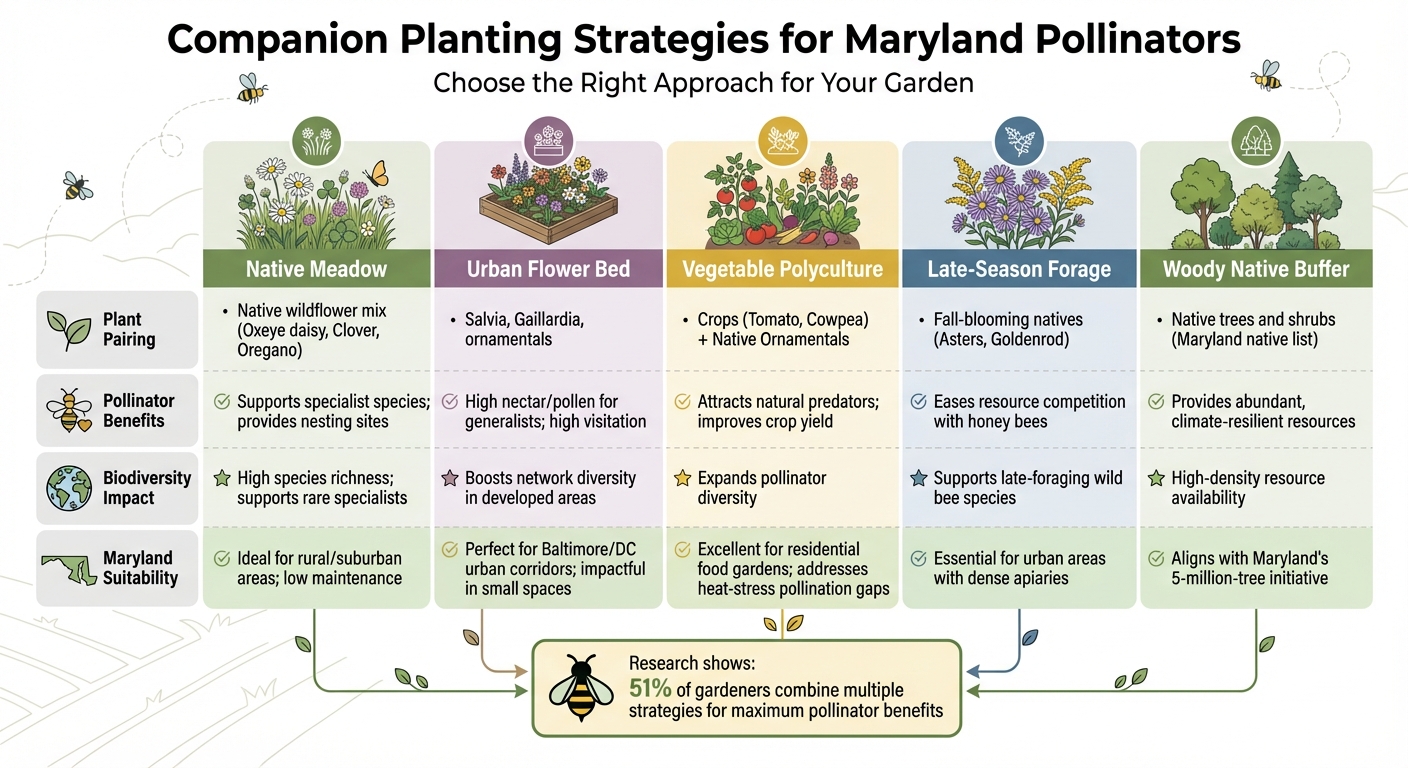
Companion Planting Strategies for Maryland Pollinators: Comparison Guide
Strategy Comparison Table
Expanding on previous insights, let’s delve into how different companion planting strategies work in Maryland’s diverse settings. Rural and suburban areas, with their open spaces, are ideal for garden meadows, creating a naturalistic aesthetic. In contrast, urban environments like Baltimore and Washington, DC, benefit more from compact flower bed plantings that fit within limited spaces [2].
Each approach offers unique advantages for pollinators. For example, native meadows cater to specialist bees reliant on specific plants, while vegetable polyculture attracts helpful insects that naturally manage pests [4]. Urban gardeners, even with space constraints, can rely on container plantings filled with pollinator-friendly ornamentals, as discussed earlier [2,3].
Timing also plays a crucial role in Maryland gardening. Late-season forage plantings are particularly valuable, helping wild bees compete with managed honeybee colonies during periods of resource scarcity [6]. Gabriela Quinlan, an NSF postdoctoral research fellow, emphasizes this point:
"Planting late-season forage and leaving bare ground as nesting resources in urban gardens could help alleviate some of the stressors that developed land and urban beekeeping can put on these bee groups" [6].
The table below summarizes the key aspects of each strategy, including plant pairings, pollinator advantages, biodiversity contributions, and suitability for Maryland’s unique conditions.
| Strategy | Plant Pairing | Pollinator Benefits | Biodiversity Impact | Maryland Suitability |
|---|---|---|---|---|
| Native Meadow | Native wildflower mix (Oxeye daisy, Clover, Oregano) | Supports specialist species; provides nesting sites | High species richness; supports rare specialists | Ideal for rural/suburban areas; low maintenance [2] |
| Urban Flower Bed | Salvia, Gaillardia, ornamentals | High nectar/pollen for generalists; high visitation | Boosts network diversity in developed areas | Perfect for Baltimore/DC urban corridors; impactful in small spaces [2,3] |
| Vegetable Polyculture | Crops (Tomato, Cowpea) + Native Ornamentals | Attracts natural predators; improves crop yield | Expands pollinator diversity | Excellent for residential food gardens; addresses heat-stress pollination gaps [2,5] |
| Late-Season Forage | Fall-blooming natives (Asters, Goldenrod) | Eases resource competition with honey bees | Supports late-foraging wild bee species | Essential for urban areas with dense apiaries [6] |
| Woody Native Buffer | Native trees and shrubs (Maryland native list) | Provides abundant, climate-resilient resources | High-density resource availability | Aligns with Maryland’s 5-million-tree initiative [14,7] |
Research suggests that combining multiple strategies can amplify garden performance. For instance, blending fruit and vegetable crops with dedicated flower plantings has been shown to increase pollinator activity compared to using a single approach. In fact, studies reveal that 51% of residential gardeners maintain both meadows and flower beds to maximize benefits [2].
Conclusion
Recent studies back what many Maryland gardeners have long believed: companion planting plays a key role in boosting pollinator health and enriching garden biodiversity. Research highlights that adding floral variety can increase pollinator visits by 115% in urban areas, while thoughtful plant pairings support nearly 4,000 native bee species across the U.S. [3][6]. By combining diverse flowering plants with crops and ensuring blooms throughout the year, gardeners can create ecosystems that thrive – benefiting pollinators and improving garden productivity alike. This underscores the powerful impact of well-planned companion planting across Maryland.
To make the most of companion planting, incorporating a variety of blooms and strategic layouts is essential. Maryland homeowners can see significant results by planting fall-blooming natives like asters and goldenrod and leaving bare soil patches for ground-nesting bees. Christina Grozinger, Director of the Center for Pollinator Research at Penn State, emphasizes:
"One of the best ways people can help both wild and managed bees is to add more flowering plants to the landscape, including city streets and backyards" [6].
For Maryland gardeners looking to take these strategies further, expert advice can make all the difference. Understanding the state’s unique climate and landscapes is critical for success. Pro Landscapes MD offers specialized services to create pollinator-friendly environments in Howard County, Montgomery County, Baltimore County, and nearby areas. Their team of horticulturists can design landscapes featuring native flowering trees, establish meadow gardens for suburban spaces, or craft compact pollinator gardens for urban areas like Baltimore and Washington, DC.
Whether you’re planning a full-scale landscape project or simply adding pollinator-friendly elements to your yard, tailoring your approach to your property’s specific needs is key. Urban gardeners often benefit from diverse perennial flower beds, while suburban and rural properties thrive with native meadow plantings. For those aiming to support Maryland’s goal of planting 5 million native trees by 2031 while enhancing pollinator habitats, professional expertise ensures long-term success [13].
Ready to turn your garden into a pollinator haven? Contact Pro Landscapes MD to explore landscape design, native plant installations, and garden services tailored to Maryland’s pollinators and your unique property.
FAQs
What’s the easiest way to keep blooms available from May to November in Maryland?
The simplest way to enjoy flowers from May through November in Maryland is to plant a variety of native, nectar-rich perennials with staggered blooming periods. This ensures continuous color and sustenance for pollinators throughout the growing season. To go a step further, create habitats and provide shelter for pollinators, helping them thrive. Stick with plants that naturally flourish in the region and draw pollinators for a lively, thriving garden.
How close should companion flowers be to my vegetable crops to boost pollination?
Plant companion flowers near your vegetable crops, ideally within a few feet. This setup attracts pollinators, encouraging them to visit both the flowers and your crops. The result? Better pollination and healthier harvests.
Which native Maryland plants support pollinators without increasing pests?
Native Maryland plants that help pollinators thrive while keeping pests at bay include blazing star (Liatris spicata), New York ironweed (Vernonia noveboracensis), and butterfly weed (Asclepias). Adding these to your garden not only boosts pollinator activity but also supports local biodiversity.
Chat with Us