









- bhavya gada
- No Comments
Composting transforms organic waste into a nutrient-rich material that enhances soil quality. It improves soil structure, fertility, and water retention, making it easier for plants to grow in challenging conditions like clay-heavy or sandy soils. Here’s a quick breakdown:
- Soil Structure: Compost reduces compaction, loosens soil, and promotes better air and water flow.
- Fertility: It provides essential nutrients (like nitrogen, phosphorus, and potassium) through slow release, supporting long-term plant growth.
- Water Retention: Compost holds water effectively, prevents runoff, and reduces erosion.
For Maryland landscapes, compost is especially useful for improving clay soils, retaining moisture in sandy areas, and managing extreme weather impacts like heavy rainfall. Regular application – such as mixing compost into soil or using it as mulch – supports healthier plants and reduces reliance on synthetic fertilizers.
How Compost Improves Soil Structure
Reducing Soil Compaction
In Maryland, compacted soil is a common issue, often caused by construction equipment pressing down on the subsoil [3]. This compaction makes it tough for plant roots to grow. Compost helps by lowering the soil’s bulk density, creating a loose, crumbly texture that resists further compaction [3][4]. A 12-year study from Cornell found that incorporating 33% compost by volume into fractured urban soils significantly improved bulk density, active carbon levels, and the stability of soil aggregates [4]. Experts emphasize that compost not only fixes compaction but also brings lasting improvements to soil structure [3]. These changes are critical for better air and water movement within the soil.
Improving Air and Water Movement
Compost plays a key role in loosening compacted soil, forming aggregates with pores that allow air and water to flow more freely [4]. This improved flow is essential for nutrient exchange and healthy root development, directly boosting soil fertility. The effects of compost vary depending on soil type. In central Maryland’s heavy clay soils, compost breaks up the dense structure, improving water drainage and preventing pooling issues [3]. On the other hand, in sandy soils, compost fills the large gaps, increasing the soil’s ability to hold water so plants can access moisture for longer periods [3]. Compost also supports soil organisms that maintain these critical pathways, further enhancing soil health [2].
sbb-itb-843f8be
How Compost Increases Soil Fertility
Adding Nutrients to Soil
Compost enriches soil with essential nutrients like nitrogen, phosphorus, and potassium, along with secondary nutrients such as calcium, magnesium, and sulfur, plus a variety of trace minerals [2][3]. For example, plant-based compost typically has an N-P-K ratio of about 1.0-0.5-1.0, while mushroom compost is richer at 2.75-1.5-1.5 [2]. Unlike synthetic fertilizers that often deliver a quick nutrient boost, compost releases nutrients gradually through a process called mineralization. This steady release creates a nutrient reservoir, ensuring plants are nourished over time rather than experiencing a short-lived surge that could wash away with rainfall [2].
| Compost Type | Typical N-P-K Analysis | Key Characteristics |
|---|---|---|
| Plant-based | 1.0 – 0.5 – 1.0 | Slow-release; low risk of nutrient loss [2] |
| Mushroom Compost | 2.75 – 1.5 – 1.5 | Higher soluble salts; steam-sterilized [2] |
| Poultry Manure | Varies (High) | Very high in nitrogen and phosphorus; higher leaching risk [2][4] |
| Milorganite (Biosolid) | 5 – 2 – 5 | Heat-dried; consistent nutrient levels [2] |
This slow nutrient release also fosters a thriving environment for beneficial soil microbes, which play a vital role in maintaining soil health.
Supporting Beneficial Microorganisms
Compost does more than just provide nutrients – it creates a thriving ecosystem for beneficial microorganisms that keep soil healthy. These microbes, including bacteria and fungi, are essential for breaking down organic matter and converting it into nutrients plants can absorb. Compost not only feeds these microorganisms but also provides them with a habitat, thanks to its organic matter. Additionally, the improved soil structure from compost introduces air pockets and retains moisture, both of which are critical for microbial activity.
One standout group supported by compost is mycorrhizae, fungi that form symbiotic relationships with plant roots. These fungi extend the roots’ reach, helping plants access more water and nutrients while also offering protection against certain diseases. Fun fact: about 80% of land plants depend on these fungi for survival [2]. To maintain this biological network, it’s important to apply at least one inch of compost annually to garden beds. This replenishes the organic matter that microorganisms consume through oxidation [2].
How Compost Helps Soil Hold Water and Resist Erosion
Increasing Water Retention
Compost doesn’t just improve soil structure – it transforms it into a moisture-retaining powerhouse. By adding compost, you introduce organic matter that binds soil particles into stable clusters, or aggregates, which create tiny pores. These pores act like miniature reservoirs, holding both water and air for plant roots to access. Whether your soil is sandy or clay-heavy, compost makes a difference: it helps sandy soil trap moisture and encourages water to penetrate clay soil instead of pooling on the surface [4][3].
"Soils high in OM [organic matter] retain more moisture, have a crumbly structure that resists soil compaction, and contain a reservoir of nutrients that are slowly released over time." – Jon Traunfeld, Director HGIC, University of Maryland Extension [2]
The impact of compost is backed by research. A 12-year study at Cornell University revealed that incorporating 33% compost by volume into degraded urban soils significantly boosted their ability to hold water. Plants in these amended soils had access to moisture for longer periods, reducing the need for frequent watering [4]. If you’re starting new landscaping projects, try mixing 1 to 2 inches of compost into the top 6 inches of soil. This simple step not only keeps plants hydrated but also sets the stage for better erosion control [3].
Preventing Soil Erosion
While compost helps soil retain water, it also plays a key role in preventing erosion. By acting as a natural binder, compost holds soil particles together, making them less likely to wash away in heavy rain or blow away in strong winds. The organic matter supports microorganisms that produce sticky substances, forming stable aggregates that resist erosion. This was especially critical in 2018, when Maryland faced 73 inches of rainfall – conditions that could have severely eroded unprotected soil [5].
| Soil Type | Impact of Compost Amendment | Primary Benefit for Erosion/Water |
|---|---|---|
| Sandy Soil | Increases water holding capacity | Reduces water loss and drought stress [3] |
| Clay Soil | Improves water percolation | Prevents surface runoff and pooling [3] |
| Compacted Subsoil | Decreases bulk density, increases porosity | Allows roots to penetrate and water to infiltrate [3][4] |
| Degraded Urban Soil | Increases aggregate stability | Makes soil resistant to wind and rain dispersion [4][5] |
Compost doesn’t just keep soil in place – it ensures water soaks in rather than running off and carrying soil with it. When used as mulch or a topdressing, compost also shields the soil from the direct impact of raindrops. To maintain this layer of protection, apply a 1-inch layer of compost to your garden beds annually [3][5].
How Compost Improves Your Soil (And Why It Matters)
Research Findings: Compost vs. Synthetic Fertilizers
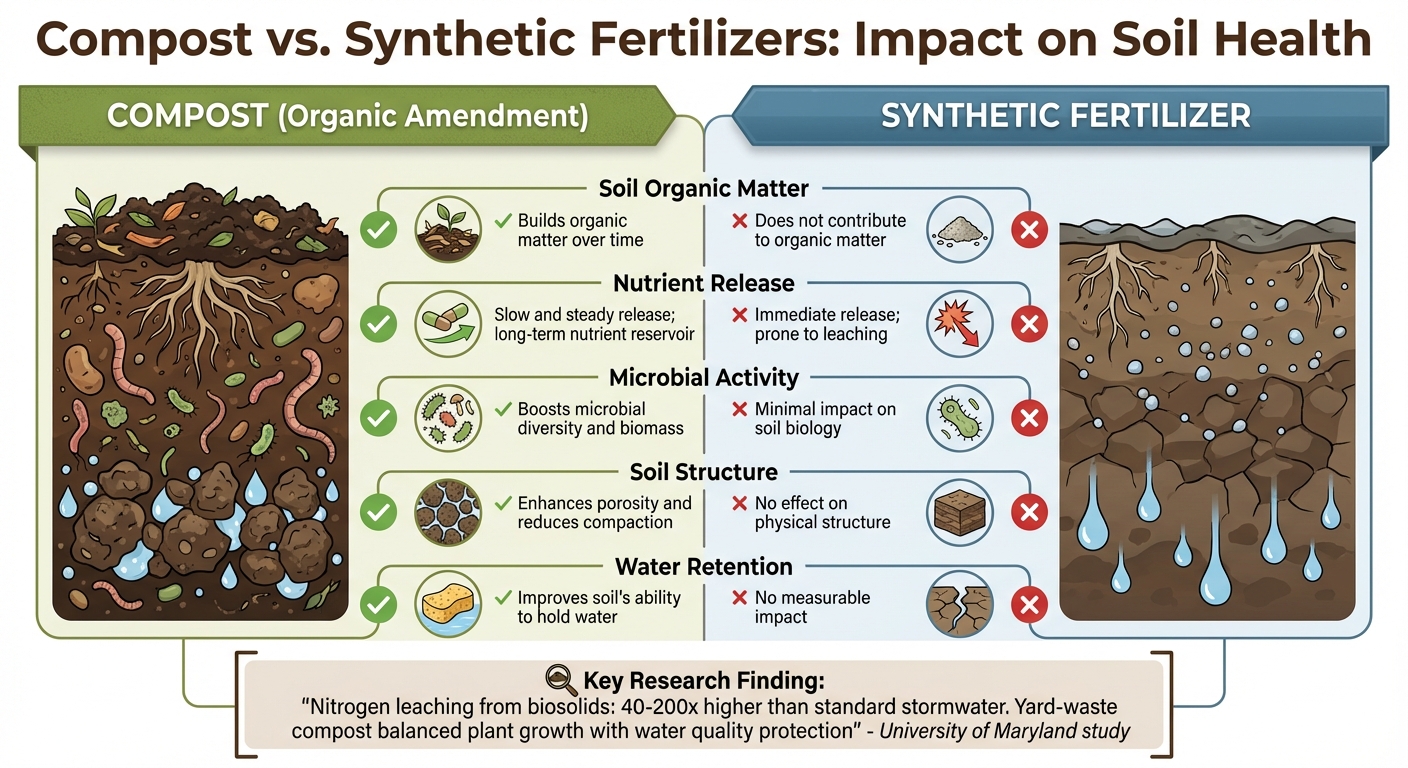
Compost vs Synthetic Fertilizers: Soil Health Comparison
What Studies Show About Compost
Research has shown time and again that compost provides benefits that synthetic fertilizers simply can’t replicate. For example, a 12-year study from Cornell demonstrated that adding 33% compost by volume to degraded urban soils improved aggregate stability, boosted active carbon levels, and reduced bulk density [4].
"Incorporation of approximately 33% compost by volume into degraded soil has been proven to improve soil health and structure over time while avoiding the financial and environmental costs of importing soil mixes." – Hannah Heyman, Cornell University [4]
One of compost’s standout features is its ability to support microbial life. While synthetic fertilizers focus solely on feeding plants, compost nourishes the entire soil ecosystem. Microbes in compost break down organic material, cycle nutrients, and produce sticky substances that bind soil particles together. Synthetic fertilizers, by contrast, don’t feed these beneficial organisms or contribute to soil biology [2][4].
Compost also serves as a long-term nutrient source, with only 5% to 10% of its nitrogen becoming available in the first year [2]. This slow-release process ensures plants are fed gradually over multiple growing seasons. Synthetic fertilizers, on the other hand, provide a quick burst of nutrients. While this may seem advantageous, these nutrients are often used up rapidly or leach into groundwater, leading to waste and potential environmental harm [2][4]. This contrast between compost’s sustainable benefits and the short-term effects of synthetic fertilizers sets the stage for a deeper comparison.
Compost Compared to Synthetic Fertilizers
When comparing compost to synthetic fertilizers, the differences in their long-term impact on soil health become clear. Let’s break it down:
| Feature | Compost (Organic Amendment) | Synthetic (Commercial) Fertilizer |
|---|---|---|
| Soil Organic Matter | Builds organic matter over time [2][4] | Does not contribute to organic matter [2] |
| Nutrient Release | Slow and steady release; long-term nutrient reservoir [2] | Immediate release; prone to leaching [4][6] |
| Microbial Activity | Boosts microbial diversity and biomass [4][1] | Minimal impact on soil biology [2] |
| Soil Structure | Enhances porosity and reduces compaction [4][3] | No effect on physical structure [2] |
| Water Retention | Improves the soil’s ability to hold water [4][3] | No measurable impact [3] |
A study by Sai Thejaswini Pamuru at the University of Maryland compared various soil amendments in greenhouse experiments. The results highlighted that some nutrient-dense amendments, like biosolids, caused nitrogen leaching 40 to 200 times higher than standard stormwater. In contrast, yard-waste compost struck the perfect balance, supporting plant growth while protecting water quality [6]. These findings emphasize why compost is a key player in sustainable landscaping, particularly for improving soil structure, fertility, and water retention in regions like Maryland. For homeowners, integrating these soil health practices is a vital part of comprehensive yard maintenance and landscape projects throughout the Mid-Atlantic.
Using Compost in Maryland Landscapes
Applying Compost to Improve Soil
Compost is a fantastic tool for improving soil health, and Maryland homeowners have several effective ways to use it in their landscapes. For new garden beds, especially in areas with heavy clay or thin topsoil, mix 2–4 inches of compost into the top 6 inches of soil. This not only enhances drainage but also encourages strong root growth, setting the stage for healthier plants [2].
When it comes to established trees and shrubs, an annual top-dressing works wonders. Start by removing the existing mulch, then spread a 1-inch layer of compost over the root zone, and replace the mulch. This method feeds the soil without disturbing the roots [2]. For lawns, apply a thin layer of screened, dry compost – about 1/4 to 1/2 inch – either in the fall or just after the first mowing in spring. This helps improve soil structure and encourages lush, healthy grass [3].
Maryland residents also have access to locally produced compost products. Options like LeafGro® – crafted from yard waste and food scraps – and BLOOM, made from Washington, D.C. biosolids, are readily available. Many local solid waste programs also produce and sell compost. To cover 1,000 square feet with a 1-inch layer of compost, you’ll need about 3 cubic yards [2].
With these techniques and resources, Marylanders can enrich their soil while embracing sustainable practices.
Eco-Friendly Landscaping with Pro Landscapes MD

Pro Landscapes MD brings compost and sustainability to the forefront of its landscaping services across central Maryland. Operating in areas like Howard, Montgomery, Carroll, Frederick, Prince George’s, and Baltimore Counties, their team of horticulturists understands the challenges of Maryland’s acidic, clay-heavy soils. By incorporating compost-based amendments into their landscape design, construction, and restoration projects, they improve soil health and plant vitality.
But they don’t stop at compost. Pro Landscapes MD also offers eco-conscious solutions like environmental pavers. These permeable hardscaping options let water seep into the soil naturally, reducing runoff and supporting healthy plant growth. Combined with compost-enriched soil, these pavers are a practical way to manage stormwater and prevent erosion.
Their services also include advanced drainage solutions, such as French drains and dry riverbeds, which work alongside improved soil conditions to protect landscapes from water damage. Whether serving communities like Bethesda, Columbia, Ellicott City, or Towson, Pro Landscapes MD focuses on transforming outdoor spaces into sustainable, thriving environments. By pairing compost’s soil-boosting benefits with innovative landscaping techniques, they ensure durable and eco-friendly results.
Conclusion
Research highlights that compost has a transformative effect on landscapes by improving soil structure, increasing fertility, and enhancing water management. It helps loosen compacted clay soils, boosts water retention in sandy soils, and provides a steady supply of nutrients over time. Additionally, compost supports a thriving microbial ecosystem, fostering a natural nutrient cycle and helping plants resist diseases [2].
The findings also underline that compost strengthens soil health while building resilience against changing climate conditions in Maryland. For homeowners experiencing hotter and wetter weather patterns, compost offers practical solutions. It creates soil aggregates that resist erosion during heavy rains and improves drought tolerance by enhancing water absorption. As Jon Traunfeld, Extension Specialist at the University of Maryland Extension, points out:
"Improving soil health is the most important thing we can do to make our farms and gardens more climate-resilient" [5].
Beyond individual gardens, compost contributes to broader environmental goals. It recycles organic waste like yard trimmings and kitchen scraps, reducing landfill contributions and cutting reliance on synthetic fertilizers, which require large amounts of natural gas to produce. Compost-enriched soils also store carbon, playing a role in reducing greenhouse gas emissions [5].
Incorporating compost into your gardening routine is a straightforward way to reap these benefits. Applying compost regularly, based on your garden’s specific needs, ensures long-term improvements to soil health [2]. Maryland residents can take advantage of locally produced compost products like LeafGro® and BLOOM, making sustainable soil care both simple and accessible.
Whether you’re maintaining your current garden or starting a new landscaping project, compost lays the groundwork for healthier plants, reduced upkeep, and lasting environmental benefits. By making compost a routine part of your gardening practices, you invest in soils that retain moisture, limit erosion, and support thriving landscapes for years to come.
FAQs
How do I know if my soil needs compost?
If you’re wondering whether your soil could use compost, start by observing its condition. Look for signs like poor structure, compacted areas, low fertility, or difficulty retaining water. Indicators include hard, dense soil, poor drainage, or plants that seem to struggle even when you’re taking good care of them. A soil test can also reveal nutrient deficiencies or pH imbalances.
Adding compost can make a big difference. It boosts fertility, improves structure, and enhances water retention, making it easier for plants to thrive. This is especially helpful for compacted soil or areas lacking organic matter.
Can I use compost instead of fertilizer?
Yes, compost improves soil structure and boosts fertility, acting as an excellent soil conditioner and nutrient provider. However, pairing compost with fertilizer is often the way to go. This ensures plants get all the essential nutrients they need in the right quantities to thrive.
Can compost hurt plants if I use too much?
Using too much compost might actually hurt your plants. It can throw off nutrient levels or make the soil too wet, which isn’t ideal for healthy growth. But when you use compost in the right amounts, it’s a game-changer. It boosts soil fertility, improves structure, and helps the soil hold water better – all of which support thriving plants. The key is moderation: apply compost carefully and make sure to mix it thoroughly into the soil.
Chat with Us