









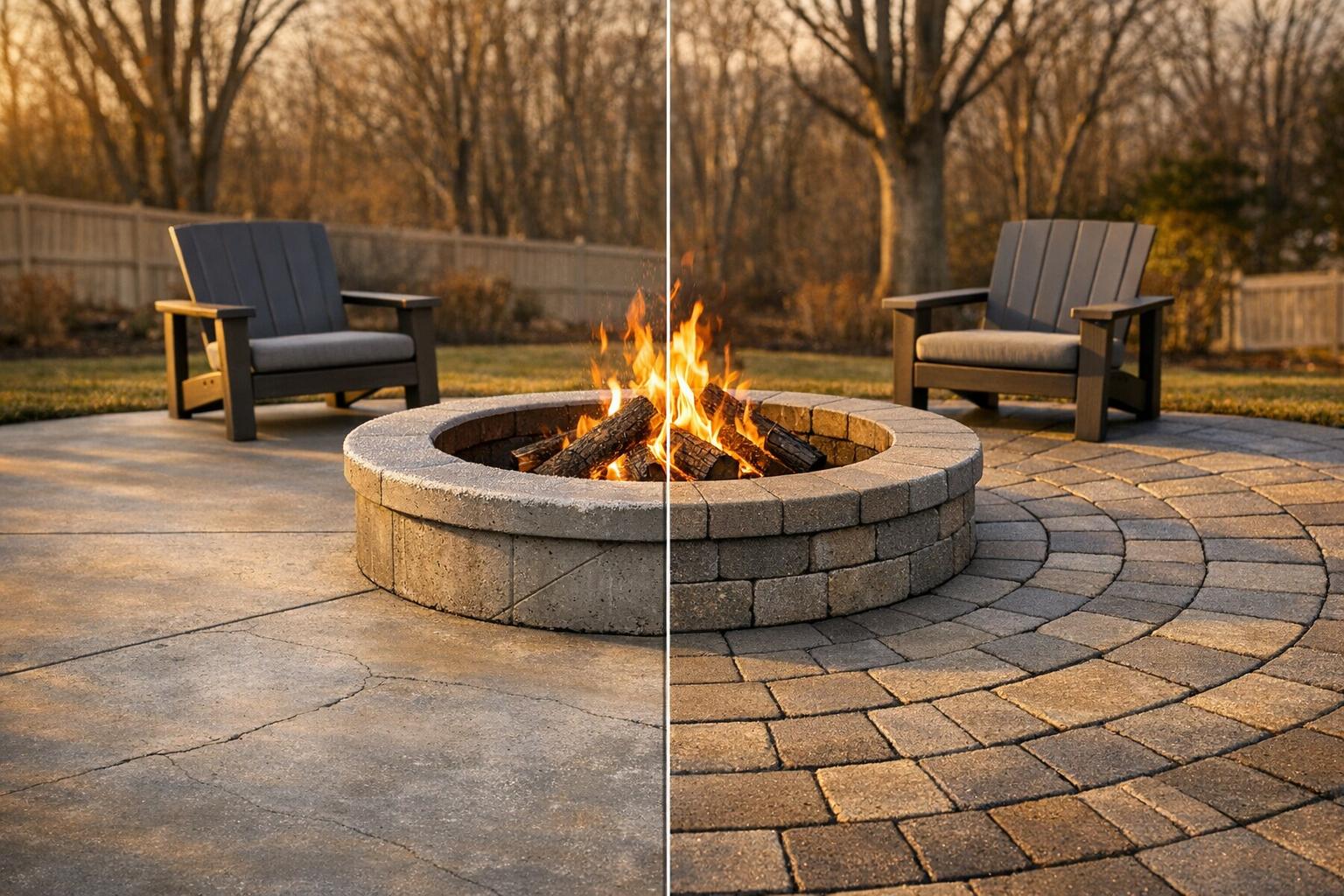
- bhavya gada
- No Comments
When deciding between concrete and pavers for your fire pit, it boils down to budget, durability, and aesthetics. Here’s the quick takeaway:
- Concrete: Cheaper upfront ($6–$20/sq. ft.), but prone to cracks in Maryland’s freeze-thaw climate. Lifespan: ~20–30 years. Repairs are costly and visible. Offers a modern, minimalist look but limited design options.
- Pavers: Higher initial cost ($15–$50+/sq. ft.), but lasts longer (50–100 years) and handles soil movement better. Repairs are easy and blend seamlessly. Provides more design flexibility with textured, upscale finishes.
Quick Comparison
| Feature | Concrete | Pavers |
|---|---|---|
| Cost | $6–$20/sq. ft. | $15–$50+/sq. ft. |
| Lifespan | 20–30 years | 50–100 years |
| Crack Resistance | Low | High |
| Repair Difficulty | High | Low |
| Design Options | Limited | Extensive |
If you’re on a tight budget and need something quick, concrete works. But for long-term value and better looks, pavers are the smarter choice – especially in Maryland’s challenging climate.
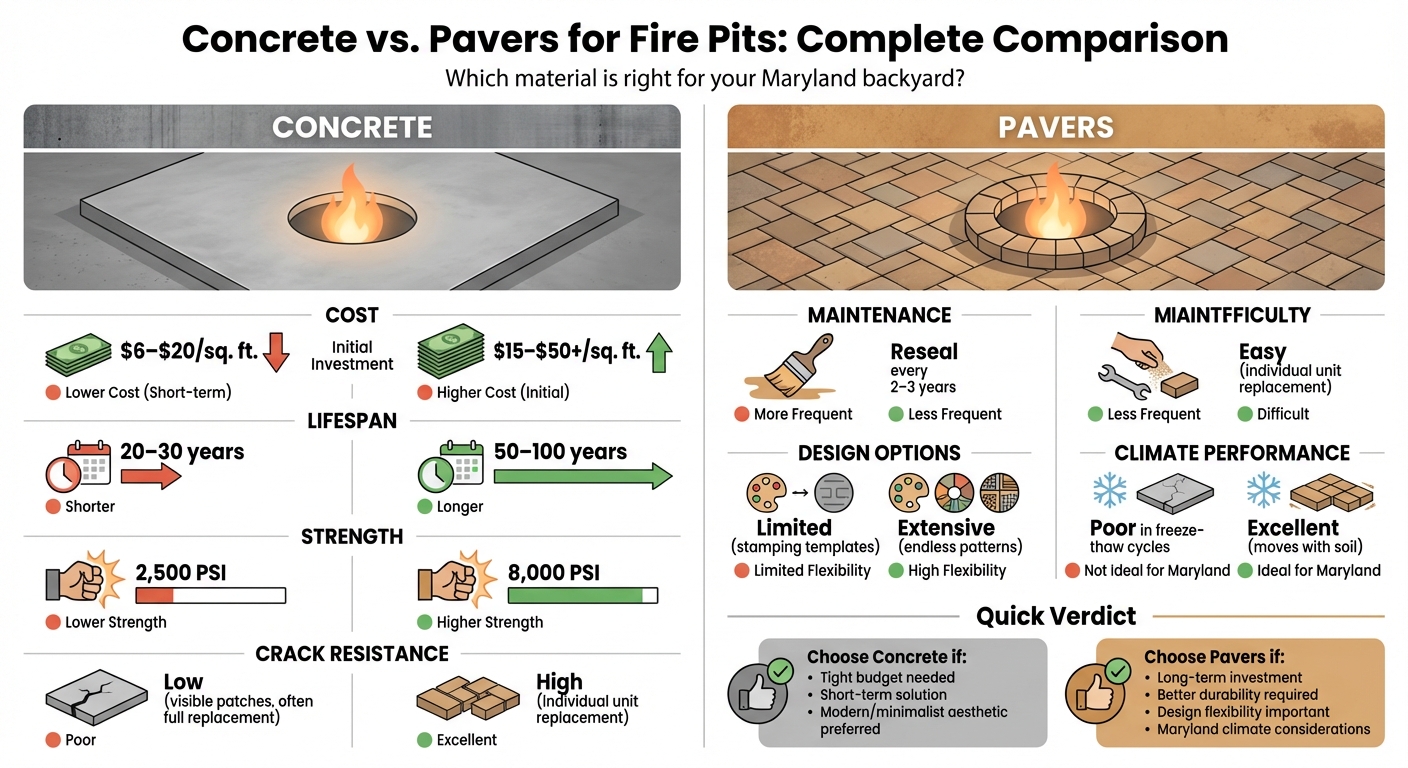
Concrete vs Pavers for Fire Pits: Cost, Durability and Design Comparison
Durability Comparison
Concrete Durability
Concrete fire pits struggle in Maryland’s climate, largely due to the state’s clay-heavy soil and freeze–thaw cycles. Concrete, being a single rigid slab, doesn’t handle the natural expansion and contraction of the ground well. This often leads to spiderweb-like cracks that are nearly impossible to repair inconspicuously [2][4].
"Once concrete cracks, the damage is permanent, and repairs can be conspicuous. Pavers are unlikely to crack due to natural wear, and should any single paver become damaged, it can easily be replaced."
Heat adds another layer of stress. Thermal expansion can create cracks that become permanent, even when expansion joints are used. Some homeowners attempt to mitigate this by using steel or copper inserts to protect inner surfaces, but the underlying issue remains [2][3]. These factors make concrete less durable and harder to maintain in Maryland’s challenging weather conditions.
Pavers Durability
Pavers, on the other hand, are well-suited for Maryland’s climate. Their modular design, with gaps filled by sand, allows each unit to move and flex independently as the ground shifts [2][1]. This flexibility significantly reduces the risk of cracking.
Pavers also boast impressive strength, withstanding up to 8,000 PSI compared to concrete’s 2,500 PSI [2].
"Pavers, in contrast, are laid with deliberate gaps that accommodate the freeze/thaw expansion. Their independent nature allows them to move with the changing conditions without cracking."
- Chesapeake Landscapes [2]
Even if a paver does sustain damage, which is uncommon, it’s a simple fix. Individual units can be replaced without disrupting the rest of the structure, making repairs quick and seamless [2][1].
Durability Comparison Table
| Feature | Concrete | Pavers |
|---|---|---|
| Compressive Strength | ~2,500 PSI | ~8,000 PSI |
| Expected Lifespan | 20–30 Years | 50–100 Years |
| Crack Resistance | Low (Rigid slab) | High (Flexible joints) |
| Maryland Climate Performance | Prone to freeze–thaw damage | Excellent (Moves with soil) |
| Repair Difficulty | High (Visible patches) | Easy (Individual replacement) |
With durability covered, the next step is to evaluate costs to determine which option delivers better overall value for Maryland homeowners.
sbb-itb-843f8be
Cost Comparison
Concrete Costs
When it comes to affordability, concrete stands out as a budget-friendly option. It typically costs $6–$20 per square foot, making it about 3–4 times less expensive than pavers in Maryland [2]. Plus, the installation process is quick – most concrete fire pit surrounds can be poured and finished in just a single day [2].
"For those allocating a budget, concrete is the more economical choice, with installation costs running approximately 3-4 times less per square foot compared to pavers."
- Chesapeake Landscapes [2]
However, this lower upfront cost comes with trade-offs. Concrete requires resealing every 2 to 3 years to protect against moisture damage and ash stains [2]. Cracks, a common issue in Maryland’s freeze-thaw climate, can lead to expensive repairs. In many cases, homeowners end up replacing entire sections within 20 to 30 years [2].
Pavers Costs
Pavers, on the other hand, demand a larger initial investment, with costs ranging from $15 to $50+ per square foot, depending on the materials and design [2]. Installation is more labor-intensive, as each piece must be hand-placed on a properly prepared subgrade, which can take several days [2].
That said, the long-term advantages often justify the upfront expense. Pavers require minimal upkeep – occasional sweeping and refilling of joint sand are typically all that’s needed [1]. If a paver cracks, it can be replaced individually for less than $50. With a lifespan of 50 to 100 years, pavers often result in a lower overall cost over time compared to concrete [2].
"Once you factor in repairs, resurfacing, sealing, and even full replacements, concrete can become the more expensive option over time. With pavers, you’re investing a bit more upfront for a much lower lifetime cost."
Cost Comparison Table
| Feature | Concrete | Pavers |
|---|---|---|
| Installation Cost | $6–$20 per sq. ft. | $15–$50+ per sq. ft. |
| Installation Time | 1 day | Several days |
| Maintenance | Reseal every 2–3 years | Refill joint sand occasionally |
| Repair Cost | High (often full replacement) | Low (individual unit replacement) |
| Typical Lifespan | 20–30 years | 50–100 years |
| Lifetime Cost | Higher (due to repairs) | Lower (minimal upkeep) |
For Maryland homeowners with long-term plans, pavers can be a smarter investment despite the higher initial cost. Concrete, however, might appeal to those working with tighter budgets or shorter timelines. With costs covered, it’s time to explore the aesthetic appeal of these two options.
Pavers vs Concrete: 6 DIFFERENCES You Need to Know BEFORE Your Next Project!
Aesthetics Comparison
When it comes to fire pits, aesthetics are about more than just appearances – they help set the tone for your Maryland backyard and define its role as a gathering space.
Concrete Aesthetics
Concrete offers a sleek, modern vibe that fits well with contemporary backyard designs. Its smooth, uninterrupted surface creates a minimalist or industrial feel, perfect for those who favor clean lines and simplicity [4][8]. Contractors often enhance concrete with stamping and staining techniques to mimic natural materials like stone, slate, or wood [7][10].
But there’s a downside. As one landscaping professional notes:
"Concrete is pretty limited when it comes to visual appeal. Sure, you can stain or stamp it – but despite staining or stamping, its intrinsic appearance remains unchanged." – Green Garden Landscape [1]
Design options depend on the stamping templates your contractor has, which can limit creativity [11]. While acid stains can produce unique marbled or translucent effects, these colors may fade over time [9][11]. Another drawback? Concrete absorbs heat, making it uncomfortable to walk on barefoot during Maryland’s hot summers [1][9].
Pavers Aesthetics
Pavers bring a more textured, upscale look to the table, with unmatched design flexibility. They come in a wide range of shapes, sizes, and colors, catering to styles from rustic cobblestone to sleek modern patterns [1][7]. Their modular nature allows for intricate layouts like herringbone, circular designs, or custom mosaics – patterns that poured concrete simply can’t achieve [5].
"Pavers come in a wide variety of colors, styles, shapes, and patterns. Whether you’re dreaming of a cobblestone walkway or a modern geometric patio, pavers make it happen." – Green Garden Landscape [1]
Natural stone pavers, such as travertine or flagstone, add a premium touch that can enhance property value [5][6]. Their color runs throughout the material, meaning it won’t fade like surface stains. Plus, pavers tend to stay cooler underfoot and offer better traction, making them a safer option around fire pits [1][9].
Aesthetics Comparison Table
| Feature | Concrete | Pavers |
|---|---|---|
| Design Flexibility | Moderate; limited by stamping templates | High; endless patterns and custom layouts |
| Visual Style | Clean, modern, industrial | Textured, traditional, or contemporary |
| Color Options | Surface stains that may fade | Integrated pigments throughout material |
| Slip Resistance | Can be slippery without treatment | Naturally textured; slip-resistant finishes available |
| Heat Retention | Absorbs and holds heat | Stays cooler, especially natural stone |
| Pattern Customization | Predetermined stamps only | Hand-laid in unique arrangements |
For Maryland homeowners aiming for a tailored, high-end aesthetic that works with both classic and modern designs, pavers are the clear winner. On the other hand, concrete suits those who prefer a minimalist, budget-friendly option with a straightforward installation process.
Best Choice by Category
A clear winner emerges:
Durability: Pavers
When it comes to durability, pavers take the lead, especially in Maryland’s tough climate. The state’s freeze-thaw cycles can cause significant damage to solid concrete surfaces. Pavers, however, are built to adapt – they flex and shift with ground movement, reducing the risk of cracks. As Opulands notes:
"Pavers are generally more durable than concrete because they can flex and shift with ground movement, reducing the likelihood of cracking." [12]
Concrete, on the other hand, is more prone to cracking. And when it does, you might end up replacing an entire section. With pavers, you can simply swap out the damaged piece without disturbing the rest of your fire pit area.
In regions with expansive clay soil, which is common in Maryland, using a 6–8" compacted base under pavers can help prevent settling – a common issue with rigid concrete slabs [13]. Now, let’s dive into how cost plays into this equation.
Cost: Concrete for Budget, Pavers for Long-Term Value
If you’re working with a tight budget, concrete is the more affordable option upfront, costing between $6 and $12 per square foot. That’s about 30% to 50% less than pavers, which range from $15 to $35 per square foot. For a quick and functional fire pit area, brushed concrete makes sense.
However, the story changes when you look at long-term costs. Concrete requires sealing every 2–3 years, and Maryland’s freeze-thaw weather can lead to expensive repairs, often involving large sections. Pavers, on the other hand, need polymeric sand refreshing every 5–7 years. And because pavers allow for individual repairs, they help keep maintenance costs down over time. Drew Stanley, Founder & Lead Contractor at Shepherd Construction, puts it well:
"Pavers provide premium aesthetics and easier repairs, justifying their higher cost through enhanced property value and visual appeal." [13]
But durability and cost aren’t the only factors – let’s talk about how these materials look.
Aesthetics: Pavers
When it comes to visual appeal, pavers win hands down. They offer unmatched customization with a variety of colors, textures, and patterns. While concrete can be stamped or stained, its options are limited to pre-designed templates. Pavers, on the other hand, come in endless combinations – think herringbone, basket weave, or even custom mosaics [13].
For those looking to elevate their outdoor space, natural stone pavers like travertine or flagstone can add a premium touch that stamped concrete just can’t replicate. Plus, these upgrades can boost your home’s resale value [13][14].
Another bonus? Light-colored pavers stay 15–20°F cooler than darker materials during Maryland’s hot summers, making your fire pit area more comfortable on warm days [13].
Recommendations for Maryland Homeowners
If you’re looking for a cost-effective option and have short-term plans, basic concrete might be your best bet. With an upfront cost ranging from $7–$12 per square foot, it’s affordable and quick to install, meeting essential needs without breaking the bank[9].
For those thinking long-term, pavers offer better value. They’re built to handle Maryland’s freeze-thaw cycles with minimal upkeep, and individual pieces can be replaced easily if damaged. Plus, they boast an impressive lifespan of 30–50 years, making them a durable and attractive choice for your outdoor space[1].
Once you’ve chosen your material, it’s crucial to ensure your project complies with local safety standards. Before you start building a fire pit, check Maryland’s regulations regarding permits and setback requirements. Many communities require permits for permanent fire features and enforce setback rules, typically mandating a distance of 10–20 feet from nearby structures[15].
For professional help, Pro Landscapes MD has extensive experience designing and installing fire pits throughout central Maryland. Whether you opt for concrete or pavers, their team handles every aspect – from site preparation and obtaining permits to the final installation. Their work is tailored to withstand Maryland’s weather extremes, ensuring your fire pit is both functional and durable. They serve a wide range of areas, including Howard County, Montgomery County, Carroll County, Frederick County, Prince George’s County, and Baltimore County. Specific towns like Ellicott City, Columbia, Bethesda, and Towson are also within their service area.
Whether you prioritize cost, longevity, or aesthetics, your choice of material will shape the centerpiece of your outdoor space. A professionally installed fire pit not only ensures compliance with safety codes but also provides proper drainage, creating a safe and inviting spot for gatherings year-round.
FAQs
Do I need a permit for a fire pit in Maryland?
In Maryland, small, portable fire pits used for recreation typically don’t require permits. However, if you’re planning a permanent or built-in fire pit, you might need one – especially if the project involves extensive construction or if there are specific local regulations in place. It’s always a good idea to check with your county or city authorities to make sure you’re following the rules.
What base depth do pavers need around a fire pit?
When installing pavers around a fire pit, aim for a base depth of about 6 inches. This setup should include a compacted aggregate base topped with a 1-inch layer of bedding sand. Make sure the base extends at least 6 inches beyond the edge of the fire pit. Taking these steps ensures the pavers remain stable and long-lasting.
How do I keep concrete from cracking near a fire pit?
To keep concrete around a fire pit from cracking, focus on proper installation and care. Avoid pouring concrete if the temperature dips below 35°F, and try to limit the temperature difference between the concrete and the air to less than 20°F. Opt for a well-prepared mix with the right ingredients, include synthetic microfibers to help minimize cracking, and ensure the structure is properly braced. Controlled curing is also key to maintaining durability during installation.
Chat with Us