









- bhavya gada
- No Comments
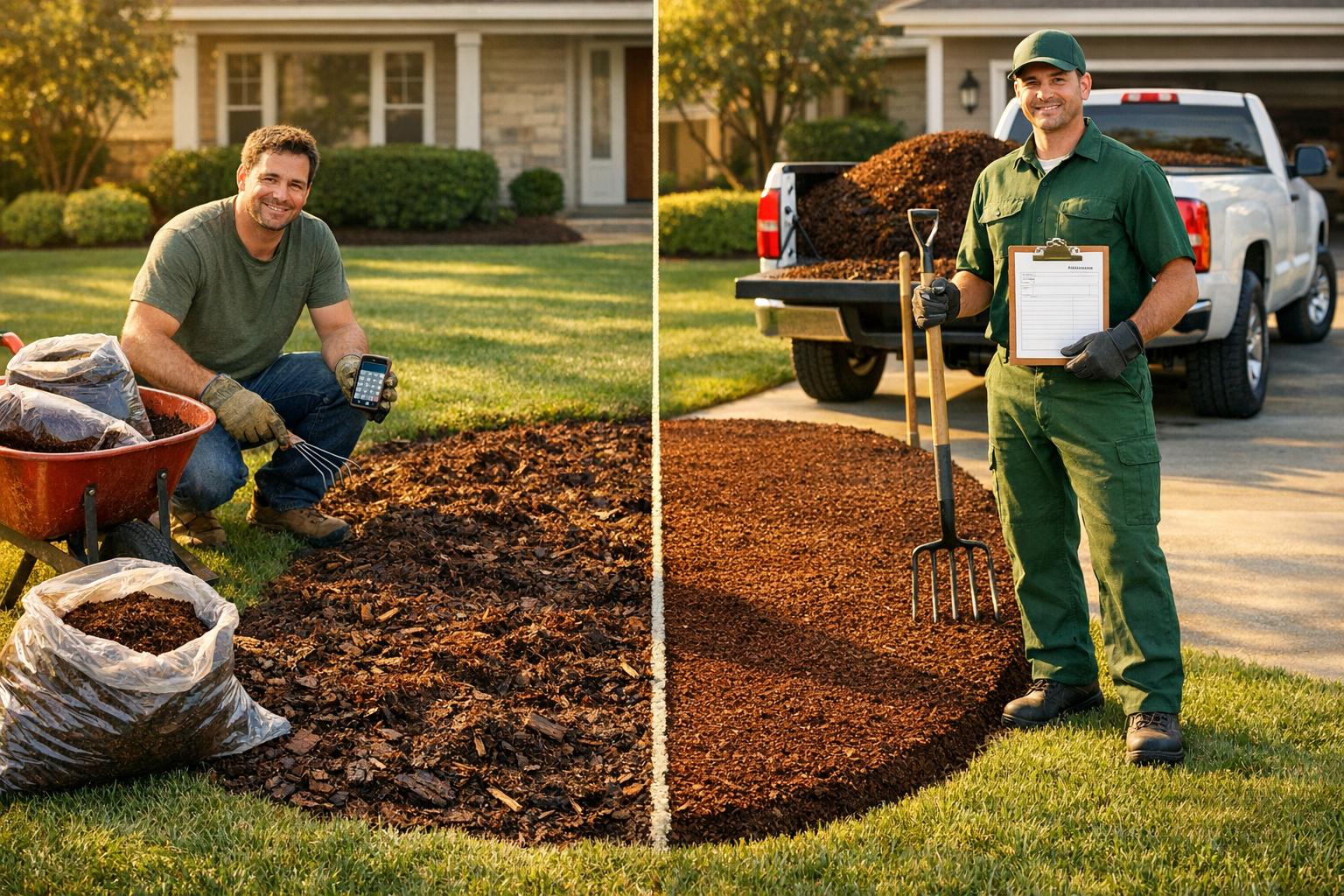
Mulching can enhance your yard’s appearance while protecting soil and plants. But should you DIY or hire a professional? Here’s a quick breakdown:
- DIY Costs: $150–$500 for bagged mulch (50–100 bags at $3–$5 each). Add $200–$300 for tools and $75–$125/day for truck rental if needed.
- Professional Costs: $75–$150 per cubic yard, including materials, labor, delivery, and cleanup. Most homeowners spend $100–$350, with a national average of $180.
- Time & Effort: DIY takes a weekend or more, while pros finish in 4–6 hours. DIY involves heavy lifting and physical labor.
- Quality: Professionals use bulk mulch with consistent color and size, applied with precision. DIY often relies on retail bags, which may vary in quality.
Key Takeaway: For small yards, DIY may save money but requires significant effort. For larger or complex landscapes, professional services offer better quality and save time. This is especially true when integrating mulch with Baltimore hardscaping features like retaining walls or stone patios.
| Feature | DIY Mulching | Professional Mulching |
|---|---|---|
| Cost | Lower upfront (materials only) | Higher (includes labor, etc.) |
| Time | 1–2 weekends | 4–6 hours |
| Physical Effort | High | None for homeowner |
| Quality | Variable | High-quality and precise |
| Long-Term Value | May need frequent touch-ups | Lasts longer with proper prep |
Ultimately, the choice depends on your budget, time, and desired results.
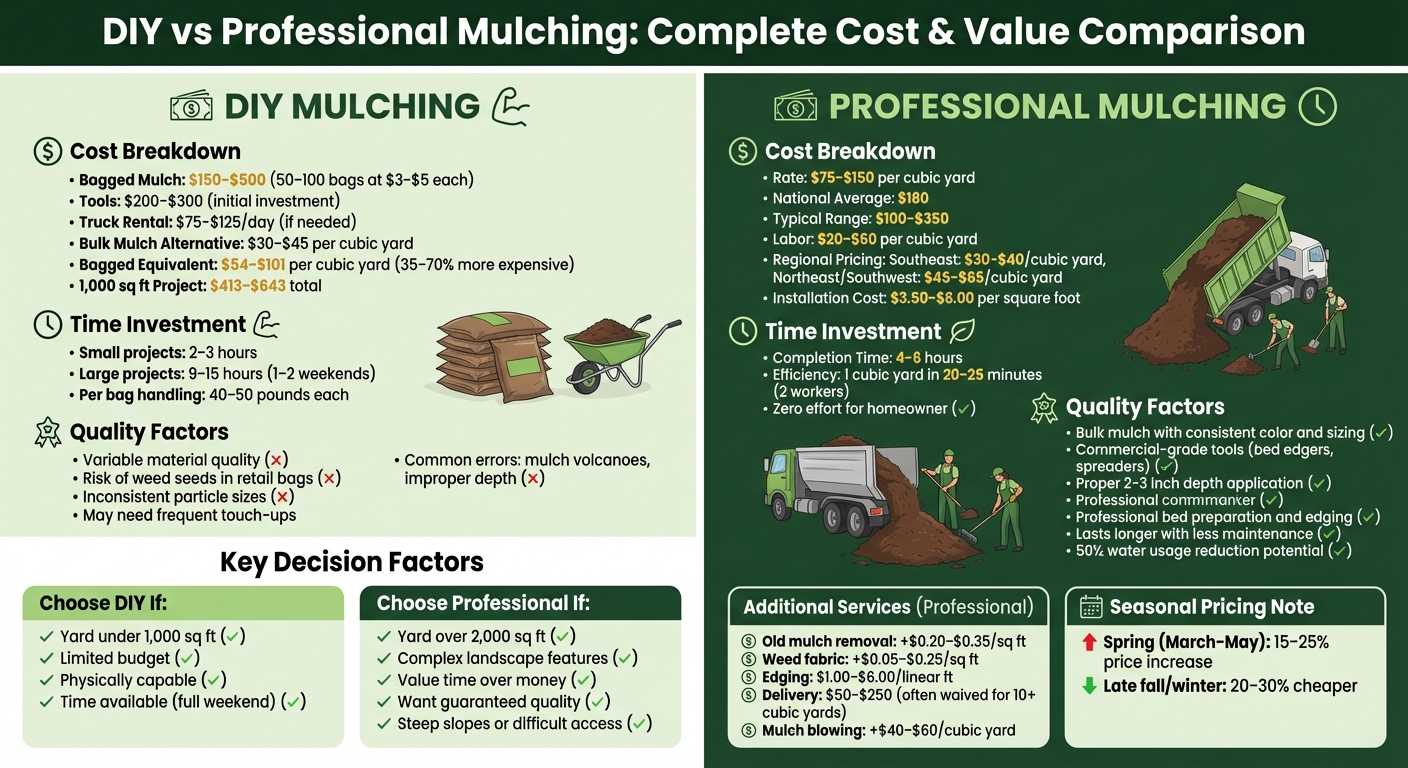
DIY vs Professional Mulching Cost and Time Comparison
How to Bid, Charge, Estimate and Install Mulch
sbb-itb-843f8be
1. Professional Mulching Services
Hiring professionals for mulching comes with several distinct advantages, from cost-effectiveness to quality and long-term benefits.
Cost
Professional mulching typically ranges between $75 and $150 per cubic yard, which includes materials, delivery, labor, and cleanup [2]. For most residential projects, homeowners spend between $100 and $350, with the national average landing around $180 [4]. However, prices can vary by region. In the Northeast and Southwest, rates often fall between $45 and $65 per cubic yard, mainly due to higher transportation and labor costs. In contrast, homeowners in the Southeast may pay just $30 to $40 per cubic yard [7]. Labor alone accounts for $20 to $60 per cubic yard, and specialized services like mulch blowing for hard-to-reach areas can add $40 to $60 per cubic yard [4]. While these costs might seem high, they reflect the quality and efficiency of professional services.
Quality
Professional mulching ensures top-tier results. Experts source bulk mulch directly from manufacturers, guaranteeing consistent color, uniform sizing, and freshness [2]. They use commercial-grade tools like bed edgers and spreaders, which result in clean lines and even 2–3 inch coverage [2][5]. This precision avoids common DIY errors, such as creating "mulch volcanoes" around tree trunks – a mistake that can suffocate roots and attract pests [2].
According to Stephen Hambleton of Reliable Lawn Care, "Professional installation often lasts longer due to proper preparation and quality materials. You might need DIY touch-ups more frequently, increasing annual costs" [2].
The meticulous application not only improves the appearance of your landscape but also speeds up the installation process.
Time Investment
Professional crews are incredibly efficient. They can finish most residential projects in 4 to 6 hours, with two workers spreading one cubic yard in just 20–25 minutes [2][3]. This level of efficiency saves homeowners significant time and effort, making it a great option for those with packed schedules.
Long-Term Benefits
Beyond aesthetics, professionally installed mulch supports healthier soil and plants. As organic mulch breaks down, it enriches the soil with nutrients [1][6]. When applied at the ideal depth of 2–3 inches, mulch helps retain moisture, potentially cutting water usage by up to 50% during summer months [8][6]. Additionally, clean mechanical edging and thorough preparation – like removing weeds and clearing debris – ensure the mulch stays in place longer and maintains its neat appearance throughout the season [1][5].
2. DIY Mulching
Going the DIY route might seem like a cost-effective option at first glance, but it comes with hidden costs in terms of time, effort, and potential quality issues. Here’s a closer look at how DIY mulching stacks up against professional services.
Cost
At face value, DIY mulching appears cheaper, but the numbers tell a more nuanced story. Bulk mulch costs between $30 and $45 per cubic yard, while bagged mulch equivalents range from $54 to $101 per cubic yard – a price jump of 35% to 70% [7].
For a 1,000-square-foot area requiring 9.3 cubic yards of mulch, here’s how the costs break down:
- Bulk mulch: $353 for materials, plus $60 for delivery, totaling $413–$428.
- Bagged mulch: $564–$643 for 126 bags you’ll need to transport yourself [7].
On top of that, factor in an initial investment of $200–$300 for tools and $75–$125 per day if you need to rent a truck for hauling bulk materials [9][2]. While DIY labor can save around $326 for this size project, it comes at the cost of significant time and physical effort [7].
Quality
The quality of a DIY mulching project largely depends on the materials you choose and how well you apply them. Bagged mulch from retail stores often includes inconsistent particle sizes, weed seeds, or even harmful chemicals, whereas professional-grade bulk mulch is sourced directly from manufacturers and tends to be more reliable [2].
Without specialized tools like bed edgers, achieving neat, uniform coverage can be tricky. Mistakes such as piling mulch against tree trunks can suffocate roots, while improper depth – less than 2 inches or more than 3 inches – can either fail to suppress weeds or smother the soil [2][10][4].
Time Investment
Time is one of the biggest challenges for DIY mulchers. Spreading bulk mulch for a 1,000-square-foot area might take about 30 minutes, but if you’re dealing with 126 bags, expect to spend 2–3 hours just opening and spreading them [7]. For larger projects, the time investment jumps to 9–10 hours for bulk mulch or 12–15 hours for bagged mulch, which can easily consume an entire weekend [7].
Each bag weighs 40–50 pounds, making the work physically demanding and increasing the risk of injury [2].
Stephen Hambleton of Reliable Lawn Care explains, "Time becomes the biggest challenge for most DIY mulchers. Measuring beds, calculating cubic yards, shopping for materials, and spreading mulch takes entire weekends" [2].
This time commitment contrasts sharply with the speed and efficiency of professional crews.
Long-Term Benefits
When done correctly, DIY mulching offers the same benefits as professional work, such as moisture retention, weed suppression, and nutrient enrichment. However, achieving these benefits requires proper preparation. Without steps like deep weeding, bed edging, and using professional-grade weed barriers, your mulch may shift, thin out, or need more frequent touch-ups [1][2].
Unlike professional installations, which often require minimal maintenance, DIY projects can demand ongoing upkeep. This extra effort could chip away at the initial cost savings, making the DIY option less appealing in the long run.
What Affects Mulching Costs
When it comes to mulching, several factors play into the overall cost, whether you’re hiring professionals or tackling the project yourself. Knowing these variables can help you plan your budget and avoid surprises along the way.
Material selection is one of the biggest cost drivers. For example, shredded hardwood mulch typically costs between $30 and $45 per cubic yard, while premium cedar mulch can range from $50 to $110 per cubic yard. If you prefer dyed mulch, expect to pay an additional $5 to $10 per cubic yard compared to natural options, though keep in mind that the color may fade over time. For something different, recycled rubber mulch is another option, priced at $65 to $140 per cubic yard [3][4][7].
Property size and accessibility also play a major role in determining costs, especially for labor. Professional installation typically costs between $3.50 and $6.00 per square foot, but more complex properties – think steep slopes, tight corners, or areas far from the street – can drive up labor costs. In these cases, specialized equipment like blower trucks might be required, adding $0.20 to $0.35 per square foot [3][5].
Add-on services can quickly increase the final price. For instance, removing old mulch or weeds costs an extra $0.20 to $0.35 per square foot, and laying down weed fabric adds another $0.05 to $0.25 per square foot. Edging, which gives a neat, finished look and helps contain the mulch, is billed separately – basic edging costs $1.00 to $3.00 per linear foot, while premium edging can run $3.00 to $6.00 per linear foot. Don’t forget delivery fees, which range from $50 to $250 depending on the distance, although many suppliers waive these fees for orders over 10 cubic yards [3][7][11].
Seasonal timing is another factor to consider. Mulch prices tend to spike by 15% to 25% during the busy spring months (March–May), while late fall or winter installations can be 20% to 30% cheaper. Regional pricing differences also come into play. For instance, mulch is more affordable in areas like the Southeast and Pacific Northwest, where it costs around $30 to $40 per cubic yard due to abundant timber. In contrast, prices climb in the Southwest and Northeast, reaching $45 to $65 per cubic yard, largely because of higher transportation and labor costs [7].
Pros and Cons
When deciding between DIY mulching and hiring professionals, understanding the trade-offs can help you make an informed choice. Here’s a breakdown of how these approaches differ and what that means for your investment.
Cost is the biggest differentiator. DIY mulching generally has lower upfront costs since you’re only paying for materials. However, retail bagged mulch can be surprisingly expensive – especially for larger projects. For instance, if your yard needs more than one cubic yard of mulch (around 14 bags), buying in bulk, as professionals do, often becomes the more economical option.
Time and effort are another major consideration. Professional crews can finish most residential mulching jobs in 4 to 6 hours [2]. In contrast, DIY projects can take an entire weekend – or more – depending on the yard’s size. Plus, handling 40 to 50-pound bags and manually spreading mulch can be physically taxing. Professionals avoid these challenges by using specialized equipment like blower trucks and bed edgers, which also reduce the risk of injury [2][5].
Material quality and installation techniques play a key role in long-term results. Professionals typically use bulk mulch that’s free of weed seeds and offers consistent color and texture. Retail bags, on the other hand, can vary in quality and even contain unwanted materials [2]. Additionally, professional services include thorough bed preparation – like deep edging, weed removal, and proper grading – which ensures better results and avoids common DIY errors. Mistakes like "mulch volcanoes" (piling mulch against tree trunks) can lead to serious issues like root rot, potentially costing you more in the long run [2][12].
Stephen Hambleton, Owner of Reliable Lawn Care, notes, "Professional installation often lasts longer due to proper preparation and quality materials. You might need DIY touch-ups more frequently, increasing annual costs" [2].
To help you compare, here’s a summary of the key differences:
| Feature | DIY Mulching | Professional Mulching Services |
|---|---|---|
| Upfront Cost | Lower (materials only) | Higher (includes labor, delivery, cleanup) |
| Material Quality | Variable; retail bags may contain weed seeds | High-quality bulk; consistent color and sizing |
| Time Requirement | High; 1–2 weekends for large yards | Low; 4–6 hours for most properties |
| Physical Demand | High; lifting 40–50 lb bags | None for the homeowner |
| Quality of Results | Variable; risk of improper depth or "mulch volcanoes" | Professional; includes edging and even 2–3 inch depth |
| Long-term Value | Lower; may require more frequent touch-ups | Higher; better soil health and durability |
| Equipment | Basic tools (rake, shovel, wheelbarrow) | Commercial grade (edgers, blower trucks) |
Ultimately, your decision comes down to balancing time, effort, and cost with the quality and durability you want for your landscape. Whether you go DIY or hire professionals, understanding these factors ensures you’ll make the right choice for your yard.
Conclusion
Deciding between professional mulching and a DIY approach comes down to your budget, time, and the results you’re aiming for. If you have a smaller yard – under 1,000 square feet – and the physical effort doesn’t intimidate you, DIY mulching can be a practical option using basic tools. However, for larger properties, especially those over 2,000 square feet or with challenging features like steep slopes or mature trees, hiring professionals is often the better route. While professional services range between $750 and $3,000, they help you avoid common mistakes like “mulch volcanoes” and ensure proper preparation of your landscape beds. Plus, professional crews typically finish the job in just 4 to 6 hours, saving you a lot of time and effort.
What makes professional mulching worth it is the durability and quality of the work. Expert techniques and materials mean the installation lasts longer, cutting down on the need for frequent maintenance.
For homeowners in Maryland – particularly in Howard, Montgomery, and Frederick Counties – Pro Landscapes MD offers mulching services tailored to the local soil and climate. Their process includes precise bed edging, thorough weed removal, and carefully measured mulch application, ensuring your yard stays both beautiful and healthy.
FAQs
How do I calculate how many cubic yards of mulch I need?
To figure out how much mulch you need in cubic yards, start by measuring the area and deciding on the desired depth of mulch. Here’s how to do it step by step:
- Multiply the length by the width (in feet) to find the total square footage of the area.
- Convert the depth from inches to feet by dividing the depth in inches by 12.
- Multiply the square footage by the depth (in feet) to calculate the volume in cubic feet.
- Finally, divide the cubic feet by 27 (since 1 cubic yard equals 27 cubic feet) to get the volume in cubic yards.
For instance, if you’re covering a 10-foot by 10-foot area with a mulch depth of 3 inches, the math would look like this:
- Area: 10 ft × 10 ft = 100 square feet
- Depth in feet: 3 inches ÷ 12 = 0.25 feet
- Volume in cubic feet: 100 × 0.25 = 25 cubic feet
- Volume in cubic yards: 25 ÷ 27 ≈ 0.93 cubic yards
This method ensures you order just the right amount of mulch for your project.
Which mulch type is best for my beds (hardwood, cedar, dyed, rubber)?
The best mulch choice depends on what you need and prefer for your garden. Hardwood mulch and cedar mulch are excellent organic options. They help enrich the soil, keep weeds in check, and work well for most garden beds. Cedar has the added benefit of repelling pests and gives off a pleasant scent, while hardwood provides durable, long-lasting coverage. If you’re looking for a pop of color, dyed mulch can brighten up your garden, though it might include chemicals. For pathways, rubber mulch is a tough, long-lasting option, but since it doesn’t break down, it’s not ideal for improving soil health.
How often should mulch be replaced or topped off?
Most types of mulch need a yearly refresh to stay effective and look good. However, some, like cedar mulch, can last up to two years. Inorganic mulches, such as gravel or rubber, can stick around for 5 to 10 years. To keep your mulch working as it should, inspect it regularly for thinning or wear and touch it up as needed.
Chat with Us