









- bhavya gada
- No Comments
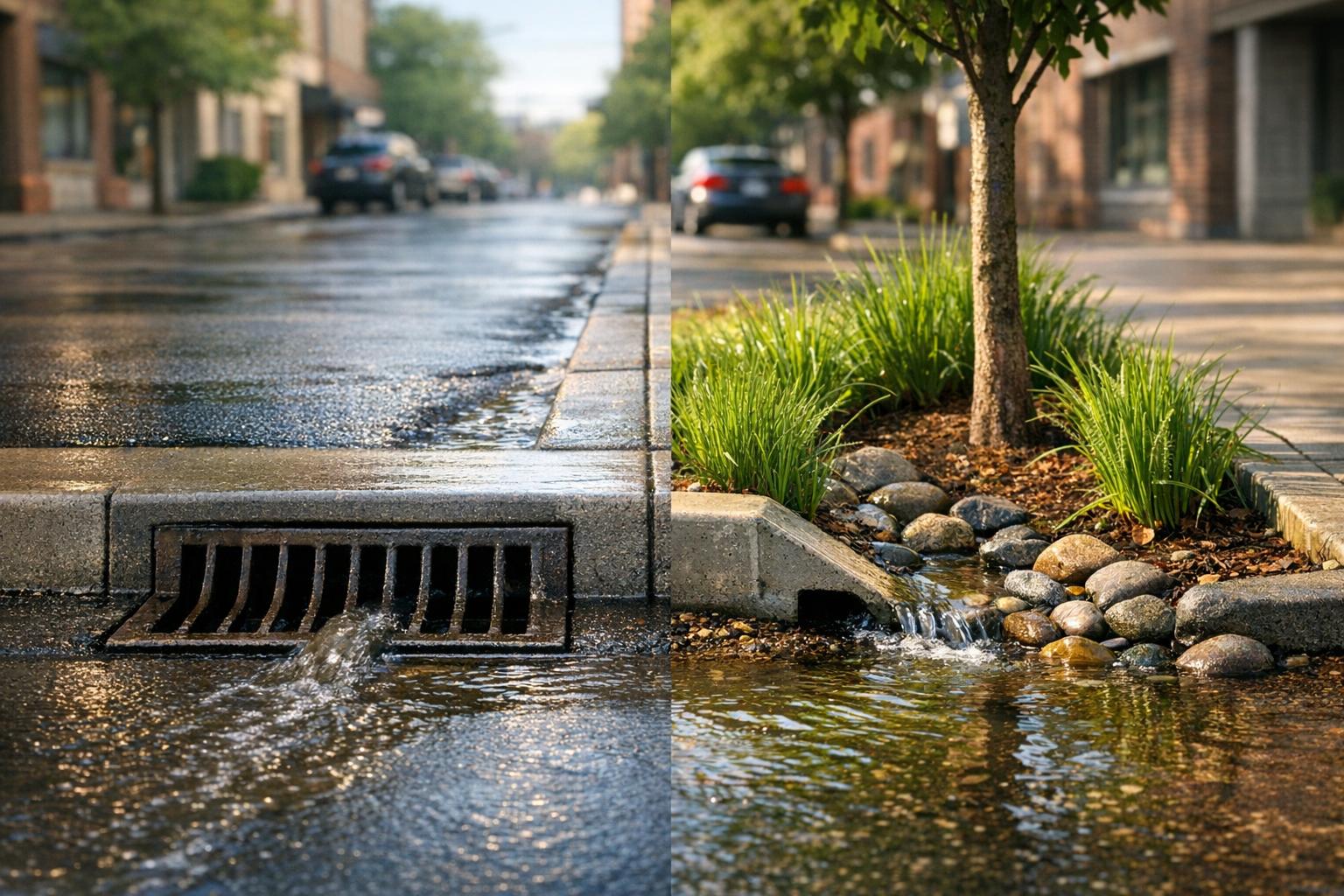
Curbside bioswales and traditional drainage systems tackle stormwater runoff differently, with distinct advantages and limitations. Bioswales use vegetation and soil to filter and absorb water, reducing pollution and replenishing groundwater. Traditional systems, like curbs and gutters, focus on quickly moving water to prevent flooding but often lead to untreated runoff entering waterways.
Key Takeaways:
- Bioswales: Reduce runoff, improve water quality, and promote infiltration. Best for small to moderate storms but require careful design and installation.
- Traditional Systems: Efficient for heavy storms and rapid water removal but contribute to downstream flooding and erosion.
- Cost: Bioswales have lower long-term maintenance costs and can save 15–80% in initial installation compared to traditional systems.
- Environmental Impact: Bioswales protect ecosystems, while traditional systems can degrade them.
Quick Comparison:
| Feature | Bioswales | Traditional Drainage |
|---|---|---|
| Runoff Management | Delayed, filters pollutants | Immediate, untreated runoff |
| Flood Prevention | Effective for small storms | Handles heavy storms better |
| Cost Efficiency | Lower long-term costs | Higher maintenance costs |
| Environmental Impact | Positive (filtration, recharge) | Negative (erosion, pollution) |
Bioswales are ideal for integrating stormwater management with urban landscapes, offering cleaner water and reduced long-term costs. Traditional systems remain effective for heavy rainfall but come with higher environmental and operational costs.
Bioswales vs Traditional Drainage Systems: Performance and Cost Comparison
What Are Bioswales?
sbb-itb-843f8be
Design and Installation Differences
Traditional drainage systems are built around concrete curbs, gutters, catch basins, and underground pipes. These systems are designed to quickly move water away from streets, following established engineering standards while keeping the surface footprint minimal [1]. On the other hand, bioswales combine natural elements with engineered designs to manage runoff in a more integrated way.
Bioswales are constructed using a mix of soil layers, vegetation, and structural components. Their design typically includes a foundation of engineered soil media with a clay content capped at 5% and an infiltration rate of 5–10 inches per hour. Native plants that are well-suited to the local climate and capable of handling water stress are planted above this layer. The system also incorporates features like curb cuts (at least 18 inches wide) for water entry, stone energy dissipaters to reduce erosion, and overflow drains raised about 6 inches above the soil to manage excess water during heavy storms. To ensure stability, side slopes are ideally graded at a 4:1 ratio, with a maximum of 3:1 [3].
The installation methods for these systems highlight their differences even further. Traditional drainage systems rely on standardized construction methods. Modern versions often consolidate components like bypass weirs, treatment units, and junction manholes, which simplifies the process and reduces both installation time and site disruption [5]. In contrast, bioswale installation is far more specialized. It requires expertise in areas like soil science, hydrology, and landscape architecture. There are also specific design considerations, such as maintaining at least 5 feet of clearance between the bottom of the bioswale and the high groundwater table. Additionally, protective measures like waterproof liners may be used to separate the bioswale from nearby roadbeds or utility lines [3].
"Bioswales are the most effective type of green infrastructure facility in slowing runoff velocity and cleansing water while recharging the underlying groundwater table." – NACTO [3]
Acknowledging their benefits, the Maryland State Highway Administration has incorporated bioswales as part of their engineered best management practices (BMPs) to treat stormwater runoff directly at its source [2]. This decentralized approach stands in stark contrast to traditional systems, which rely on centralized networks of street-level pipes. While traditional systems can be installed relatively quickly with standard construction crews, bioswales require a more detailed process. This includes layering soil and stone carefully and planting vegetation with precision, which naturally extends the construction timeline [4].
Stormwater Management Performance
Pollutant Removal and Water Quality
Traditional curb-and-gutter systems and bioswales take very different approaches to handling pollutants. Curb-and-gutter systems focus on moving water quickly, which means runoff – including oil, heavy metals, nutrients, and debris – flows untreated into storm drains and eventually into local waterways. Bioswales, on the other hand, slow down water flow, allowing it to filter through specially engineered soil and vegetation. This process helps remove pollutants before the water enters drainage systems or seeps into groundwater.
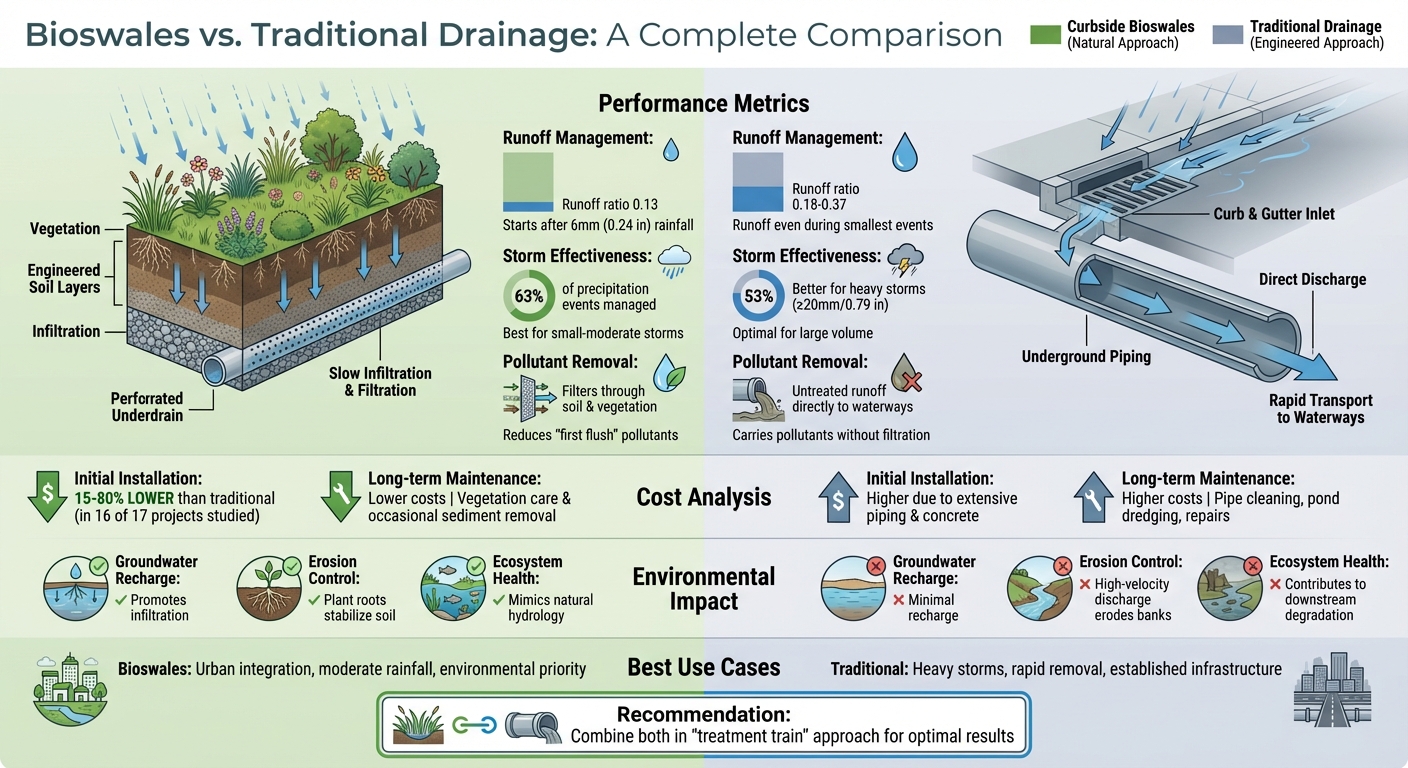
A study conducted in Maryland between November 2017 and July 2018 by researchers S. Woznicki, K. Hondula, and T. Jarnagin compared four suburban catchments ranging from about 1.9 to 13 acres. The "green" catchment, which used vegetated swales, had a runoff ratio of just 0.13 and only began producing runoff after 6 mm (roughly 0.24 inches) of rainfall. In contrast, the three "grey" catchments – using conventional infrastructure – showed runoff even during small rain events, with ratios of 0.18, 0.35, and 0.37 [1].
"The catchment with decentralized SCMs [Stormwater Control Measures] reduced runoff, runoff ratio, and peak runoff compared with the grey infrastructure catchments." – US EPA [1]
This "threshold effect" allows bioswales to absorb light rainfall entirely, reducing the initial surge of pollutants – commonly referred to as the "first flush" – that conventional systems often fail to manage. By achieving a lower runoff ratio, bioswales not only filter more water but also help mitigate urban flooding through better water retention.
Flood Prevention and Water Retention
In addition to managing pollutants, bioswales excel in delaying runoff and reducing peak flows during moderate storms. According to the Maryland study, bioswales successfully managed 63% of precipitation events by increasing the time between rainfall and runoff, known as "runoff lag." This delay allows more water to soak into the soil, replenishing groundwater supplies [1].
When it comes to heavy storms (≥20 mm or 0.79 inches of rainfall), bioswales perform similarly to traditional systems. These larger storms accounted for 37% of the total rainfall during the study but occurred in only 10 out of 72 recorded events [1]. To handle both everyday rainfall and intense storms effectively, researchers recommend using bioswales as part of a "treatment train" approach, which includes additional measures like end-of-pipe detention systems [1].
"Green infrastructure is effective in altering the runoff hydrograph by increasing runoff lag and decreasing runoff volume. However, its effectiveness diminishes as precipitation volume and intensity increase." – US EPA [1]
Traditional systems, by contrast, prioritize moving water quickly, regardless of storm size. While this approach can prevent immediate flooding on streets, it does little to reduce the total runoff volume and often worsens downstream flooding by channeling large amounts of water without promoting natural infiltration.
Cost Comparison
Initial Installation Costs
When it comes to urban development services, balancing performance with cost efficiency is essential. Bioswales not only deliver environmental and functional benefits but also stand out as a cost-effective solution compared to traditional drainage systems. The upfront expenses for these two approaches differ significantly in how funds are allocated. Traditional curb-and-gutter systems rely heavily on concrete, extensive piping, and centralized retention ponds, all of which drive up costs. Moreover, these systems often require dedicated land for detention facilities, which can reduce the number of buildable lots in a development project [7].
In contrast, bioswales are designed to integrate seamlessly into existing landscapes. They utilize engineered soil, native vegetation, and precise grading, which eliminates the need for costly underground piping and large retention ponds. While the design of bioswales might appear more intricate, the cost savings are substantial. A review of 17 development projects revealed that implementing Low Impact Development (LID) techniques, including bioswales, resulted in savings of 15%–80% in capital costs, with only one project reporting higher expenses [7].
"Capital cost savings ranged from 15 to 80% when LID was used in these project designs." – USEPA [7]
These savings stem from eliminating the need for expensive infrastructure like pipe networks and large detention basins. In urban areas where land is at a premium, bioswales also maximize space efficiency, offering a financial edge by reducing the need for additional land acquisition.
Maintenance Costs Over Time
After installation, bioswales generally require less intensive maintenance compared to traditional systems. Maintenance tasks typically involve vegetation care and occasional sediment removal, both of which are relatively simple when native plants adapted to the local environment are used [6]. On the other hand, traditional systems demand regular pipe cleaning, inspections, and repairs to prevent blockages and erosion. Additionally, retention ponds need periodic dredging to manage sediment buildup and prevent problems like mosquito infestations [6].
"While the initial setup for bio-swales may be higher, they generally require less ongoing maintenance compared to traditional solutions." – Doug Liles [6]
This lower maintenance burden translates into reduced recurring costs over the lifespan of a bioswale system. Even if the initial design and setup costs are slightly higher, these savings often offset the upfront investment. Traditional drainage systems, however, continue to incur costs for mechanical cleaning, infrastructure repairs, and pond maintenance, making them more expensive to operate in the long run. The table below highlights the key cost differences for easy comparison.
Cost Comparison Table
| Feature | Curbside Bioswales (LID) | Traditional Drainage (Grey) |
|---|---|---|
| Initial Installation | Often 15–80% lower due to reduced infrastructure [7] | Higher due to extensive piping and concrete [7] |
| Primary Components | Engineered soil, native plants, grading [6] | Concrete curbs, gutters, pipes, ponds [7] |
| Maintenance Needs | Vegetation care, sediment removal [6] | Pipe cleaning, pond dredging, repairs [6] |
| Long-term Value | Increased property value and aesthetic appeal [7] | Seen as less valuable [7] |
| Space Efficiency | High: fits within existing landscapes [6] | Low: needs extensive dedicated space [7] |
Environmental Impact and Benefits
Groundwater Recharge and Erosion Control
Bioswales are game-changers for stormwater management in cities, offering a practical way to recharge groundwater and curb erosion. Unlike traditional systems that whisk water away to storm drains, bioswales allow it to seep into the ground gradually. This process not only replenishes groundwater but also helps stabilize soil.
For instance, a study showed that areas using bioswales achieved a runoff ratio of just 0.13, while traditional systems had ratios between 0.18 and 0.37. This highlights how bioswales keep more water in the ground [1].
Erosion control is another major perk. Traditional systems often discharge water at high speeds, which can erode soil and damage stream banks. Bioswales, on the other hand, spread water across vegetated areas, where plant roots hold the soil together, preventing erosion.
But that’s not all – bioswales also play a role in filtering pollutants, which is a big win for urban ecosystems.
Pollution and Ecosystem Health
Traditional drainage systems are notorious for quickly funneling pollutants into waterways. Bioswales, however, take a different approach. They delay runoff – only starting after about 6 mm of rainfall – giving soil and vegetation time to filter out contaminants and protect aquatic ecosystems.
"Runoff only commenced after 6 mm of precipitation at the decentralized SCM catchment, whereas runoff occurred even during the smallest events at the grey catchments." – US EPA [1]
By mimicking natural water flow, bioswales help reduce peak runoff rates and maintain water quality. This stability benefits aquatic life, from fish to insects, by creating a healthier environment.
Environmental Impact Comparison Table
Here’s a quick look at how bioswales stack up against traditional drainage systems:
| Environmental Metric | Curbside Bioswales (Green) | Traditional Drainage (Grey) |
|---|---|---|
| Runoff Ratio | Low (~0.13) | High (0.18–0.37) |
| Runoff Initiation | Delayed (~6 mm/0.24 in rain) | Immediate (even small events) |
| Peak Runoff Rate | Reduced/Attenuated | High/Rapid |
| Groundwater Impact | Promotes recharge via infiltration | Minimal recharge; directs water away |
| Erosion Control | Plant roots stabilize soil | High-velocity discharge erodes banks |
| Ecosystem Health | Mimics pre-development hydrology | Contributes to downstream degradation |
| Water Quality | Filters pollutants via vegetation/soil | Direct discharge of contaminants |
Source: US EPA study (2018) [1]
Bioswales clearly offer a more sustainable approach, balancing urban development with environmental preservation.
Applications in Maryland Urban Areas
Implementation in Local Communities
Bioswales have become a popular choice in Maryland’s suburban areas for managing stormwater runoff. A 2018 study conducted in the state highlighted the advantages of bioswales over traditional drainage systems. The research found that green catchments, like bioswales, had a runoff ratio of just 0.13, compared to 0.37 in conventional systems [1].
The Maryland State Highway Administration (MDOT SHA) has adopted bioswales as a key part of its stormwater management strategy across the state [2]. However, their effectiveness can be limited during heavy rainfall. Bioswales tend to perform less effectively when precipitation exceeds 0.79 inches (20 mm). In fact, of the 72 rainfall events analyzed, those with more than 0.79 inches accounted for 37% of the total precipitation [1]. This underscores the need for bioswales to be part of a broader stormwater management plan, which includes backup systems like detention basins for handling intense storms.
These findings highlight the importance of integrating bioswales with other stormwater solutions in Maryland’s urban development plans. By doing so, urban areas can benefit from the performance and environmental advantages bioswales offer, making them a valuable alternative to traditional drainage systems.
Pro Landscapes MD‘s Drainage and Landscaping Services

To address the challenges of stormwater management, local professionals provide customized solutions. Pro Landscapes MD specializes in eco-conscious drainage systems, serving communities across Howard, Montgomery, Carroll, Frederick, Prince George’s, and Baltimore Counties. Their service areas include cities like Columbia, Ellicott City, Bethesda, Silver Spring, and Towson.
Pro Landscapes MD offers services such as grading, drainage installation, and stormwater management. They also provide complementary systems like French drains and dry riverbeds, which can work alongside bioswales in a "treatment train" approach. With expertise in horticulture, they ensure the right vegetation and soil composition are chosen for bioswale success. Their designs are tailored to local conditions, offering solutions that not only protect landscapes but also support environmental health.
Conclusion
Curbside bioswales consistently outperform traditional drainage systems when it comes to managing stormwater runoff. Research highlights that bioswales significantly reduce runoff volumes and delay its onset until rainfall exceeds roughly 0.24 inches. In contrast, conventional systems often generate runoff even during the lightest rain events [1]. This makes bioswales an effective solution for mimicking natural water absorption processes while safeguarding downstream ecosystems.
While the upfront cost of installing bioswales may be higher, their long-term maintenance is minimal once native plants are established [6]. On the other hand, traditional systems like retention ponds require frequent upkeep, including inspections, clearing debris, and managing erosion, which can add up over time. The decision between these systems ultimately depends on factors like your budget, available space, and specific site requirements.
In Maryland’s climate, combining bioswales with other drainage solutions such as French drains or detention basins provides a reliable approach to handling heavy storms, particularly those with rainfall exceeding 0.79 inches [1]. This integrated approach ensures effective stormwater management under varying weather conditions.
For Maryland homeowners and developers in areas like Howard, Montgomery, Carroll, Frederick, Prince George’s, or Baltimore Counties, Pro Landscapes MD offers tailored solutions designed for local conditions. Their expertise in stormwater management, grading, and eco-friendly drainage systems ensures your property remains both functional and environmentally conscious. By incorporating the right vegetation and soil components, they create bioswale systems designed for long-term success and sustainability.
FAQs
Is my site suitable for a curbside bioswale?
Your property’s potential for a curbside bioswale hinges on a few key factors, such as available space, soil quality, and grading. These systems are ideal for areas with sufficient curbside space, proper drainage, and suitable vegetation to help manage stormwater while filtering out pollutants. However, if your site has limited room, poor drainage, or a high water table, alternative solutions may be more appropriate. It’s a good idea to consult with a professional landscaper or stormwater expert to assess your property’s specific needs and conditions.
Do bioswales cause mosquito or standing-water problems?
Bioswales, if not designed or maintained correctly, can become a source of standing water, leading to mosquito problems. Issues such as water pooling, uncontrolled vegetation growth, or silt accumulation in the gravel can create ideal conditions for mosquitoes to breed. To avoid this, it’s crucial to focus on thoughtful design and consistent upkeep. This includes ensuring proper water flow and addressing any stagnant water promptly.
Can bioswales be combined with French drains or detention basins?
Bioswales can complement systems like French drains and detention basins to handle stormwater effectively. While bioswales use vegetation and soil to naturally filter, slow down, and absorb surface runoff, detention basins temporarily store excess water to reduce peak flow rates. French drains, on the other hand, manage subsurface drainage. By combining these approaches, you can create a more efficient system for controlling water quality and flow – especially useful in urban areas where space is limited.
Chat with Us