









- bhavya gada
- No Comments
Looking to transform your Maryland backyard into a poolside haven? Here’s what you need to know:
Designing a poolside landscape in Maryland means balancing aesthetics with practicality. The state’s humid summers, cold winters, and unique soil conditions require smart plant and material choices. Native plants like Black-eyed Susans and switchgrass thrive in the local climate, while durable hardscaping materials like bluestone and flagstone can handle freeze-thaw cycles.
Key Steps to Get Started:
- Evaluate your space: Identify slopes, drainage issues, and sun patterns.
- Plan activity zones: Create spaces for dining, lounging, and privacy.
- Choose resilient plants: Opt for local species that tolerate heat and occasional freezes.
- Add durable hardscaping: Use non-slip, weather-resistant materials for patios and walkways.
- Incorporate lighting and water features: Extend usability and create a relaxing ambiance.
Proper planning ensures your poolside retreat is functional, beautiful, and built to last year-round. Start early to enjoy your space by summer!
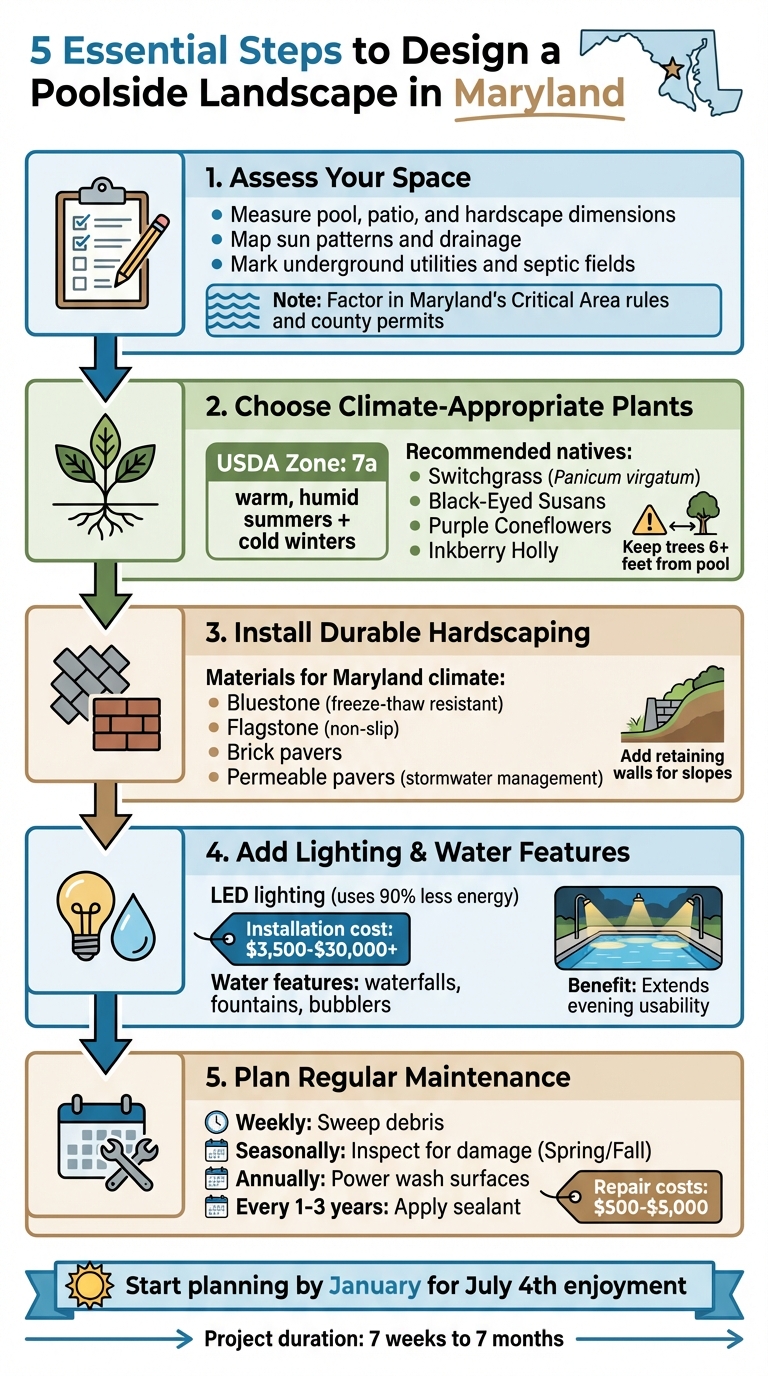
5 Essential Steps to Design a Poolside Landscape in Maryland
Mt. Airy Maryland Swimming Pool with Swim Up Bar and Landscaping
sbb-itb-843f8be
Assess Your Poolside Space and Set Goals
Start by evaluating your poolside area. Take a close look at your property to identify existing features like the pool, nearby structures, trees, slopes, and any spots where water tends to collect after heavy rainfall. As Rhine Landscaping emphasizes, "The most important part of installing a swimming pool is proper design and elevation. If a pool is built without taking such aspects as the landscape into consideration, problems can arise including the need for retaining walls and drainage systems that were not originally budgeted or planned." [5]
Measure and Map Your Area
Grab a tape measure and create a rough sketch of your poolside layout. Include the dimensions of your pool, patio, and any hardscape elements. Pay attention to sun patterns, as these will help you decide where to plant greenery or position lounge chairs. Be sure to mark underground utilities, septic fields, and drainage patterns on your map. For instance, in one Potomac project, homeowners Nancy and Mark Labus had to obtain a county permit to move a reserve septic field before they could start digging for their pool [1].
Maryland’s regulations add an extra layer of complexity. You’ll need to factor in Critical Area rules, stormwater management requirements, and county-specific permits [6]. If your property has steep slopes, which is common in areas like Potomac, you might need to plan for tiered levels or use boulders strategically to manage elevation changes in a cost-effective way [1].
Once you’ve mapped out the area, think about how you want to use each section.
Divide the Space into Activity Zones
Consider how you’ll use the space. Will it include a quiet corner for morning coffee, a dining area for weekend gatherings, or perhaps a fire pit for chilly evenings? Using different flooring materials – such as natural stone for dining spaces and pavers for walkways – can help visually separate these areas. Grouping furniture in each section further defines these zones [8].
Make sure to plan clear, functional pathways connecting your home, the pool, and each activity area. This avoids awkward layouts where guests have to weave around furniture or plants to get to the pool [7]. You might also want to include privacy features, like tall hedges or stone walls, to create a more intimate setting [2][8].
Finally, tailor your design to Maryland’s unique climate and soil for a layout that lasts.
Consider Maryland’s Climate and Soil Conditions
Maryland’s warm, humid summers and occasional cold snaps in winter mean you’ll need to choose materials and plants that can handle these conditions. Creative Land Design explains, "Maryland’s freeze-thaw cycles, humidity, soil variations, and seasonal temperature swings require careful plant selection and material choices. Selecting the wrong hardscape materials or plant palette can lead to long-term failure." [6]
Test your soil to determine its drainage capabilities and pH levels. Opt for resilient plants like boxwoods and ornamental grasses, which can thrive in the region’s humid summers and cooler spring weather [2]. If you’re considering features like a fire pit or outdoor kitchen, think about how these elements can help you enjoy your poolside area well into the fall and early spring [1][2].
Choose Plants That Thrive in Maryland
Designing a poolside landscape in Maryland means aligning your plant choices with the local climate. The Washington, D.C. area and nearby Maryland suburbs fall under USDA plant hardiness zone 7a. This means warm, humid summers and cold winters with occasional freezes are the norm [10]. Add in the unique challenges of a poolside – like reflected sunlight, chemical splashes, and the need for low-maintenance plants – and you’ll need greenery that’s not just visually appealing but also tough enough to handle these conditions.
Here’s a closer look at plants that are well-suited for Maryland’s poolside environments.
Use Native and Hardy Plant Species
Native plants are a great choice because they’re adapted to local conditions, making them easier to maintain. They also play an essential role in supporting local ecosystems. As Johnson’s Landscaping Service explains, "Native plants are the backbone of our local ecosystems, playing a crucial role in supporting biodiversity, providing habitat for wildlife, and sustainability." [9]
For sunny poolside spots, the University of Maryland Extension suggests switchgrass (Panicum virgatum), little bluestem (Schizachyrium scoparium), and yellow indiangrass (Sorghastrum nutans) as excellent options [10]. If your pool uses saltwater, you can opt for salt-tolerant natives like Joe Pye Weed or specific types of switchgrass that handle splashes well [9].
Looking for perennials? Black-Eyed Susans (Maryland’s state flower), Purple Coneflowers, and Amsonia are all great for poolside settings. Amsonia hubrichtii, in particular, is praised by Homestead Gardens for its summer beauty and vibrant fall colors [11]. For shrubs that provide privacy without invasive roots, consider Inkberry Holly, Summersweet, or Virginia Sweetspire [10].
When it comes to trees, placement is key. Keep them at least six feet away from the pool to avoid root damage and excessive debris. Steer clear of river birches and willows, as their aggressive root systems can harm your pool’s structure [10]. Instead, go for native trees like Serviceberry, Eastern Redbud, or Sweetbay Magnolia, which bloom in spring before swimming season kicks off.
Layer Plants for Privacy and Depth
Creating a layered garden not only enhances privacy but also adds depth to your poolside landscape. Start with low-growing groundcovers like Christmas Fern or Green and Gold at the front. Add a mid-layer of perennials such as Black-Eyed Susans, and finish with taller ornamental grasses or shrubs in the back. This staggered arrangement helps block sightlines and gives your garden a lush, tiered look.
For year-round privacy, evergreens like Inkberry Holly or Eastern Red Cedar are excellent choices. Pair these with deciduous shrubs to add seasonal interest. Mixing textures – such as combining the fine leaves of ornamental grasses with the broader foliage of native shrubs – can help manage the intense heat by providing much-needed afternoon shade.
With a layered design in place, the next step is selecting plants that can handle Maryland’s heat and occasional dry spells.
Select Drought-Tolerant and Year-Round Plants
Even though Maryland gets regular rainfall, poolside areas often have fast-draining soil and intense sun exposure, which can stress plants. Drought-tolerant natives like Threadleaf Blue Star (Amsonia hubrichtii) and Blue False Indigo (Baptisia australis) develop deep roots, making them resilient during dry periods [11][12]. Succulents like Sedum are another great option – they store water in their fleshy leaves and hold up well in the summer heat [13][14].
While drought-tolerant plants require consistent watering initially to establish their roots, they become low-maintenance over time [12][13]. For winter interest, Little Bluestem grass turns a striking bronze-orange and retains its color throughout the colder months. Coral Bells (Heuchera) bring year-round appeal with their foliage, which shifts to rose-purple hues during winter [9][14]. Leaving the seed heads of Coneflowers and Black-Eyed Susans intact through winter not only adds texture but also provides food for birds, ensuring your poolside garden remains lively even after the swimming season ends.
Add Hardscaping for Function and Design
Once you’ve selected your plants, it’s time to think about hardscaping to complete a functional and inviting poolside retreat. Hardscaping not only enhances the aesthetic but also ensures safety, manages drainage, and prevents erosion. Features like patios, walkways, and retaining walls are essential for creating stable surfaces for furniture, controlling water flow, and addressing sloped terrain. It’s crucial to choose materials that can withstand Maryland’s freeze-thaw cycles and humid summers. As Budding Branch Landscape & Design emphasizes, "If your pool is not thoughtfully planned by a professional landscape designer… you could end up with poor drainage, improper grading, a layout that doesn’t meet your needs, or even an unfinished project." [4]
With the right hardscaping, your poolside area becomes a comfortable spot you can enjoy year-round.
Pick Safe, Durable Materials
When it comes to poolside hardscaping, safety should be your top concern. Wet surfaces can easily become slippery, especially in Maryland’s humid climate, where moss and mold can grow quickly. Natural stone options like bluestone and flagstone are excellent choices. They provide secure footing and hold up well against Maryland’s seasonal temperature swings without cracking or degrading.
Brick pavers are another reliable option, offering both durability and a polished look throughout the year [2][16]. If you’re looking for an eco-friendly choice, permeable pavers allow water to filter through the surface, reducing runoff and helping manage stormwater. These pavers also cut down on maintenance by preventing pooling water [3][15].
Keep in mind that all materials require maintenance. Regularly clean your pool deck to prevent moss and mold buildup, and perform seasonal tasks like re-sanding paver joints to protect your hardscaping from Maryland’s challenging weather [15].
Install Retaining Walls and Stone Features
If your property includes sloped areas, retaining walls are essential for creating flat, usable spaces around your pool. For example, in Potomac, Maryland, homeowners Nancy and Mark Labus collaborated with landscape architect Chad Talton of Surrounds Landscaping to tackle a steep two-acre lot. Instead of using only costly masonry walls, the project incorporated boulders, tiered planting beds, and short steps to stabilize the slope. This approach not only reduced expenses but also maintained a natural, cohesive look [1].
Nancy Labus shared her thoughts on the project:
"I think Chad was very clever in the way he dealt with the slope. You don’t feel like you are in a yard with a steep drop off because of all the different tiers he put into it." [1]
In addition to slope management, stone features like garden walls, seat walls, and stone veneers can enhance the structure and visual appeal of your poolside area. These elements help define spaces, guide foot traffic, and create distinct zones for relaxation or activities [8].
Create Outdoor Living Spaces
Maryland’s mild spring and fall seasons make outdoor entertaining a must, so consider adding features that extend the usability of your pool area. Patios with seating, fire pits, or outdoor kitchens can transform your poolside into a multi-functional space beyond just swimming [2][16]. Some homeowners in Maryland even install heating systems beneath stone patios to keep the area warm during cooler months [16].
When planning these spaces, think about practical details like furniture placement, utility access, and how people will move through the area. Durable poolside furniture made from teak, metal, or weatherproof wicker is a smart choice, as it can handle Maryland’s humid summers and cooler seasons [2]. If a full outdoor kitchen isn’t in your budget, a high-quality grill station can still elevate your space [1].
It’s also wise to plan ahead for underground cables, pool equipment access, and septic systems during patio construction. This foresight can save you from expensive excavation work down the line [4].
To complete your poolside design, consider adding lighting and water features for a truly inviting atmosphere.
Add Lighting and Water Features
Once your hardscaping is complete, take your Maryland poolside retreat to the next level by incorporating smart lighting and tranquil water features.
Strategic lighting and water features can extend the usability of your pool area well into the evening. Outdoor lighting enhances safety and creates a welcoming atmosphere, while water features bring movement and help mask unwanted background noise.
Install Outdoor Lighting for Safety and Atmosphere
Safety should be your top priority when adding lighting, especially in areas prone to wet surfaces where slips and falls are a risk. Path and step lights are great for illuminating walkways, stairs, and pool decks, making it easier for guests to navigate after dark. For added visibility, underwater LED lights can brighten the pool itself, allowing you to monitor swimmers, including children, during nighttime use.
To create a warm and inviting ambiance, layer different lighting techniques. Uplighting can showcase architectural elements, while downlighting casts soft, natural shadows. Modern LED systems are an excellent choice – they’re energy-efficient, using up to 90% less energy than traditional halogen lights, and they last much longer [18]. In Maryland, professional landscape lighting installations can range from $3,500 for basic setups to over $30,000 for more elaborate designs [17].
For maximum efficiency and minimal upkeep, opt for low-voltage LED fixtures with waterproof seals. Start by mapping your outdoor space at night to identify key areas for lighting placement.
Pair your lighting setup with water features to enhance the visual and acoustic appeal of your poolside retreat.
Include Water Features for Visual Interest
Adding water features is a great way to elevate the look and feel of your poolside area while addressing Maryland’s unique climate considerations.
Options like waterfalls, fountains, and bubblers provide soothing sounds that can drown out neighborhood noise, giving your space a more private and serene vibe [2]. These features work particularly well on sloped properties, where they can be integrated into tiered landscapes using carefully placed boulders.
A perfect example comes from Potomac, Maryland, where homeowners Nancy and Mark Labus collaborated with Chad Talton of Surrounds Landscaping in October 2025. Their project transformed a steep slope into a stunning poolside retreat by incorporating tiered boulders and a custom waterfall that flows directly into the pool.
When designing water features, consider using local materials like bluestone or flagstone to ensure the installation blends seamlessly with Maryland’s natural surroundings [2]. Submersible lighting designed for waterfalls or fountains can further enhance their beauty at night, highlighting the movement of the water. Don’t forget to plan for easy access to pumps and filters, ensuring routine maintenance doesn’t disrupt the visual harmony of your landscape [4].
Maintain Your Poolside Landscape
Once you’ve designed your poolside retreat, keeping it in top shape requires consistent care, especially given Maryland’s unpredictable climate. From freeze-thaw cycles to high humidity and seasonal fluctuations, these factors can take a toll on both plants and hardscaping. Regular maintenance not only helps avoid costly repairs but also protects the integrity of your poolside structures and landscaping[6].
Perform Regular Plant Care
Pruning is essential for maintaining healthy plants and keeping them from overtaking your pool area. Fast-growing options like arborvitae or bamboo need frequent trimming to stay in check and avoid crowding the pool deck[2]. If you’re working with native plants like Black-eyed Susans or boxwoods, you’ll find them easier to care for since they naturally thrive in Maryland’s climate[2]. Trimming native grasses and shrubs also helps stabilize soil around your pool, reducing erosion over time[2].
Monitor Drainage and Water Flow
Good drainage is critical for safeguarding your pool area. Poor water flow can lead to standing water, which not only damages foundations but also creates a breeding ground for mosquitoes. After heavy rains, inspect areas near pool equipment and retaining walls for pooling water, which might signal the need for regrading or clearing blocked drainage paths[4]. Maryland’s stormwater systems require regular attention to ensure they function as designed[7].
To prevent issues, clean out French and channel drains seasonally – clogs are a common cause of shifting hardscapes and foundation problems[21]. If your property is sloped, check that tiered planting beds and boulders are effectively keeping soil in place. Address any erosion patterns immediately. You might also consider eco-friendly options like permeable paving to manage water flow while supporting a healthier landscape[3].
In addition to drainage checks, inspecting hardscape elements regularly is key to keeping your pool area safe and visually appealing.
Check and Repair Hardscaping Elements
Inspect your patios, walkways, and retaining walls twice a year, ideally in spring and fall. Look for cracks, uneven surfaces, or bowing in retaining walls, as Maryland’s freeze-thaw cycles can cause significant wear over time[19][20][21]. Small cracks should be filled right away to prevent water from seeping in and causing further damage[20][21]. If pavers shift or become uneven, lift and adjust the base material before resetting them to maintain a level surface[21].
Keep hardscaping clean and protected by sweeping weekly to remove debris, power washing annually to tackle grime, and applying sealants every 1–3 years to guard against moisture and chemical wear[20][21][22]. During winter, avoid salt or chemical deicers on poolside surfaces, as they can erode materials. Instead, use sand or cat litter for traction[21]. Remove weeds and moss from paver joints as soon as they appear, as their roots can push against stones and walls, leading to cracks and movement over time[21]. Considering that residential landscape repair costs can range from $500 to $5,000, addressing minor issues early can save you from more expensive fixes later[20].
| Maintenance Task | Frequency | Purpose |
|---|---|---|
| Sweeping/Debris Removal | Weekly | Prevents staining and organic breakdown[21] |
| Damage Inspection | Seasonally (Spring/Fall) | Identifies cracks, shifting, or bowing early[21] |
| Power Washing | Annually | Removes deep-seated grime and algae[21] |
| Sealing | Every 1–3 Years | Protects against moisture and wear[20][22] |
| Weed/Moss Removal | As needed | Prevents root-related shifting and cracking[21] |
For tailored maintenance and repair solutions designed for Maryland’s climate, Pro Landscapes MD offers professional expertise to keep your poolside landscape in prime condition.
Conclusion
Creating a poolside landscape in Maryland means factoring in the state’s unpredictable weather and unique environmental challenges. Start by evaluating your space, choosing plants that thrive locally, incorporating durable hardscaping, and ensuring proper drainage. This approach helps craft a backyard retreat that’s both beautiful and practical throughout the year.
Sometimes, turning your vision into reality requires more than just a solid plan – it calls for professional expertise. Skilled professionals can help you navigate zoning laws, tackle tricky grading or drainage issues, and manage construction schedules to avoid costly mistakes.
Timing is everything when planning for summer enjoyment. If you hope to be swimming by July 4th, you’ll need to start planning well before January. Depending on the complexity of your project, the process can take anywhere from seven weeks to seven months[23]. Waiting until spring might push your timeline too far for a summer-ready poolside.
FAQs
What permits might I need for a poolside landscape in Maryland?
In Maryland, you’ll generally need a building permit if you’re planning to build, modify, or expand a residential swimming pool or any related features, such as fences, decks, or similar structures. For pool fences, there are specific height and safety standards that must be followed. Make sure to check your local county regulations to confirm that your project complies with all necessary requirements before you begin.
What plants are best near a saltwater pool in Maryland?
Plants that thrive near a saltwater pool in Maryland often include salt-tolerant native species such as seaside goldenrod. Other great options are agave, succulents, and specific types of grasses, sedges, and rushes that can handle saline conditions. These plants not only add beauty to your poolside landscape but also stand up well to salt exposure, ensuring your yard stays healthy and vibrant.
How do I prevent drainage problems around my pool?
To keep drainage issues at bay around your pool, make sure the surrounding landscape slopes away from it. This helps water flow naturally and prevents pooling. For added protection, consider installing features like French drains to direct excess water away from the area. If your yard has steep sections, retaining walls or terraced slopes can help stabilize the soil and manage water flow effectively. Don’t forget to regularly check and maintain these drainage systems to avoid water buildup and safeguard your pool area from potential damage.
Chat with Us