









- bhavya gada
- No Comments
When deciding between drainage pipes and dry riverbeds, it all comes down to your water management needs. Drainage pipes (French drains) handle subsurface water issues, like soggy lawns or basement moisture, by channeling water underground. Dry riverbeds manage surface runoff, reducing erosion and adding a decorative touch to your yard. Here’s a quick breakdown:
- Drainage Pipes: Best for subsurface water, foundation protection, and slow-draining clay soils. Cost: $15–$50/linear foot. Lifespan: 20–30 years.
- Dry Riverbeds: Ideal for surface water, sloped areas, and erosion control. Cost: $5–$40/linear foot. Lifespan: 15–20 years.
Quick Comparison
| Feature | Drainage Pipes (French Drains) | Dry Riverbeds (Creek Beds) |
|---|---|---|
| Primary Function | Subsurface water management | Surface runoff control |
| Installation Depth | 18–36 inches | 8–12 inches |
| Cost per Linear Foot | $15–$50 | $5–$40 |
| Lifespan | 20–30 years | 15–20 years |
| Best For | Foundation protection | Slopes and erosion control |
To choose the right system, observe your property during heavy rain. Persistent sogginess points to subsurface water (use drainage pipes), while visible runoff and erosion suggest surface water issues (opt for dry riverbeds). In some cases, combining both systems can provide a complete solution.
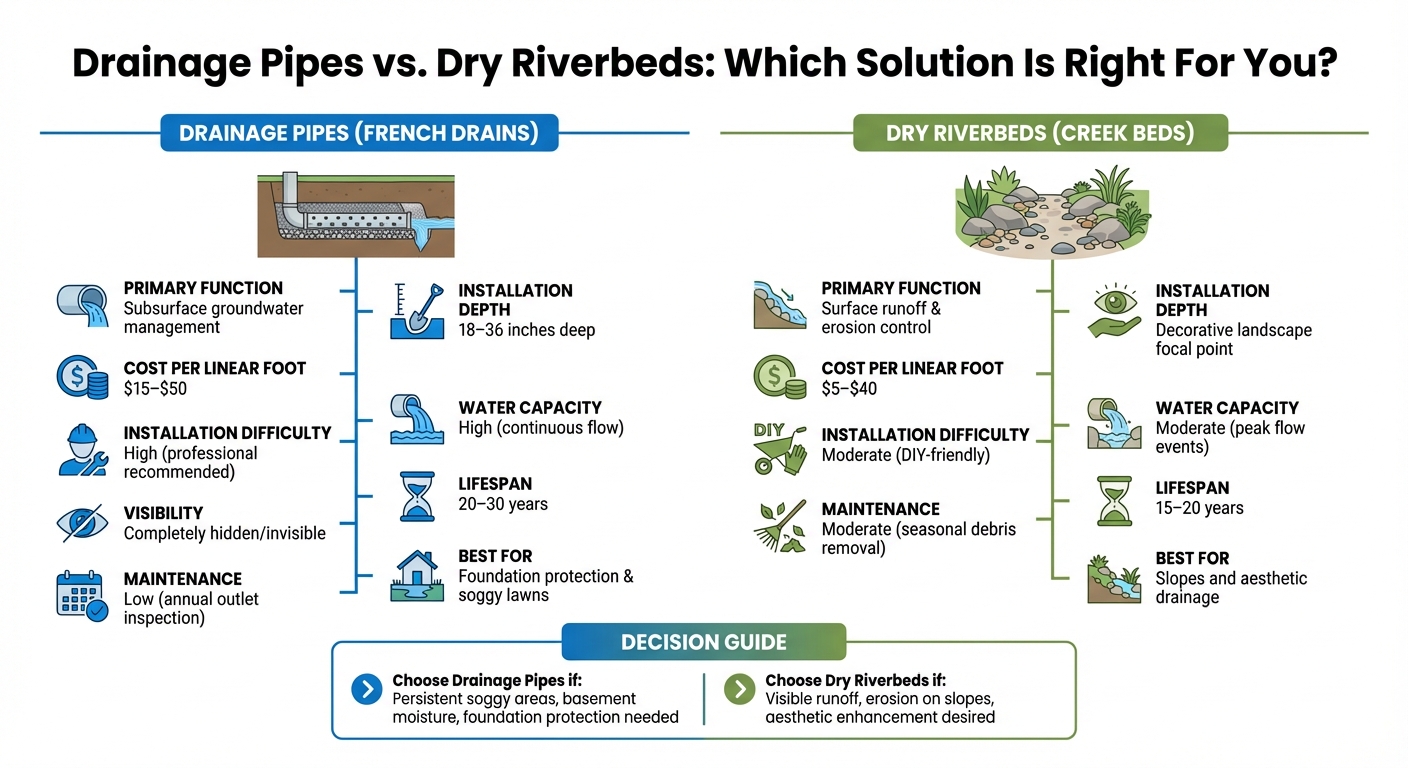
Drainage Pipes vs Dry Riverbeds Comparison Chart
How Drainage Pipes Work
Installation and Design
Drainage pipes are designed to intercept subsurface water before it reaches a building’s foundation. These systems rely on gravity, which means the pipes must follow a continuous downward slope of at least 1% – about 1 inch of drop for every 8 feet of pipe [1][3].
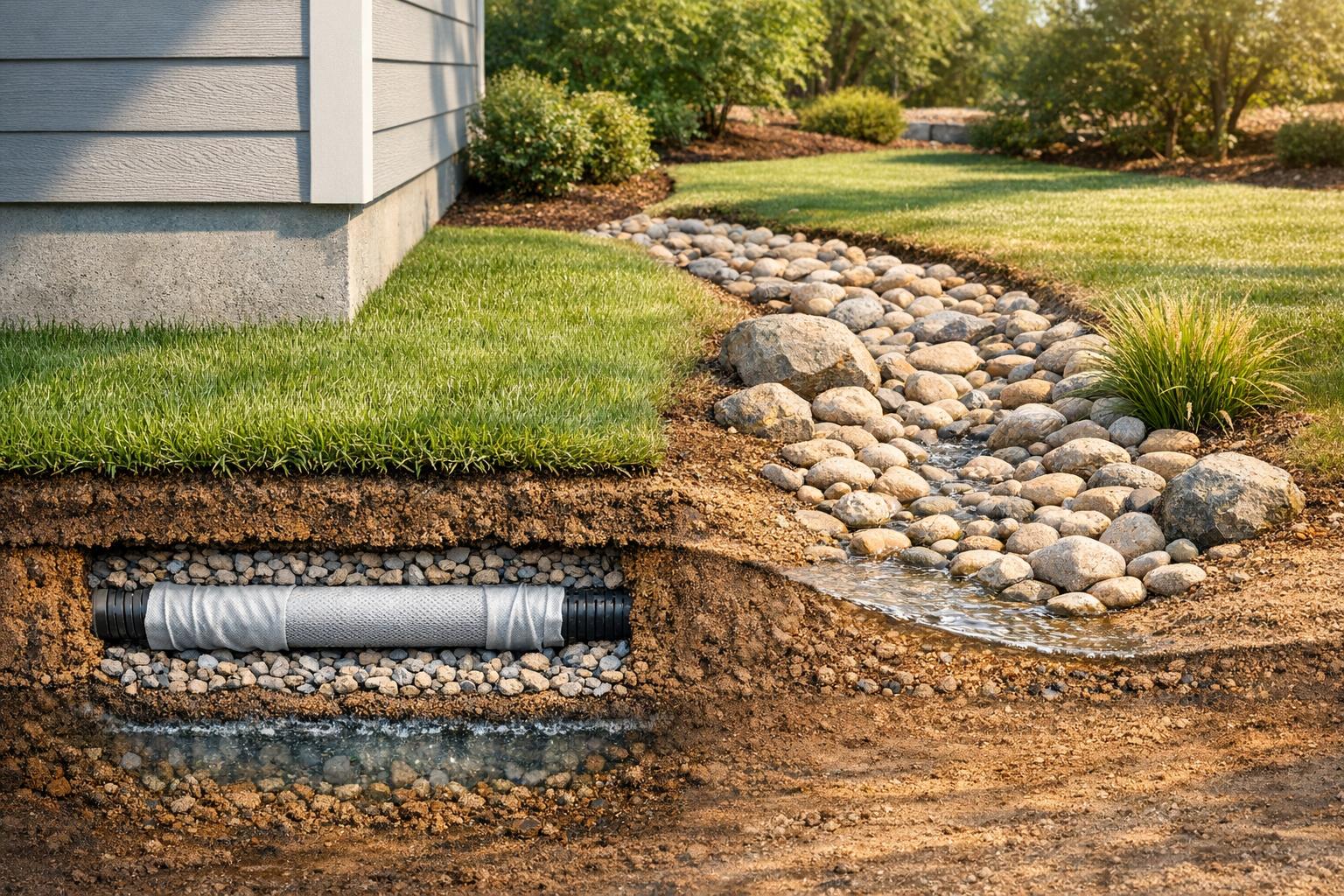
To install the system, start by digging a trench 12–36 inches deep, depending on the groundwater level. The trench must maintain that 1% slope throughout. At the bottom, lay a perforated pipe – typically 4–6 inches in diameter – made from rigid PVC or flexible corrugated plastic. Surround the pipe with ¾-inch drainage stone and wrap the entire setup in non-woven geotextile fabric to prevent fine particles from clogging the system. Clean-out ports should be installed every 50 feet to simplify maintenance [1][3].
Water enters the pipe through small perforations and flows downward to a discharge point, such as a dry well, storm drain, or a "daylight" exit at a lower elevation [3]. This precise setup differentiates drainage pipes from surface solutions like dry riverbeds, which only handle water at ground level.
When installed correctly, drainage pipes provide a consistent and reliable solution for managing groundwater.
Benefits of Drainage Pipes
The main advantage of drainage pipes is their ability to protect a building’s foundation. By collecting and redirecting groundwater, these systems prevent hydrostatic pressure – the force that pushes moisture through basement walls and floors. This pressure can cause cracks, leaks, and even mold growth [3][5].
In areas with slow-draining clay soils, perforated pipes offer a drainage pathway that natural soil alone cannot provide. Another plus? These systems are buried, making them invisible once installed and eliminating any interference with foot or vehicle traffic [3][7].
Additionally, drainage pipes can handle heavy rain and rapid snowmelt right after installation. With proper maintenance, they can function effectively for 20 to 30 years [3][5].
However, as with any system, there are challenges to consider.
Drawbacks of Drainage Pipes
The biggest downside to drainage pipes is the installation cost, which ranges from $15 to $50 per linear foot. This is 30% to 40% more expensive than surface drainage options due to the labor-intensive excavation required [1][3]. The complexity of the process often necessitates hiring professionals to ensure proper grading and secure connections.
While maintenance is usually minimal, occasional inspections are necessary to prevent clogs caused by sediment or tree roots [3][7]. If a pipe becomes blocked or damaged, repairs require excavation, which can add to the overall expense. In areas with heavy tree root activity, rigid PVC is often preferred over flexible corrugated plastic, as the latter is more prone to root intrusion [3].
These challenges highlight the importance of careful planning and professional installation to ensure long-term performance.
sbb-itb-843f8be
How Dry Riverbeds Work
Installation and Design
Dry riverbeds are surface-level drainage systems designed to mimic natural streams, guiding runoff away from areas prone to water issues. Unlike underground pipes, these features manage water directly at the surface, catching it as it flows from slopes, driveways, or overflowing gutters [3][4].
The installation process is relatively straightforward compared to buried drainage systems. Instead of deep trenches, dry riverbeds require shallow channels – about 12 to 24 inches deep – to manage surface water effectively [1]. The design relies on a meandering path with gentle curves, avoiding straight lines. As landscape designer Marie Chieppo points out:
A meandering stream reduces water velocity and enhances a natural appearance [6].
Once the channel is excavated, a heavy-duty non-woven geotextile fabric is laid at the bottom to block weeds and prevent the stones from sinking into the soil [2][3]. The stone placement follows a layered approach: large boulders anchor the edges, medium-sized stones shape the channel, and smaller river rocks create the flowing surface [1][2]. This method not only adds a natural aesthetic but also reinforces the structure. To further stabilize the area, many homeowners plant native, water-tolerant vegetation along the edges, which helps hold soil in place and softens the rocky appearance [1][2].
The trench must follow a proper slope to ensure water flows efficiently [3]. This thoughtful design achieves both functionality and a natural look, offering a wide range of benefits.
Benefits of Dry Riverbeds
Dry riverbeds combine practicality with visual appeal. They effectively control erosion while enhancing the overall landscape. The stones and boulders reduce the speed of flowing water, preventing erosion and protecting topsoil. As landscape expert John Anderson explains:
The rocks dissipate energy, preventing the cutting action that causes gullies [3].
Another advantage is their ability to allow water to gradually soak into the ground, helping recharge groundwater supplies – something underground systems can’t do [1][3]. This reduces strain on municipal stormwater systems. Additionally, dry riverbeds trap debris and sediment, preventing pollutants from entering natural waterways [1][3].
Maintenance is straightforward because their surface design makes it easy to spot and remove leaves or debris, especially after storms [1][3]. When installed properly and maintained, these features can last 15 to 20 years [3]. For basic installations, costs typically range between $5 and $7 per linear foot [3].
Drawbacks of Dry Riverbeds
While dry riverbeds offer many advantages, they do have limitations. Their primary drawback is that they manage only surface water. Unlike drainage pipes, which can address hidden groundwater issues, dry riverbeds are designed to handle runoff from rain and snowmelt [3][4]. If your property has problems like groundwater seepage or basement moisture, a dry riverbed won’t resolve those issues.
Regular maintenance is required to clear debris, especially in areas with many trees where leaves accumulate during fall [3][4]. Capacity is another consideration – while they work well during moderate storms, extreme rainfall can overwhelm their ability to handle runoff [3][4]. For properties with both surface and subsurface water challenges, a hybrid solution may be necessary. Installing a perforated pipe beneath the dry riverbed can address both types of water issues simultaneously [7][3].
Drainage Pipes vs. Dry Riverbeds: Direct Comparison
Comparison Table
| Feature | Drainage Pipes (French Drains) | Dry Riverbeds (Creek Beds) |
|---|---|---|
| Primary Function | Subsurface groundwater management | Surface runoff & erosion control |
| Installation Depth | 18–36 inches deep | 8–12 inches deep |
| Cost per Linear Foot | $15–$50 | $5–$40 |
| Installation Difficulty | High (professional recommended) | Moderate (DIY-friendly) |
| Visibility | Completely hidden/invisible | Decorative landscape focal point |
| Maintenance | Low (annual outlet inspection) | Moderate (seasonal debris removal) |
| Water Capacity | High (continuous flow) | Moderate (peak flow events) |
| Lifespan | 20–30 years | 15–20 years |
| Best For | Foundation protection & soggy lawns | Slopes and aesthetic drainage |
Main Differences Between the Two
The table highlights the main points of comparison, but it’s worth diving deeper into how these systems differ in function, cost, and installation. Choosing the right option depends on your property’s specific needs.
Drainage pipes are designed for subsurface water management, using buried perforated pipes to channel groundwater. In contrast, dry riverbeds focus on surface water, guiding runoff through stone-lined channels [3]. This distinction is crucial for addressing whether your issue lies underground or above.
Cost is another key factor. Dry riverbeds are generally 30–40% cheaper than drainage pipes, making them a more budget-friendly option. Landscape expert John Anderson explains:
"Dry creek beds are typically 30 – 40% cheaper ($1,500 – $5,000 vs $2,500 – $8,000) but less effective for deep drainage."
Installation difficulty is also a major consideration. Drainage pipes require deeper excavation (18–36 inches) and precise grading, with a slope of at least 1% (1 inch drop per 8 feet) to function properly. On the other hand, dry riverbeds are shallower (8–12 inches) and often manageable as a DIY project, making them more accessible for homeowners [3].
Maintenance needs differ as well. Dry riverbeds require seasonal debris removal, especially after storms, as leaves and branches can accumulate in the channel. Drainage pipes, being underground, are less visible but demand annual inspections of the outlet to ensure they remain clear [3]. Both systems have their strengths, but understanding these differences ensures you pick the one that aligns best with your goals.
When to Use Each Solution
When to Choose Drainage Pipes
Drainage pipes are the go-to option when water problems stem from below the surface. If you’re dealing with a flooded basement, damp crawl spaces, or water seeping through foundation walls, a French drain can tackle the issue head-on by removing groundwater directly from the soil. As landscape expert John Anderson puts it:
"A perimeter French drain around your home’s foundation can save you thousands in water damage repairs and mold remediation." [3]
These pipes are particularly effective at protecting your foundation by relieving the hydrostatic pressure that builds up against basement walls. Persistent standing water in your yard that doesn’t drain within 48 hours after a storm is another telltale sign of subsurface saturation – a problem that buried drainage systems are designed to solve [3].
In areas with heavy clay soils, where water drains at a snail’s pace, surface solutions won’t cut it. The perforated pipes of a drainage system create an underground pathway, bypassing the slow-draining soil entirely [3][5]. They’re also ideal for compact spaces where you need high-capacity water management without sacrificing surface area for a wide, open channel [1].
For high-traffic spots like driveways, walkways, or patios, drainage pipes offer a discreet solution. They eliminate tripping hazards while staying out of sight, ensuring they don’t interfere with daily activities [7][4]. Professionally installed systems can last 20 to 30 years, providing long-term protection that’s completely hidden from view [3][5].
However, if your water issues are primarily due to visible surface runoff, a different approach might be better suited.
When to Choose Dry Riverbeds
Dry riverbeds shine when it comes to managing surface runoff. If heavy rain causes water to rush down slopes, carve gullies in your lawn, or create erosion channels, a dry riverbed can slow the flow and prevent soil loss. The mix of stone sizes helps to dissipate the water’s energy, reducing its speed and protecting your landscape [5].
Sloped properties are particularly well-suited for dry riverbeds. The stones create friction to slow the water, and a winding path increases the travel distance, allowing more time for the water to soak into the ground. Marie Chieppo, Principal at Masters at Work Garden Design, emphasizes:
"A meandering stream helps reduce the velocity of the water (increasing the likeliness that it will irrigate) and creates a more natural look." [6]
If aesthetics are important to you, dry riverbeds pull double duty by solving drainage issues while enhancing your landscape. They add natural texture and visual appeal, serving as functional yet decorative features. For homeowners focused on sustainability, they also promote groundwater recharge instead of simply diverting water to storm drains [6][2].
Dry riverbeds can complement drainage pipe systems by acting as "daylighting" solutions, transitioning water from underground pipes to a natural-looking surface flow. At $5 to $15 per linear foot for basic installations, they’re also 30% to 40% more affordable than French drains, making them a budget-friendly choice [3][5].
How a French Drain System can Prevent a Dry Creek Bed Failure
What to Consider Before Choosing
Before picking a drainage solution, it’s crucial to understand your water source. For instance, puddles that disappear quickly suggest surface runoff, making a dry riverbed a good option. On the other hand, persistent sogginess points to subsurface water issues, which are better addressed with drainage pipes [3].
Your soil type is another key consideration. Heavy clay soils drain slowly and often require perforated pipes. A simple test – filling a 12-inch hole with water – can help you gauge your soil’s drainage rate [3][1]. Sandy soils, which drain faster, can work with either solution.
The slope of your property and the available space also play a significant role. Dry riverbeds need a channel about 12–18 inches wide and 8–12 inches deep, making them ideal for sloped areas where they can slow water flow and reduce erosion [8][3]. Drainage pipes, on the other hand, are more compact and can be installed closer to foundations, but they do require at least a 1% grade (about 1 inch of drop per 8 feet) to function effectively [3][1].
Lastly, consider both installation and maintenance costs. Dry riverbeds and French drains differ in their upfront expenses and long-term upkeep, which can vary based on your specific site conditions. Consulting with experts can help you choose the solution that best fits your property.
Getting Professional Help
After evaluating your property, seeking professional advice can ensure your drainage system performs well over time. DIY projects often lead to costly mistakes, with improper grading being a common issue. Even if a slope looks adequate, it might not meet the exact 1% grade required for drainage pipes to work properly. For French drains installed 18 to 36 inches deep near foundations, professionals handle critical tasks like utility marking and securing permits for major grading work [1][3].
Pro Landscapes MD specializes in drainage solutions tailored to properties in central Maryland. Their team assesses factors like soil type, slope, water table levels, and existing landscaping to design systems that address both immediate water concerns and long-term property protection. Whether you’re considering a French drain to protect your foundation, a decorative dry riverbed for surface runoff, or a hybrid approach, professional installation is key to ensuring durability and effectiveness.
For properties with challenging topography, multiple water sources, or foundation risks, professional engineering isn’t just helpful – it’s essential to prevent future damage and ensure your system works as intended [1][4].
Conclusion
Selecting between drainage pipes and dry riverbeds depends on your property’s specific water management challenges. Drainage pipes are ideal for controlling subsurface water and protecting foundations, making them a smart choice for areas with persistent wet spots or basement moisture. These systems typically cost between $15–$50 per linear foot and can last 20–30 years when installed professionally [1][3]. On the other hand, dry riverbeds are effective for managing surface runoff and preventing erosion, particularly on sloped properties where water flow causes soil loss. They are also more budget-friendly, ranging from $5–$40 per linear foot, and can enhance the natural look of your landscape [1][5].
To recap, drainage pipes are best for addressing subsurface water issues, while dry riverbeds excel at controlling visible runoff and erosion. The right choice depends on your property’s conditions. For example, if you have heavy clay soil and standing water near your foundation, drainage pipes are essential. Conversely, if erosion is the main concern, a dry riverbed can dissipate water energy and stabilize the soil. In many cases, combining the two – such as installing a French drain beneath a dry creek bed – can manage both surface and subsurface water effectively [5].
To determine the solution that works for you, observe your property during heavy rain. Look for areas where puddles form and drain quickly (surface runoff) versus spots that stay saturated for long periods (subsurface water) [3]. Take into account factors like soil type, slope, and whether you prefer a visible feature like a dry riverbed or an out-of-sight system like drainage pipes.
If you’re in central Maryland, Pro Landscapes MD offers professional site evaluations and installations tailored to your needs. Their team considers everything from soil composition to topography to design drainage systems that protect your property for the long haul. Whether you’re dealing with foundation issues, erosion, or both, their expertise ensures your system will function efficiently for years to come.
Investing in the right drainage solution can save you from costly water damage down the road. Take the time to assess your property’s needs and consult experienced professionals to ensure proper installation, material choices, and compliance with local regulations.
FAQs
How do I tell if my drainage problem is surface runoff or groundwater?
To figure out whether your drainage problem stems from surface runoff or groundwater, pay attention to how water behaves during and after rainfall. Surface runoff is easy to spot – it often leads to visible pooling, water flowing across sloped areas, or the formation of puddles. On the other hand, groundwater issues show up as slow seepage, persistently soggy soil, or dampness in basements, even when it hasn’t rained for a while. Signs like erosion or consistently wet areas can help confirm the source of the problem. Solutions such as French drains or dry riverbeds can be tailored to address either surface or subsurface drainage challenges effectively.
Where can water from a French drain legally discharge?
When using a French drain, the water it collects can be directed into stormwater systems, drainage ditches, or nearby natural water bodies. However, it’s crucial to comply with local rules. Make sure to check if permits are needed before connecting your drain to public stormwater systems to stay on the right side of the law.
Can I combine a French drain and a dry riverbed in one system?
Combining a French drain with a dry riverbed is a smart way to tackle both underground and surface water runoff. A French drain works to channel subsurface water away from areas like foundations, preventing water buildup below ground. Meanwhile, a dry riverbed addresses surface water by guiding runoff and reducing erosion. Together, these two methods create an effective drainage system, especially for properties with slopes or intricate landscaping where water management can be more challenging.
Chat with Us