









- bhavya gada
- No Comments
Struggling with erosion on slopes? Drought-resistant grasses can help. These grasses have deep roots that stabilize soil, reduce runoff, and thrive in dry conditions with minimal maintenance. Here are seven options perfect for Maryland’s climate (USDA zones 6-7):
- Switchgrass: Deep roots, grows 3–6 ft, handles sandy to clay soils.
- Little Bluestem: Drought-tolerant, 2–4 ft, ideal for erosion control.
- Big Bluestem: Grows 4–8 ft, thrives in summer heat, excellent soil anchor.
- Indian Grass: Roots reach 6–10 ft, supports water infiltration.
- Eastern Gamagrass: Roots extend 10–15 ft, strong slope stabilizer.
- Tall Fescue: Cool-season option, survives short droughts, grows 2–4 ft.
- Weeping Lovegrass: Compact, drought-hardy, prevents soil loss.
These grasses protect slopes, improve soil health, and reduce sediment runoff. Choose the right one based on your slope’s conditions, plant in spring or fall, and water until roots are established.
1. Switchgrass
Root Depth and Soil Stabilization Capability
Switchgrass develops a deep, intricate root system that firmly anchors soil particles in place. These roots extend both downward and outward, creating a dense underground structure that helps reduce erosion, even during heavy rain. Over time, this root network adds organic matter to the soil, improving its ability to absorb and retain water – particularly useful on steep slopes where runoff and soil loss are common challenges.
Drought Tolerance
Once established, switchgrass thrives with minimal care, showing high drought tolerance and requiring little to no fertilization. Its deep roots access moisture from below the surface, allowing it to stay healthy even during dry periods when other plants might struggle. This makes it an ideal choice for areas where regular watering isn’t feasible. Beyond its resilience, switchgrass also enhances the landscape with its natural beauty.
Height and Growth Habits
Switchgrass typically grows between 3 and 6 feet tall, forming upright, clumping foliage. Its leaves turn golden or reddish-bronze in the fall, providing visual appeal throughout the year and adding texture and color to your outdoor space.
Suitability for Maryland Slopes and Soil Types
As a native plant in Maryland, switchgrass is well-suited for USDA zones 6-7 and can thrive in a variety of soil types, from sandy to clay-heavy. Before planting, it’s a good idea to clear any existing vegetation and test the soil to adjust pH and nutrient levels as needed. In Maryland, switchgrass is often used in habitat restoration projects on erosion-prone slopes, where it helps prevent soil loss while supporting wildlife habitats and biodiversity corridors [1].
sbb-itb-843f8be
2. Little Bluestem
Root Depth and Soil Stabilization Capability
Little Bluestem is well-known for its deep root system, which extends far into the soil to access moisture buried deep below the surface. These roots anchor the soil firmly, reducing the risk of erosion during heavy rains or storms. This makes it an excellent choice for areas prone to soil loss, as its roots continuously work to keep slopes stable and intact.
Drought Tolerance
Unlike many cool-season grasses, Little Bluestem thrives in dry conditions, thanks to its ability to draw water from deep within the soil. Once it’s established, this grass requires very little watering, making it ideal for drought-prone areas in Maryland. It performs exceptionally well as a low-maintenance ground cover in such regions [2][3]. In contrast, grasses like Timothy Grass struggle without regular moisture, but Little Bluestem’s deep roots give it a distinct advantage during prolonged dry spells [5][6].
Height and Growth Habits
This grass grows in a clumping pattern, reaching heights of 1½ to 4 feet. Its blue-green summer foliage transitions into beautiful bronze-red hues in the fall, adding visual interest throughout the year. The clumping growth habit not only enhances soil stabilization but also prevents the grass from spreading aggressively into neighboring areas. This makes it a practical and attractive option for slope planting [2][4].
Suitability for Maryland Slopes and Soil Types
Native to Maryland’s Piedmont region and the Chesapeake Bay Watershed, Little Bluestem is perfectly suited to the state’s conditions. Beyond its erosion control benefits, it contributes to reducing sediment runoff into the Chesapeake Bay, supporting local environmental health [1]. Its adaptability to Maryland’s diverse landscapes and its role in sustaining regional wildlife habitats make it a smart, eco-friendly choice for slope stabilization projects across the state. These qualities make Little Bluestem an indispensable option for tackling erosion challenges in Maryland.
3. Big Bluestem
Root Depth and Soil Stabilization Capability
Big Bluestem (Andropogon gerardii) has a deep and complex root system that anchors firmly into the soil, making it an excellent choice for preventing erosion on slopes, especially during heavy rains. Mikaela Boley, Master Gardener Coordinator at the University of Maryland, highlights this characteristic:
Native grasses… do not like to be mowed, but they also develop a much deeper and elaborate root system [7].
This deep rooting helps stabilize the soil and maintain slope integrity.
Drought Tolerance
Big Bluestem stands out for its ability to withstand drought conditions. Its roots reach deep underground to access moisture, enabling it to survive extended dry spells. During periods of severe dryness, it can enter a dormancy phase, conserving energy until water becomes available again [7]. These survival traits make it a key player in slope stabilization efforts across Maryland.
Height and Growth Habits
Growing to an impressive height of 5–8 feet, Big Bluestem is easily recognizable by its ‘turkey foot’ seed heads and its blue-green foliage in summer, which transitions to striking shades of orange or copper-red in the fall [4]. Its height and seasonal color changes make it a visually appealing choice for large-scale restoration and habitat projects [4].
Suitability for Maryland Slopes and Soil Types
Big Bluestem is well-suited to Maryland’s diverse conditions. It thrives in various soil types and is native to the Mountain and Piedmont regions of the state [4]. As a warm-season grass, it grows best in temperatures ranging from 80–95°F, aligning perfectly with Maryland’s summer climate [8]. Its adaptability, combined with its native status, makes it an ideal option for conservation and slope restoration projects throughout central Maryland [4].
4. Indian Grass
Root Depth and Soil Stabilization Capability
Indian Grass (Sorghastrum nutans) sends its roots deep – about 6 to 10 feet into the ground – making it a powerhouse for soil stabilization. These roots don’t just anchor the soil; they also improve water infiltration, helping to manage runoff during Maryland’s heavy rainstorms. This deep-rooted structure is especially helpful on erosion-prone slopes in central Maryland, where soil loss can be a constant issue [1].
Drought Tolerance
Once it’s established, Indian Grass is built to handle drought. Its roots tap into moisture deep below the surface, allowing it to withstand Maryland’s hot, dry summers with little need for watering. While other grasses may struggle during these conditions, Indian Grass thrives with minimal care [1][3].
Height and Growth Habits
This grass can grow anywhere from 3 to 8 feet tall, forming upright clumps with striking plume-like seed heads that appear in late summer and fall. Its bunching growth habit makes it great for stabilizing slopes without spreading out of control. The dense clumps it forms are effective at holding soil in place while maintaining a neat, natural look [1][4].
Suitability for Maryland Slopes and Soil Types
As a native warm-season grass, Indian Grass is perfectly suited to Maryland’s climate. It prefers full sun and adapts well to the region’s changing weather patterns. Once it’s established, it requires little mowing or upkeep. The University of Maryland Extension highlights it as a native option that not only strengthens soil health but also reduces nutrient runoff – a win for efforts to restore the Chesapeake Bay. Its ability to stabilize slopes and support wildlife habitat makes it a top choice for field borders, buffers, and steep inclines in areas like Howard and Montgomery Counties. Its resilience and low maintenance needs make it a key player in Maryland’s slope stabilization efforts [1][4].
Low Water Use and Drought Tolerant Grasses & Sedges
5. Eastern Gamagrass
Eastern Gamagrass follows Indian Grass as another excellent choice for stabilizing slopes, thanks to its impressive root structure.
Root Depth and Soil Stabilization Capability
Eastern Gamagrass (Tripsacum dactyloides) boasts roots that can reach depths of 10 to 15 feet. This extensive root system allows the plant to draw moisture from deep within the soil, far beyond the reach of many shallow-rooted grasses. This ability not only helps secure soil on slopes but also makes it a reliable, eco-friendly choice for erosion control [9].
Drought Tolerance
Its deep roots also give Eastern Gamagrass an edge during droughts. While other grasses may struggle through Maryland’s hot and dry summers, this grass thrives by tapping into deeper water reserves. It endures high temperatures and long dry spells with little need for maintenance or additional watering.
6. Tall Fescue
Tall Fescue (Festuca arundinacea) is a strong contender for Maryland slopes, thanks to its ability to stay green throughout the year and handle the challenges of a cool-season climate. Known for its impressive drought tolerance, this grass is ideal for areas requiring reliable coverage and soil stabilization[2][3].
Root Depth and Soil Stabilization
Tall Fescue boasts roots that can reach depths of up to 3 feet, creating a secure anchor for soil on slopes. This deep root system plays a critical role in reducing erosion and controlling runoff. While it thrives best in moist, well-drained loamy soils, it can still perform admirably in less-than-ideal conditions. Once established, it provides long-lasting stabilization for slopes[2].
Handling Drought Conditions
Although Tall Fescue may brown during prolonged droughts, it outperforms other cool-season grasses in surviving dry periods. Experts from North Carolina University Extension note that while it struggles with droughts lasting over three weeks, it remains "the last grass to brown out in summer" compared to options like Kentucky bluegrass[3][10]. Once its roots are established, it requires little irrigation, as it can tap into deep soil moisture reserves during Maryland’s hot summers.
Growth Characteristics
This grass grows in clumps rather than spreading aggressively, which makes it less likely to invade flower beds or gardens. When left unmowed, it typically reaches a height of 2 to 3 feet[6]. Its slow clump-forming growth means it doesn’t demand frequent mowing or fertilizing, making it a low-maintenance choice for homeowners[8][10]. Additionally, it’s wear-resistant and has minimal disease issues, adding to its appeal for slope stabilization projects[10].
Ideal for Maryland Slopes
Tall Fescue is particularly suited for Maryland’s coastal regions, thanks to its tolerance for both drought and salt[8]. It also handles moderate shade well, making it a versatile option for areas with varying light conditions[8][10]. To establish it successfully on Maryland slopes, plant the seeds in early fall or spring, and ensure consistent watering during the first growing season to help the roots develop deeply[6]. For steeper slopes, blending it with grasses like Switchgrass can enhance erosion control and provide even better results[1][6].
7. Weeping Lovegrass
Weeping Lovegrass (Eragrostis curvula) is a practical choice for stabilizing slopes in areas prone to drought, thanks to its deep root system and ability to conserve water.
Root Depth and Soil Stabilization Capability
This grass forms an extensive, deep root network that taps into moisture reserves beyond the reach of most shallow-rooted plants[7]. These roots act like a natural web, holding soil particles firmly in place and reducing the risk of erosion on slopes.
Drought Tolerance
Weeping Lovegrass has narrow, waxy leaves that help limit water loss. During extended dry periods, it can enter dormancy, effectively pausing growth to survive harsh conditions[7]. Once favorable conditions return, it resumes growth. These characteristics make it a dependable option for stabilizing Maryland slopes, working well alongside other drought-tolerant grasses mentioned earlier[7].
Comparison Table
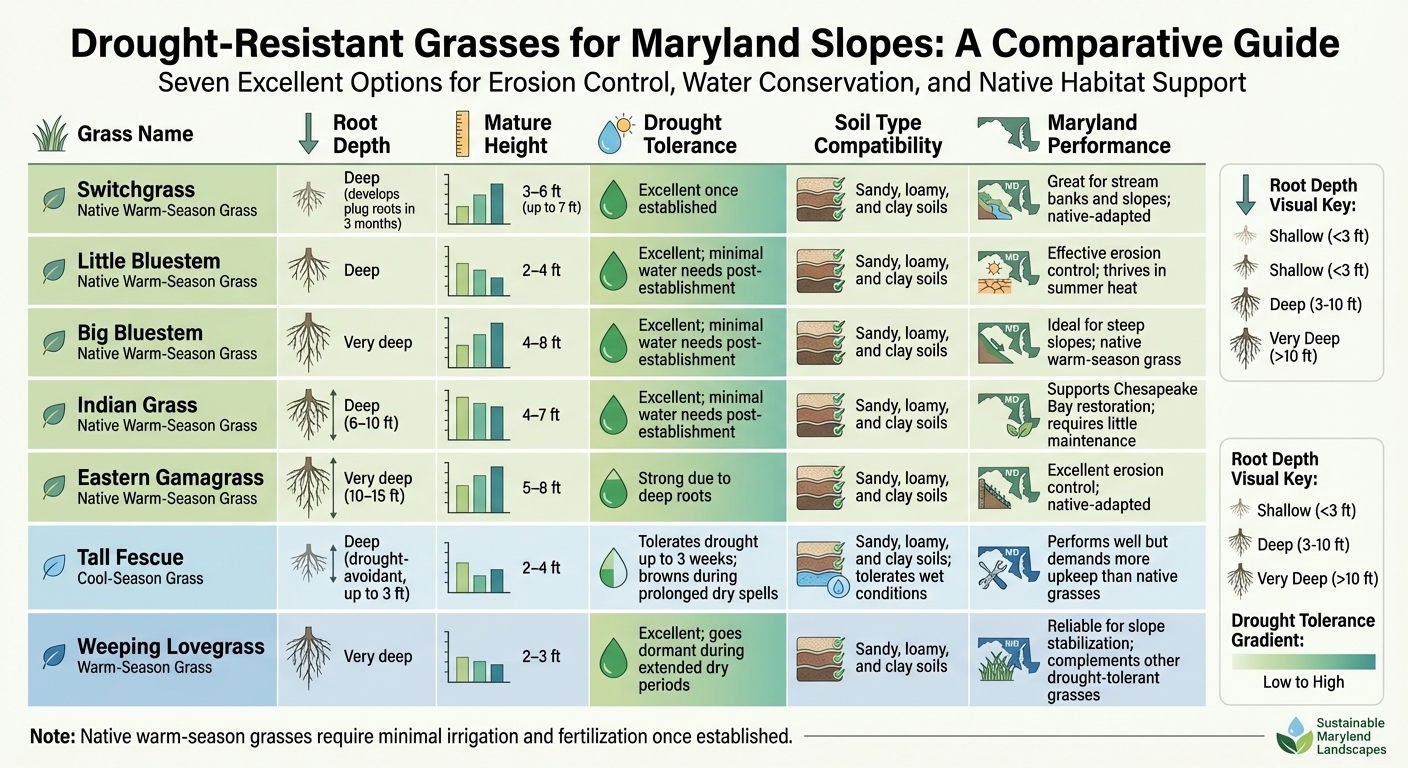
Comparison of 7 Drought-Resistant Grasses for Maryland Slopes
The table below highlights the key traits of various drought-resistant grasses suitable for stabilizing Maryland slopes.
| Grass | Root Depth | Mature Height | Drought Tolerance | Soil Type Compatibility | Maryland Performance |
|---|---|---|---|---|---|
| Switchgrass | Deep (develops plug roots in 3 months) | 3–6 ft (up to 7 ft) | Excellent once established | Thrives in sandy, loamy, and clay soils | Great for stream banks and slopes; native-adapted [11] |
| Little Bluestem | Deep | 2–4 ft | Excellent; minimal water needs post-establishment | Thrives in sandy, loamy, and clay soils | Effective erosion control; thrives in summer heat [1] |
| Big Bluestem | Very deep | 4–8 ft | Excellent; minimal water needs post-establishment | Thrives in sandy, loamy, and clay soils | Ideal for steep slopes; native warm-season grass [1] |
| Indian Grass | Deep | 4–7 ft | Excellent; minimal water needs post-establishment | Thrives in sandy, loamy, and clay soils | Supports Chesapeake Bay restoration; requires little maintenance [1] |
| Eastern Gamagrass | Very deep | 5–8 ft | Strong due to its deep roots | Thrives in sandy, loamy, and clay soils | Excellent erosion control; native-adapted [1] |
| Tall Fescue | Deep (drought-avoidant) | 2–4 ft | Tolerates drought up to 3 weeks; browns during prolonged dry spells | Thrives in sandy, loamy, and clay soils; tolerates wet conditions | Performs well but demands more upkeep than native grasses [12] |
| Weeping Lovegrass | Very deep | 2–3 ft | Excellent; goes dormant during extended dry periods | Thrives in sandy, loamy, and clay soils | Reliable for slope stabilization; complements other drought-tolerant grasses [3] |
Each grass species brings unique benefits to erosion control and slope stabilization in Maryland. Native warm-season grasses like Switchgrass, Little Bluestem, Big Bluestem, Indian Grass, and Eastern Gamagrass are particularly resilient once established. They require minimal irrigation, can thrive in low-fertility soils without added fertilizers, and are well-suited for reducing sediment and nutrient runoff into the Chesapeake Bay [1].
Tall Fescue, although a cool-season grass with deep roots, is better described as drought-avoidant. It can withstand short dry spells but requires more maintenance compared to native options [12]. Meanwhile, Weeping Lovegrass is a dependable choice for stabilizing slopes, especially when used alongside other drought-resistant varieties [3].
Before planting, test your soil’s pH and nutrient levels. Native grasses usually don’t need additional fertilization, making them a low-maintenance choice [1]. The next section will cover practical planting and management tips tailored to Maryland slopes.
Planting and Maintenance Tips for Maryland Slopes
To keep slopes in Maryland stable and thriving, it’s important to focus on proper planting techniques and ongoing care.
Start with site preparation. A soil test is your first step – this helps you check pH and nutrient levels. While native grasses often don’t need fertilizers, knowing your soil’s condition can prevent unnecessary treatments. Clear any existing vegetation and grade the slope to improve drainage before planting. Timing is also key to ensuring healthy growth.
When should you plant? In Maryland (USDA zones 6–7), the timing depends on the type of grass. For cool-season grasses like Tall Fescue, plant in early fall (August 15 to September 30) or spring (March through April) when soil temperatures range from 50°F to 65°F. For warm-season natives like Switchgrass, Big Bluestem, Little Bluestem, Indian Grass, or Eastern Gamagrass, aim for late spring (May to June) when the soil warms up to 60°F–85°F [2][10]. Use broadcast seeding (10–20 lbs per acre) with light raking or a cultipacker for good soil contact. Hydroseeding is another effective option, especially for controlling erosion [2][10].
Watering is critical after planting. For the first 4–8 weeks, provide 1 inch of water weekly using drip or soaker hoses. As roots develop (around 6 to 12 weeks), reduce watering to 0.5 inches every 2 to 3 weeks, or let rainfall take over. Once the plants mature and roots deepen, they typically don’t need extra watering unless there’s an extended dry spell lasting over 4 weeks [8][3].
Mowing schedules depend on the grass type. Warm-season grasses like Switchgrass and Little Bluestem should be mowed to 3–4 inches, about 2–3 times per season. For Tall Fescue, mow to a height of 3–3.5 inches every 7–10 days during its active growth periods. Always follow the one-third rule: cut no more than one-third of the blade length to encourage strong root systems. Using a mulching mower can also help return nutrients to the soil and reduce the need for cleanup, especially on slopes [8][3][10].
Fertilization should be minimal. For cool-season grasses, apply 1 pound of nitrogen per 1,000 square feet in the spring. For warm-season grasses, do this in late spring if needed. Opt for slow-release, organic fertilizers that are low in phosphorus to minimize runoff. Native grasses like Indian Grass are well-suited to poor soils and usually don’t need fertilization more than once every 2–3 years. Regular soil tests can help you avoid over-fertilizing while keeping your plants healthy [2][10].
Pro Landscapes MD Services

Pro Landscapes MD specializes in slope stabilization throughout central Maryland, combining horticultural know-how with precise grading and planting techniques. Their services extend to Howard County, Montgomery County, Baltimore County, Carroll County, Frederick County, and Prince George’s County, covering communities like Columbia, Ellicott City, Bethesda, Towson, and Gaithersburg.
Each project begins with grading and land leveling, which improves drainage and stabilizes slopes. This careful preparation creates a solid foundation for planting deep-rooted, drought-resistant grasses like Indian Grass and Eastern Gamagrass. By addressing drainage and leveling first, they significantly reduce the risk of erosion from the outset. These steps not only manage stormwater effectively but also set the stage for long-lasting erosion control and slope stabilization.
Pro Landscapes MD handles every aspect of landscape installation, from design and plant selection to the actual planting process. Their team of professional horticulturists selects grass species that thrive in Maryland’s diverse conditions, taking into account factors such as soil type, sunlight, and moisture levels unique to each property.
In addition to planting, they enhance slope stabilization with drainage solutions like French drains, dry riverbeds, and drainage repairs. These methods protect the landscape’s structural integrity and promote the success of drought-resistant plantings, ensuring slopes remain stable through Maryland’s wet springs and dry summers.
To maintain and improve landscapes over time, they also provide lawn care and restoration services. These efforts transform erosion-prone areas into stable, visually appealing landscapes, featuring native, drought-resistant grasses. Their work spans communities such as Silver Spring, Annapolis, and the greater Baltimore-Washington corridor, ensuring properties remain both functional and beautiful.
Conclusion
Drought-resistant grasses offer a practical solution for stabilizing slopes while cutting down on long-term maintenance for Maryland homeowners. Their deep root systems help anchor the soil during both heavy rains and periods of drought, reducing erosion and protecting landscapes [13][4]. Beyond that, these grasses contribute to broader environmental efforts, such as creating habitats for wildlife and minimizing sediment runoff into Chesapeake Bay tributaries – benefits particularly important in areas like Howard and Montgomery counties [1].
Once established, these grasses require very little upkeep [1][8][2]. For instance, Tall Fescue grows low, recovers slowly, and doesn’t invade flower beds, while native species like Switchgrass and Indian Grass thrive with minimal inputs, keeping maintenance costs low [1][8][2]. Their ability to control erosion effectively, paired with their low-maintenance nature, makes them an excellent choice for Maryland’s challenging transition zone climate.
To get started, assess your slope’s unique characteristics – such as sunlight exposure, soil type, and steepness. Choose grasses suited to your site’s needs: Weeping Lovegrass performs well in dry conditions, while Tall Fescue thrives in shaded areas. Plant during spring or fall and water the area until the roots are well-established [8][2].
For homeowners who want expert guidance, local professionals can help. Pro Landscapes MD specializes in designing and installing these low-maintenance solutions tailored to your property. Their team of horticulturists can recommend the right grass species, handle grading and drainage concerns, and provide ongoing care to ensure your slopes remain stable and visually appealing throughout the year.
FAQs
What is the best grass for a steep, sunny slope?
Broomsedge bluestem (Andropogon virginicus) is a standout choice among native grasses for steep, sunny slopes. Thanks to its deep root system, it’s great for stabilizing soil. Plus, it’s incredibly resilient in dry conditions, making it a top pick for areas prone to drought.
How long until these grasses stop needing regular watering?
Drought-resistant grasses generally no longer need regular watering after they become well-established. This establishment period can take anywhere from several weeks to a few months, depending on the grass species and the environmental conditions specific to Maryland.
Do I need erosion control blankets or hydroseeding on a slope?
Erosion control blankets and hydroseeding are great tools for stabilizing slopes. Blankets, often made from biodegradable materials, shield the soil from rainfall, minimize runoff, and encourage vegetation to take root. On the other hand, hydroseeding involves spraying a blend of seeds, mulch, and tackifiers, which helps establish ground cover quickly. Using these techniques alongside native grasses like switchgrass or little bluestem can significantly improve soil stability and manage erosion during the crucial early stages of plant growth.
Chat with Us