









- bhavya gada
- No Comments
Permeable pavers are a smart alternative to concrete or asphalt driveways. They allow rainwater to soak into the ground, reducing runoff and filtering pollutants. Made from materials like recycled concrete, plastic grids, or asphalt, these pavers last 20–40 years and require less maintenance in winter by reducing ice formation. Costs range from $10 to $40 per square foot, and Maryland homeowners may qualify for tax credits or reduced stormwater fees. While the upfront cost is higher, the long-term benefits include durability, lower maintenance, and better water management.
Key Highlights:
- Water Management: Absorbs up to 95% of rainwater, reducing flooding and pollution.
- Durability: Lasts 20–40 years, outlasting asphalt (15–20 years).
- Cost: $10–$40/sq. ft.; typical projects cost $5,867–$13,209.
- Maintenance: Annual cleaning required to prevent clogs.
- Winter Benefits: Reduces salt usage by 75–100%.
Permeable pavers are ideal for areas prone to flooding and for homeowners looking to meet stormwater regulations while maintaining long-term value.
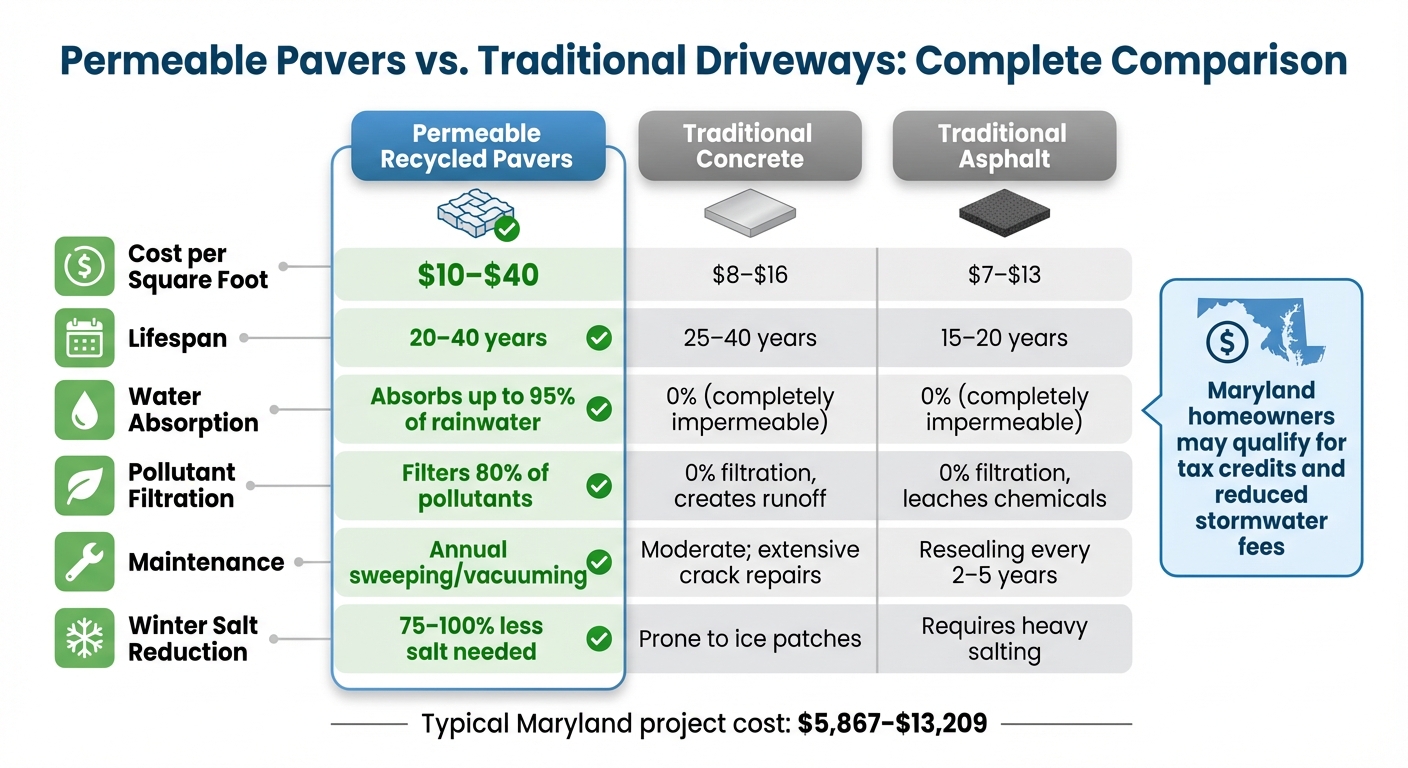
Permeable Pavers vs Traditional Driveways: Cost, Lifespan & Environmental Impact Comparison
1. Permeable Recycled Pavers
Features
Permeable recycled pavers are crafted from materials like ground-up concrete, recycled plastic grids, or recycled asphalt. These pavers stand out with a thicker 3-inch design and wider joints (ranging from 1/8 to 1/2 inch) filled with washed crushed stone [2] [3].
The real magic happens beneath the surface. These systems use a layered structure to temporarily store water while filtering out pollutants. The stone layers act as a natural filter, capturing oil, grease, and heavy metals before they can seep into the water table [2] [1]. Additionally, bacteria within the gravel chemically break down some contaminants [1]. This intricate design not only boosts functionality but also impacts the overall cost of installation.
Cost
The price depends on the type of recycled material used. Here’s a breakdown:
- Grass pavers (recycled plastic grids): $3 to $9 per square foot
- Recycled asphalt: $7 to $13 per square foot
- Recycled concrete: $8 to $16 per square foot [3]
For general permeable pavers, costs range from $10 to $40 per square foot [3], with installation costs averaging $10 to $70 per square foot [4]. Maryland homeowners typically spend between $5,867 and $13,209 for a full driveway installation [2].
Labor costs add another $3 to $8 per square foot [2]. The higher upfront expense comes from the need for deep-base excavation and multi-layer installations. However, the investment pays off in the long run, as permeable pavers last 20 to 40 years [2]. Calvin van Eck from Panda Pavers explains:
"While you might replace asphalt 3-4 times, good permeable pavers can last 20-40 years" [2].
Homeowners in Maryland may also qualify for tax credits or reductions in stormwater fees when installing permeable surfaces [1] [3].
Environmental Impact
These pavers manage stormwater much like a forest floor, allowing up to 95% of rainwater to seep into the ground [2]. They also filter out up to 80% of pollutants from rainwater, helping protect local waterways and the Chesapeake Bay watershed [3].
By using recycled materials, these pavers cut down on the energy needed to produce new ones and keep waste out of landfills [2] [1]. They also stay cooler than traditional asphalt, reducing the urban heat island effect by letting the ground "breathe" [1]. During winter, their efficient drainage prevents water from freezing on the surface, cutting salt usage by 75% to 100% compared to traditional pavement [2].
Durability and Maintenance
Permeable pavers are well-suited to Maryland’s freeze-thaw cycles. Their flexible design, combined with air spaces in the stone base, helps prevent cracking [2] [5]. With proper care, these pavers can last 20 to 40 years [2] [5].
Maintenance is relatively simple but crucial. To keep the system functioning, clean the joints annually to remove debris and leaves that could clog it [4]. Avoid using sand in the joints – stick to 1/4-inch washed crushed stone to maintain water flow [2] [4]. Before installation, conduct a percolation test to ensure your soil can handle the drainage. Poor drainage may require a deeper gravel base [4].
For Maryland homeowners looking for professional installation, Pro Landscapes MD specializes in permeable pavers and stormwater management solutions in Howard, Montgomery, Baltimore, and nearby counties.
sbb-itb-843f8be
2. Concrete and Asphalt Driveways
Features
Traditional concrete and asphalt driveways are completely impermeable, unlike recycled permeable options. This means they block 100% of water from soaking into the ground, preventing any natural infiltration [7][2]. While this solid structure may seem durable, it comes with challenges. These materials are prone to cracking due to soil compression, frost, or the natural expansion and contraction caused by temperature changes [6][8].
Additionally, these surfaces absorb solar heat, contributing to the urban heat island effect. This phenomenon raises local temperatures by trapping heat and eliminating the natural cooling benefits found in permeable systems that allow water infiltration [6][9].
Cost
When it comes to cost, traditional poured concrete and asphalt range between $6 and $15 per square foot, with labor adding an extra $3 to $8 per square foot [2]. While the initial price might seem appealing, long-term costs can add up. Asphalt, for instance, requires sealing within six months of installation and then a fresh coat annually to avoid moisture-related damage. Concrete, on the other hand, often demands replacing entire sections when cracks or damage occur. This is in stark contrast to interlocking pavers, where individual units can be replaced as needed [1][6][2].
These ongoing maintenance needs not only increase expenses but also contribute to the overall environmental footprint of traditional driveways.
Environmental Impact
Traditional driveways force all rainwater to become runoff, which overwhelms storm drains and increases the risk of flooding [2][4]. As the water moves across these surfaces, it collects pollutants like oil, grease, and de-icing salts, channeling them directly into local streams and rivers without any filtration [2][4]. Permeable pavers, by contrast, naturally filter out these contaminants during water infiltration. Troy Johnson from Outdoor Escapes highlights this difference:
"The best way to green up a driveway is to install permeable pavers… Contrast that with a typical driveway, where water picks up oil and other chemicals as it washes into the street, overloading storm drains, polluting waterways, and increasing the chances of flooding from runoff." [4]
Runoff also creates additional strain on water treatment facilities, which require energy-intensive processes to clean the water. This contributes to air pollution and CO₂ emissions [1]. Moreover, traditional surfaces prevent groundwater recharge, limiting the replenishment of natural water tables [2][1].
Durability and Maintenance
Maintenance is another area where traditional driveways fall short. Asphalt driveways require annual sealing, while concrete needs extended curing times and often significant repairs. Even with regular upkeep, asphalt surfaces may need to be replaced three to four times over the 20- to 40-year lifespan that high-quality permeable pavers can achieve [2].
Winter adds another layer of difficulty. Traditional driveways often require heavy salt application to manage ice, as water pools and freezes on the surface. In contrast, permeable systems typically need only 0% to 25% of the salt used on standard pavement, making them much easier to manage during colder months [2].
Installing a Permeable Paver Driveway
Advantages and Disadvantages
Permeable recycled pavers come with a range of benefits, particularly when it comes to their impact on the environment. Their ability to handle drainage effectively reduces water runoff and can even lower winter maintenance needs, as previously discussed.
However, these benefits come at a higher cost compared to traditional options. Installing permeable pavers typically requires deep excavation – about 15 inches or more – and multiple layers of washed, crushed stone, making professional expertise essential [4]. Additionally, in areas with poor-draining soil, extra drainage solutions may be necessary, which can further drive up costs [4].
Maintenance is another area where permeable pavers stand out. They need to be swept or vacuumed annually to prevent clogging, and weeds can sometimes grow between the joints [2]. On the other hand, asphalt driveways require resealing every 2 to 5 years, and repairs to cracked concrete can be both extensive and visually disruptive [10]. A major plus for pavers is that individual units can be swapped out without affecting the overall look.
| Feature | Permeable Recycled Pavers | Traditional Concrete | Traditional Asphalt |
|---|---|---|---|
| Cost (per sq. ft.) | $10–$40 [3] | $8–$16 [3] | $7–$13 [3] |
| Lifespan | 20–40 years [2] | 25–40 years | 15–20 years |
| Environmental Impact | Filters 80% of pollutants; recharges groundwater [2][3] | High runoff; contributes to urban heat islands | High runoff; leaches chemicals |
| Maintenance Needs | Annual sweeping/vacuuming [2] | Moderate; crack repairs can be extensive [10] | Requires resealing every 2–5 years [11] |
| Winter Safety | Needs 75–100% less salt [2] | Prone to ice patches [2] | Requires heavy salting [2] |
When it comes to longevity, permeable pavers offer a strong advantage, lasting 20 to 40 years, while asphalt may need to be replaced multiple times within the same timeframe [2]. Additionally, some municipalities provide incentives like tax credits or stormwater fee discounts to help offset the upfront costs. The market for permeable pavers is also on the rise, with projections showing growth from $15.8 billion in 2023 to $35.4 billion by 2032 [2].
Conclusion
Permeable pavers made from recycled materials present a smart choice for homeowners looking to combine eco-consciousness with long-term value. Although the initial cost – ranging from $10 to $40 per square foot – may exceed that of traditional asphalt or concrete, the benefits make up for it over time. These systems not only reduce pollutants in stormwater runoff but also allow rainwater to seep into the ground, replenishing groundwater supplies. Their durability, as discussed earlier, adds another layer of appeal.
In Maryland, stormwater regulations and tax incentives make these pavers even more appealing. Capable of handling 5 to 10 inches of rain per hour, they are particularly effective in flood-prone areas [2]. Additionally, many local governments offer tax credits or reduced stormwater fees for installing permeable surfaces, making them a financially sound investment.
Maintenance is straightforward – just an annual sweep or vacuuming of the joints is enough to keep them performing efficiently. By reducing upkeep demands, these pavers provide both environmental and practical advantages.
However, proper installation is critical to ensure maximum performance. The process often involves creating a multi-layered stone base at least 15 inches deep with precise grading, which is why professional expertise is essential [4]. Pro Landscapes MD offers specialized services in central Maryland, ensuring your driveway is not only functional but also visually appealing for years to come.
Before moving forward, consider conducting a percolation test to assess your soil’s infiltration rate and check with local authorities about available incentives. With the global permeable paver market expected to hit $35.4 billion by 2032 [2], there’s no better time to invest in a sustainable, eco-friendly driveway solution.
FAQs
Will permeable pavers work with my soil?
Permeable pavers are compatible with a range of soil types, but their performance hinges on correct installation and suitable site conditions. These pavers let water pass through the gaps and into the soil or gravel layer beneath. For less absorbent soils, such as clay, incorporating a gravel or sand base can improve drainage. Hiring professionals for installation ensures the system works efficiently, helping to minimize runoff, avoid flooding, and boost environmental advantages.
How do I prevent permeable pavers from clogging?
Regular upkeep is crucial to keep permeable pavers functioning as they should. Make it a point to sweep or vacuum the joints at least once a year. This helps clear out leaves, dirt, and debris that tend to accumulate and can block water from passing through. By keeping the joints clean, you ensure the pavers stay effective at filtering water and maintaining proper permeability over the years.
Are there Maryland incentives for permeable driveways?
Yes, Maryland provides incentives for installing permeable driveways, thanks to their ability to manage stormwater and reduce runoff. These driveways play a key role in supporting local efforts to address water management challenges while promoting eco-conscious practices. By encouraging the use of permeable materials, Maryland aims to align with broader environmental goals and improve community resilience against stormwater issues.
Chat with Us