









- bhavya gada
- No Comments
Edge restraints are essential for keeping permeable paver installations stable and functional. They prevent pavers from shifting, ensure proper drainage, and support the overall structure. Without them, pavers can move, leading to gaps, cracks, and drainage issues.
Here’s what you need to know:
- Purpose: Edge restraints counteract lateral pressure caused by weight on pavers, ensuring they stay in place.
- Materials: Common options include plastic, aluminum, steel, and modified concrete.
- Importance for Permeable Systems: These systems use open-graded bases, which are prone to spreading without proper restraints.
- Types:
- Plastic Spike-Less: Lightweight, good for curves, but less effective for permeable bases.
- Modified Concrete: Flexible, permeable, and ideal for areas with freeze-thaw cycles.
- Aluminum/Metal: Durable, rust-resistant, and suitable for heavy traffic.
- Precast Concrete: Rigid but prone to cracking in freeze-thaw climates.
- Installation Tips:
- Install directly on a compacted base, not on bedding sand.
- Use spikes every 8–12 inches for stability.
- For concrete systems, apply as a wedge below the paver surface.
Choosing the right edge restraint depends on your base type, traffic load, climate, and design. Proper installation ensures long-term durability and performance.
Permeable Paver Edging Install
sbb-itb-843f8be
Types of Edge Restraints for Permeable Surfaces
The effectiveness of edge restraints depends on how well they interact with the open-graded base used in permeable installations. Here’s a breakdown of the four main types, each tailored to specific project needs.
Plastic Spike-Less Systems
Traditional plastic edging often relies on spikes, which don’t hold up well on permeable bases due to the lack of fine particles to secure them [2]. Instead, newer systems incorporate geogrid anchors that distribute the load across the open-graded stone base. These are particularly suited for residential driveways and patios where flexibility matters and heavy vehicle traffic isn’t a concern.
Flexible Wet Concrete Systems
Products like Perma-Edge and Alliance Gator Xtreme Edge use a specialized concrete mix that includes polymers, microfibers, and cement. This mix is over 700% more flexible and 40% more permeable than standard concrete [2][7]. The flexibility prevents cracking by allowing the material to move with ground shifts, while its permeability ensures water flows through rather than pooling. Typically, the mix is applied as a wedge at a 30-degree angle along the paver edges, stopping about 1/2 inch below the surface [2]. With a standard mix ratio of 0.5 US gallons of water per 50-lb bag of dry material [2], it bonds directly to both the pavers and the base, making it ideal for open-graded permeable installations.
Precast Concrete or Stone Edging
This method uses rigid units, such as vertical stones embedded in or set flush with concrete. Installation requires partially removing the foundation layer and replacing it with concrete to ensure a secure bond [5]. Precast concrete or stone edging works best in light-duty areas like garden paths or spaces with stable foundations. However, in freeze-thaw climates, these materials may crack over time. They’re also best suited for straight lines or geometric designs, as they’re less adaptable to curves [6].
Cut Pavement or Building Foundation Edges
Existing structures, such as building foundations, retaining walls, cut pavement, or planters, can double as edge restraints without needing additional materials [1][2]. This approach is particularly useful when installing permeable pavers against a garage, house foundation, or alongside an existing concrete driveway. It eliminates material costs for those sections and provides a stable edge, as long as the structure is solid and the base is properly compacted. This method offers a practical and budget-friendly solution when applicable.
How to Choose the Right Edge Restraint
Edge Restraint Types Comparison for Permeable Surfaces
Factors to Consider When Choosing
When picking the right edge restraint, there are several key factors to weigh, as they directly impact the success and longevity of your project.
Start with the type of base. For permeable bases, plastic edge restraints aren’t a good choice since they lack the fine particles needed to hold spikes securely [2][7]. Instead, opt for modified concrete or aluminum systems designed to work with larger aggregates in permeable setups.
Next, think about traffic loads. For areas like heavy-traffic driveways, you’ll need reinforced concrete or aluminum edge restraints with spikes spaced every 8 to 12 inches to handle lateral forces [1]. On the other hand, lighter materials with standard 10 to 12-inch spike spacing are fine for garden paths or pedestrian areas [9]. Climate resilience is another big consideration, especially in regions prone to freeze-thaw cycles. Standard concrete may crack, and plastic can heave or creep, but aluminum holds up well in extreme temperatures without becoming brittle. Permaloc emphasizes aluminum’s durability in all climates [5].
Design geometry also plays a role. Flexible materials like plastic or aluminum are better suited for curved layouts, while rigid metal systems work great for straight designs [5][3][7]. Then there’s installation time. Prefabricated systems with pre-drilled holes are quicker to install, while troweled concrete requires more time for mixing and curing [3][1]. As landscape professional Greg Ambrose points out:
You can ask five different contractors for the right way to install a troweled concrete edge restraint, and they will give you six different answers! [3]
By taking into account your base type, traffic demands, local climate, design needs, and installation complexity, you can select an edge restraint system that ensures your permeable installation stays intact and functional.
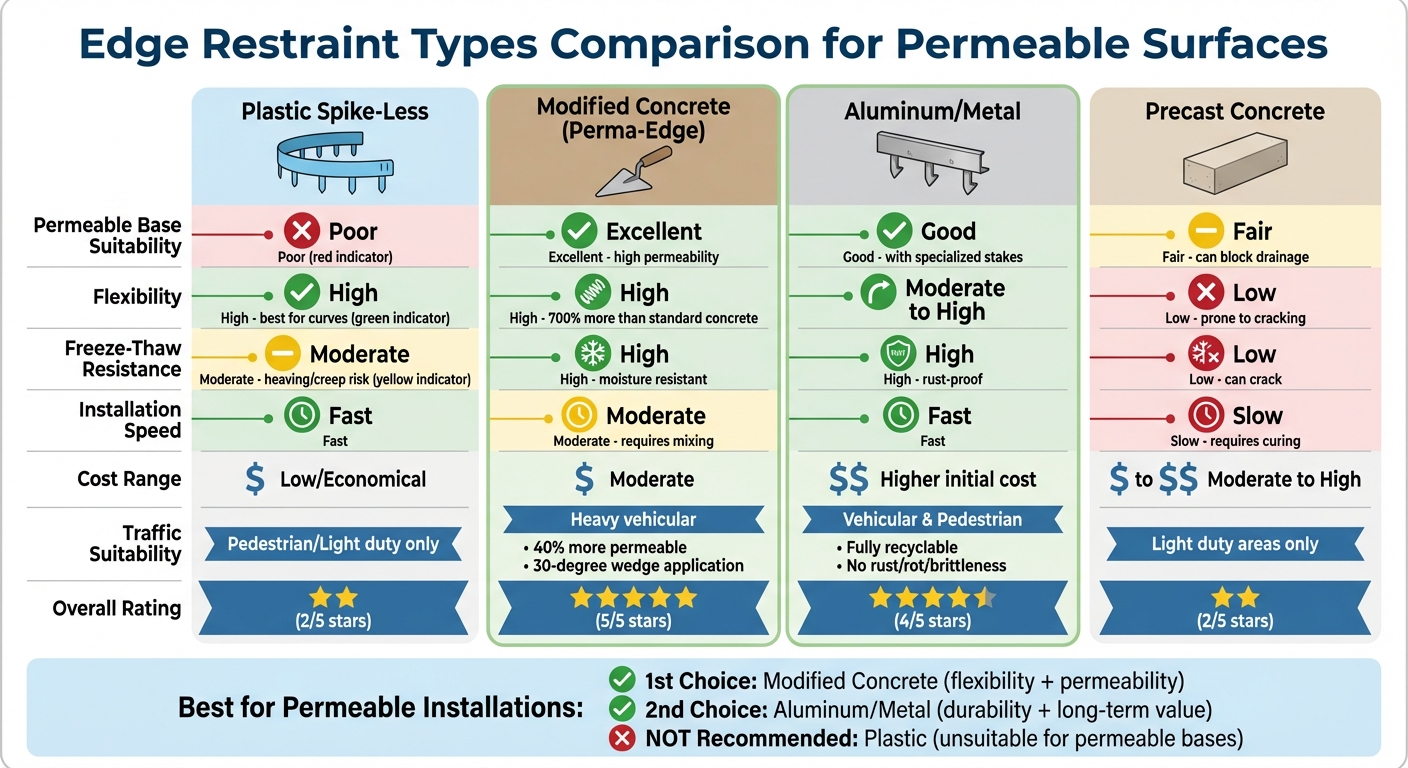
Comparison of Edge Restraint Types
| Feature | Plastic Spike-Less | Modified Concrete (Perma-Edge) | Aluminum/Metal | Precast Concrete |
|---|---|---|---|---|
| Permeable Base Suitability | Poor [2] | Excellent (high permeability) [7] | Good (with specialized stakes) [7] | Fair (can block drainage) |
| Flexibility | High (best for curves) [5] | High (700% more than standard) [7] | Moderate to High [5] | Low (prone to cracking) [5] |
| Freeze-Thaw Resistance | Moderate (heaving/creep risk) | High (moisture resistant) [7] | High (rust-proof) [5] | Low (can crack) [5] |
| Installation Speed | Fast [2] | Moderate (requires mixing) [7] | Fast [1] | Slow (requires curing) [3] |
| Cost Range | Low/Economical [5] | Moderate | Higher initial cost [5] | Moderate to High |
| Traffic Suitability | Pedestrian/Light duty | Heavy vehicular | Vehicular & Pedestrian | Light duty areas |
For permeable installations, plastic is not a suitable choice. Instead, consider modified concrete for its flexibility and permeability or aluminum for its durability and long-term value [7][2]. Modified concrete, like Perma-Edge, is over 700% more flexible and 40% more permeable than standard concrete [7], making it ideal for areas prone to ground movement or curved designs. Aluminum, on the other hand, offers added benefits like full recyclability and resistance to rust, rot, or brittleness [5], making it worth the higher upfront cost in the long run.
Step-by-Step Guide to Installing Edge Restraints
Preparation and Excavation
Start by marking the project boundaries using stakes and string lines. Once outlined, excavate the area to a depth of 6–8 inches for patios or walkways and 10–12 inches for driveways. This ensures enough space for the paver thickness and the required base layers beneath them [4][10].
Next, create the base layer by adding 4–6 inches of open-graded crushed stone or gravel. Use a plate compactor to thoroughly compact the base, which helps prevent settling and provides a solid, level foundation. Before installing edge restraints, scrape back the bedding sand along the perimeter. This allows the restraint to sit directly on the compacted base instead of loose sand, which could lead to shifting over time [2]. As Unilock emphasizes:
It’s important that the edging rests directly on the base and not the bedding material itself… Any movement may cause the restraints and eventually the pavers to shift. [2]
With the base firmly in place, you’re ready to move on to installing the edge restraints.
Installation of Edge Restraints
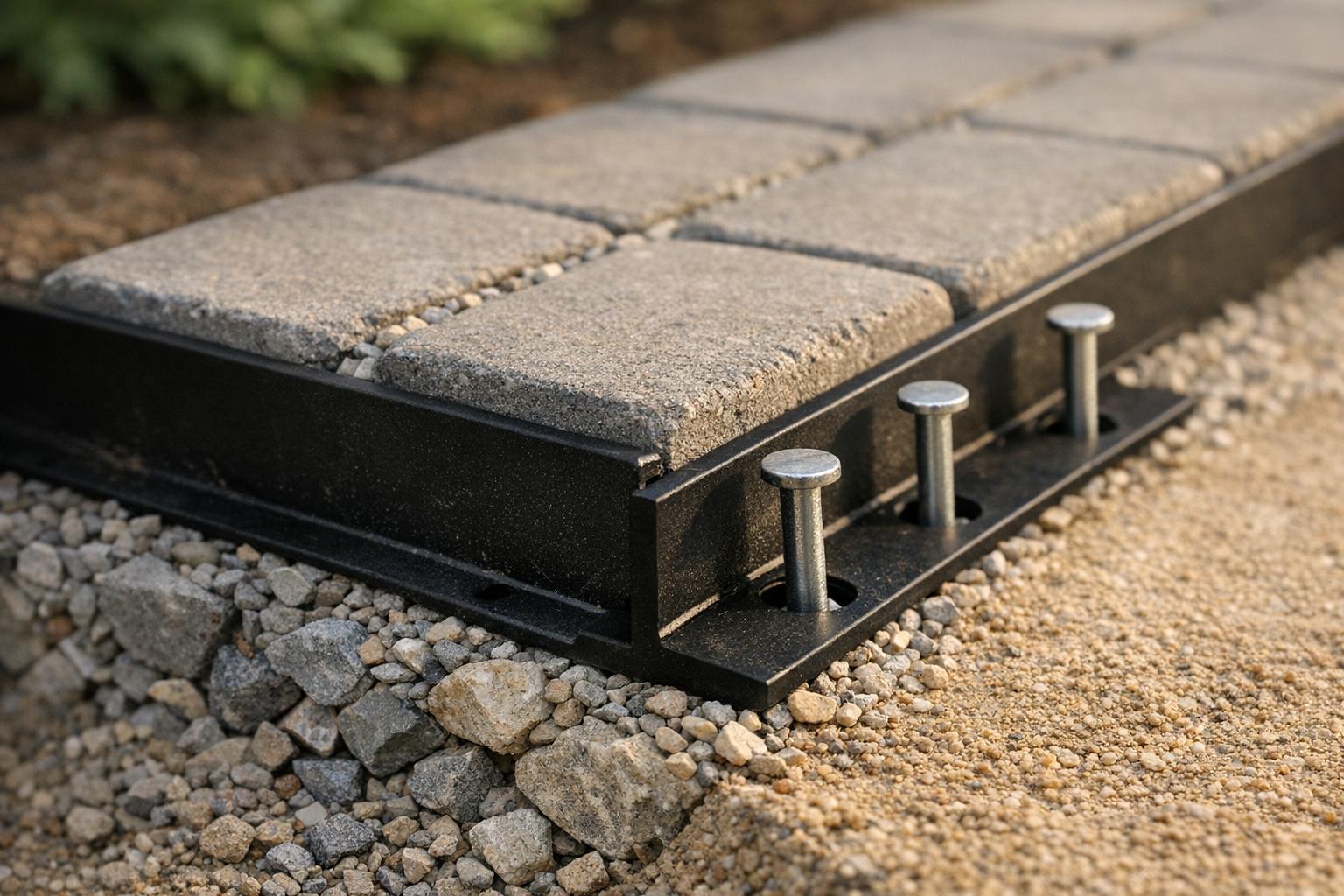
For plastic or metal restraints, position the L-shaped strips along the edges of the compacted base. Secure these strips with 12–18 inch spikes, driving them in at a slight angle. The spacing for the spikes depends on the area’s use: every 8 inches for driveways and every 12 inches for walkways [4][1]. When driving the spikes, leave them about 1/4 inch above the collar to avoid disturbing the compacted surface [2]. Non-galvanized metal spikes are preferred because their natural rusting process helps them grip the base more securely over time [2].
For modified concrete edge restraints, which are ideal for permeable systems, mix high-performance polymer-modified concrete on-site. Use a paddle mixer and follow the typical ratio of 1/2 US gallon (1.9 liters) of water per 50 lb bag of dry mix [2]. Apply the concrete along the edge of the pavers with a flat trowel, shaping it into a 30-degree wedge that tucks slightly under the pavers and stops about 1/2 inch below the paver surface [2]. This design keeps the restraint hidden and allows for smooth backfilling with soil or grass while maintaining drainage and stability.
Final Steps: Paver Placement and Backfilling
Once the edge restraints are secured, proceed with placing the pavers. Sweep polymeric sand into the joints, then use a plate compactor to settle the surface [4]. Lightly mist the area with water to activate and harden the sand.
Finally, backfill around the edge restraints with soil, mulch, or sod to hide the system and create a clean, polished transition to the surrounding landscape with professional hardscaping [1][8]. If you’ve used troweled concrete, allow 24–48 hours for curing before exposing the surface to heavy traffic [10]. Check that the restraints are level with the pavers using a spirit level and string lines to ensure a safe, trip-free surface [10].
Maintenance and Benefits of Edge Restraints for Permeable Surfaces
Regular Maintenance Tips
Check your edge restraints twice a year, especially after winter, to spot any shifting, settlement, or gaps. Maryland’s freeze-thaw cycles can loosen metal spikes or even crack concrete restraints, so it’s important to stay on top of this.
Keep the surface and perimeter clean by removing debris and organic buildup. If material collects under the restraints, it can lift pavers and weaken the system. Pay close attention to any signs of shifting, chips, or cracks, and address these issues promptly to maintain stability [10].
For permeable systems with open-graded bases, avoid using plastic edge restraints. These bases lack the fine particles needed to properly anchor spikes, making plastic restraints less effective [2].
Sticking to a consistent maintenance routine not only keeps the structure intact but also ensures your installation performs at its best.
Key Benefits for Permeable Surface Projects
Edge restraints do more than just make maintenance easier – they play a crucial role in the overall success of your project. Acting as a rigid barrier, they prevent lateral shifting and keep perimeter pavers securely locked in place [1]. Without them, vertical loads can create lateral pressure, leading to dislodged pavers. These restraints also help distribute weight evenly, reducing the risk of pavers sinking or cracking [8].
For permeable surfaces, properly installed edge restraints minimize gaps where weeds and debris can collect. This is critical because clogged drainage joints can compromise the system’s ability to manage water effectively. Modified concrete edge restraints are especially beneficial. They’re built with added flexibility and permeability, making them more resistant to freeze-thaw damage while supporting drainage goals [7].
Pro Landscapes MD‘s Expertise in Edge Restraints

Strong edge restraints are essential for keeping pavers in place and maintaining long-term permeability. Pro Landscapes MD specializes in professional-grade edge restraints and environmental pavers throughout central Maryland, covering areas like Howard County, Montgomery County, Carroll County, Frederick County, Prince George’s County, and Baltimore County. They understand Maryland’s challenging climate and carefully select restraint systems – whether modified concrete, aluminum, or specialized metal – that can handle freeze-thaw cycles and heavy rainfall.
With years of experience installing permeable pavers for patios, walkways, and driveways, Pro Landscapes MD ensures that edge restraints are properly installed on a compacted base (never on bedding sand) [2]. Their comprehensive drainage and stormwater management solutions enhance both the durability and eco-friendliness of outdoor spaces, serving communities from Ellicott City to Bethesda and Columbia to Potomac.
Conclusion
Key Takeaways
Edge restraints serve as essential barriers to prevent lateral movement, sinking, and the failure of interlocking paver systems [1][3]. Without these restraints, vertical loads create pressure that pushes edge pavers outward, leading to gaps that compromise the overall structure [1]. As Unilock explains:
Edge restraints… are designed to keep the surface of your pavers in shape, quite literally. They’re created for engineering, not aesthetics [1].
For permeable surfaces with open-graded bases, standard plastic restraints aren’t suitable because the coarse aggregate lacks the fine particles needed to hold spikes securely [2]. Instead, modified concrete (fiber-reinforced) or specialized metal systems are better choices, as they are designed to anchor effectively in these conditions [2][7]. Modified concrete, in particular, provides greater flexibility and permeability, making it ideal for regions with freeze-thaw cycles or drainage-focused projects [7].
Proper installation is just as important as selecting the right material. Restraints must be installed directly on the compacted base material – never on bedding sand – and should sit about 0.5 inches below the paver surface. This ensures they stay hidden while allowing for grass or mulch to cover the edges [1][2]. Spikes should be driven every 8 to 12 inches, with closer spacing in high-traffic areas like driveways [1]. Adhering to these steps ensures the structural stability and drainage performance of your permeable system for years to come.
How Pro Landscapes MD Can Help
Pro Landscapes MD brings extensive experience in installing edge restraints for permeable pavers, perfectly suited to central Maryland’s challenging climate. With the region’s freeze-thaw cycles and heavy rainfall in mind, they provide tailored solutions – whether it’s using modified concrete for open-graded bases or determining the ideal spike spacing for high-load areas like driveways. Serving communities from Ellicott City to Bethesda, and throughout Howard, Montgomery, Carroll, Frederick, Prince George’s, and Baltimore Counties, their team is equipped to address local challenges effectively.
When you choose Pro Landscapes MD, you gain access to expert advice on selecting the right restraint system for your specific base type. They ensure proper installation directly on compacted aggregate (not bedding sand) and offer seasonal maintenance inspections to identify and resolve potential issues before they become major problems. Their expertise in environmental pavers, drainage solutions, and stormwater management guarantees that your permeable surface functions as intended. Visit prolandscapesmd.com to discuss your project and get personalized recommendations for your property.
FAQs
Do I really need edge restraints for permeable pavers?
Edge restraints are absolutely essential for permeable pavers. They help keep the pavers in place by preventing shifting, creeping, or destabilization. This ensures the installation stays secure and lasts over time. Without proper edge restraints, the pavers can misalign, which could affect both their appearance and their ability to function as intended.
Which edge restraint works best in freeze-thaw climates?
Permeable interlocking concrete pavers, when paired with proper edge restraints and well-drained bases, are a top choice for areas with freeze-thaw cycles. These pavers are built to withstand temperature swings, reducing the risk of cracking or shifting and providing long-lasting stability.
Can I use an existing concrete slab or house foundation as an edge restraint?
It’s usually not a good idea to rely on an existing concrete slab or house foundation as an edge restraint for pavers. Edge restraints are purpose-built to keep pavers in place and stop them from shifting. Concrete slabs or foundations, on the other hand, aren’t designed to interact properly with soil or base materials, which can compromise their effectiveness.
Chat with Us