









- bhavya gada
- No Comments
In Maryland, construction or landscaping projects disturbing 5,000 square feet of soil or involving 100 cubic yards of excavation require an erosion control permit. These permits prevent soil erosion into waterways, protecting the Chesapeake Bay. Missing the permit process can lead to $1,000 daily fines and project stoppages.
Key points:
- Permit thresholds: 5,000+ sq. ft. disturbance or 100+ cubic yards of excavation.
- County-specific rules: Requirements vary by location (e.g., Montgomery and Prince George’s counties).
- Timeline: Permit approvals can take 4-8 weeks for local projects and up to 6 months for state-level reviews.
- Inspections: Pre-construction meetings and ongoing compliance checks are mandatory.
- Expiration: Permits are valid for two years but require regular inspections to remain active.
Preparation involves submitting detailed erosion and sediment control plans, stormwater management calculations, and other required documents. Working with professionals can streamline the process and help avoid delays.
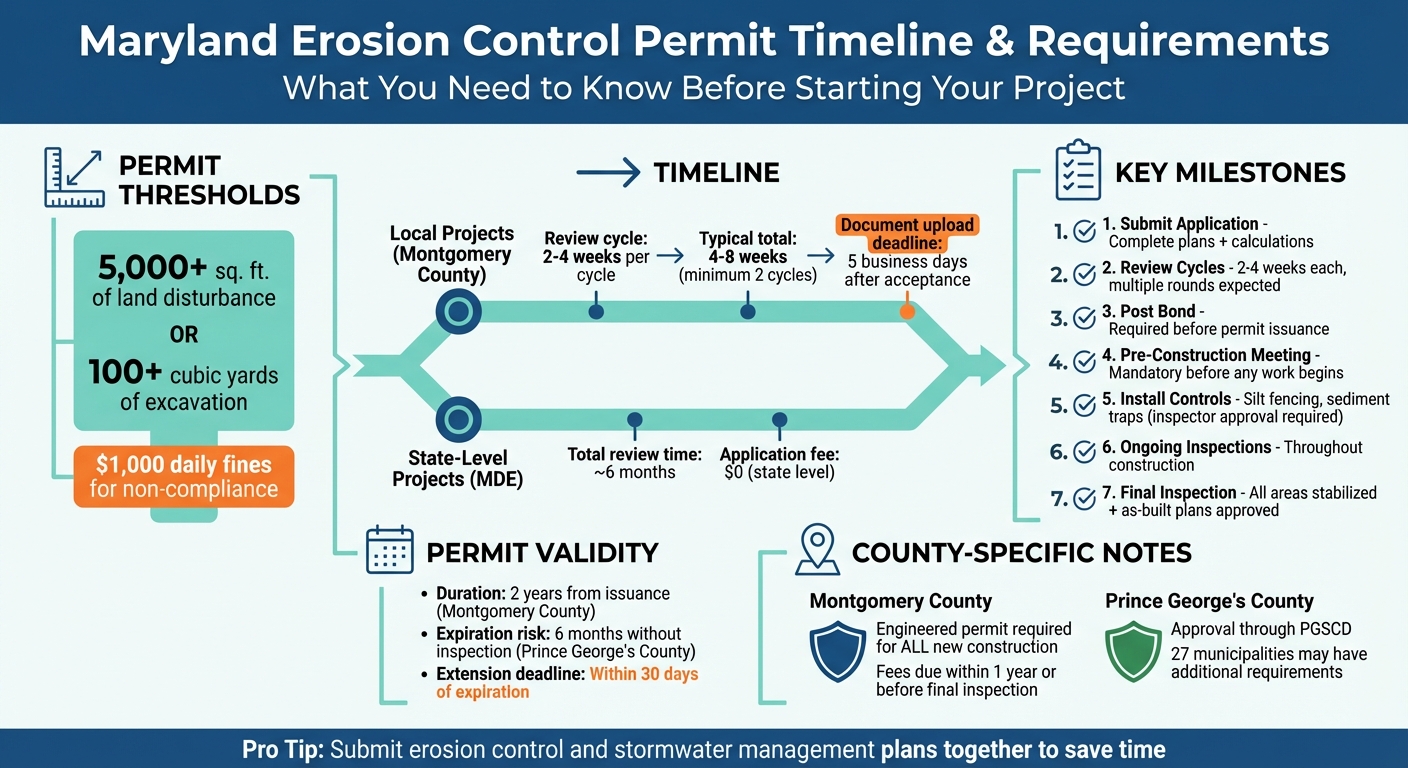
Maryland Erosion Control Permit Timeline and Requirements
MDE Guidance For Protecting Stormwater Best Management Practices During Construction November 2023
sbb-itb-843f8be
When You Need an Erosion Control Permit in Maryland
In Maryland, erosion control permits are mandatory for projects that disturb 5,000 square feet or more of land or involve the excavation of 100 cubic yards or more, regardless of who owns the property [1][2].
Additionally, any project that alters an existing stormwater management facility requires approval, even if the area of disturbance is less than 5,000 square feet [1]. County-specific rules and additional requirements can also influence whether a permit is necessary.
Permit Thresholds by County
While state regulations set the foundation, individual counties often add their own layers of requirements. For instance:
- Montgomery County requires an Engineered Sediment Control Permit for constructing any new residential or commercial building, no matter the size of the land disturbance [3]. Even small additions to existing structures trigger this requirement.
- Prince George’s County handles erosion and sediment control plan approvals through the Prince George’s Soil Conservation District (PGSCD) instead of the general permitting department [4]. Moreover, the 27 municipalities within the county may have their own specific permitting rules. If your project falls within a municipal boundary, you may need additional permits [3][4].
Permit durations also vary. In Montgomery County, sediment control permits are valid for two years from the issuance date [3]. In Prince George’s County, permits can expire if an inspection isn’t conducted within six months, and building permit applications are considered abandoned if not issued within one year of filing [4].
Common Projects That Require Permits
Certain types of projects automatically require permits, even if they don’t meet the numeric thresholds. These include:
- New residential construction, such as single-family homes or townhomes [2].
- Commercial building projects, which are subject to the same rules.
- Landscaping projects involving clearing, grading, or stripping land – especially those tied to housing developments – to prevent soil erosion into storm drains and waterways [1].
Public infrastructure projects, whether undertaken by state, federal, or local agencies, must also comply with these regulations if they meet disturbance thresholds [1]. For smaller land-disturbing activities, some counties offer a streamlined option through the Small Land Disturbing Activities (SLDA) application [2][3].
Projects that integrate erosion control with stormwater management – like installing drainage systems, French drains, or grading for water diversion – often require dual approvals: erosion and sediment control and stormwater management plans [1].
Creating Your Erosion and Sediment Control Plan
To protect Maryland’s waterways and minimize soil erosion during construction, you’ll need to prepare an erosion and sediment control plan. This plan should include detailed technical specifications, clearly marked Limits of Disturbance (LOD), and a step-by-step construction sequence. Together, these elements help guide both inspectors and contractors throughout the process [1][2].
Your submission should also include stormwater management plans and technical calculations [1]. Before the pre-construction meeting, make sure the LOD is staked in the field [2]. The plan should feature measures like siltation barriers, soil stabilization techniques, and stormwater systems such as retention ponds or infiltration setups. A well-prepared plan not only protects the environment but also simplifies the application process, as discussed in the following section.
Documents You Need to Submit
Once your plan is finalized, gather the necessary documents for submission. Most counties require electronic submission through platforms like ePlans or eServices. For instance, in Montgomery County, you must upload all drawings and documents within 5 business days of application acceptance to avoid having your application voided [2].
Your submission package typically includes:
- Site plans showing both existing and proposed conditions
- Erosion and sediment control drawings
- Stormwater management calculations
- Authorization forms from the Maryland Department of the Environment (MDE), if applicable
Don’t forget to account for local filing fees and bonds. In Montgomery County, a non-refundable fee is due upfront, with additional charges required either within one year or before the final inspection [2]. After construction, you’ll also need to submit "as-built" stormwater plans [2].
Working with Professionals for Plan Preparation
Hiring a licensed design professional can make the process much smoother. They’ll help navigate complex regulations like COMAR 26.17.01 and 26.17.02, manage multi-cycle reviews, and ensure your plan meets all requirements. In Montgomery County, each review cycle takes about 2–4 weeks and often involves multiple rounds [2].
Professionals also handle on-site pre-construction meetings and ensure you hit key inspection milestones [2]. Considering that permit approvals can take around 6 months on average [1], their expertise can save you from costly delays and streamline the entire process.
How to Apply for an Erosion Control Permit
Once your erosion and sediment control plan is ready, the next step is applying for the permit. In Maryland, the Maryland Department of the Environment (MDE) handles permits for state, federal, and local government projects. For private developments, county agencies are in charge. Often, you can get approval for both stormwater management and erosion control plans at the same time, which can save you some effort and time [1].
Steps to Submit Your Application
Start by downloading the necessary forms from the Maryland OneStop portal [1]. You’ll need to submit complete erosion, sediment, and stormwater plans, including all required calculations, to the MDE. If your project is reviewed at the state level, the permit application is free. However, county-level permits might involve fees, so check the specific requirements for your area.
Many jurisdictions now require electronic submissions. For example, in Montgomery County, you must upload all drawings and documents within five business days of your application being accepted. Missing this deadline will void your application. Be sure to pay any filing fees online promptly to avoid unnecessary delays [2][3].
Once submitted, your application will likely go through several review cycles, each taking about two to four weeks. After your plans are approved, you’ll need to post a refundable construction bond before the permit is issued. Applications should be mailed to 1800 Washington Boulevard, Baltimore, MD 21230. If you have questions about the statewide permit, you can contact an MDE representative at 537-3551 [1]. Staying organized and aware of the process can help you avoid unnecessary setbacks.
Common Mistakes That Cause Delays
One major mistake is failing to upload your documents within the required five-day window after your application is accepted [2][3]. Make sure all your digital files are ready to go before starting the online submission process.
Another frequent issue is neglecting to secure additional agency approvals, such as those from zoning or health departments, which may be required before finalizing your sediment control plans. Submitting incomplete plans or leaving out required calculations can also lead to extra review cycles, which will slow down the process. To avoid these headaches, consider working with a design professional familiar with local regulations. This can help you stay on track and move through the approval process more efficiently.
Next, we’ll cover how long the permit review process typically takes and what to expect during inspections.
How Long Permit Review and Approval Takes
Once you’ve submitted your application, understanding the expected timelines for permit review is essential for realistic planning. Below, we outline the review durations by county and provide insights into how state-level processes differ.
Review Timelines by County
In Montgomery County, the permit review process typically spans 2–4 weeks per cycle, with most projects requiring at least two cycles. This means the total review time generally ranges from 4–8 weeks for local approvals [2]. For smaller projects, the county offers a Small Land Disturbing Activities (SLDA) permit. This option is less demanding than the full Engineered Sediment Control Permit, which applies to projects disturbing over 5,000 square feet of land or moving more than 100 cubic yards of soil [2]. While SLDA permits are designed to be processed faster, specific timelines for these are not published.
For projects that fall under the jurisdiction of the Maryland Department of the Environment (MDE) – such as state, federal, or large private endeavors – the review process takes approximately 6 months [1]. This extended timeframe reflects the added complexity and coordination required at the state level.
What Affects Approval Times
Several factors can influence how quickly your permit is approved. The completeness of your submission plays a major role. Missing documents, incomplete plans, or unpaid fees can lead to additional review cycles. For example, if required uploads are missing, the review cycle essentially restarts [2].
Inter-agency approvals – such as those involving zoning or health departments – can also add time to the process. Identifying and addressing these requirements early can help prevent delays. Submitting all approvals concurrently, when possible, is a good way to avoid bottlenecks.
For more complex projects, factors like multi-phase designs or unique site conditions may require extra scrutiny. Partnering with a design professional who understands local regulations can be a game-changer, helping you navigate these challenges and reduce potential delays. Accurate, thorough submissions are key to keeping your project on track.
What Happens After Permit Approval
Inspections and Ongoing Maintenance
Once your permit is approved, the real work begins with inspections to ensure compliance with Maryland’s erosion control standards. Before any land disturbance starts, you’re required to schedule an on-site pre-construction meeting with your assigned inspector [2]. During this meeting, the inspector will confirm that the limits of disturbance are properly marked in the field according to your approved plan [2].
After the meeting, you’ll need to install initial sediment control measures – like silt fencing or sediment traps – as outlined in your plan. Construction cannot proceed until an inspector confirms these measures are correctly installed [2]. Skipping this step or starting early could lead to permit violations and penalties.
Throughout the project, inspectors will conduct periodic checks to ensure compliance. It’s your responsibility to schedule these inspections as outlined in your permit and approved plan [2]. The "Sequence of Construction" section in your plan provides clear instructions on when inspections are needed. If your project involves stormwater management measures, additional meetings and certifications will be required during construction [2]. Finally, a timely final inspection is necessary to close out your permit process.
For the final inspection, ensure all disturbed areas are stabilized – either with permanent vegetation or completed paving – and that any required as-built plans are approved [2]. Inspectors won’t pass the final inspection if any areas are non-compliant. Once you pass, the inspector will start the bond release process [2].
Permit Expiration and Renewal
Regular inspections are not just important during construction but are also key to keeping your permit active. In Montgomery County, erosion control permits are generally valid for two years from the date of issuance [2]. In Prince George’s County, building permits expire automatically if no inspections are scheduled within six months [4]. Regular inspection activity is essential to avoid permit expiration.
If your project goes beyond the permit’s validity period, you’ll need to apply for an extension. In Prince George’s County, extension requests must be submitted within 30 days of the permit’s expiration [4]. In Montgomery County, any remaining permit fees are due either one year after the permit is issued or before the final inspection, whichever comes first [2]. Missing these deadlines can disrupt your project and may even void your permit [4].
Combining Erosion Control with Stormwater Management
Why a Combined Approach Works Better
Erosion control and stormwater management work hand-in-hand to protect your property both during and after construction. Erosion and sediment control (ESC) focuses on safeguarding exposed soil during active construction, keeping it from washing into storm drains and nearby waterways [1]. On the other hand, stormwater management (SWM) handles runoff after construction is complete, ensuring long-term site protection [1].
In Maryland, regulations combine these two programs to address issues like erosion, pollution, and flooding caused by urban development [1]. As development increases impervious surfaces, it changes how water flows, making this dual approach essential.
The process is designed to be efficient. You can secure both ESC and SWM approvals at the same time, saving time and ensuring a cohesive site design [1]. For projects disturbing 5,000 square feet or more, both approvals are mandatory. The combined review typically takes about six months, and while the state-level application fee through the Maryland Department of the Environment is $0, local jurisdictions may have their own charges [1]. This integrated process not only ensures compliance but also simplifies the permitting journey.
These principles are the foundation of the services offered by Pro Landscapes MD.
Pro Landscapes MD‘s Erosion and Stormwater Services

Pro Landscapes MD brings these strategies to life with custom drainage and stormwater solutions. Serving central Maryland, they offer services that cover both temporary erosion control during construction and permanent stormwater management systems.
Their drainage solutions include French drains, dry riverbeds, drainage installation, grading, and site leveling – all designed to manage water flow effectively and prevent erosion. They also implement stormwater systems that restore runoff levels to pre-construction conditions. By addressing both short-term and long-term water management needs, Pro Landscapes MD ensures your project complies with Maryland regulations while protecting your property from water-related damage.
Conclusion
When tackling Maryland’s erosion control permits, early planning and realistic timelines are essential. For projects disturbing 5,000 square feet or more, the approval process typically takes about six months[1]. Be prepared for several review cycles before receiving final approval, with permits generally valid for two years[3].
Approval is just one step. Before clearing or grading begins, you’ll need to attend a mandatory pre-construction meeting with an assigned inspector to confirm compliance[2]. After that, ongoing adherence to your approved plans and proactive maintenance are critical. Sticking to the plan not only prevents work stoppages but also ensures the release of your construction bond after the final inspection.
Submitting erosion and stormwater plans together can save time by addressing both immediate and long-term water management needs. This dual approach minimizes siltation in storm drains and waterways while protecting your property from flooding and erosion. It’s an effective way to safeguard both your project and the surrounding environment.
Avoiding delays often comes down to working with experts who understand Maryland’s COMAR 26.17.01 and 26.17.02 regulations. Pro Landscapes MD specializes in navigating these requirements for projects across central Maryland. From preparing plans and coordinating permits to installing compliant erosion control and stormwater systems, they handle it all. Their services, including French drains, grading, and stormwater management, help ensure your project meets all regulatory standards while protecting your investment.
Starting early and partnering with knowledgeable professionals is the best way to manage review cycles, secure approvals, and stay on track. A solid permit strategy not only keeps your project moving but also lays the groundwork for long-term success.
FAQs
Do I need a permit if my project disturbs less than 5,000 sq. ft.?
No, you don’t need a permit if your project disturbs less than 5,000 square feet. An erosion and sediment control permit is only required for projects that disturb 5,000 square feet or more.
How can I speed up erosion control permit approval in my county?
To speed up the approval process for erosion control permits, make sure your application is thorough and adheres to all necessary guidelines. Include a comprehensive erosion and sediment control plan that covers key details like limits of disturbance, grading, stormwater management, and soil types. If your project involves disturbing more than 5,000 square feet of land or moving over 100 cubic yards of soil, ensure you use the appropriate form. Reaching out to local permitting offices early in the process can also help you sidestep potential delays.
What if my permit expires before my project is completed?
If your permit runs out before your project is finished, you’ll likely need to either apply for a new one or ask for an extension. Once a permit expires, continuing work is usually not allowed, which can result in fines or project delays. Reach out to your local authorities to explore your options and keep your project on track.
Chat with Us