









- bhavya gada
- No Comments
Maryland’s fertilizer laws are designed to protect the Chesapeake Bay by limiting nutrient runoff. Here’s what you need to know:
- Phosphorus Use: Prohibited for established lawns unless a soil test shows a deficiency. Starter fertilizers with phosphorus are allowed for new lawns or repairs.
- Nitrogen Limits: Applications are capped at 0.9 pounds per 1,000 sq. ft. for slow-release and 0.7 pounds for water-soluble forms. Annual limits vary by grass type (e.g., tall fescue: 2.7 pounds/year).
- Blackout Period: Fertilizer application is banned from November 16 to March 1.
- Buffer Zones: Maintain a 10-15 foot no-fertilizer zone near waterways.
- Soil Testing: Required before applying phosphorus-based fertilizers; results are valid for three years.
Follow these rules to comply with state law, maintain healthy lawns, and help protect local water quality.
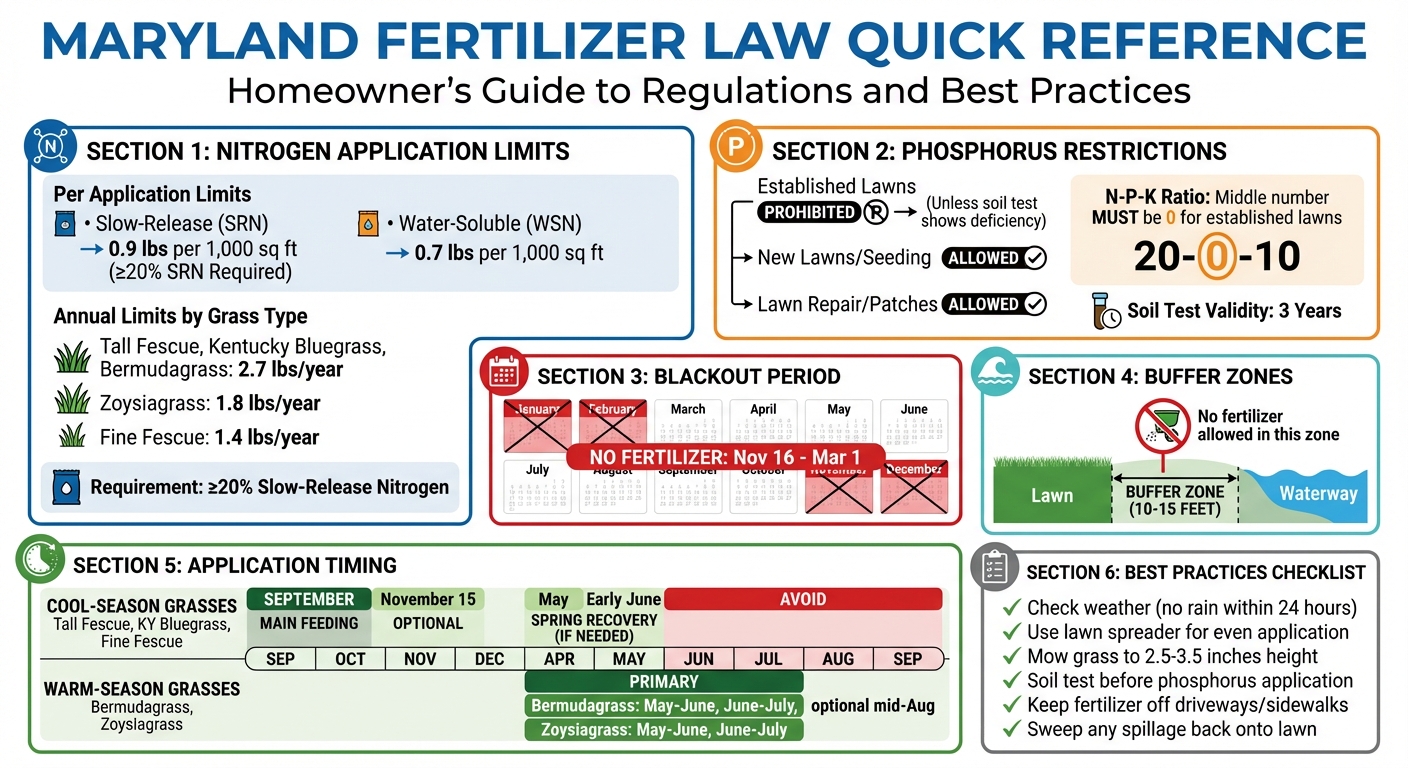
Maryland Fertilizer Law Quick Reference Guide
MDA – HOW TO FERTILIZE YOUR LAWN
sbb-itb-843f8be
Choosing Fertilizers That Meet Maryland Requirements
To comply with Maryland’s state regulations, always select fertilizers labeled specifically for Maryland and follow the instructions on the package carefully [5][6]. These products are designed to stay within the legal nitrogen limit of 0.9 pounds per 1,000 square feet [5][6].
It’s also essential to understand and adhere to specific nutrient restrictions for every application to remain within the state’s legal standards.
Phosphorus Restrictions
For established lawns, check the fertilizer’s N-P-K ratio – the middle number must be 0 to indicate no phosphorus content [6]. For instance, a product labeled 20-0-10 contains no phosphorus and is suitable for regular lawn care [6].
Exceptions to this rule apply when seeding a new lawn or repairing bare spots. In these cases, "starter" fertilizers with phosphorus are allowed [4]. However, if you suspect your lawn needs phosphorus, a soil test is required to confirm a deficiency. Keep in mind that soil test results are valid for three years [4].
| Scenario | Phosphorus Restriction |
|---|---|
| Established Lawns | Prohibited unless a soil test confirms a deficiency |
| New Lawns | Allowed for seeding or sodding |
| Lawn Repair | Allowed for patching or repairing thin or damaged areas |
Nitrogen Application Rates
Maryland requires maintenance fertilizers to include at least 20% slow-release nitrogen. Additionally, applications are capped at 0.9 pounds per 1,000 square feet for slow-release forms and 0.7 pounds for water-soluble forms per application [5][6].
The annual nitrogen limits depend on the type of grass:
- Tall fescue, Kentucky bluegrass, and Bermudagrass: Up to 2.7 pounds per year
- Fine fescue: Limited to 1.4 pounds per year
- Zoysiagrass: Limited to 1.8 pounds per year [5]
To avoid over-application, measure your lawn’s size accurately and match it with the product’s coverage recommendations. Fertilizer bags are often labeled for areas of 5,000, 10,000, or 15,000 square feet [6]. Use a lawn spreader set to the manufacturer’s guidelines for even application, as applying by hand can lead to uneven results [6].
When to Apply Fertilizer in Maryland
Timing your fertilizer applications correctly not only ensures healthy lawn growth but also keeps you in compliance with Maryland’s environmental regulations. These rules prioritize protecting the Chesapeake Bay from nutrient pollution.
Maryland’s Fertilization Blackout Period
In Maryland, applying lawn fertilizer is prohibited between November 15 and March 1. This restriction, part of the Fertilizer Use Act of 2011, is designed to prevent nutrient runoff during periods when grass growth slows significantly. To stay compliant, finish any fall fertilizing by November 15 and wait until after March 1 to resume. Violating this rule, even during unusual weather conditions, is against the law.
For the best results, tailor your fertilization schedule to the type of grass in your lawn.
Fertilizing Cool-Season Grasses
Cool-season grasses like tall fescue, Kentucky bluegrass, and fine fescue thrive with a fall-focused fertilization plan. The main feeding should occur in September, with an optional second application between October and November 15, if needed. These grasses have specific nitrogen requirements:
- Tall fescue and Kentucky bluegrass: Up to 2.7 pounds of nitrogen per 1,000 square feet annually.
- Fine fescue: Limited to 1.4 pounds of nitrogen per 1,000 square feet annually[5][7].
If your lawn has suffered winter damage or heavy use, a spring application (between May and early June) can aid recovery. However, avoid fertilizing during the hot summer months, as this can lead to stress and increase the risk of lawn diseases.
Warm-season grasses, on the other hand, require a completely different approach.
Fertilizing Warm-Season Grasses
Warm-season grasses like Bermudagrass and Zoysiagrass perform best with a summer fertilization schedule. Plan applications between May and July, when these grasses are actively growing and absorbing nutrients. Here’s how much nitrogen these grasses typically need:
- Bermudagrass: Up to 2.7 pounds of nitrogen annually, applied in stages – May–June, June–July, and optionally mid-August[5][7].
- Zoysiagrass: Around 1.8 pounds of nitrogen annually, usually split between May–June and June–July[5][7].
To prevent nutrient waste and runoff, avoid fertilizing warm-season grasses before May or after mid-August, as they are not actively growing during these times.
Preventing Fertilizer Runoff
Once you’ve chosen the right fertilizer and figured out the best time to apply it, the next step is making sure it stays where it belongs – on your lawn. Preventing runoff is key to safeguarding Maryland’s waterways, including the Chesapeake Bay.
Keeping Buffer Zones
In Maryland, you’re required by law to maintain a fertilizer-free buffer zone of 10 to 15 feet from the edge of any waterway, even small streams [2][3]. Start by measuring and marking this zone along the water’s edge. Make sure no fertilizer spreads into this area or onto impervious surfaces like driveways or sidewalks. If any fertilizer does end up there, sweep it back onto the lawn.
Another tip? Mow your grass to a height of 2.5 to 3.5 inches. Taller grass naturally filters water, slows down runoff, and reduces erosion [3][8].
Checking Weather Before Application
Always check the weather forecast before applying fertilizer. If heavy rain is expected within 24 hours, hold off. Rain can wash nutrients away before they have a chance to soak into your lawn [2][3].
Use a lawn spreader instead of applying fertilizer by hand. This tool ensures an even application and helps you avoid overloading certain areas, which can lead to runoff if unexpected rain hits. These small steps not only keep your lawn healthy but also contribute to Maryland’s efforts to protect its water quality.
Testing Your Soil
Soil testing is a key step in ensuring your fertilizer matches your lawn’s specific needs, complementing proper selection and timing.
Before applying any phosphorus-based fertilizer, make sure to test your soil. Maryland’s regulations require that fertilizer use – and the quantities applied – be based on actual soil test results [3].
A soil test measures the existing nutrient levels in your lawn, helping you apply fertilizer more precisely and avoid overuse. According to the University of Maryland Extension, "Excess nitrogen and phosphorus (two components of fertilizers) can migrate from the soil and pollute groundwater. These two nutrients can also wash off landscapes and pollute surface waters and eventually, the Chesapeake Bay" [8]. By testing your soil, you align with Maryland’s nutrient management standards and protect local waterways.
Testing also determines whether your lawn needs phosphorus, letting you adjust your fertilizer application to avoid noncompliance [7]. Additionally, soil test results help you calculate nitrogen needs, which vary depending on the type of grass. For instance, tall fescue requires about 2.7 pounds of nitrogen per 1,000 square feet annually, while fine fescue needs only 1.4 pounds [7]. Without testing, you risk wasting fertilizer or applying it ineffectively.
Keep a record of your soil test results and fertilizer applications. This not only helps you monitor your lawn’s health but also ensures you stay compliant with state regulations [3]. Using accurate soil data allows you to make informed decisions about nutrients and refine your application methods for better results.
Working with Certified Lawn Care Professionals
Hiring a certified lawn care professional in Maryland not only ensures compliance with state fertilizer laws but also helps protect local waterways. Under Maryland law, all lawn care professionals must be licensed and certified by the Maryland Department of Agriculture (MDA) before applying fertilizer. As the MDA explains:
"the law requires lawn care professionals to be licensed and certified by the department to apply fertilizer" [2]
This certification is part of a statewide effort to reduce nitrogen and phosphorus pollution in the Chesapeake Bay watershed. Certified professionals are trained to implement best practices that align with these environmental goals.
Through MDA’s specialized training, certified professionals learn proper application techniques and how to use advanced equipment to minimize runoff and maintain buffer zones. They ensure nitrogen applications meet state-mandated rates based on grass type and follow all environmental protection guidelines.
Before hiring a lawn care provider, it’s important to verify their certification. The Maryland Department of Agriculture offers a list of certified professionals, and they recommend:
"When hiring a lawn care professional to fertilize, be sure that he or she is certified by the department’s Turfgrass Nutrient Management Program or works under the supervision of a certified professional" [2]
This verification step underscores the importance of responsible lawn care and contributes to safeguarding the Chesapeake Bay.
Certified professionals rely on soil tests to make informed decisions about fertilizer applications [3]. These tests help determine whether additional phosphorus or nitrogen is needed for your lawn. Professionals also adhere to strict state guidelines, such as blackout dates from November 15th to March 1st, a maximum single application limit of 0.9 pounds of nitrogen per 1,000 square feet, and a requirement that at least 20% of nitrogen in fertilizer products must be slow-release [5]. Homeowners can request a copy of these soil test results to ensure their lawn care plan is tailored to their soil’s specific needs [3].
Pro Landscapes MD offers compliant and environmentally responsible lawn care services throughout central Maryland, promoting healthy lawns while prioritizing the health of the Chesapeake Bay.
Conclusion
Complying with Maryland’s fertilizer laws not only keeps your lawn healthy but also helps protect the Chesapeake Bay. These regulations, in place for over 12 years, reflect the state’s dedication to improving water quality [1]. By focusing on reducing excess nitrogen and phosphorus, they aim to prevent harmful runoff into local streams and the Bay.
Maryland Agriculture Secretary Kevin Atticks highlights the importance of teamwork in this effort:
"Everyone – from farmers to lawn care professionals to homeowners – needs to do their part if we are to restore the health and vitality of our Chesapeake Bay" [1].
Each time you apply fertilizer responsibly, you’re contributing to this shared goal.
To make a meaningful impact, follow these essential guidelines: observe blackout dates from November 16 to March 1, test your soil before adding phosphorus, maintain a 10- to 15-foot buffer around waterways, and always check the weather forecast before applying fertilizer. These practices not only enhance nutrient management but also safeguard local water quality [1][2].
Pro Landscapes MD offers lawn care services that align with these environmental standards across central Maryland. Their certified professionals combine regulatory expertise with turf science to ensure your lawn thrives while protecting nearby waterways.
FAQs
How do I calculate pounds of nitrogen from a fertilizer bag?
To figure out how much nitrogen (N) is in a fertilizer bag, start by looking at the label for the nitrogen percentage – this is the first number in the sequence (e.g., 27 in 27-0-5). Convert that percentage into a decimal (e.g., 27% becomes 0.27), then multiply it by the bag’s total weight in pounds.
For example, if you have a 17-pound bag labeled as 27% nitrogen, you would calculate the nitrogen content like this: 17 × 0.27 = 4.59 pounds of nitrogen.
What qualifies as a “waterway” for Maryland buffer zones?
In Maryland, the term "waterway" for buffer zones covers streams, rivers, storm drains, and other bodies of water that eventually lead to the Chesapeake Bay. Fertilizer runoff into these waterways can cause harm, making it essential to follow buffer zone rules carefully.
How can I tell if my lawn is cool-season or warm-season grass?
You can figure out your lawn type by paying attention to its growth habits. Cool-season grasses – such as fescue, bluegrass, and ryegrass – tend to grow most vigorously in spring and fall, staying green longer as temperatures drop. On the other hand, warm-season grasses like Bermuda and zoysia thrive during late spring and summer, maintaining their green color even through hot, dry weather. Watching when your lawn grows most actively will help you identify its type.
Chat with Us