









- bhavya gada
- No Comments
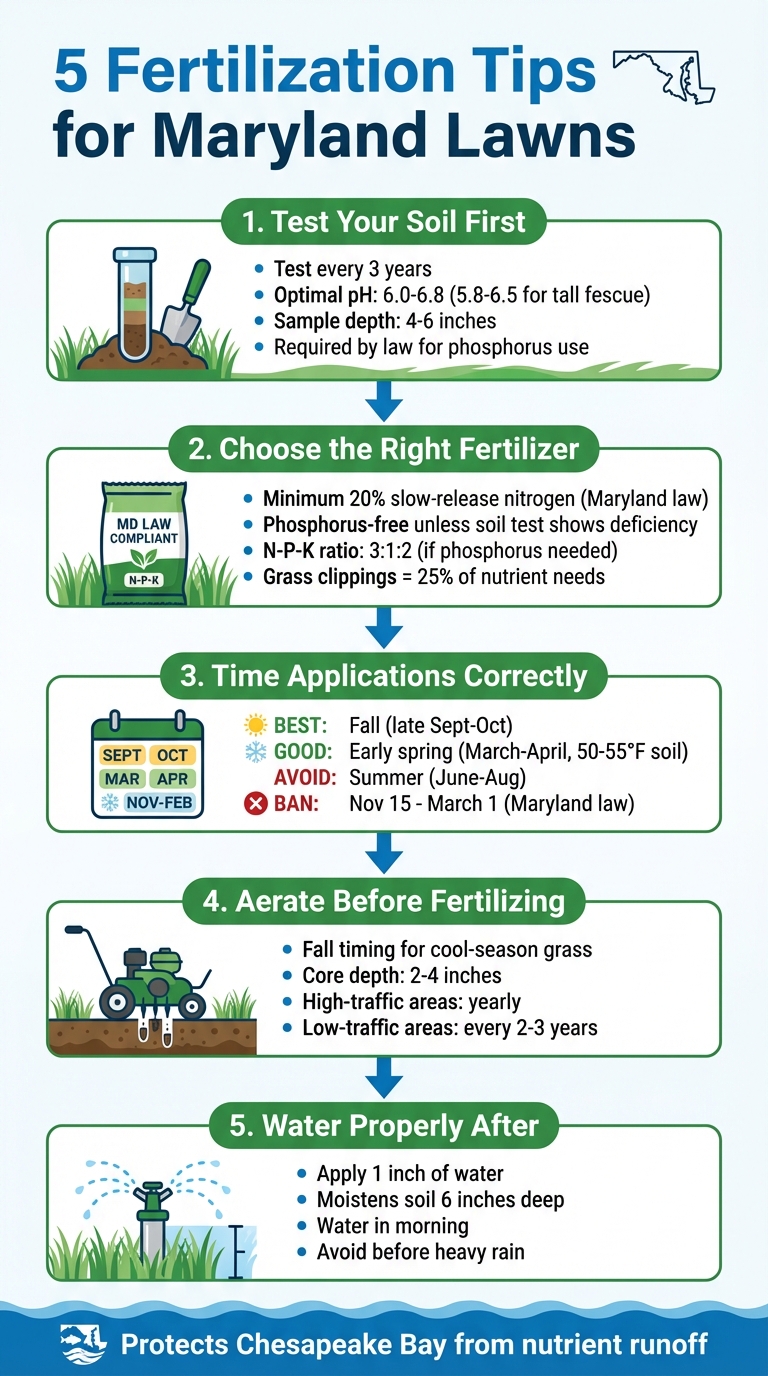
Taking care of a Maryland lawn is tricky due to the state’s unique climate and soil conditions. Here’s a quick rundown of five tips to help you fertilize effectively while staying compliant with local laws:
- Test Your Soil First: Start with a soil test to determine pH levels and nutrient needs. Maryland law restricts phosphorus use unless a deficiency is confirmed.
- Choose the Right Fertilizer: Use products with at least 20% slow-release nitrogen to prevent runoff. Stick to phosphorus-free formulas unless your soil test indicates otherwise.
- Time Applications Correctly: Fertilize cool-season grasses in fall or early spring. Avoid summer applications to prevent nutrient burn.
- Aerate Before Fertilizing: Aerate compacted soil in fall to help nutrients reach the root zone. Use a core aerator for best results.
- Water Properly After Fertilizing: Apply about 1 inch of water to help nutrients absorb into the soil. Morning watering is best to reduce the risk of disease.
These steps ensure a healthy lawn while protecting the Chesapeake Bay from nutrient runoff.
5 Essential Fertilization Tips for Maryland Lawns
How to fertilize your lawn and protect the Chesapeake
sbb-itb-843f8be
1. Test Your Soil First
Before buying fertilizer, make sure to test your soil. In Maryland, applying phosphorus is restricted by law unless a lab test confirms a deficiency [1]. Soil testing provides critical insights, like pH levels and nutrient deficiencies, which directly impact how well your lawn absorbs fertilizer.
Getting the pH right is key. Most turfgrass grows best in a pH range of 6.0 to 6.8, while tall fescue prefers a slightly lower range of 5.8 to 6.5 [1]. If your soil’s pH falls outside these ranges, your grass might struggle to take in nutrients properly.
To gather a soil sample, use a soil core sampler, trowel, or even a screwdriver to dig 4 to 6 inches deep – this is where the majority of grass roots grow [1]. Send the sample to a professional lab for analysis. The University of Maryland Extension offers a list of trusted labs to help you get started [3]. Plan to test your soil every three years to keep track of any changes.
When you receive your results, stick to the lab’s recommendations. For example, if your soil’s pH is below 5.5 and you’re advised to apply more than 50 pounds of lime per 1,000 square feet, split the application into two treatments, spaced six months apart, starting in the fall [1]. Keep in mind that lime can take up to six months to show noticeable effects [1].
Regular soil testing doesn’t just help you fertilize more effectively – it also prevents over-fertilization, which can lead to nutrient runoff into local waterways, including the Chesapeake Bay [1]. With accurate soil data in hand, you’ll be ready to pick the best fertilizer blend for your Maryland lawn.
2. Choose the Right Fertilizer
Once you’ve got your soil test results, picking the right fertilizer becomes much easier. In Maryland, there’s a specific rule: lawn fertilizers must contain at least 20% slow-release nitrogen. This requirement helps minimize nutrient runoff into the Chesapeake Bay, protecting the environment [1].
Fertilizers come in two main types: synthetic and organic. Synthetic fertilizers often include water-soluble nitrogen, which provides a quick green-up but can lead to burning or nutrient loss if overused. They also contain water-insoluble nitrogen (labeled as "WIN"), which releases nutrients at a slower pace. On the other hand, organic fertilizers, made from natural materials like compost or corn gluten, depend on soil microbes to gradually break down and release nutrients. Keep in mind that compost only releases a small portion of its nutrients during the first year [1].
For lawns that are already established, stick to phosphorus-free formulas unless your soil test shows a need for it. If phosphorus is required, choose a fertilizer with an N-P-K ratio close to 3:1:2. Additionally, mulching grass clippings can naturally supply up to 25% of your lawn’s nutrient needs, saving you some effort and money [1].
To avoid overbuying and to stay within the legal limit of 0.9 pounds of nitrogen per 1,000 square feet per application, you can use this handy formula for precise measurements:
(desired lbs of N ÷ % N in analysis) × (lawn square footage ÷ 1,000) [1].
This ensures you’re applying just the right amount for a healthy and thriving lawn.
3. Time Applications Correctly
Getting the timing right for fertilizing your lawn in Maryland is key. Cool-season grasses, such as tall fescue and Kentucky bluegrass, thrive in the state’s mild spring and fall weather but struggle during extreme heat or cold [2].
Fall is the prime time. Fertilizing between late September and October helps your lawn recover from summer stress, strengthens roots for the winter, and sets the stage for lush growth in the spring. If you can only fertilize once a year, this is the window to choose for maximum impact on root health and recovery [1][2].
Early spring (March to April) is another option. Once your grass comes out of dormancy, you can fertilize – but only after soil temperatures consistently hit 50–55°F. A helpful tip: when forsythia bushes start blooming, it signals that the early spring fertilization window is closing [2].
Skip summer. Fertilizing in the summer months (June through August) can do more harm than good. Cool-season grasses enter a semi-dormant state to survive high temperatures and can’t process nutrients efficiently. Applying fertilizer during this time increases the risk of nutrient burn. Turf Medic explains:
Stressed grass can’t process nutrients properly in heat. Risk of fertilizer burn is highest during these months.
Once you’ve nailed the timing, pairing it with proper soil prep and balanced nutrients will give your lawn the best chance to thrive.
4. Aerate Before Fertilizing
Aeration creates pathways that allow fertilizer, water, and air to reach the roots more effectively. Without it, nutrients can either wash away or fail to penetrate compacted soil. According to the University of Maryland Extension:
Mechanical aeration helps alleviate compaction by creating channels for air and water to move more easily through soil layers. Added benefits include enhancing seed germination and integrating lime or fertilizer into the root zone.
Maryland’s clay-heavy soils are particularly prone to compaction from foot traffic and lawn equipment. Even a thin compacted layer – just 1/4 to 1/2 inch at the surface – can block nutrients and harm your lawn’s health [1]. Core aerators are the most effective tools for the job, as they remove soil plugs that are 2–4 inches deep and ½–¾ inch wide, spaced 2–6 inches apart. This process ensures nutrients are delivered where they’re needed most, making timing all the more important.
Timing matters. For cool-season grasses like tall fescue, fall is the best time to aerate. Lawns in high-traffic areas benefit from yearly aeration, while less-used areas may only need it every 2–3 years. Always aerate when grass is actively growing – avoid doing so during dormant periods like summer for cool-season grasses or winter for warm-season varieties.
To prepare, water dry soil beforehand and use a core aerator with hollow tines. Avoid solid-tined models, as they simply push the soil aside, potentially worsening compaction. The soil plugs removed during aeration will naturally break down in about two weeks, adding organic matter back into your lawn.
5. Water and Follow Up Properly
Watering is a crucial step after fertilizing – it helps carry the nutrients down into the root zone where they can be absorbed. Skipping this step can lead to issues like fertilizer evaporating, staying in the upper soil layers, or even causing leaf burn due to excess nitrogen.
To do it right, apply about 1 inch of water after fertilizing. This amount should moisten the soil to a depth of about 6 inches. You can check this by using a rain gauge or placing a shallow container in the yard and measuring the water collected. If you’re unsure about soil depth, use a screwdriver or trowel to confirm.
Timing matters too. The University of Maryland Extension emphasizes watering in the morning for better results:
Water in the morning to minimize how long the grass stays wet, since prolonged leaf wetness can lead to disease outbreaks. Water will also be lost to higher evaporation rates in the afternoon. [1]
For areas with slopes or clay-heavy soil, water slowly and in stages. This ensures the water has time to soak in without running off. On the other hand, avoid fertilizing just before a heavy rainstorm – downpours can wash nutrients away before they reach the roots.
Lastly, don’t overdo it. Deep but infrequent watering sessions encourage strong root systems while reducing the risk of nutrient leaching or promoting weed growth.
Conclusion
Taking care of a lawn in Maryland involves more than just spreading fertilizer – it’s about careful planning and timing. Start with regular soil tests to pinpoint what your grass truly needs. From there, select a fertilizer that complies with Maryland’s regulations, ensuring it contains at least 20% slow-release nitrogen. This type of fertilizer not only nourishes your lawn steadily but also helps protect the Chesapeake Bay. Timing is everything: cool-season grasses like tall fescue benefit from fertilization in late summer through autumn, while warm-season varieties like zoysia thrive with applications in late spring through summer.
Don’t overlook the importance of aerating your lawn before fertilizing and watering it thoroughly afterward. These steps help nutrients reach the root zone instead of sitting on the surface. Plus, staying mindful of Maryland’s laws – which ban nitrogen and phosphorus applications from November 15 to March 1 – keeps you on the right side of regulations.
Consistency makes all the difference. Recycling grass clippings is a simple way to return nutrients to the soil, and proper watering techniques ensure those nutrients get to where they’re needed most – deep in the root zone.
If you’re looking for professional help to achieve a lush lawn without the hassle of monitoring soil conditions or weather patterns, Pro Landscapes MD has you covered. They offer services like soil testing, nutrient management, core aeration, and fertilization, all tailored to Maryland’s specific climate and legal guidelines. Covering areas from Annapolis to Towson and beyond, their team combines local knowledge with top-tier products to keep your lawn looking its best throughout the year.
Whether you choose to tackle these tasks yourself or enlist expert assistance, following these steps will set your Maryland lawn up for success.
FAQs
How can I tell if my lawn needs phosphorus?
To keep your lawn healthy and comply with Maryland law, it’s important to perform a soil test before applying phosphorus. Maryland restricts the use of phosphorus unless a soil test confirms a deficiency. By testing your soil, you can determine its nutrient levels and ensure you’re fertilizing responsibly, promoting strong, vibrant lawn growth while staying within legal guidelines.
What fertilizer is legal to use in Maryland?
Fertilizers sold in Maryland must align with the Maryland Lawn Fertilizer Law, which sets strict limits on nitrogen and phosphorus usage. Generally, most lawn fertilizers available in the state already meet these standards. They typically contain zero phosphorus and at least 20% slow-release nitrogen, unless a soil test indicates that phosphorus is necessary. Always read the label carefully to ensure the fertilizer complies with these regulations.
Should I fertilize if heavy rain is coming?
Avoid applying fertilizer to your lawn just before heavy rain. When it rains heavily, the excess fertilizer can wash away, making it less effective and potentially polluting nearby water sources. To get the best results and protect the environment, wait for a dry spell so the fertilizer has time to absorb properly into the soil.
Chat with Us