









- bhavya gada
- No Comments
Fire pits can be a great addition to your outdoor patio space, but Maryland has specific rules to ensure safety and compliance. Here’s what you need to know:
- Size and Distance: Recreational fire pits must be under 3 feet in diameter and 2 feet in height, and at least 15 feet away from structures.
- Approved Materials: Only dry, seasoned wood, propane, or natural gas can be used. Avoid burning trash, treated wood, or green vegetation.
- Supervision: An adult (18+) must be present at all times, and fires should be fully extinguished after use.
- Burn Bans: Maryland enforces a burn ban from June 1 to August 31 in certain areas, with additional emergency bans during droughts or high fire risks.
- Permits: Fires near woodlands or larger than 3 feet require permits. Violations can result in fines up to $1,000.
Key Tip: Always check local rules and air quality alerts before lighting a fire. Stay safe and avoid hefty fines by following these guidelines.
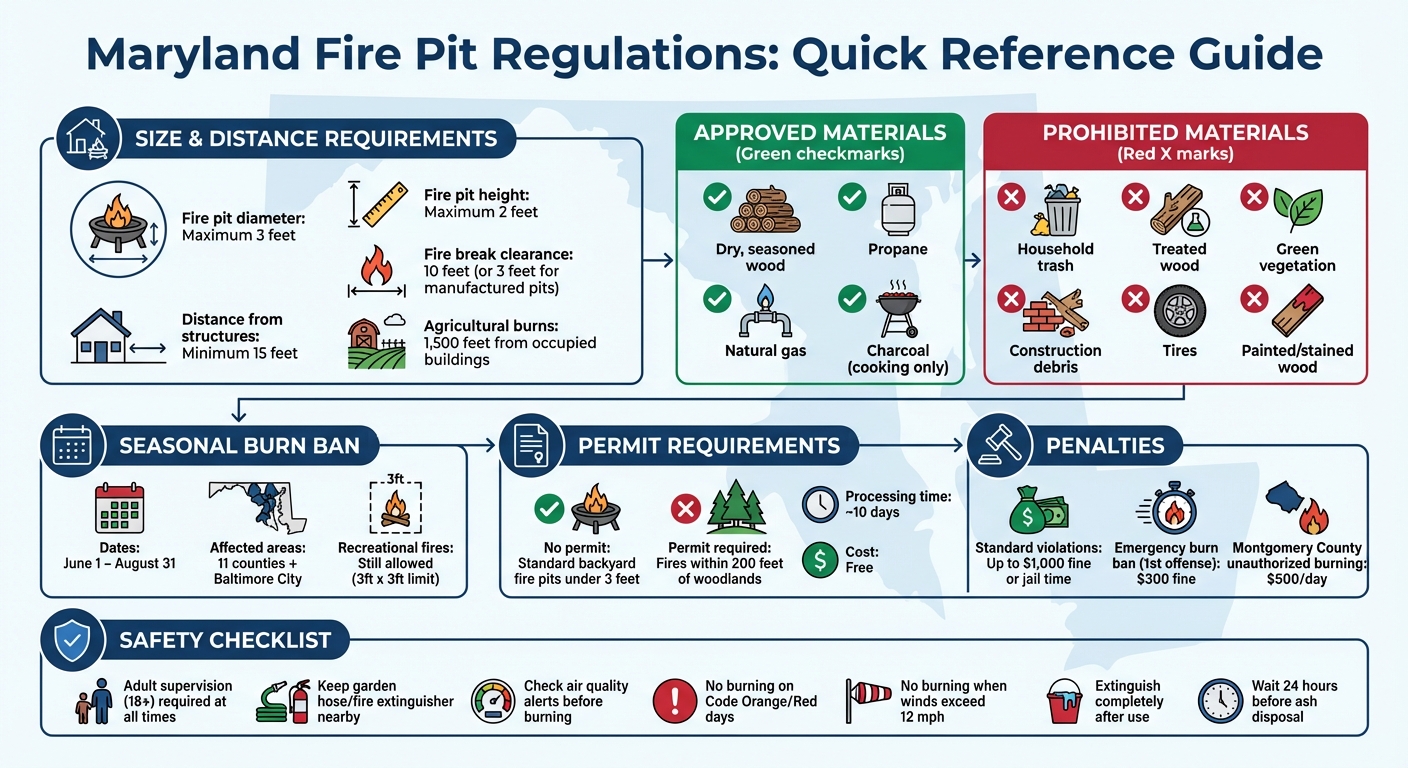
Maryland Fire Pit Regulations Quick Reference Guide
Maryland’s Fire Pit Regulations Explained
Statewide Rules and Seasonal Burn Bans
Maryland enforces an annual open burning ban from June 1 to August 31 to help lower ozone levels during the late summer months [5]. This ban affects 11 counties and Baltimore City, including Anne Arundel, Baltimore, Calvert, Carroll, Cecil, Charles, Frederick, Harford, Howard, Montgomery, and Prince George’s. However, recreational fires used for cooking or leisure are allowed as long as they stay within a 3-foot by 3-foot size limit [5][1].
In addition to the seasonal ban, Maryland’s Secretary of the Department of Natural Resources can issue emergency statewide burn bans during periods of extreme drought or high fire risk. Under such bans, wood-burning fire pits and charcoal grills are prohibited, though propane devices with an on/off switch are usually still permitted [4][6]. Anne Hairston-Strang, Maryland’s State Forester, emphasized the importance of these bans:
"While fines may be imposed for violations, the most important result of a ban of this type is that it communicates to the public the severity of the situation" [4].
Recreational Fire Permits and Requirements
For most homeowners, no permit is needed to use a backyard fire pit. However, if you plan to burn within 200 feet of woodlands, you’ll need to obtain a state Open Air Burning Permit from the Maryland Forest Service. These permits are free and typically processed within about 10 days [7].
Fires larger than the 3-foot limit – such as bonfires – or those for agricultural purposes require permits from both your local health department and the DNR Forest Service. Violating these regulations can lead to fines up to $1,000 or even jail time [5]. During emergency burn bans, first-time offenders face a $300 fine [4][6]. Adhering to these guidelines ensures that your fire stays within legal boundaries.
Legal vs. Illegal Burning: What’s the Difference?
Understanding the difference between legal and illegal burning often comes down to purpose, size, and materials. Recreational fires are allowed for cooking, warmth, or religious ceremonies, provided they remain within the 3-foot size limit and use only natural wood or charcoal [1][3]. These fires generally don’t require permits.
Illegal burning, on the other hand, includes activities like waste disposal, land clearing, or burning larger fires without proper permits [3]. Agricultural burns, for instance, must be conducted at least 1,500 feet away from any occupied building or public roadway [3]. Even if your fire meets all legal criteria, authorities can still require it to be extinguished if the smoke causes a nuisance to neighbors or creates unsafe conditions [5].
sbb-itb-843f8be
Here’s what to know about MD’s burn ban | NBC4 Washington
Approved Materials for Fire Pits
When it comes to fire pits, knowing what materials are allowed is key to ensuring safety and staying within the law.
Approved Fuel Sources
In Maryland, the rules about what you can burn in a backyard fire pit are straightforward. The primary fuel for recreational fire pits, chimineas, and outdoor fireplaces must be dry, seasoned wood. This is because green or freshly cut wood produces too much smoke, which not only violates regulations but also creates unnecessary air pollution [3].
For those using prefabricated fire pits or grills, propane and natural gas are also approved options. These fuels provide a safer alternative during burn restrictions since they come with an easy on/off mechanism [4]. Charcoal is allowed, but only for outdoor cooking equipment like grills and hibachis [3]. Additionally, small amounts of natural wood can be used as kindling to start fires [3].
It’s important to avoid flammable liquids like gasoline or lighter fluid when starting or accelerating fires. These substances pose serious safety risks and are strictly discouraged [3].
Why Material Quality Matters
The quality of the fuel you use has a big impact on safety and air quality. Burning unseasoned or green wood releases harmful pollutants, including particulate matter, carbon monoxide, and volatile organic compounds [3]. In Montgomery County, for example, recreational fires are required to avoid producing "dense smoke", which is defined as visible emissions exceeding 20% opacity for more than three minutes in any hour [3].
Using seasoned hardwood is a better choice. Its lower moisture content means it burns hotter and cleaner, generating less smoke and providing more heat. This also reduces the likelihood of complaints from neighbors. The Montgomery County Department of Environmental Protection highlights the broader effects of poor fuel choices:
"The air pollution created by open burning can directly affect the health and well-being of people who live or work near the burn sites by aggravating respiratory conditions, irritating eyes and lungs, obscuring visibility, and creating annoying odors" [3].
Choosing the right materials ensures a safer and more enjoyable fire pit experience while keeping the environment and community in mind.
Prohibited Materials and Their Risks
What You Cannot Burn
There are certain materials you should never burn in a fire pit or open flame. This includes household trash, tires, construction debris, yard waste, lumber, treated wood, asphalt shingles, tar paper, green vegetation (like leaves or grass clippings), and freshly cut wood [3]. Construction materials often contain chemicals or adhesives that release harmful fumes when burned [3]. Similarly, wood that has been painted, stained, or treated is unsafe for burning. Green vegetation and freshly cut wood are also problematic because they produce heavy smoke, which can lead to air quality violations [3].
Environmental and Health Impacts
Burning prohibited materials isn’t just a legal issue – it’s a serious threat to both health and the environment. When items like plastics, treated wood, or household trash are burned, the process often leads to incomplete combustion, releasing toxic chemicals such as benzene, dioxins, furans, and polycyclic aromatic hydrocarbons (PAHs) [9]. These harmful substances can penetrate deep into the lungs and even enter the bloodstream, potentially causing bronchitis, aggravated asthma, heart disease, and other severe health issues [8][9].
The Montgomery County Department of Environmental Protection highlights the risks:
"Smoke is dangerous for people with respiratory diseases like asthma, bronchitis, emphysema, and pneumonia because it can aggravate the symptoms of these diseases" [3].
Illegal burning also impacts the broader community. It contributes to regional air quality problems, creates unpleasant odors, and may damage nearby properties [3]. Instead of burning yard waste, consider alternatives like using curbside collection services, composting organic materials, or taking debris to a solid waste transfer station [2][3]. Following these guidelines helps protect your health, your neighbors, and the environment.
Fire Pit Safety Best Practices
Placement and Distance Guidelines
Where you place your fire pit plays a big role in keeping things safe. In Maryland, fire pits need to be at least 15 feet away from structures like decks, sheds, vehicles, or anything flammable to reduce the risk of fire spreading[2][1]. Specific county rules differ: Montgomery County suggests 10 feet for single-family homes and 25 feet for multi-family residences, while Baltimore County requires 15 feet for apartments. If you’re building a ground fire as part of your Baltimore hardscaping, it should be 300 feet from any habitable dwelling[3][2].
Create a safety zone by clearing a 10-foot fire break around your fire pit (or 3 feet for smaller, manufactured pits). This area should be free of dry grass, leaves, mulch, or any debris that could catch fire[3][1]. And while it might be tempting, never use fire pits on balconies or decks – this is especially risky in multi-family buildings[2][3]. Once the fire pit is set up in a secure spot, proper supervision becomes your next priority.
Supervision and Fire Management
Keeping an eye on the fire is just as important as placing it in the right spot. Always supervise the fire until every ember is completely out[3][2][1].
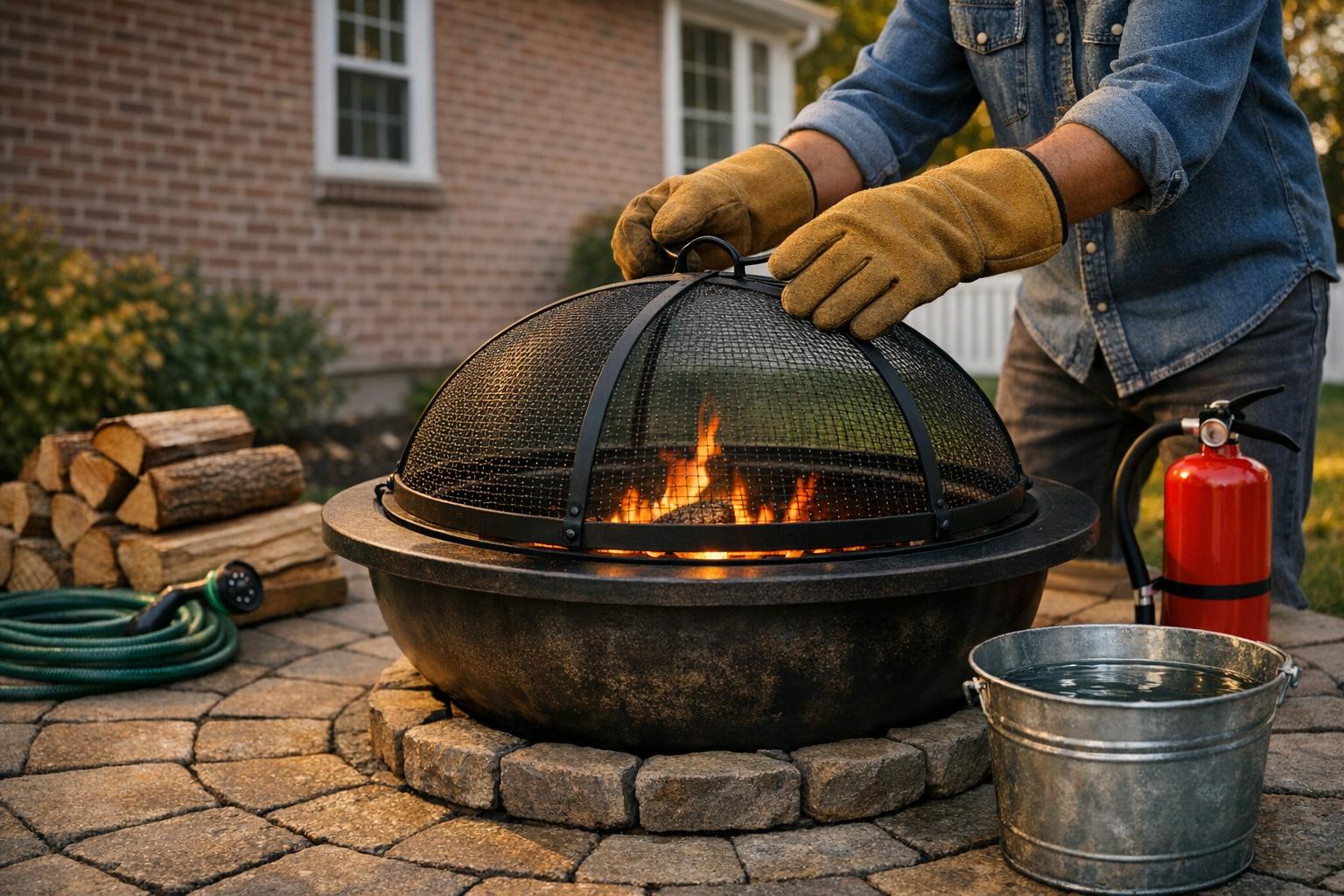
Before lighting the fire, have safety tools like a garden hose, fire extinguisher, or buckets of sand or dirt within reach. Keep the flames under control by maintaining a height of no more than 2 feet[1]. Avoid using flammable liquids like gasoline, kerosene, or lighter fluid to start or revive the fire – these can cause unexpected and dangerous flare-ups[3][2].
Check the weather and air quality before starting a fire. Skip burning on Code Orange/Red air quality days or when winds exceed 12 mph, as these conditions make fires more hazardous[3].
When you’re ready to call it a night, extinguish the fire thoroughly. Douse it with water, stir the ashes to uncover any hidden embers, and repeat until everything is cool to the touch. Wait at least 24 hours before disposing of the ashes. When you do, dampen them and store them in a metal container – never use paper bags, cardboard boxes, or compost piles for ash disposal[3][2].
County-Specific Rules and Permit Processes
How to Apply for Burn Permits
In Montgomery County, the process for small backyard fires is straightforward. If your fire pit is under 3 feet in diameter, you don’t need a permit – just call the Department of Fire and Rescue Services at 240-683-6520. For larger fires or special events, permits are required from both the Division of Fire Prevention and Code Compliance and the Department of Environmental Protection. Be sure to submit your application at least 30 days before your planned event.
For Baltimore County residents living outside the I-695 Beltway, permits are required for recreational bonfires. To apply, contact the local Office of the Fire Marshal at 410-887-4880. However, if you live within the Beltway, all open burning, including recreational bonfires, is prohibited.
The Maryland Forest Service handles permits for open-air burning across the state. These permits are free and generally take about 10 days to process. They apply to burns within 200 feet of woodlands but typically exclude small recreational fires in incorporated towns. These statewide permits are designed to align with local rules for added safety.
Local Guidelines and Restrictions
Local rules often build on statewide regulations to ensure safe and responsible burning. For example, Worcester County requires a permit for open fires, charges a fee, and limits burning hours to between 6:00 AM and 10:00 PM. Even with a permit, you must notify the Environmental Programs office before starting your fire.
Agricultural burning has its own set of rules. In Montgomery County, commercial agricultural burns need approval from the Department of Environmental Protection. You can reach them at askdep@montgomerycountymd.gov or 240-777-0311. A site inspection may be necessary, and between June 1 and August 31, burning is restricted to specific "recropping" purposes verified by the Maryland Department of Agriculture.
Be aware that unauthorized open burning in Montgomery County can result in fines of up to $500 per day [3].
Conclusion
Sticking to Maryland’s fire pit regulations is crucial for safeguarding your property, protecting your neighbors, and preserving the state’s natural surroundings, especially during drier periods.
The rules are simple: use only dry, seasoned wood in a fire pit no larger than 3 feet across, keep it at least 15 feet away from any structure, and ensure a responsible adult is present at all times. Avoid burning household trash, construction debris, or yard waste, as these materials release harmful smoke that can worsen respiratory conditions like asthma and bronchitis [3]. Always check for burn bans and air quality alerts before starting a fire, and have a garden hose or fire extinguisher on hand for emergencies.
Breaking these rules has real penalties. A first offense for violating a statewide burn ban comes with a $300 fine [4], while in Montgomery County, fines for unauthorized burning can reach $500 per day [3]. Beyond the financial cost, ignoring these regulations endangers lives and property.
For help with safe and regulation-compliant fire pit installations, reach out to Pro Landscapes MD.
FAQs
How do I know if a burn ban applies where I live?
To find out if a burn ban is in effect, check both statewide and local restrictions. In Maryland, the Department of Natural Resources enforces bans during periods of dryness or heightened fire risk. Some counties, such as Baltimore and Montgomery, have their own rules and may require permits for open burning. For accurate information, reach out to local authorities or consult official updates.
Do I need a permit for my fire pit or bonfire?
Yes, in Maryland, a permit is required for open-air burning, such as bonfires, particularly if they are near woodlands or other flammable materials. However, small recreational fires – like campfires or fires for cooking – are typically exempt from this requirement. It’s always a good idea to review local regulations to make sure you’re following fire safety guidelines.
What should I do if neighbors complain about smoke?
If you’re planning to enjoy a fire pit in Maryland, make sure it meets state and local regulations. This includes using approved materials for the fire pit and adhering to any restrictions, like designated hours for use.
When dealing with complaints, consider ways to reduce smoke emissions, such as using seasoned wood or smokeless fuels. If the smoke is still a problem, relocating the fire pit to a less disruptive spot might help.
Keep in mind that open burning often requires permits and strict compliance with local rules. Always check the specific guidelines for your area to stay within the law and avoid potential issues.
Chat with Us