









- bhavya gada
- No Comments
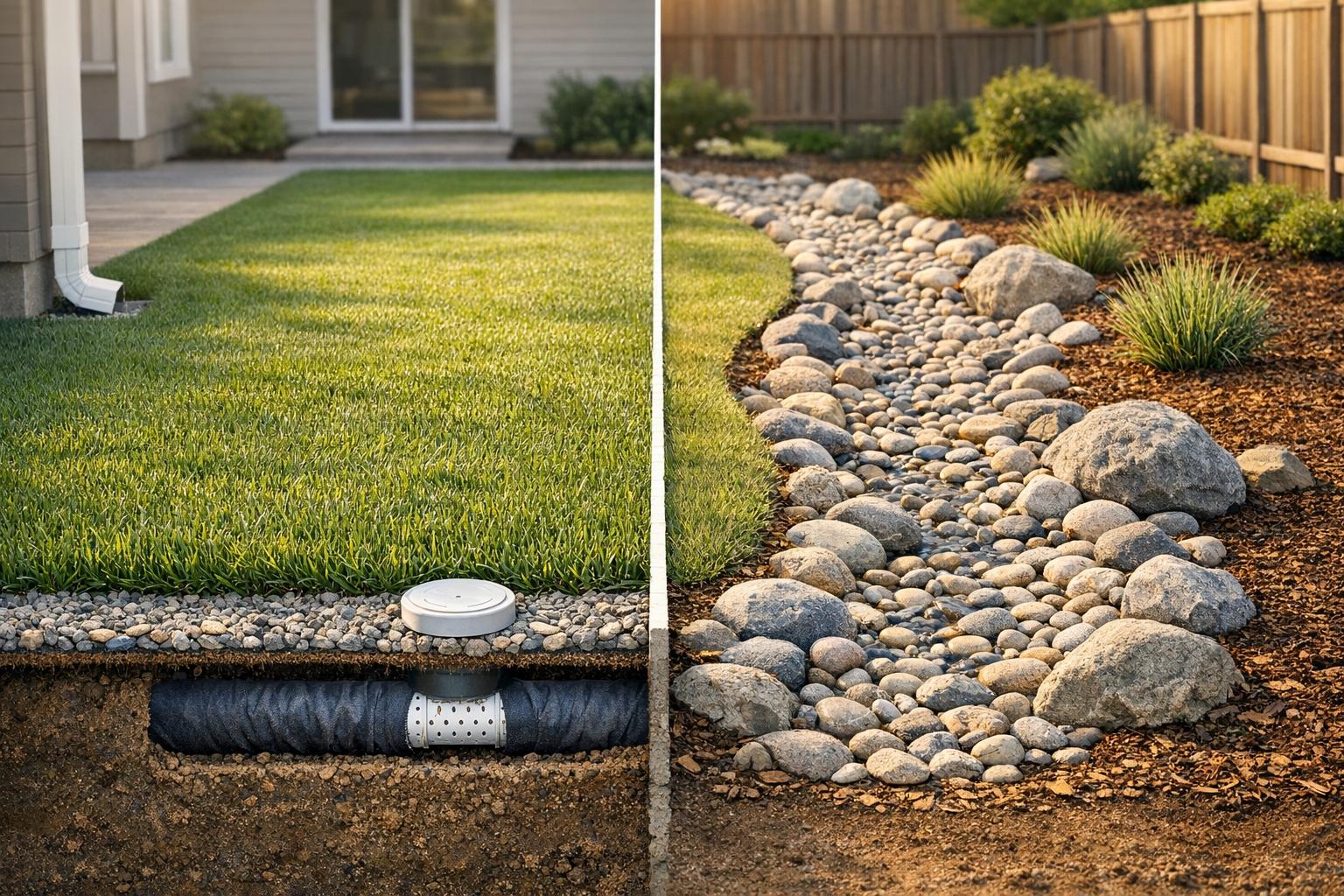
When it comes to solving yard drainage issues, French drains and dry riverbeds are two popular options. Here’s the quick answer: dry riverbeds are generally cheaper upfront, costing $15–$40 per linear foot compared to French drains at $15–$50 per linear foot. However, the best choice depends on your specific drainage problem, soil type, and property layout.
- French Drains: Ideal for managing underground water and protecting foundations. They are more complex to install and require regular maintenance, but they last 20–30 years.
- Dry Riverbeds: Better for surface water and sloped yards, offering a decorative touch. They are easier to maintain but may need occasional reshaping over time.
Quick Comparison:
| Feature | French Drains | Dry Riverbeds |
|---|---|---|
| Cost (per linear foot) | $15–$50 | $15–$40 |
| Best For | Subsurface water | Surface runoff |
| Installation Time | 2–5 days | 3–7 days |
| Maintenance Cost | $1–$3/year | $2–$5/year |
| Lifespan | 20–30 years | Indefinite with upkeep |
French drains are more effective for serious water issues, while dry riverbeds are simpler and add aesthetic value. In some cases, combining both systems can provide the most effective solution.
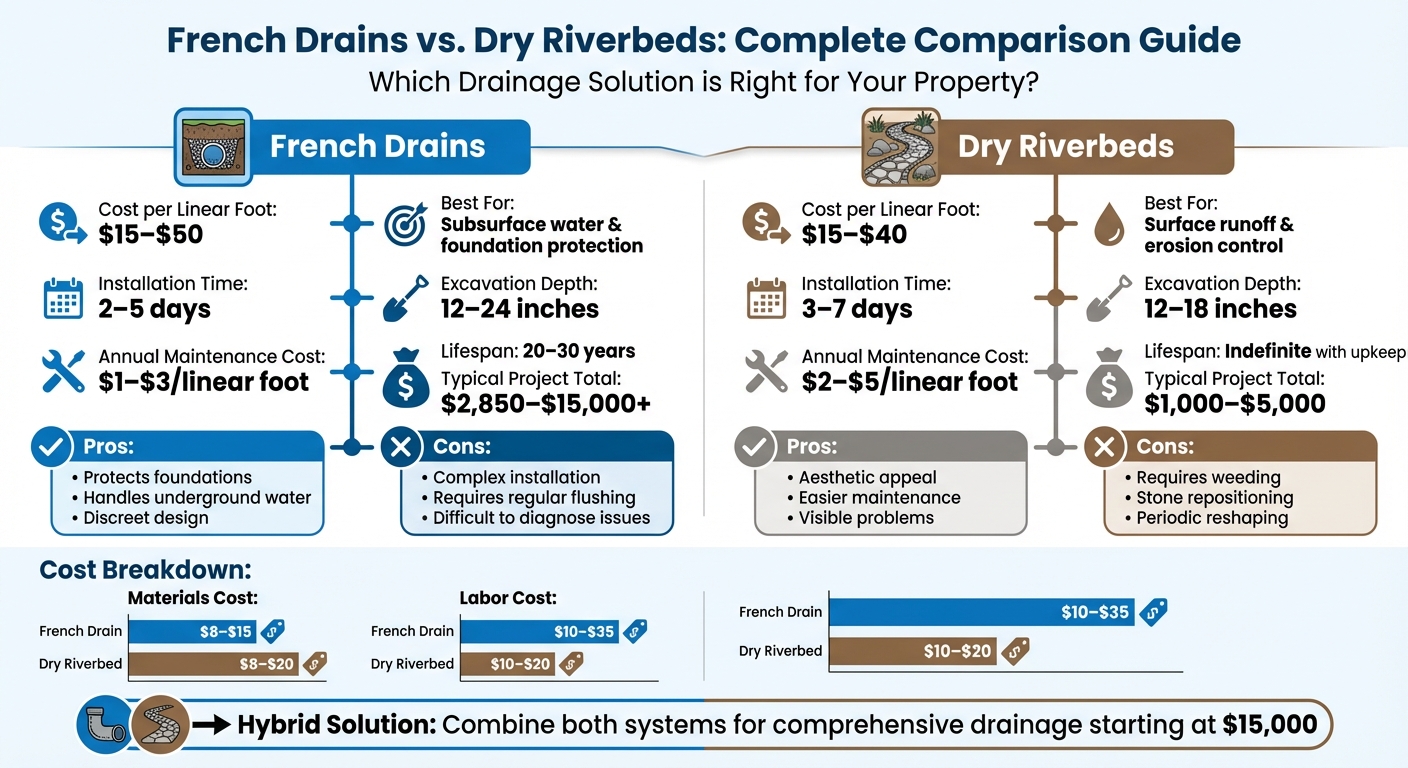
French Drains vs Dry Riverbeds Cost and Features Comparison
Difference Between French and Surface Drains – Jim Dutton
sbb-itb-843f8be
Cost Comparison: French Drains vs. Dry Riverbeds
The final cost for drainage solutions depends on materials, labor, and site-specific factors. Below is a detailed breakdown to help you compare French drains and dry riverbeds.
French Drain Costs
French drains are more complex than they might seem. They require perforated PVC or corrugated pipe, 3/4-inch clean drainage gravel, and geotextile filter fabric to keep soil from clogging the system. These materials alone cost about $8–$15 per linear foot[2].
Labor costs can be higher due to the need for 12–24-inch trenches with a 1% slope and the challenge of working around underground utilities. In areas like central Maryland, where heavy clay soil is common, excavation becomes even trickier and demands high-quality filter fabric[5].
"Typical cost: $2,850 – $15,000+ depending on length, depth, and materials." – Bob Carr, TLC Incorporated[5]
Professional installation generally ranges from $15–$50 per linear foot, with most projects landing between $4,000 and $5,000[2][3]. However, more intricate setups – like those involving sump pumps or extensive grading – can push costs beyond $15,000[3][5].
Dry Riverbed Costs
Dry riverbeds use a blend of materials, including large boulders (12–36 inches), medium stones (6–12 inches), river rock (2–6 inches), and either pea gravel or sand as a base[2]. Since decorative stone is pricier than standard gravel, material costs fall between $8–$20 per linear foot[2].
Labor costs are lower compared to French drains because the work is surface-level, averaging $10–$20 per linear foot. Installation typically takes 3–7 days, slightly longer than the 2–5 days needed for French drains[2].
"Dry creek beds are visible surface drainage features… typically costing $15-40 per linear foot." – Landscaping Expert, Crenshaw Landscaping[2]
Total professional installation for dry riverbeds comes to about $15–$40 per linear foot, with projects in central Maryland ranging from $1,000 to $5,000[5]. For homeowners wanting a polished design, professional landscaping to integrate the riverbed with the yard could add $200–$500[2].
Cost Comparison Table
| Cost Component | French Drain | Dry Riverbed |
|---|---|---|
| Materials (per linear foot) | $8–$15 [2] | $8–$20 [2] |
| Labor (per linear foot) | $10–$35 [2] | $10–$20 [2] |
| Total Installation (per linear foot) | $15–$50 [2] | $15–$40 [2] |
| Typical Project Total (Central Maryland) | $2,850–$15,000+ [5] | $1,000–$5,000 [5] |
| Installation Time | 2–5 days [2] | 3–7 days [2] |
| Excavation Depth | 12–24 inches [2] | 12–18 inches [2] |
In Maryland, heavy clay soil in counties like Howard and Montgomery can make French drains more labor-intensive and costly compared to the surface-level simplicity of dry riverbeds. These costs set the stage for the challenges that arise during installation, which will be addressed next.
Installation Process and Challenges
Installing a French Drain
The first step in installing a French drain is to contact local utility companies to mark any underground lines before digging begins[6]. After that, a trench is excavated – typically between 6 and 14 inches wide – with a slope of 1% to 2%, which translates to about a 2.5-inch drop for every 10 feet of length[6][8]. In areas like Maryland, where clay-heavy soil is common, spring is often the best time for this work because the soil is more manageable when saturated than during the dry summer months[7].
Once the trench is dug, a non-woven geotextile filter fabric (available in 4oz or 8oz varieties) is used to line it, ensuring soil does not clog the system over time[7][8]. A perforated pipe is then placed directly on the fabric at the bottom of the trench. Robert Sherwood, Owner of French Drain Man, emphasizes the importance of this placement:
"When people tell you, ‘Oh, put three, four inches of stone down, then put down your yard drain pipe,’ that’s bad information. Because you’re not going to get the water that’s laying in that stone that’s three inches underneath the yard drain pipe."[7]
The trench is then filled with 1.5-inch round rock or screened crushed stone. The fabric is folded over the top of the stone in what’s often called a "burrito wrap", fully enclosing the stone to prevent soil intrusion[7]. Finally, topsoil and grass seed are added, and a proper outlet – such as a pop-up emitter or dry well – is installed to prevent water from backing up[6][7][8].
For those seeking a less labor-intensive option, dry riverbeds provide a surface-level alternative.
Installing a Dry Riverbed
Dry riverbeds are simpler to install compared to French drains. The process involves creating a shallow path or a deeper stone well (2 to 3 feet deep) to allow water to seep into the ground[6]. The excavated area is then filled with layers of stones: large boulders (12 to 36 inches) form the base, medium-sized stones (6 to 12 inches) are added next, and the top is capped with river rock or pea gravel for a polished look[2][6].
Although the process involves fewer technical steps, it typically takes 3 to 7 days to complete, compared to the 2 to 5 days needed for French drains. This is largely due to the additional landscaping and aesthetic work required, such as carefully positioning heavy boulders for a natural appearance[2]. Dry riverbeds are particularly effective on sloped properties, where they help control runoff. However, they’re less useful on flat terrain, where water may have no natural path to flow[9].
For expert help adapting these solutions to Maryland’s unique soil and terrain, visit Pro Landscapes MD at https://prolandscapesmd.com.
Long-Term Performance and Maintenance Costs
Now that we’ve explored installation challenges, let’s dive into the long-term performance and upkeep expenses. Maintenance needs and costs vary significantly depending on the drainage system.
French Drain Maintenance
Subterranean French drains present unique challenges when it comes to maintenance. These systems, when professionally installed, can last 20 to 30 years before major components like pipes or fabric need replacing[2]. However, Maryland’s heavy clay soil can speed up sediment buildup inside the perforated pipes, requiring annual inspections and flushing to keep the system working efficiently. Maintenance costs typically range between $1 and $3 per linear foot[2].
Regular testing, especially after heavy spring rains or rapid snowmelt – both common in Maryland – is crucial[4]. Including cleanout ports during installation simplifies inspections and allows for high-pressure flushing without the need to dig up the trench[2]. Another challenge is root intrusion from nearby trees, which can block pipes. Addressing this requires professional snaking or chemical treatments[2].
"French drains are perfect for your yard if water pools around the foundation of your home, or if you’re worried about your basement flooding… [they are] highly effective for long-term water redirection." – TLC Incorporated[5]
Diagnosing issues with French drains can be tricky. Problems like deep clogs may not surface until water begins pooling near the foundation. Over time, sediment removal – typically required every 15 to 25 years – can involve costly re-excavation[2]. These factors can significantly influence the overall cost-effectiveness of the system.
Dry Riverbed Maintenance
Dry riverbeds, on the other hand, are much easier to maintain. Since everything is at ground level, problems are visible and straightforward to address. Annual upkeep costs are slightly higher than French drains, ranging from $2 to $5 per linear foot, due to the ongoing landscaping work required[2].
Maintenance involves clearing seasonal debris and silt to ensure proper water flow[2]. Weeds often grow between the stones, so regular weeding is necessary to preserve the riverbed’s appearance. Maryland’s freeze-thaw cycles can shift stones over time, requiring annual repositioning to keep the channel functional and aesthetically pleasing[2][4].
"Dry creek beds excel at combining functional drainage with beautiful landscape features… [but] require periodic cleaning of trapped debris." – Crenshaw Landscaping[2]
While dry riverbeds can last indefinitely, they need periodic "refreshing" to maintain both function and appearance. This includes replacing displaced stones, renovating edge plants every 3 to 7 years, and reshaping the channel every 10 to 15 years to prevent erosion from altering the water’s path[2][4][5]. Over time, these recurring costs can add up, setting dry riverbeds apart from French drains in terms of long-term maintenance.
Choosing the Right Drainage Solution
The best drainage solution depends on the specific water issues you’re facing – whether water collects underground, pools on the surface, or impacts your yard’s overall appearance.
When to Choose a French Drain
French drains are ideal for managing water that threatens your home’s foundation or accumulates underground. If you notice water pooling near your foundation or persistent moisture issues, a French drain can help redirect that water effectively [2][5]. This system is particularly useful in areas like Maryland, where clay-heavy soils make it difficult for water to naturally drain into the ground [5].
Homes with high water tables or crawl spaces prone to moisture benefit greatly from French drains, as they handle both surface and subsurface water at the same time [2][4]. Another advantage is their discreet design, which keeps your yard and garden beds intact while solving drainage problems [2].
When to Choose a Dry Riverbed
Dry riverbeds are an excellent choice for sloped properties, as they slow down water runoff and help prevent erosion [2][4]. If heavy rain causes water to rush down hillsides, washing away topsoil and forming gullies, a dry riverbed can reduce the flow and protect your landscape [4].
"As far as aesthetics go, the dry creek bed usually wins over a French drain." – Andrea Pejoska, O’Neill Landscape Group [1]
Beyond functionality, dry riverbeds add a decorative element to your yard, serving as a visually appealing feature while managing moderate water volumes [1][2]. For properties dealing with both surface and subsurface water issues, combining this system with a French drain creates a comprehensive solution.
Combining Both Systems
A hybrid system takes advantage of the strengths of both approaches. One common method uses a dry riverbed to capture surface runoff, which is then directed into a French drain to safely move water away from your home’s foundation [2][3].
"Many effective drainage systems combine both approaches strategically – using dry creek beds for aesthetic enhancement and moderate surface drainage while employing French drains for comprehensive groundwater management and foundation protection." – Crenshaw Landscaping [2]
For properties with both surface and subsurface water issues, a hybrid system can be a smart investment, starting at around $15,000. In this setup, the dry riverbed manages surface water and erosion, while the French drain handles foundation protection and subsurface drainage [2][4]. If cost is a concern, you can implement these systems in stages. Start with a dry riverbed for surface water control (typically $15 to $40 per linear foot), and add a French drain later when the budget allows (typically $15 to $50 per linear foot) [2].
Professional drainage experts can design custom solutions tailored to your property’s unique topography and soil conditions [2]. For example, Pro Landscapes MD offers drainage assessments across central Maryland, helping homeowners decide whether a standalone system or a combination is the best fit for their water management needs.
Conclusion
French drains are a solid choice for managing subsurface water, costing between $15–$50 per linear foot, especially effective in protecting foundations in clay-heavy soils. On the other hand, dry riverbeds handle surface runoff while boosting curb appeal, with installation costs ranging from $15–$40 per linear foot[2].
When it comes to upkeep, French drains typically require $1–$3 per linear foot annually, covering tasks like clearing clogs or maintaining discharge paths. Dry riverbeds, however, demand slightly more at $2–$5 per linear foot annually, largely for weeding and debris removal. Over a decade, this translates to total costs of around $150–$500 per linear foot for French drains and $150–$400 per linear foot for dry riverbeds[2]. These figures highlight the need for professional expertise, especially given Maryland’s unique soil and drainage challenges.
"There’s no one-size-fits-all drainage solution. The ‘best’ option depends on your soil, slope, budget, and long-term goals." – Bob Carr[5]
Key factors like proper grading, slope calculation, and thorough site evaluation are essential to avoid issues such as clogged pipes or poorly directed water discharge[3]. That’s why Pro Landscapes MD provides detailed drainage assessments across central Maryland. Their services include French drain installation, dry riverbed design, grading, and stormwater management solutions – all tailored to fit your property’s specific needs.
Whether you’re focused on protecting your foundation, controlling erosion, or both, a professional drainage assessment is the key to achieving long-term success and avoiding costly water damage.
FAQs
Can I DIY either option to save money?
While it’s tempting to tackle the installation of French drains or dry riverbeds on your own, it’s not a great idea unless you have the right expertise. Installing French drains involves precise trench digging, correctly placing pipes, and ensuring the slope is just right. Similarly, creating a dry riverbed demands careful planning and proper placement of materials to guide water effectively. Errors in either project can result in water damage or expensive fixes down the line. Hiring professionals ensures the job is done right the first time, offering peace of mind and saving money in the long run.
Where should the water drain to (street, dry well, pop-up)?
Water needs to flow toward a proper outlet, like a street, a dry well, or a pop-up emitter. The right choice will depend on your property’s drainage setup and local rules. Talking to a professional can help ensure everything is done correctly and efficiently.
How do I know if my problem is surface runoff or groundwater?
To figure out whether you’re dealing with surface runoff or groundwater, pay attention to how the water behaves. Surface runoff typically appears soon after rain or snowmelt, moving visibly across the ground and often collecting in low spots. On the other hand, groundwater issues involve water rising from below, leaving the soil constantly damp or soggy. Knowing the source is key to picking the right fix – like installing French drains for groundwater problems or creating dry riverbeds to manage runoff.
Chat with Us