









- bhavya gada
- No Comments
French drains and dry wells are two reliable solutions for managing water around your home’s foundation, especially in areas like Maryland with heavy rains and clay-heavy soil. Here’s the gist:
- French Drains: Redirect water using a sloped trench filled with gravel and a perforated pipe. Best for managing groundwater and hydrostatic pressure near basements. Costs range from $5,000–$15,000 and last 10–15 years.
- Dry Wells: Underground basins that collect and slowly disperse stormwater into the soil. Ideal for handling large roof runoff or sump pump discharge. Average cost is $3,000, with a lifespan of up to 30 years.
Quick Comparison
| Factor | French Drain | Dry Well |
|---|---|---|
| Function | Redirect water away from foundation | Collect and disperse water into soil |
| Best For | Groundwater, hydrostatic pressure | Roof runoff, sump pump discharge |
| Installation | Sloped trench with gravel/pipe | Deep basin or pit |
| Soil Type | Struggles in clay-heavy soil | Needs permeable soil (sandy/loamy) |
| Cost | $5,000–$15,000 | ~$3,000 |
| Lifespan | 10–15 years | Up to 30 years |
Choosing the right system depends on your soil type, drainage needs, and property layout. For Maryland homes, combining both systems can often provide the best protection against water damage.
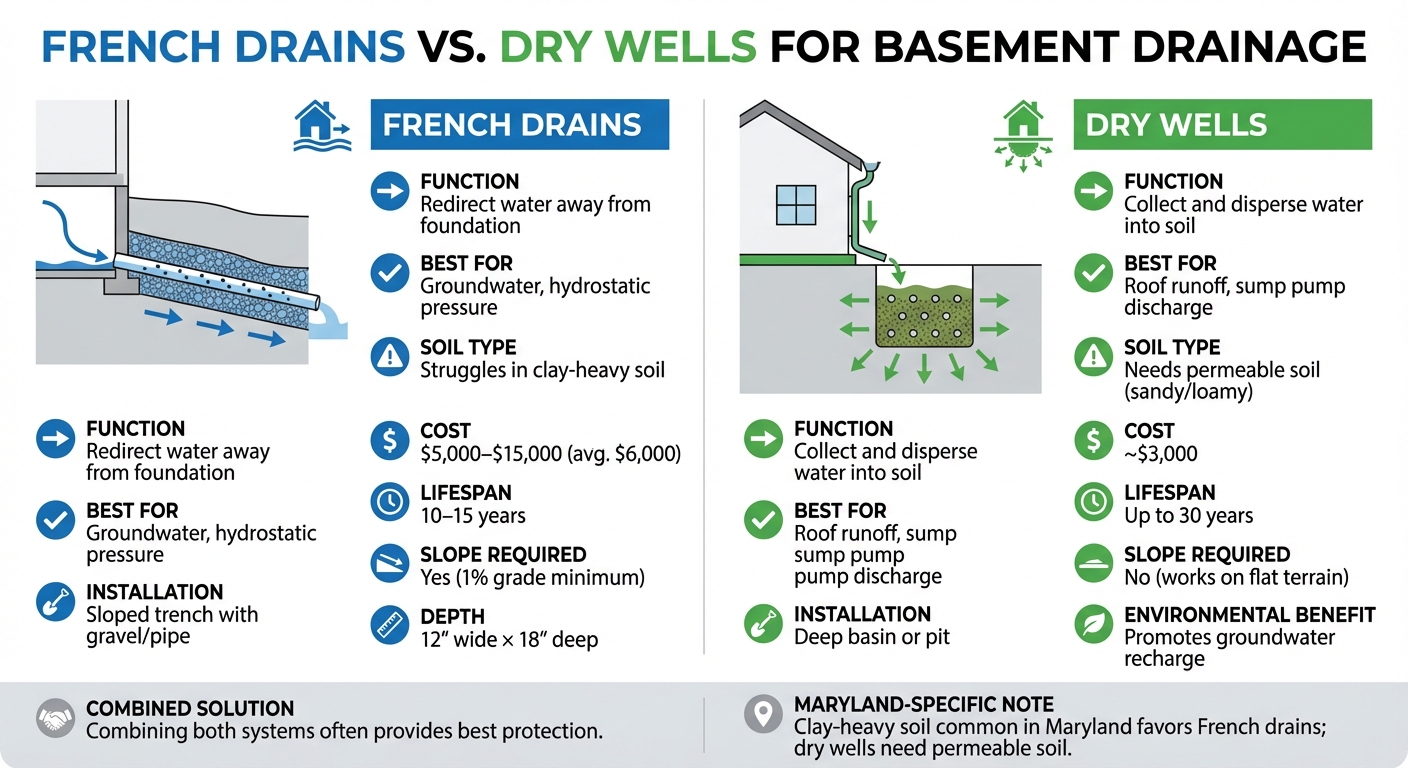
French Drains vs Dry Wells Comparison Chart for Basement Drainage
Dry Well or Sump Pump, Which Works Better with French Drain – DIY
sbb-itb-843f8be
What Are French Drains?
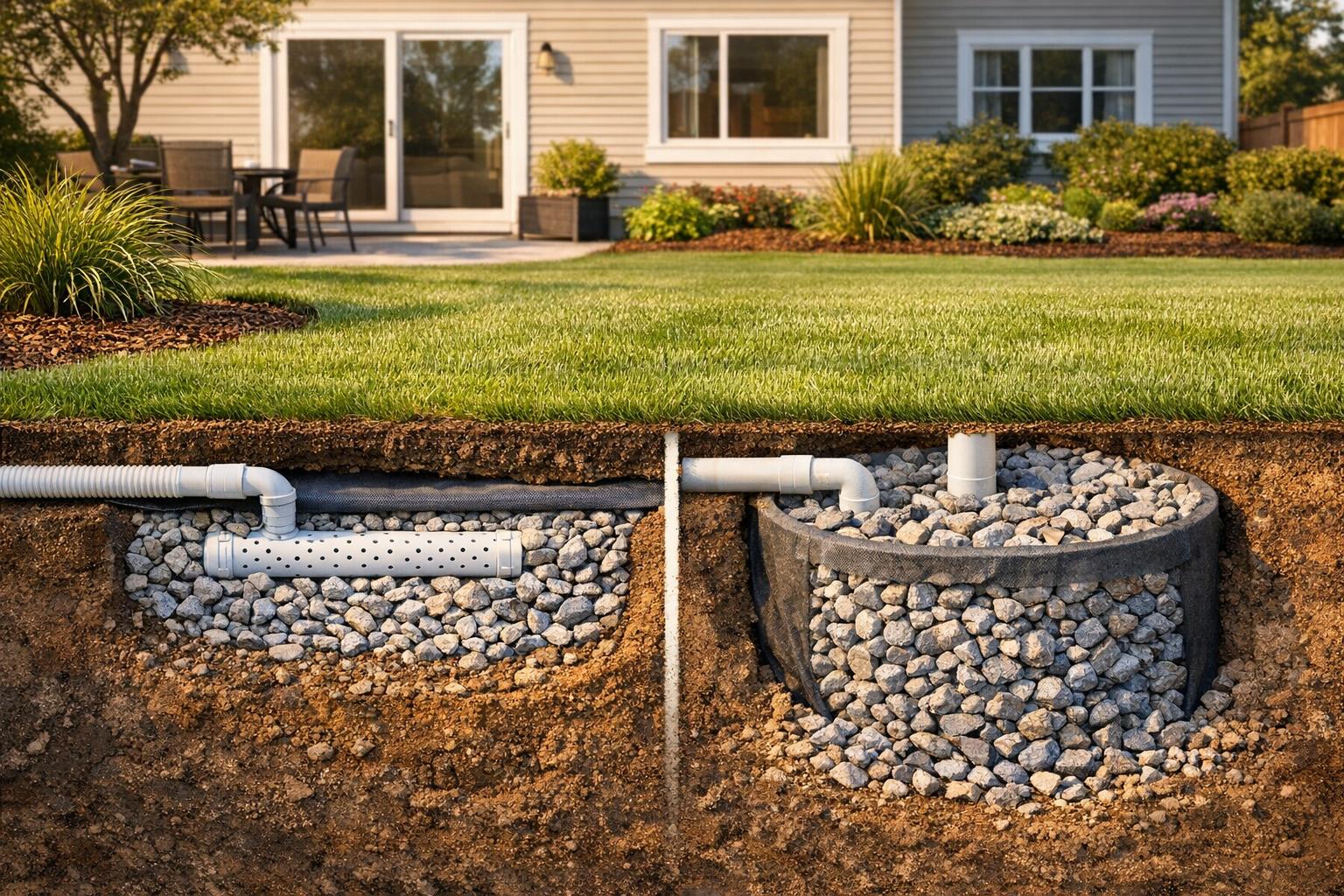
A French drain is an underground system designed to redirect both groundwater and surface water away from your property’s foundation. It works by intercepting water before it has a chance to reach your basement [4]. The system includes a sloped trench filled with washed gravel or stone and a perforated pipe (often called a weeping tile). To keep the system functioning over time, a layer of filter fabric is used to wrap the pipe or line the trench, preventing soil and silt from clogging the pipe. By understanding how these components come together, it’s easier to see how French drains effectively channel water away from your home.
How French Drains Work
Here’s how it all comes together: water seeps into the gravel-filled trench and enters the perforated pipe through small holes. From there, gravity takes over, guiding the water down the sloped trench to a designated discharge point, such as a storm drain, dry well, or a lower area on your property.
Exterior French drains are typically 12 inches wide and 18 inches deep, using a 4-inch perforated pipe with the holes facing downward. These systems are designed to catch water before it builds up pressure around your foundation. Interior French drains, on the other hand, are installed along the basement perimeter and capture water that has already infiltrated, channeling it to a sump pump for removal [1][3]. Both types of systems are effective at reducing the risk of basement flooding.
"Basement waterproofing is not about stopping water. It’s about managing where it goes." – Oriole Basement Waterproofing [3]
A French drain system usually lasts about 10 to 15 years. Installation costs vary based on factors like the size and complexity of the project, ranging from $5,000 to $15,000, with the average cost landing around $6,000 [5][4]. This makes French drains a reliable solution for protecting basements from water damage.
Common Uses for French Drains
French drains are particularly useful for managing water issues in basements. They’re ideal if your home experiences frequent flooding during heavy rains, water seeping through the joint where the walls meet the floor, or signs of moisture damage like mold, musty odors, or efflorescence (white, powdery mineral deposits) on concrete walls [3][4].
In addition, if you notice structural issues such as foundation cracks or bowing walls caused by water pressure, a French drain could help alleviate the problem [1][4]. For homes with exterior drainage issues, exterior French drains are a great option. However, for existing homes where digging around the foundation could disrupt landscaping, patios, or driveways, interior French drains offer an effective alternative [1][3].
What Are Dry Wells?
A dry well is an underground structure designed to collect and gradually disperse excess stormwater into the deeper layers of soil. Unlike French drains that guide water along a sloped path, dry wells act as storage basins, holding water temporarily before releasing it into the surrounding soil. These systems are typically made from large, perforated containers – constructed from plastic or concrete – or consist of a gravel- or stone-filled pit.
Water enters a dry well through various sources, such as gutters, downspouts, sump pump discharge lines, or drainage pipes from impervious surfaces like driveways and patios. Once inside, the water seeps out through the perforations and surrounding gravel into the soil below. This slow, controlled release prevents surface water pooling, minimizes erosion, and helps recharge groundwater. Additionally, dry wells reduce the burden on municipal sewer systems, making them an effective tool for managing stormwater in Maryland homes. They often work alongside other drainage solutions to provide comprehensive water management.
Dry wells are typically installed in low-lying areas of a property, away from the home’s foundation to avoid water damage. When properly maintained, these systems can last up to 30 years – double the lifespan of most French drain systems, which average 10–15 years. Installation costs for a dry well are about $3,000 on average, which is roughly half the cost of a French drain system.
How Dry Wells Work
Dry wells function by collecting water through connected pipes and storing it in a perforated basin. The water then slowly seeps through the basin’s holes and the surrounding gravel into the soil. This gradual dispersion prevents hydrostatic pressure from building up against basement walls, reducing the risk of water seepage.
The type of soil surrounding the dry well is crucial to its performance. Sandy or loamy soils, which absorb water quickly, are ideal for ensuring efficient drainage. On the other hand, heavy clay soils can limit water infiltration, potentially reducing the effectiveness of the system. For this reason, testing the soil’s absorption rate before installation is a smart step. This controlled infiltration process makes dry wells particularly suitable for handling large amounts of stormwater runoff.
Common Uses for Dry Wells
Dry wells are especially effective for managing stormwater runoff from roofs during heavy rains. They also serve as discharge points for basement sump pumps and can handle overflow from irrigation systems. For homes with significant roof runoff or frequent sump pump activity, a dry well provides a practical solution.
These systems are also great for managing water accumulation on impervious surfaces like driveways and patios. Because they are installed underground, dry wells remain out of sight, maintaining the property’s appearance. Some homeowners even combine a French drain to collect surface water with a dry well to ensure efficient infiltration of excess water.
French Drains vs. Dry Wells: Key Differences
French drains and dry wells both help manage water, but they work in entirely different ways. Think of French drains as underground gutters – they intercept water and guide it away from your foundation through a sloped trench system [4]. Dry wells, in contrast, collect water and allow it to seep vertically into the deeper layers of soil [6]. Let’s break down how these systems differ in terms of water management, installation, and soil compatibility.
Water Types They Handle
French drains are great for dealing with groundwater, surface pooling, and reducing hydrostatic pressure against basement walls [4]. On the other hand, dry wells shine when it comes to handling large amounts of stormwater runoff, like what you’d get from roof downspouts or sump pump discharge lines [6]. This distinction is especially important in areas like Maryland, where spring rains and winter thaws can cause unique drainage issues.
Installation Differences
The way these systems are installed also sets them apart. French drains rely on gravity, meaning they need a consistent downward slope to work effectively [5]. Typically, they involve shallow trenches that are anywhere from a few inches to 18 inches deep [7]. Dry wells, however, don’t require sloped terrain. Instead, they rely on vertical infiltration and need a larger, deeper excavation to create a basin that can hold and disperse water [7].
Soil Compatibility
Soil type plays a huge role in how well these systems perform. French drains can struggle in clay-heavy soils because such soils don’t drain well – a common issue in parts of Maryland. Dry wells, on the other hand, need highly permeable soils like sandy or loamy types to work efficiently [5]. Testing your soil’s absorption rate before installation can help prevent costly failures.
Comparison Table: French Drains vs. Dry Wells
| Factor | French Drain | Dry Well |
|---|---|---|
| Primary Function | Redirects water away from the foundation | Collects and infiltrates water into the soil |
| Best For | Groundwater and hydrostatic pressure | Stormwater runoff from roofs and downspouts |
| Installation | Trenching with perforated pipe and gravel | Deep excavation for a basin or pit |
| Soil Requirement | Less effective in clay-heavy soils | Needs permeable (sandy/loamy) soil |
| Slope | Requires downward grading | Can work on flat terrain |
| Longevity | 10–15 years | Up to 30 years |
| Average Cost | $6,000 (up to $15,000) | ~$3,000 |
| Environmental Impact | Moves water away from the site | Promotes groundwater recharge |
Each system has its strengths, but understanding these differences can help you choose the right solution for your specific drainage needs. Whether you’re dealing with pooling water around your foundation or trying to manage heavy runoff, picking the right system is crucial for long-term success.
Pros and Cons of French Drains
French drains are a practical way to manage water around your home, especially when dealing with hydrostatic pressure near foundation walls. By redirecting water, they help reduce seepage, control groundwater, and prevent surface pooling and basement flooding [3][4][1]. One of the standout benefits of interior French drains is that they can be installed year-round, even during winter, without disturbing landscaping, driveways, or patios [3]. As Oriole Basement Waterproofing explains, "An internal french drain is a less disruptive, often more cost-effective solution for existing homes, especially when exterior excavation is impractical or undesirable" [3]. Additionally, these systems can lower basement humidity levels, which not only improves indoor air quality but also helps minimize the risk of mold growth [1].
However, French drains aren’t without their downsides. They tend to be more expensive and have a shorter lifespan compared to dry wells. Regular maintenance is also a must – clogs caused by silt, sediment, or vegetation can compromise their effectiveness [5].
Performance-wise, these systems rely on gravity, which means they need a consistent downward slope to work correctly [1][4]. Poor grading can cause the entire system to fail. They’re also less effective in clay-heavy soils, a common issue in areas like Maryland [5]. Another potential challenge is finding a proper discharge point, such as a municipal storm drain, a dry well, or a naturally lower part of your property. Without an appropriate outlet, the system may not function as intended [1][7].
The installation process can be invasive, requiring trenches that are typically at least 12 inches wide and 18 inches deep [1]. If you’re planning to finish your basement, it’s crucial to install a French drain beforehand to protect your investment in flooring and drywall from future water damage [4]. For added reliability, connecting the French drain to a sump pump with a battery backup ensures it continues working during power outages [3][4].
Pros and Cons of Dry Wells
Dry wells come with several benefits for managing basement water issues. They efficiently handle stormwater runoff from roofs, driveways, and gutters by directing water deep into the soil, which helps reduce hydrostatic pressure on basement walls [7][6]. With a lifespan of up to 30 years – double that of French drains – and an average cost of $3,000 (compared to $6,000 for French drains), they’re a cost-effective option [5]. Since they are installed underground, they don’t disrupt the landscape visually [5]. Additionally, dry wells encourage groundwater recharge by letting water naturally seep into the local water table, helping ease the burden on municipal sewer systems [5].
However, dry wells also have their limitations. They work best in sandy or loamy soils with good permeability and struggle in clay-heavy soils, which are common in areas like Maryland [5][2]. In cases of heavy rainfall, they can be overwhelmed if the water volume exceeds their capacity or if the soil doesn’t absorb water quickly enough [5]. Unlike French drains, which redirect water immediately, dry wells depend on slower infiltration into the surrounding soil [5][6]. Regular maintenance is crucial to prevent clogging [5]. Installing a dry well requires significant excavation to create a deep pit for the basin and gravel [7], and placement is key – it must be far enough from the foundation to avoid water pooling near the house [5].
To get the most out of a dry well, it’s important to test your soil’s permeability before installation. Keeping gutters and downspouts free of debris like leaves and silt can help prevent sediment from clogging the system [5]. For more complex drainage needs, you might combine a French drain to collect water near the foundation with a dry well as the final discharge point [5][6].
When to Choose French Drains for Basement Protection
French drains are a practical solution for managing groundwater and easing hydrostatic pressure – the force of water pressing against your foundation walls. If you’ve noticed a white, powdery residue called efflorescence on your basement walls, it’s a sign that water is seeping through and evaporating, leaving behind mineral deposits. Addressing this moisture early is crucial to avoid potential structural issues.
Homes with high water tables are particularly well-suited for French drains. When water rises through the basement floor or leaks through the joint where the wall meets the floor, a French drain steps in to intercept and redirect it. The goal isn’t to stop water entirely but to control its flow. Homes situated on a natural slope are especially ideal for this system, as gravity assists in channeling water to a safe discharge point – whether that’s a storm drain or a lower area of the property. For effective drainage, the system should be installed with at least a 1% grade, meaning a 1-inch drop for every 10 feet of pipe [8].
Interior French drains are a great option for existing homes, particularly when exterior excavation would disrupt established landscaping or when water is already entering at the floor-wall joint. If you’re planning to finish your basement, installing an interior French drain beforehand can help protect your investment from water damage. On the other hand, exterior French drains are designed to stop water before it even reaches your foundation, making them ideal for areas prone to pooling surface water during heavy rains.
To maximize your French drain system, it’s important to ensure proper installation. Direct the drain toward a sump pit equipped with a reliable pump and a battery backup to keep it operational during power outages. Professionally installed French drains typically last 10 to 15 years and can cost anywhere from $5,000 to $15,000 [4] [5]. In states like Maryland, where spring rains and winter thaws frequently challenge basement integrity, French drains offer a dependable way to manage unpredictable weather and protect your home. Choosing the right setup for your specific conditions is key to keeping your basement dry and secure.
When to Choose Dry Wells for Basement Protection
Dry wells work best in sandy or highly permeable soils that allow water to disperse quickly [2][5]. If your property has clay-heavy soil, it’s worth consulting a professional for a proper soil assessment, as clay can significantly limit the system’s effectiveness [6][7].
Space limitations are another reason to consider dry wells. Unlike French drains, which require long, sloped trenches that stretch across your yard, dry wells are compact, vertical systems installed underground, often in low-lying areas away from your home’s foundation [5]. Their discreet design makes them ideal for smaller yards and helps maintain the overall appearance of your landscaping. If your property is flat and lacks the natural slope needed for a gravity-fed drainage system, a dry well can still handle water efficiently without depending on a consistent downward incline [5].
Dry wells are particularly effective at managing sudden, heavy runoff from sources like roof downspouts, gutters, and sump pump discharge lines [5]. For example, during Maryland’s intense spring storms, a dry well can capture large amounts of water before it pools near your foundation. This makes it a reliable choice for protecting your basement from water damage. If you don’t have access to a municipal storm drain or a lower area for water to flow, a dry well serves as a self-contained solution, dispersing water deep into the ground [5][7].
In addition to handling high-volume runoff, dry wells are cost-effective and built to last. While regular maintenance – like clearing debris from gutters and pipes – is essential to prevent clogging, the system offers long-term benefits. It also helps recharge groundwater and reduces the strain on local sewer systems, making it a practical and environmentally friendly option [5].
Combining French Drains and Dry Wells
In Maryland, pairing French drains with dry wells is an effective way to protect your basement from water damage. Here’s how it works: the French drain collects and redirects water – whether it’s surface runoff or groundwater – away from your foundation. That water is then sent to a dry well, which is essentially an underground, gravel-filled basin. The dry well allows the water to slowly seep into the deeper soil layers. This method is particularly useful for properties without a natural slope or access to a municipal storm drain, as it efficiently handles both surface and stormwater runoff by moving water away from the foundation and into a dedicated storage area.
For the system to work properly, the French drain needs to have a consistent downward slope, and the dry well should be placed at least 10 feet away from the foundation to avoid any risk of water backflow. You can also connect multiple water sources – like gutter downspouts or sump pump discharge lines – to a single dry well for a centralized drainage solution.
As with any drainage system, a thorough site assessment is key. Before installing a combined setup, it’s important to have a professional evaluate your soil’s ability to absorb water. The dry well relies on soil that can handle water absorption quickly enough to prevent overflow, especially during Maryland’s heavy spring rains or winter thaws. Homeowners can expect to pay between $8,000 and $20,000 for a comprehensive setup that includes both systems, but the added protection is well worth the investment compared to using either system on its own [9][10].
Factors to Consider for Your Maryland Property
Protecting your basement in Maryland starts with understanding the region’s specific drainage needs. In areas like Montgomery, Prince George’s, and Baltimore Counties, the soil often contains a lot of clay. This type of soil doesn’t absorb water well, making a French drain a smart choice. French drains channel water to a designated discharge point instead of depending on the soil to soak it up. On the other hand, dry wells are better suited for properties with permeable soils, as they disperse water more effectively in such conditions[5].
The slope of your property is another key consideration. French drains work best when there’s a steady downward grade, as they rely on gravity to move water. If your yard is flat, dry wells can still be a good option, provided the deeper soil layers allow for quick drainage. A professional soil test can be incredibly helpful here, as soil conditions can vary greatly – even within the same neighborhood[5].
Maryland’s weather also plays a big role. The state experiences intense thunderstorms, heavy seasonal rains, and freeze-thaw cycles, all of which can worsen basement water problems. When water pressure builds up against your foundation, a French drain often does a better job of keeping moisture from seeping into your basement. For handling large amounts of surface runoff – like water from gutters, downspouts, or driveways during a storm – a dry well can be a practical solution[6].
Cost and maintenance are also important factors to weigh. French drains typically cost between $5,000 and $15,000 and last around 10–15 years. Dry wells, on the other hand, are more affordable, averaging about $3,000, and can last up to 30 years[5].
If you’re unsure which option is best for your property, you can turn to the experts at Pro Landscapes MD. Their team specializes in assessing local soil conditions, grading, and water management issues to recommend the right solution – whether it’s a French drain, a dry well, or a combination of both. With their knowledge of local regulations and drainage systems, they can help you keep your basement dry and protected all year long.
Conclusion
Both French drains and dry wells bring distinct benefits when it comes to managing water around your basement. French drains are excellent at channeling groundwater away from your foundation, reducing hydrostatic pressure and helping to safeguard the structural integrity of your home. On the other hand, dry wells are designed to handle large amounts of stormwater, dispersing it deep into the ground. Often, the best solution combines the strengths of both systems for a more thorough approach to water management.
Understanding the technical details can make your decision easier. In Maryland, where clay soils are common, French drains tend to perform better, while dry wells are more effective in sandy, highly permeable soils. French drains require a steady downward slope to work properly, while dry wells can function even on relatively flat ground. Cost and longevity also differ: French drains generally require a bigger upfront investment and have a shorter lifespan, whereas dry wells are typically more durable and less expensive to install. Consulting a professional is key to identifying the right solution for your specific property.
"There is never a one-size-fits-all solution that will guarantee the same results for everyone. Every home is different, which means the solution that works best for you might differ from the solution that works for your friends down the road." – Drycrete Waterproofing [7]
Choosing the wrong drainage system can lead to serious issues like foundation cracks, basement flooding, and mold growth – problems that can be both stressful and expensive to fix. That’s why a professional evaluation is so important. Pro Landscapes MD specializes in assessing Maryland properties to recommend the most effective drainage solution, whether it’s a French drain, a dry well, or a combination of both. With their expertise in local soil conditions, grading, and regulatory requirements, they can help ensure your basement stays dry and your foundation remains secure for years to come.
FAQs
What’s the difference between a French drain and a dry well for basement drainage?
French drains and dry wells tackle water management in distinct ways, making each better suited for specific scenarios. A French drain is essentially a trench filled with gravel and a perforated pipe designed to collect and redirect water away from your property. This system excels in areas with clay-heavy soil or high water pressure, as it efficiently channels water to a sump pump or a lower-lying section of your yard.
A dry well, by contrast, is an underground pit or chamber filled with gravel. Its purpose is to collect excess water and allow it to gradually seep into the surrounding soil. Dry wells are most effective in sandy or well-draining soils and are often used to handle runoff from gutters or sump pumps. They’re generally a more cost-effective choice but do require occasional maintenance to prevent clogging.
To sum it up, French drains actively carry water away, while dry wells temporarily store water and let it soak into the ground. The right choice depends on your soil conditions, drainage requirements, and budget.
How can I tell if a French drain or dry well is better for my soil?
To figure out whether a French drain or a dry well is the right choice for your soil, you can start with a simple percolation (perc) test. Here’s how: dig a hole about 12 inches deep and 6 inches wide, fill it with water, and time how long it takes for the water level to drop by one inch. If it takes 30 seconds or less, your soil is highly permeable – likely sandy or loamy – making it well-suited for a dry well. On the other hand, if it takes 10 minutes or more, the soil drains slowly, such as clay or heavy silt, which usually makes a French drain the better fit.
You can also get a sense of your soil type by touch. Gritty, crumbly soil typically indicates sand, while sticky, smooth soil that forms ribbons when squeezed points to clay. For example, in Maryland, clay-heavy soil is common, so French drains are often more effective there. In contrast, sandy regions are more likely to benefit from dry wells. If you’re still unsure, a professional assessment – like those provided by Pro Landscapes MD – can help determine the best drainage solution for your specific needs.
Can I use French drains and dry wells together for better basement drainage?
Yes, French drains and dry wells can be used together to create a more efficient drainage system. A French drain channels water away from your basement or other problem areas, while a dry well provides a designated spot for that water to seep back into the ground. By combining these two methods, you can handle excess water more effectively and reduce the risk of moisture-related problems in your home. This setup is particularly helpful in regions with heavy rain or soil that doesn’t drain well.
Chat with Us