









- bhavya gada
- No Comments
Struggling with water pooling around your patio? You’ve got two main drainage options: French drains and dry wells. Each tackles water issues differently, and the right choice depends on your soil, slope, and budget.
- French Drains: Redirect water using a sloped trench filled with gravel and a perforated pipe. Ideal for sloped areas or managing surface and groundwater. Costs ~$6,000 and lasts 10–15 years.
- Dry Wells: Collect and disperse water into the soil via a gravel-filled pit or container. Best for flat areas with sandy or loamy soil. Costs ~$3,000 and lasts up to 30 years.
Key Factors:
- Soil: French drains work in various soils; dry wells need permeable soil.
- Slope: French drains need a 1% grade; dry wells suit flat terrain.
- Water Source: French drains handle pooling; dry wells manage runoff.
Quick Comparison:
| Feature | French Drain | Dry Well |
|---|---|---|
| Water Management | Redirects water | Infiltrates water |
| Soil Requirement | Versatile | Permeable soil only |
| Slope Needed | 1% grade | None |
| Cost | ~$6,000 | ~$3,000 |
| Lifespan | 10–15 years | Up to 30 years |
Pro Tip: Combine both systems for complex drainage issues. French drains redirect water into a dry well for controlled dispersal.
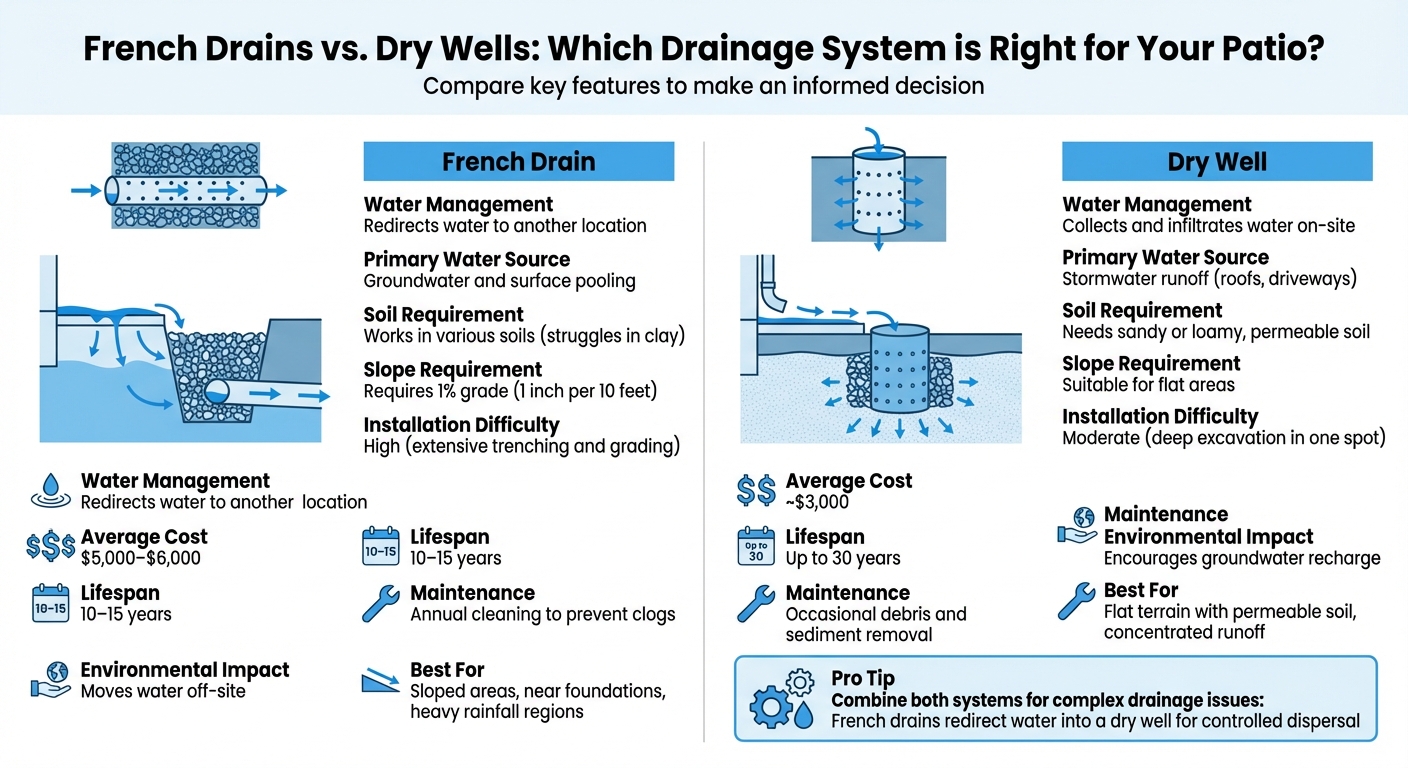
French Drains vs Dry Wells Comparison Chart for Patio Drainage
What is a French Drain?
A French drain is a type of underground drainage system designed to redirect surface and groundwater away from areas prone to pooling, such as patios and building foundations. It consists of a sloped trench filled with gravel or rock and a perforated pipe that guides water to a safe discharge point, like a storm drain or dry well [1][3].
Typically, a French drain trench measures 12 inches wide and 18–24 inches deep [4][5]. Inside the trench, a 4-inch perforated pipe – commonly made of rigid PVC or corrugated plastic – is surrounded by gravel with particles measuring at least 3/4 inch (often granite or river gravel). The system is lined with non-woven geotextile fabric (usually 4–6 ounces) to prevent soil and debris from clogging the pipe [4][5].
How French Drains Work
French drains rely on gravity to move water efficiently. Water seeps through the gravel layer and enters the perforated pipe at the bottom of the trench. From there, the pipe directs the water to a discharge point, such as a storm drain, a dry well, or a lower area on the property [1][3].
For the system to work effectively, the trench must have a minimum 1% slope – an incline of approximately 1 inch for every 8–10 feet of pipe. Without this slope, water may stagnate instead of flowing out. The pipe is installed with its perforations facing downward, allowing water to enter from below as the trench fills [3][4][5]. This straightforward yet efficient design ensures proper drainage and sets the stage for determining when a French drain is the right solution.
When to Use French Drains
French drains are particularly useful for properties with slopes where water tends to flow toward patios or other vulnerable areas, creating pooling issues. They are also highly effective in regions with frequent or heavy rainfall, as they can handle large volumes of water with ease.
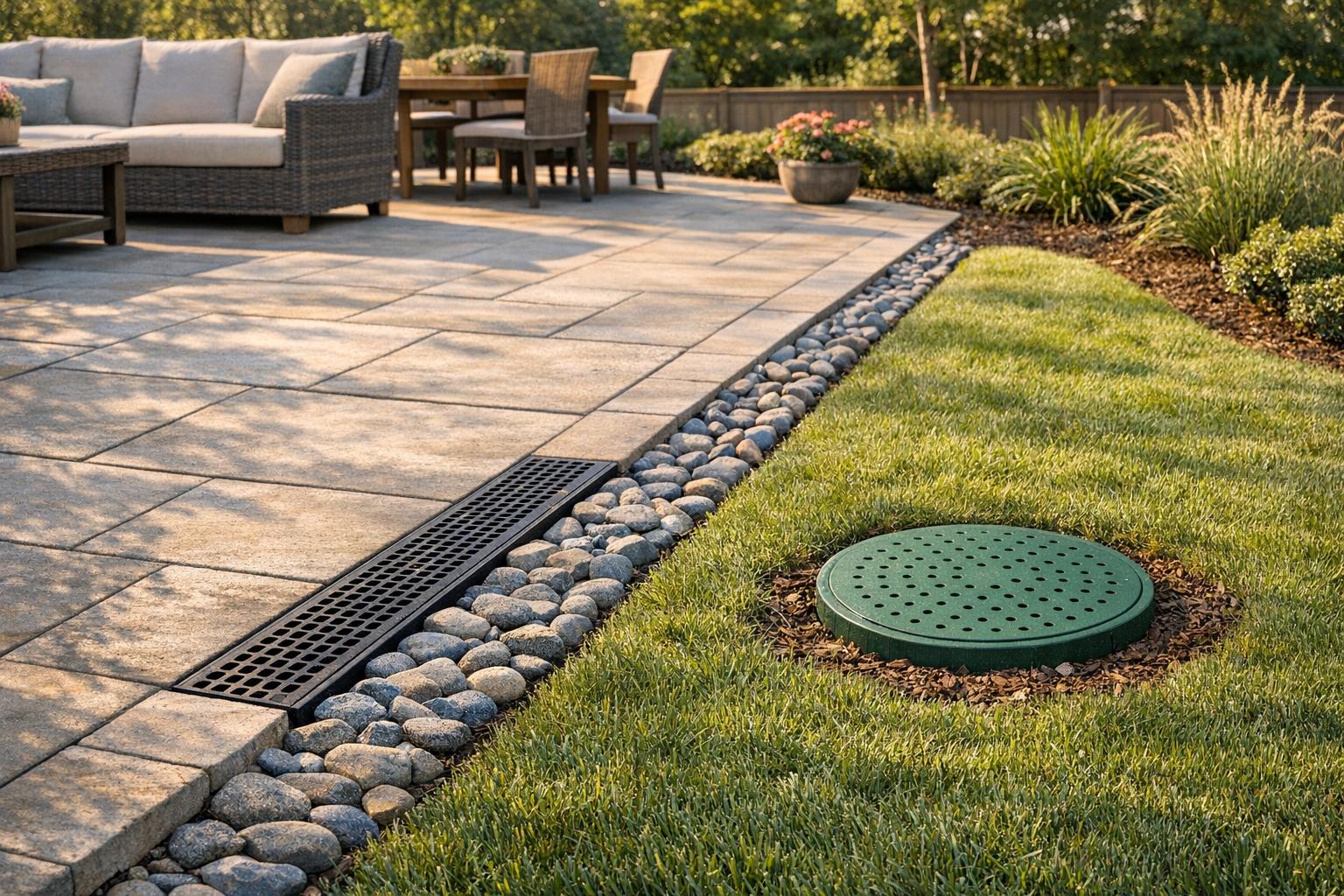
If you’re dealing with hydrostatic pressure – where water pushes against a patio or foundation wall – a French drain can help alleviate this pressure, reducing the risk of cracks or structural damage [3][4]. For patios, shallower systems, often referred to as "channel drains" or "trench drains", can be installed to capture surface runoff before it collects on the hardscape [5].
The cost of professional installation typically ranges from $25–$40 per linear foot, while a DIY approach using basic materials costs around $10–$15 per linear foot [4].
What is a Dry Well?
A dry well is an underground system designed to manage stormwater runoff from areas like patios, roofs, and driveways by allowing water to soak into the surrounding soil. These wells are typically constructed as gravel-filled pits or as prefabricated containers with perforated walls. Unlike French drains, which direct water away from specific areas, dry wells temporarily hold water and let it seep into the ground at a controlled rate [2].
For residential use, a dry well is usually 2 to 4 feet wide and about 3 feet deep [6]. This compact size makes it ideal for homes, in contrast to the longer and more linear design of French drains. Water is directed into the well via pipes connected to gutters, downspouts, or other drainage channels. Once inside, the water slowly escapes through the perforations or gravel, making it a great option for handling runoff from surfaces like driveways or roofs.
When properly maintained, a dry well can last up to 30 years and typically costs around $3,000 to install [2]. Since they are installed entirely underground, they are often called "invisible" drainage systems, blending seamlessly into the landscape without disrupting its appearance.
How Dry Wells Work
Dry wells work by collecting water and letting it gradually seep into the soil. Water flows into the well through pipes that should have a 1% grade drop – this means a 1-inch decline for every 10 feet of pipe – to ensure smooth water movement [3]. The perforated walls or gravel inside the well allow the water to slowly disperse into the surrounding earth. This process not only reduces stormwater runoff entering municipal sewer systems but also helps recharge groundwater levels [2]. However, the system’s efficiency depends on the soil’s ability to absorb water.
When to Use Dry Wells
Dry wells are especially useful in flat areas with soil that absorbs water well, such as sandy or loamy soils. They aren’t as effective in heavy clay soils, which can hinder water infiltration. These systems are best placed in low-lying spots where water tends to accumulate, but they should be positioned far enough from building foundations to prevent seepage issues.
Before installing a dry well, it’s essential to check local building codes for specific size and placement requirements. Additionally, you’ll need to locate any underground utility lines before digging. To prevent sediment buildup, consider lining the well with landscape fabric before filling it with gravel [6]. This preparation ensures the system remains efficient over time.
French Drains vs. Dry Wells: Key Differences
French drains and dry wells tackle patio drainage in distinct ways. A French drain is a horizontal trench system that uses a perforated pipe surrounded by gravel to channel water away from problem areas, typically to a storm drain or lower elevation [2]. On the other hand, a dry well is a vertical system designed to collect water and gradually let it seep into the ground [2].
The main difference lies in how these systems manage water. French drains rely on gravity and require a slight slope (about 1%) to move water, making them ideal for sloped areas [3]. Dry wells, however, focus on vertical infiltration, making them better suited for flat areas where water tends to pool [2].
Soil type is another critical factor. French drains work in various soil conditions but can struggle in heavy clay soils [2]. Dry wells, in contrast, need highly permeable soils, like sandy or loamy types, to function effectively [2]. In areas with poor drainage, such as those with clay-heavy soil, water may collect in a dry well rather than soaking into the ground.
Cost and lifespan also set these systems apart. Dry wells, which cost around $3,000 to install, can last up to 30 years with proper maintenance [2]. French drains, while more expensive – averaging $5,000 to $6,000 – have a shorter lifespan of 10 to 15 years [2][3]. However, French drains can manage a wider range of water sources, including both groundwater and surface pooling. Dry wells, on the other hand, are specifically designed to handle stormwater runoff, such as water from roofs or driveways.
Here’s a quick breakdown of their differences:
Comparison Table
| Feature | French Drain | Dry Well |
|---|---|---|
| Water Management | Redirects water to another location | Collects and infiltrates water on-site |
| Primary Water Source | Groundwater and surface pooling | Stormwater runoff (e.g., roofs, driveways) |
| Soil Requirement | Works in various soils but struggles in clay | Needs sandy or loamy, permeable soil |
| Slope Requirement | Requires a 1% grade [3] | Suitable for flat areas |
| Installation Difficulty | High (extensive trenching and grading) | Moderate (deep excavation in one spot) |
| Average Cost | $5,000–$6,000 [2][3] | ~$3,000 [2] |
| Lifespan | 10–15 years [2] | Up to 30 years [2] |
| Maintenance | Annual cleaning to prevent clogs | Occasional debris and sediment removal |
| Environmental Impact | Moves water off-site | Encourages groundwater recharge |
Both systems have their strengths, but choosing the right one depends on your site’s slope, soil type, and water management needs.
Pros and Cons of Each System
Let’s dive into the strengths and weaknesses of each system and how they address water management challenges.
French Drain: Strengths and Weaknesses
French drains are excellent for quickly redirecting both groundwater and surface water away from areas like foundations, basements, and waterlogged patios. This helps minimize structural damage and controls erosion effectively [1][2]. They’re also quite flexible in terms of placement – you can install them at various spots on your property, whether it’s higher ground, near a foundation, or alongside driveways. Plus, they can blend into your landscaping with decorative gravel or other design elements, making them a subtle addition [1][2].
On the downside, French drains come with a hefty price tag, with costs averaging around $6,000 and sometimes reaching as high as $13,000. They also require regular maintenance to prevent sediment buildup, which can clog the system. Their lifespan is relatively short too – typically only 10 to 15 years. If your property has clay-heavy soil, the system’s efficiency can also take a hit, as water movement becomes more restricted [1][2].
Dry Well: Strengths and Weaknesses
Dry wells offer a different solution, and they come with their own set of benefits. They’re more budget-friendly, costing around $3,000, and can last up to 30 years if maintained properly. Once installed, they stay out of sight and manage stormwater runoff efficiently while also helping to replenish groundwater [2].
That said, dry wells have their own challenges. They need permeable soil to work effectively, which limits their use in certain areas. During heavy rainfall, they can overflow, and periodic debris removal is necessary to keep them functioning. Additionally, they must be installed at a safe distance from a building’s foundation to avoid any potential issues [2].
sbb-itb-843f8be
How to Choose the Right Drainage System
Picking the right drainage system for your patio hinges on two main factors: the type of soil and the slope of your site. You’ll need to assess these conditions carefully to strike a balance between performance, cost, and maintenance.
Soil Type and Site Layout
Start by evaluating your soil’s permeability. If your soil is sandy or loamy, a dry well might be a good option since these soils allow water to drain efficiently. However, if your soil is heavy with clay, a dry well may struggle to keep up during heavy rainfall, leading to overflow [2]. In such cases, a French drain could be a better fit. French drains are versatile and can redirect water to a lower exit point or a storm drain, even in denser soils [2].
Slope is another critical factor for French drains. As Kamron Sanders explains:
A crucial requirement for a French drain is the correct slope. You need at least a 1 percent grade drop – meaning a 1-inch decline over every 10 feet – for the drain to work properly [3].
If your patio is on flat terrain and this slope isn’t achievable, a dry well could be the more practical choice. Alternatively, you might consider a system equipped with a sump pump for areas without natural slope.
The source of water also influences your decision. French drains are excellent for handling widespread surface water and groundwater pooling, while dry wells are better suited for managing concentrated runoff from downspouts, roofs, or other impervious surfaces [2]. If both surface pooling and concentrated runoff are issues, combining systems – using a French drain to collect surface water and directing it into a dry well for underground dispersal – can be an effective solution [2].
Cost and Installation
The price tag for these systems can vary significantly. A professionally installed French drain typically costs around $6,000, though this can rise to $13,000 depending on the size and complexity of the project [2][3]. Dry wells, on the other hand, are often more affordable, with professional installation averaging around $3,000 [2].
For those considering a DIY approach, the materials for a 10-foot section of perforated pipe – along with aggregate and mesh fabric – cost about $80. Renting a mini excavator will add approximately $300 per day to your expenses [3]. Keep in mind, both systems require careful excavation and precise installation. Poor grading or improper placement can significantly reduce effectiveness.
Maintenance Needs
Maintenance is another key factor to weigh when selecting a drainage system. French drains typically require more upkeep. You’ll need to clean them annually with a pressure washer or drain snake to prevent clogs from sediment and roots. They also have a lifespan of about 10 to 15 years, so regular inspections and eventual replacement are necessary [2][3].
Dry wells, on the other hand, are generally easier to maintain. Periodically clearing debris and sediment from intake points like gutters or grates will keep them functioning smoothly. With proper care, dry wells can last up to 30 years, often making them a more cost-effective choice over the long term [2].
For tailored advice and professional installation, you can consult experts like Pro Landscapes MD to ensure your patio’s drainage system is both effective and durable.
Which System Should You Choose?
Deciding on the right drainage system for your patio depends on its location and the specific water challenges you’re dealing with. Let’s break it down.
If your patio sits close to your home’s foundation, a French drain is often the go-to solution. It’s designed to channel water away from structural walls, helping to prevent issues like seepage or cracks that could weaken your foundation [2]. This is especially important if you have retaining walls nearby, as French drains can reduce hydrostatic pressure that might otherwise lead to structural failure [3].
Key Tip: Position the French drain near your foundation to effectively divert water. This is particularly crucial in areas with clay soil, which tends to absorb water poorly [2]. If your patio naturally slopes, a French drain can work with gravity to move water efficiently. Just ensure there’s at least a 1% slope – a 1-inch drop for every 10 feet – for proper drainage [3]. On the other hand, if your patio is in a flat area with sandy or highly absorbent soil, a dry well is a better choice. It collects and disperses water where it gathers, keeping your patio dry [2].
For patios facing both surface pooling and heavy runoff, a combined system is often the best solution. In this setup, a French drain collects and redirects surface water from the patio’s edges, sending it to a dry well placed farther away. This allows for slow and controlled water dispersal, addressing multiple drainage concerns at once [2].
For tailored advice, reach out to Pro Landscapes MD. Their expertise can guide you toward the ideal drainage system for your patio’s unique needs.
Conclusion
Choosing between a French drain and a dry well depends on how each system performs in specific scenarios. French drains are great for channeling water away from foundations and waterlogged areas, making them a smart choice if your patio is close to your home. On the other hand, dry wells are designed to handle large volumes of stormwater runoff from areas like roofs or driveways, making them better suited for flat surfaces with permeable soil. These distinctions emphasize the importance of letting your site’s unique conditions guide your decision.
Factors like soil type, slope, and proximity to structures play a crucial role in selecting the right system. For example, clay-heavy soil can reduce the efficiency of a dry well, while flat terrain might limit the effectiveness of a French drain. In more complex situations – such as managing both surface pooling and heavy runoff – a combination of the two systems often provides the best solution.
For optimal results, professional installation is key. Pro Landscapes MD offers expert site assessments and custom drainage solutions across central Maryland and Washington, DC. Their team helps homeowners choose and install the ideal system to address their patio’s specific drainage needs[1].
FAQs
How can I tell if my soil is suitable for installing a dry well?
To figure out if your soil is a good match for a dry well, you can perform a basic percolation test. Start by digging a hole about 12 inches wide and 18–24 inches deep. Fill the hole with water and let it drain completely. Then, refill it and measure how long it takes for the water level to drop by one inch. If it takes between 30 seconds and 2 minutes, your soil is likely sandy or loamy – ideal for a dry well. On the other hand, if it takes more than 5 minutes, the soil is probably clay-heavy and may not drain effectively.
It’s also important to choose the right location. Look for a spot with a gentle slope (no steeper than 15%) and ensure there’s at least one foot of vegetated soil above the dry well to help manage runoff. Dry wells should be installed in undisturbed native soil and should not be placed directly under patios or driveways. Since Maryland often has clay-heavy soil, this test is especially crucial. For a professional assessment and tailored solutions, the team at Pro Landscapes MD can help design a dry well that fits your patio’s drainage needs perfectly.
Can I use both a French drain and a dry well for better patio drainage?
Yes, pairing a French drain with a dry well can create a highly efficient drainage system for your patio. A French drain works by collecting surface and groundwater through a trench filled with gravel and a perforated pipe, directing the water away from the area. Meanwhile, a dry well serves as an underground reservoir, allowing the collected water to slowly seep into the surrounding soil. Together, they form a "collect-and-release" system, minimizing water pooling and reducing pressure on stormwater systems during heavy rainfall.
To achieve the best results, the French drain should have a slope of at least 1% (roughly 1 inch per 8 feet) leading toward the dry well. The dry well itself should be installed in a spot with good drainage, far from foundations and utility lines. Professional installation is crucial for ensuring the system is designed correctly, including proper pipe sizing, gravel depth, and placement, to provide a long-lasting solution tailored to your patio’s specific needs. Pro Landscapes MD specializes in these combined drainage solutions, integrating techniques like yard grading and French drains for maximum effectiveness.
How do you maintain French drains and dry wells for patios?
Both French drains and dry wells need regular upkeep to stay in good working order and prevent expensive repairs down the line. For French drains, it’s a good idea to perform an annual inspection. This involves clearing debris from the perforated pipe, checking the outlet, and flushing the system with water to ensure smooth flow. You’ll also want to inspect the grading around your patio to confirm water is still being directed away from your home’s foundation. Don’t forget to keep your gutters clean – overflow can easily disrupt the drainage system.
Dry wells require a bit more attention, usually twice a year – once in the spring and again in the fall. Maintenance tasks include clearing out sediment, making sure inlet and outlet pipes are free of blockages, and checking that the surrounding soil remains absorbent. If you notice the water level in the well staying high even during dry spells, it’s a sign of a potential clog that needs to be addressed. Seasonal grading checks and gutter cleaning are also crucial to avoid overwhelming the system.
Pro Landscapes MD specializes in maintaining both French drains and dry wells. Their services include inspections, thorough clean-outs, and repairs, ensuring your patio drainage works efficiently all year long.
Chat with Us