









- bhavya gada
- No Comments
Grading and drainage in Maryland are heavily regulated to protect properties and waterways like the Chesapeake Bay. Proper grading directs water away from buildings, while drainage systems manage stormwater to prevent erosion, flooding, and pollution. Here’s what you need to know:
- Grading Permits: Required for land disturbance over 5,000 sq. ft. or moving 100+ cubic yards of fill. Projects in sensitive areas (e.g., Chesapeake Bay Critical Area) need permits regardless of size.
- Slope Standards: Maintain a 2–3% slope to direct water away from foundations.
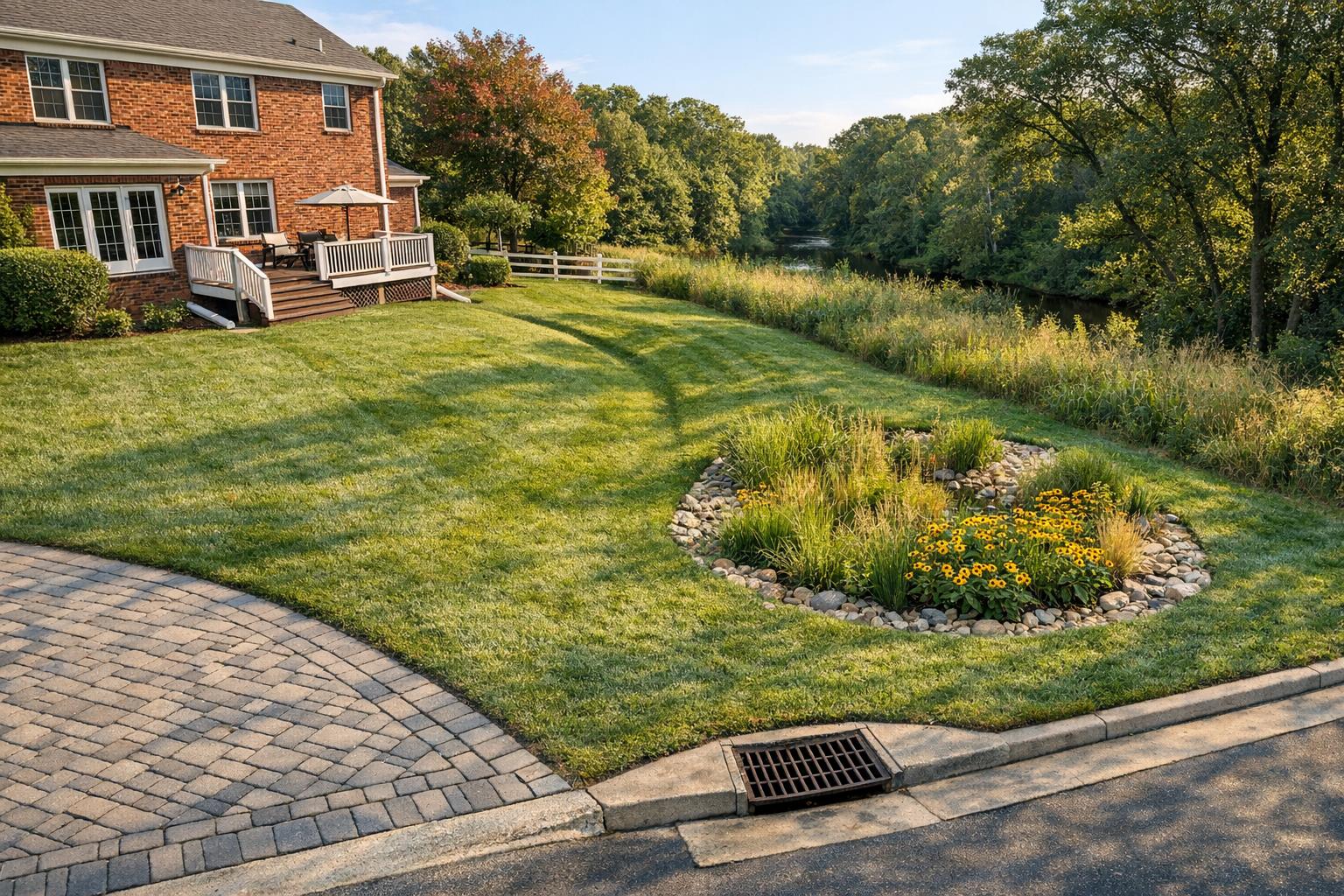
- Stormwater Management: Plans must preserve pre-development groundwater recharge levels and control runoff using methods like rain gardens and permeable pavements.
- Buffer Zones: Activities near streams, wetlands, or floodplains must include protective buffers to reduce erosion and pollution.
To comply with Maryland’s rules, follow these steps:
- Establish proper yard grading.
- Install effective drainage systems like French drains or dry riverbeds.
- Use vegetation to stabilize soil and prevent sediment runoff.
For complex projects or to avoid penalties, consider hiring professionals familiar with Maryland’s regulations.
MDE Stormwater Regulations and Design Manual Updates Listening Session – October 28 (2025)
sbb-itb-843f8be
Maryland’s Grading Regulations Explained
Maryland Grading Permit Requirements and Thresholds
Slope Requirements and Grading Limits
In Maryland, maintaining a proper slope away from building foundations is essential. This ensures water is directed safely, protecting both structures and the surrounding environment.
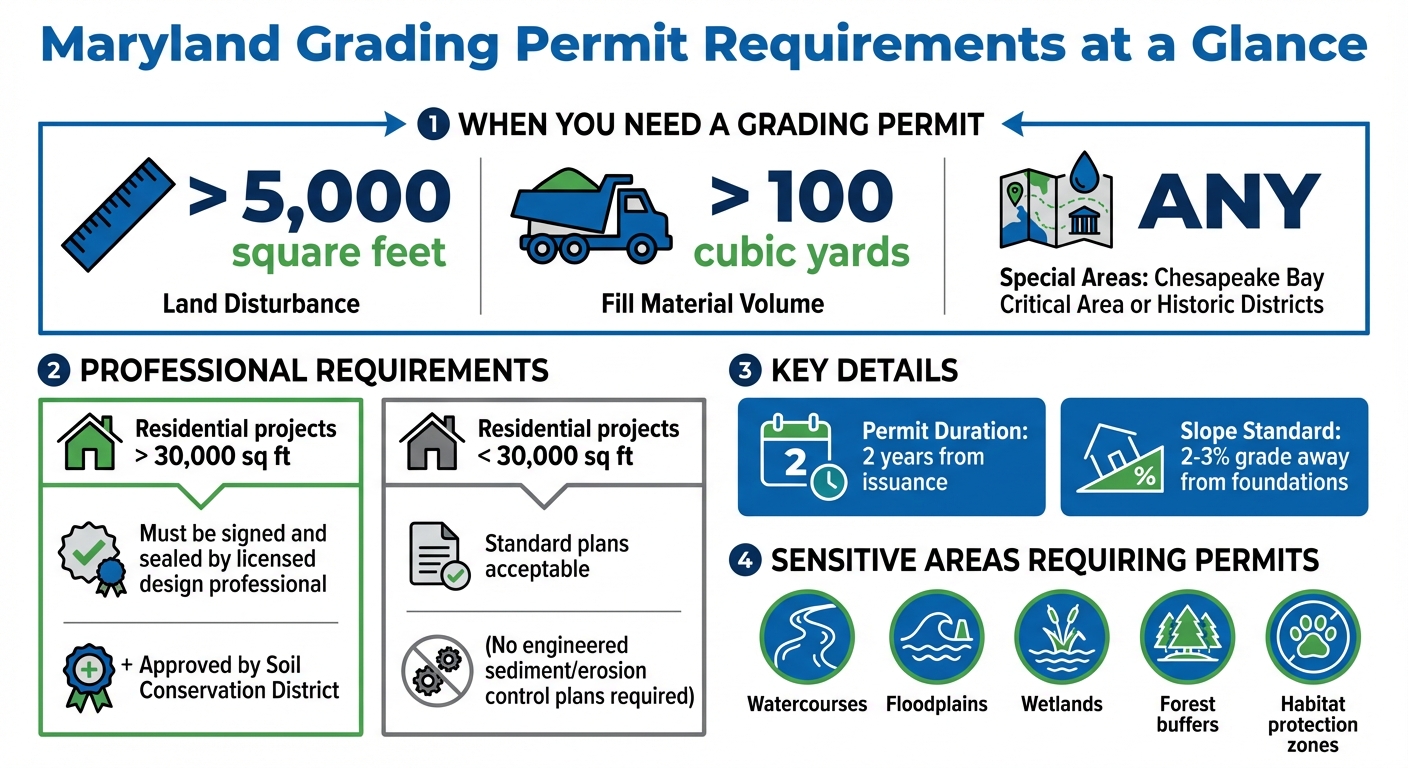
Stricter rules come into play when working near sensitive areas. For example, any grading near watercourses, floodplains, wetlands, forest buffers, or habitat protection zones requires a permit [2]. These measures are designed to safeguard the health of local watersheds.
These guidelines help establish the conditions under which grading permits are necessary.
When You Need a Grading Permit
Once you’ve addressed slope requirements, understanding when a grading permit is required is your next step.
Permits are essential to avoid violations. A grading permit is required if your project disturbs more than 5,000 square feet of land or involves moving over 100 cubic yards of fill material [2]. These limits cover most residential projects.
Location also plays a significant role. Properties within the Chesapeake Bay Critical Area or designated Historic Districts need a grading permit for any disturbance, no matter the size [2]. For larger residential projects exceeding 30,000 square feet, plans must be signed and sealed by a licensed design professional and approved by the Soil Conservation District [2]. However, for smaller residential lots under this threshold, standard plans can be used instead of engineered sediment and erosion control plans [2].
| Requirement Trigger | Threshold |
|---|---|
| Land Disturbance Area | > 5,000 square feet [2] |
| Fill Material Volume | > 100 cubic yards [2] |
| Professional Seal Required (Residential) | > 30,000 square feet [2] |
| Permit Duration | 2 years from issuance [2] |
Grading permits remain valid for two years from the date of issuance [2]. This period provides property owners with enough time to complete their projects while ensuring that outdated plans don’t linger indefinitely.
Drainage and Stormwater Management Requirements
Stormwater Volume and Drainage Standards
In Maryland, stormwater regulations are designed to preserve natural runoff patterns as they existed before development took place [3][4]. Property owners must ensure their stormwater management plans maintain 100% of the average annual pre-development groundwater recharge volume. Additionally, these plans need to address water quality, protect stream channels, and control runoff to prevent severe flooding during large storms [3][4].
The state emphasizes the use of Environmental Site Design (ESD) wherever possible. This approach captures runoff directly at its source, encouraging infiltration and delaying discharge into streams. Techniques like rain gardens, permeable pavements, and bioretention systems are preferred over traditional detention ponds [4].
Legislative proposals for 2026 aim to further refine stormwater management by focusing on slowing runoff, increasing infiltration, and enhancing evapotranspiration. Developers will also need to conduct watershed-wide analyses to evaluate how their projects affect stormwater systems, storage capacity, infiltration rates, and downstream flood risks – especially in vulnerable areas [3][4].
These evolving standards lay the groundwork for additional safeguards, including specific buffer zone requirements.
Buffer Zones and Environmental Protections
Buffer zones play a critical role in protecting natural resources alongside stormwater management. Maryland regulations limit activities that disturb streams, floodplains, and wetlands. While buffer distances can vary by location, their purpose is to preserve riparian areas, reduce erosion, filter pollutants, and maintain stream channel stability – all of which are essential for both ecological health and effective drainage [3][4]. These protections extend to various water bodies, including ponds, lakes, rivers, streams, public ditches, and floodplains. Stream regrading is only allowed when it addresses documented degradation issues [3][4].
To comply with these standards, developers must include buffer zones in their erosion and stormwater management plans. Certification of compliance with both drainage and environmental protection rules is mandatory, and local authorities will factor in state flood determinations during project approvals. This ensures that the combined effects of grading, sediment control, and stormwater management are thoroughly evaluated [4][5].
How to Comply with Grading and Drainage Rules
Setting Up Proper Yard Grading
To prevent water from pooling near your foundation, you’ll need to establish a slope that directs water away. Aim for a grade of 2–3%, which means a drop of 2–3 inches for every 10 feet. This ensures water flows away from your home, protecting the foundation. Pay attention not only to the area immediately surrounding your home but also to the overall water flow across your property, guiding it toward designated drainage points or natural waterways.
Installing Effective Drainage Systems
A reliable drainage system is key to managing water after it’s directed away from structures. French drains are a great option – they use perforated pipes surrounded by gravel to collect and redirect subsurface water. For areas with concentrated runoff, dry riverbeds can imitate natural drainage paths effectively. If your property’s current grading doesn’t meet these needs, professional regrading might be necessary. In Maryland, the Stormwater Management Program, overseen by the Maryland Department of the Environment (MDE), outlines these types of drainage requirements [1]. Once your grading and drainage are sorted, the next step is stabilizing the soil to control erosion.
Erosion Control Methods
Soil stabilization after grading isn’t just a good idea – it’s required to prevent sediment from washing into waterways like the Chesapeake Bay. Maryland regulations mandate the use of high-density vegetation, such as grass or groundcover, to secure the soil. By combining proper grading with dense vegetation, you can effectively stabilize the soil and stop sediment runoff from becoming an issue.
Working with Professional Grading and Drainage Services
Why Hire a Professional
Navigating Maryland’s grading and drainage regulations can be tricky. The Maryland Department of the Environment (MDE) enforces strict Erosion and Sediment Control (ESC) standards, and failing to meet these can lead to hefty fines and property damage. Without the right knowledge, homeowners might overlook crucial safety or environmental requirements, putting their property at risk.
Hiring a professional ensures compliance with these regulations while addressing your property’s specific needs. Experts are well-versed in MDE standards and know how to apply them effectively. Beyond avoiding penalties, they help protect your property from issues like foundation damage, soil erosion, and water intrusion. This makes professional services a smart choice for long-term peace of mind.
Pro Landscapes MD‘s Grading and Drainage Services

Professional expertise doesn’t just keep you compliant – it also provides solutions tailored to your property’s unique challenges.
Pro Landscapes MD specializes in creating drainage systems that meet Maryland’s regulations while safeguarding your property. Their services cover a wide range of needs, including drainage installation, drain pipe placement, drainage repair, French drains, dry riverbeds, stormwater management, grading, land leveling, yard leveling, and yard repair. They serve central Maryland communities such as Howard County, Montgomery County, Carroll County, Frederick County, Prince George’s County, and Baltimore County.
From initial site assessments to final erosion control measures, Pro Landscapes MD handles every step of the process. Whether you need a full regrading project to direct water away from your foundation or targeted drainage repairs for specific trouble spots, their team ensures compliance with MDE standards. They also address stormwater management requirements, including sediment control and buffer zone protections, to help preserve local watersheds.
Their approach balances functionality with aesthetics, ensuring that drainage solutions not only meet regulatory demands but also improve the look and usability of your outdoor space.
Conclusion
Key Takeaways
Maryland’s grading and drainage regulations serve as critical measures to protect both property and the environment. Overseen by the Maryland Department of the Environment (MDE), the state’s Stormwater Management Program enforces specific Erosion and Sediment Control (ESC) standards designed to prevent issues like soil erosion and harmful water runoff. These regulations provide a structured approach to ensure soil stability and safeguard local watersheds from pollution.
Following these guidelines not only preserves property value but also helps avoid structural damage. Proper grading ensures water flows away from buildings, and well-designed drainage systems manage stormwater in compliance with state regulations. Familiarity with slope requirements, necessary permits, buffer zones, and erosion control techniques is key to executing these projects effectively.
Before starting any grading work, it’s essential to review the official ESC standards available on the MDE website to ensure adherence to state rules. Be cautious with automated translations; always refer to the original English resources provided by DoIT and MDE for accuracy.
FAQs
Do I need a grading permit for my project?
In Maryland, you’ll need a grading permit if your project disturbs more than 5,000 square feet of land, involves moving over 100 cubic yards of fill, or affects areas like watercourses, floodplains, wetlands, or protected historic or environmental zones. Always review local regulations to make sure you’re following the rules.
Who approves grading and stormwater plans in Maryland?
In Maryland, the Maryland Department of the Environment (MDE), along with local permitting authorities like county or municipal agencies, oversees the approval of grading and stormwater plans. These organizations enforce regulations and issue permits for land disturbance projects, ensuring that activities meet established erosion and sediment control standards.
What happens if I grade or drain without a permit?
Grading or draining land in Maryland without the proper permits can lead to serious consequences, including fines as high as $66,712 per day, potential legal action, and harm to the environment. These permits are mandatory for land disturbance activities that surpass certain limits. They help ensure adherence to stormwater management rules and safeguard natural ecosystems.
Chat with Us