









- bhavya gada
- No Comments
Gravel is essential for building stable and effective basin foundations. Costs for gravel in Maryland range widely, influenced by material type, delivery logistics, and seasonal demand. Here’s a quick breakdown:
- Material Costs:
- Crusher Run: $20–$25 per cubic yard
- Crushed Limestone: $30–$115 per cubic yard
- Rock Base Gravel: $18–$38 per cubic yard
- Pea Gravel: $15–$75 per cubic yard
- Delivery Fees: $50–$200 per load, depending on distance and truck size.
- Seasonal Pricing: Expect a 10–20% increase in spring/summer due to high demand.
To calculate material needs, multiply the basin’s length, width, and depth (in feet), convert to cubic yards, and then to tons based on gravel density (1.3–1.7 tons per cubic yard). Ordering in bulk (10+ tons) can save 10–15%.
For Maryland homeowners, local factors like fewer quarries and higher transportation costs can raise prices by 20–50%. Proper planning, including site preparation and coordinating bulk deliveries, can help manage costs effectively.
Types of Gravel for Basin Foundations
The type of gravel you choose for a basin foundation can make or break the project’s success. It directly impacts drainage, stability, and overall performance. For Maryland basin projects, four common options stand out: crusher run, crushed limestone, rock base gravel, and pea gravel. Each serves unique purposes depending on your specific needs.
Crusher Run Gravel
Crusher run combines crushed stone with stone dust, creating a dense, stable surface. When compacted, this mix locks tightly, resisting movement and rutting even under heavy loads. The fine particles fill gaps between the stones, forming a solid foundation. However, its density limits water flow compared to more open-graded materials. If your basin requires maximum structural integrity, crusher run is an excellent choice. Prices typically range from $20 to $25 per cubic yard.
Crushed Limestone
Crushed limestone, often made with #57 stone (around 3/4 inch in size), offers a balance of stability and drainage. The angular edges of the stone interlock for structural strength, while the gaps between stones allow water to pass through easily. This makes it a versatile option for basin foundations. As GrinderCrusherScreen puts it:
"The right gravel, in the right place, produced the right way, is the difference between constant maintenance and a project that works" [4].
Expect to pay $30 to $115 per cubic yard for crushed limestone, depending on the grade and quality.
Rock Base Gravel
Rock base gravel features larger angular stones, typically ranging from 1/2 inch to 2 inches in diameter (#1 or #3 stone). This material works well as a sub-base layer, especially for filling deep soft spots or supporting heavy loads. Its larger size also makes it ideal for erosion control along basin embankments. Prices range from $18 to $38 per cubic yard, making it a budget-friendly choice for bulk applications requiring strong support.
Pea Gravel
Pea gravel consists of small, rounded stones between 1/8 inch and 3/8 inch in diameter. While it’s visually appealing and comfortable to walk on, its tendency to migrate without proper edging limits its use in basin foundations. It works best for decorative purposes or as a shallow drainage layer where heavy structural support isn’t needed. The rounded shape promotes excellent water flow, but the lack of interlocking means it won’t hold up under heavy pressure or equipment. Prices vary from $15 to $75 per cubic yard, depending on color and quality.
sbb-itb-843f8be
Maryland Gravel Prices: 2026 Averages
Gravel prices in Maryland align closely with those in other parts of the Eastern U.S., though they can vary depending on the type of material and the supplier. To put things into perspective, one cubic yard of crushed stone weighs roughly 1.5 tons, while pea gravel comes in at about 1.4 tons[1]. This weight-to-volume conversion matters because some suppliers price gravel by the ton, while others use cubic yards. Knowing this can help you make accurate comparisons and better estimate how much material you’ll need for your basin foundation.
For 2026, gravel prices range widely, from $15 to $75 per ton. According to Hello Gravel, the cost breakdown looks like this:
- Pea gravel: $30–$55 per cubic yard
- Crushed stone: $40–$75 per cubic yard
- River rock: $45–$100 per cubic yard
If you’re working on a basin foundation, you’ll likely need construction-grade crushed stone rather than decorative options, which can influence your overall budget[5].
Delivery Costs and Bulk Savings
Delivery fees can add $50 to $200 per load to your total cost. However, if you’re located within 20 miles of the supplier, you might save $10–$20 per ton. For larger loads, a 15-ton dump truck delivery will typically cost between $450 and $900, while a tri-axle truck carrying 18–22 tons will run you anywhere from $600 to $1,200[1][5].
Ordering in bulk (10 tons or more) can lead to significant discounts. Just make sure your quote includes all the extras, like delivery fees, fuel surcharges, and taxes, so there are no surprises later on[5].
Seasonal Price Fluctuations
Timing your purchase can also impact your expenses. Seasonal discounts of 10–20% are often available in late fall or winter. On the flip side, prices tend to peak during the spring and summer months when demand is highest[5].
What Affects Gravel Costs for Basin Foundations
Gravel pricing isn’t as straightforward as it might seem. Several factors influence the final cost, and understanding these can help you manage your budget more effectively. It’s not just about the gravel itself – everything from material type to delivery logistics plays a role.
Material Type and Quality
The type and quality of gravel significantly impact its price. For example, angular crushed stone costs around $15–$35 per ton, offering better compaction and stability for basin foundations. In contrast, pea gravel, priced at $25–$53 per ton, has a rounded shape that hinders interlock, making it less structurally effective [1][2]. Construction-grade gravel is tailored for stability and drainage, while decorative options prioritize appearance, often at the expense of performance. This difference is reflected in both their functionality and cost [1][3].
Quantity and Delivery Charges
How much gravel you order can also affect the price. Bulk purchases of 15 or more cubic yards often come with discounts of 10%–15% off standard rates [3]. Delivery fees are another factor to consider. For orders within 20 miles, you might pay $10–$20 per ton for delivery. Beyond that, additional mileage charges of $2–$5 per mile apply, along with a base fee of $50–$150 [1][5].
Site Preparation and Excavation Costs
Before gravel can be delivered, the site needs to be prepared. If the delivery area doesn’t meet certain requirements – like a minimum 10-foot width and clear overhead space – you may face "access difficulty" fees ranging from $25 to $100 [1]. Delays during unloading can also result in wait time charges of $50–$100 per hour [1]. Proper site preparation minimizes these extra costs, helping you stick to your budget.
Local Maryland Supplier Variations
In Maryland, local factors further influence gravel costs. Prices here typically range from $50–$60 per cubic yard – 20%–50% higher than in Southern states – due to fewer local quarries and higher transportation costs [3]. Urban areas in Maryland often have better rates than rural ones, thanks to shorter delivery distances and more competition among suppliers [1]. Additionally, some types of stone may need to be shipped into the state, adding specialty fees [2]. To find the best deal, it’s wise to request quotes from three to five local suppliers, comparing material prices, delivery fees, and minimum order requirements [1][2].
How to Calculate Gravel Needs for Your Basin
To figure out how much gravel you’ll need, use this formula: Length × Width × Depth (in feet). Make sure all measurements are in feet. Since depth is often given in inches, you’ll need to convert it by dividing by 12. For instance, if the depth is 4 inches, divide 4 by 12 to get 0.33 feet. Multiply the length, width, and converted depth to find the volume in cubic feet. Then, divide this total by 27 to convert it to cubic yards.
Let’s break it down with an example. If your basin is 12 feet wide, 100 feet long, and has a depth of 4 inches, start by converting the depth: 4 ÷ 12 = 0.33 feet. Next, multiply the dimensions: 12 × 100 × 0.33 = 400 cubic feet. Finally, divide by 27: 400 ÷ 27 ≈ 14.8 cubic yards.
Since gravel is usually sold by weight (in tons), you’ll need to convert cubic yards to tons. Multiply the cubic yards by the material’s density factor. For crushed stone, the density factor is typically 1.5, while for pea gravel or river rock, it’s around 1.4. Using crushed stone as an example, multiply: 14.8 × 1.5 = 22.2 tons. It’s wise to add about 10% extra to account for settling, compaction, and waste. So, the final amount would be around 24.5 tons.
Always confirm the material’s density factor with your supplier to ensure accurate calculations.
Gravel Cost Comparison Table
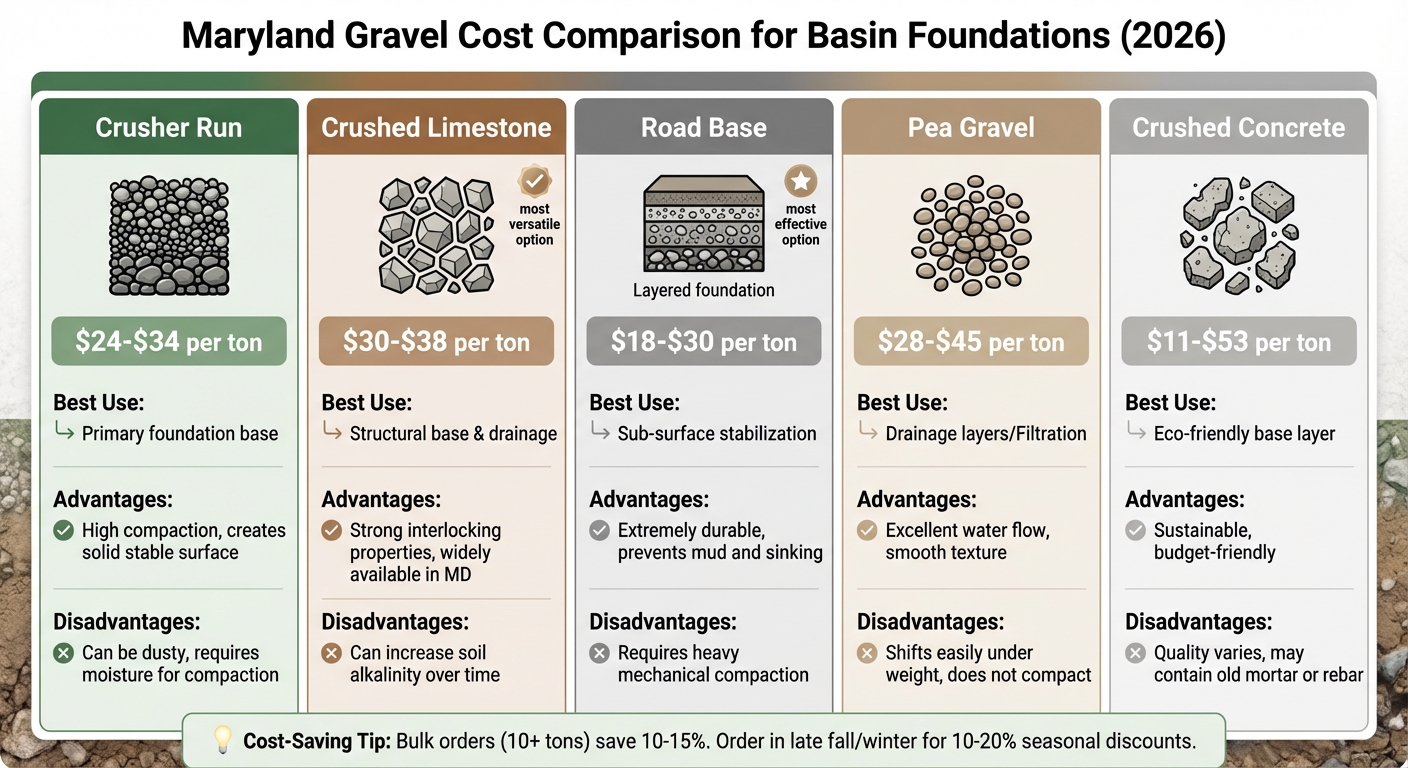
Maryland Gravel Types Comparison for Basin Foundations: Costs, Uses, and Properties
When planning basin foundations, weighing your gravel options is essential. Below is a detailed breakdown of 2026 average prices, applications, and the pros and cons of the most common gravel types in Maryland. This table highlights key factors to help you make an informed choice.
| Gravel Type | Avg. Cost per Ton | Best Use for Basins | Advantages | Disadvantages |
|---|---|---|---|---|
| Crusher Run | $24 – $34 | Primary foundation base | High compaction; creates a solid, stable surface [1] | Can be dusty; requires moisture for proper compaction [7] |
| Crushed Limestone | $30 – $38 | Structural base & drainage | Strong interlocking properties; widely available in MD [1] | Can increase soil alkalinity over time [6] |
| Road Base | $18 – $30 | Sub-surface stabilization | Extremely durable; prevents mud and sinking [6] | Requires heavy mechanical compaction for stability [7] |
| Pea Gravel | $28 – $45 | Drainage layers/Filtration | Excellent water flow; smooth texture [1] | Shifts easily under weight; does not compact [7] |
| Crushed Concrete | $11 – $53 | Eco-friendly base layer | Sustainable; often the most budget-friendly [1] | Quality varies; may contain traces of old mortar or rebar [1] |
Crusher run and crushed limestone stand out as mid-range options, delivering reliable structural support thanks to their interlocking edges [1][7]. While pea gravel falls within a similar price range, its inability to handle weight makes it suitable only for drainage layers where water flow is a priority.
For sub-surface stabilization, road base gravel provides great durability at $18–$30 per ton, though it demands mechanical compaction for maximum effectiveness [7]. If you’re looking for a budget-conscious option, crushed concrete might be the way to go, with prices ranging widely from $11 to $53 per ton. However, inspect it carefully, as quality can vary significantly [1].
As noted earlier, factors like material quality and delivery logistics can influence these prices. This table offers a straightforward comparison to simplify your decision-making and help you find the best material for your basin foundation needs.
Tips for Managing Gravel Costs
Ordering gravel in bulk can significantly cut costs. For instance, placing orders for 5, 10, or even 20+ tons often qualifies you for price breaks. Larger orders – typically 10 tons or more – might even include free delivery. If you’re working with others, consider combining orders to split delivery fees, further reducing expenses.
Timing your purchase can also make a big difference. Late fall or winter is considered the off-season for gravel, and during this time, you might snag discounts of 10%–20% due to reduced demand. If your basin foundation project allows for flexibility, planning it during these months can give you more room to negotiate.
Sourcing gravel locally is another way to save. Choosing suppliers within 20 miles can cut costs by $10–$20 per ton and help you avoid middleman markups, which can save you up to 25% overall [5]. To ensure you’re getting the best deal, request quotes from at least three local suppliers.
For an even more cost-effective option, consider using recycled materials like crushed concrete or asphalt. These alternatives can perform just as well as gravel but cost 20%–40% less [5].
Finally, make sure your site is ready for delivery. A clear 10-foot-wide access path can help you avoid surcharges ranging from $25 to $100. Ordering full truckloads – 12–15 tons for a tandem axle or 18–22 tons for a tri-axle – can also lower delivery fees, which typically range from $50 to $200 per trip [1].
Pro Landscapes MD: Your Partner for Stormwater Management

If you’re in central Maryland and need help with basin foundations or stormwater management, Pro Landscapes MD offers expert gravel selection and efficient installations tailored to your needs.
When it comes to materials, Pro Landscapes MD uses options like angular crushed stone for better stability and river rock for improved drainage [1][2][3]. They understand that Maryland homeowners installing French drains typically require 3–5 tons of gravel per 100 linear feet. This attention to detail shapes their comprehensive drainage solutions, which include more than just basic installations. Their services extend to grading, land leveling, and even creating dry riverbeds as part of a well-rounded stormwater management strategy. For labor, professional services such as leveling, ground preparation, and installation typically cost between $50 and $100 per hour [2].
Pro Landscapes MD focuses on serving central Maryland, covering areas like Howard County, Montgomery County, and Baltimore. They also work with local suppliers to source materials competitively, ensuring their services align with the specific needs of the region.
For basin construction, their team manages every step – from site preparation to final grading – while ensuring accurate material selection, precise quantity calculations, and smooth delivery coordination. This integrated approach ensures your project is handled efficiently and effectively.
To learn more or start planning your stormwater management project, visit prolandscapesmd.com. Their team is ready to help!
Conclusion
Choosing the right gravel for your basin foundation requires a solid grasp of material properties, precise quantity calculations, and proper installation methods. Angular options like crushed stone and crusher run offer the stability and compaction needed for structural foundations. On the other hand, rounded materials like pea gravel are better suited for drainage layers but may shift under pressure. Converting volume to weight is another key step to avoid over-ordering and unnecessary expenses [1].
Keeping costs under control is just as important as selecting the right material. Bulk purchasing is a smart way to save – buying 15 cubic yards or more often qualifies you for discounts of 10% to 15% off standard rates [1][3]. If you can coordinate with neighbors to fill a full truckload (typically 12–25 tons), you’ll also reduce delivery fees, which usually range between $50 and $150 per load. Additionally, homeowners who handle site preparation themselves – like clearing grass, weeds, and debris – can significantly cut down on labor costs.
Accurate calculations for volume and weight are essential to staying within budget and avoiding unnecessary expenses [1]. Proper grading is another critical step to prevent drainage problems down the line.
While laying gravel might seem straightforward, professional installation ensures the job is done right. Experts handle excavation, grading, and compaction, creating a durable foundation that can last 50 to 100 years with proper maintenance. Though professional services typically cost between $1,500 and $6,000 upfront, the long-term durability and reliability they provide make it a worthwhile investment.
For homeowners in central Maryland working on basin foundations or stormwater management projects, partnering with local professionals ensures your project is done correctly from the start. Companies like Pro Landscapes MD offer seamless installations and expert advice to help you achieve lasting results.
FAQs
Which gravel is best for my basin foundation?
The best gravel for your basin foundation depends on how well it needs to handle drainage. Crushed stone (#57) is a great choice if you’re looking for excellent drainage performance. On the other hand, pea gravel or smaller stones are better suited for managing surface drainage, especially near your home. Take some time to evaluate your specific requirements before deciding on the right material.
How do I figure out tons of gravel I need?
To figure out how much gravel you’ll need in tons, start by calculating the area’s volume in cubic yards. Multiply the length, width, and depth of the space. If your measurements are in cubic feet, divide the total by 27 to convert it into cubic yards. Once you have the volume, multiply it by the gravel’s density, which is usually about 1.4 tons per cubic yard.
For instance, if you have 10 cubic yards of gravel, it would weigh approximately 14 tons (10 x 1.4).
How can I lower gravel delivery costs in Maryland?
To save money on gravel delivery in Maryland, try ordering in bulk. Many suppliers offer discounts when you purchase 10 tons or more. Another tip is to choose gravel types that are readily available in your area. This can cut down on transportation costs, helping you stick to your budget while getting the materials you require.
Chat with Us