









- bhavya gada
- No Comments
Green roofs are an effective solution to Maryland’s stormwater runoff issues. By retaining water in their substrate and vegetation layers, they reduce urban flooding risks and improve water quality. Key findings include:
- Runoff Reduction: Best for storms under 2.5 inches, green roofs slow water discharge, preventing drainage system overload.
- Water Quality Improvement: They neutralize acid rain (raising pH from 4.82 to 7.28) and filter pollutants like nitrates and ammonium.
- Plant Selection: Sedum kamtschaticum and S. sexangulare perform better for water retention due to higher evapotranspiration rates.
- Structural Design: Built-up systems retain more water annually compared to modular trays or vegetated mats.
- Challenges: Initial costs, maintenance, and phosphorus runoff require careful planning and integration with other stormwater practices.
Green roofs, supported by Maryland’s Department of the Environment (MDE) guidelines, are a key part of urban stormwater strategies. Combining them with other methods, like bioretention cells, ensures effective water management across the state.
Green Roofs and Stormwater Management
Green Roof Structure and Function
Green roofs are designed with multiple layers, each playing a role in managing stormwater. At the top is the vegetation layer, where plants absorb water through their roots and release it into the atmosphere via evapotranspiration. Beneath that, the substrate (soil) layer acts like a sponge, soaking up rainfall. Lastly, the drainage layer at the bottom directs any excess water that the upper layers can’t retain. Together, these layers work to tackle Maryland’s stormwater challenges.
The substrate layer is especially critical during heavy storms, as it determines how much water can be retained. During lighter rainfall events, the plants themselves take center stage, with their water uptake making a significant difference. Research has shown this system is most effective for storms under 2.5 inches (62.5 mm), where plant-driven reduction of runoff shines. However, as storms grow heavier, water retention decreases at a quadratic rate [1][2].
Plant choice is another key factor in optimizing stormwater retention. In a study conducted from 2011 to 2012, Olyssa Starry from the University of Maryland monitored 16 green roof platforms. She compared the performance of three Sedum species to unplanted controls. The results revealed that Sedum kamtschaticum outperformed Sedum album, using 35% more water under fall temperatures, which significantly improved stormwater retention [2]. Starry highlighted:
The two species with the greatest stormwater retention efficiencies, S. kamtschaticum and S. sexangulare, also had the highest rates of evapotranspiration (ET), and higher ET rates resulted in less total runoff [2].
This layered approach not only reduces the volume of runoff but also improves the quality of water entering urban watersheds in Maryland.
Environmental Benefits in Maryland
Green roofs go beyond reducing runoff – they also enhance water quality. Between 2012 and 2014, the U.S. EPA studied four full-scale green roofs in Maryland during more than 100 storm events. Their findings highlighted how these roofs help filter pollutants and neutralize pH levels.
One standout result was the significant reduction in nitrogen-based pollutants, such as nitrate and ammonium, entering urban waterways. This is largely due to the reduced volume of water leaving green roofs, even though small amounts of these nutrients may still be present. Additionally, heavy metals and micronutrients were either found in very low concentrations or entirely absent in green roof runoff. This suggests that the substrate layer effectively filters these contaminants [1].
The U.S. EPA summarized their findings with this conclusion:
Green roof implementation could improve urban stormwater and subsequently urban receiving water quality if achieved at large areal scales [1].
sbb-itb-843f8be
Green Roofs for Stormwater Management: Learning the Basics & Benefits from Philadelphia Green Roofs
Research Findings on Green Roof Performance
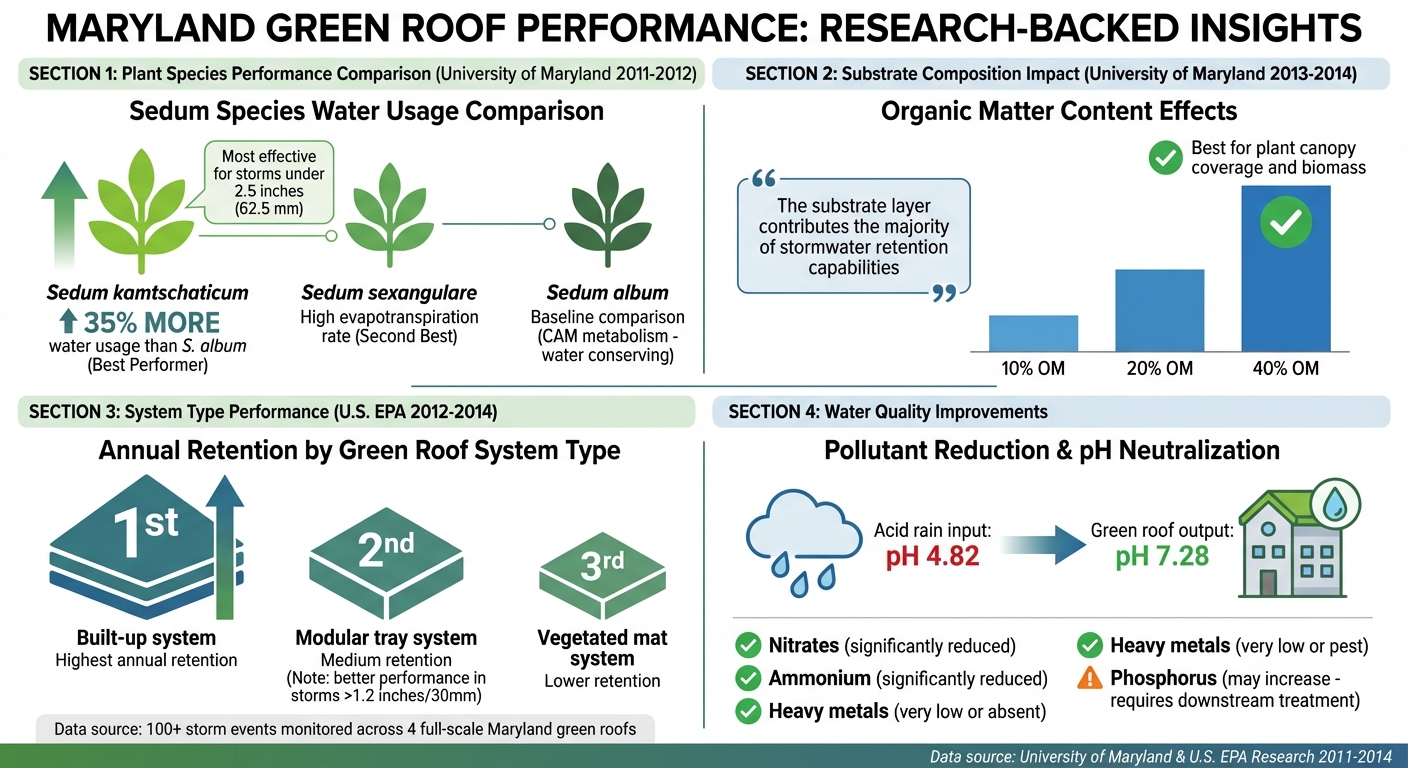
Green Roof Water Management Performance Data for Maryland
University of Maryland Research Data

Between 2011 and 2012, researcher Olyssa Starry from the University of Maryland conducted a study on 16 green roof platforms. These platforms were planted with three Sedum species – S. album, S. kamtschaticum, and S. sexangulare – and compared against unplanted controls.
The findings highlighted some striking differences. For instance, Sedum kamtschaticum used 35% more water than S. album under fall temperature conditions, making it more effective at managing stormwater. This difference stems from their water processing methods: S. kamtschaticum uses a C3 gas exchange process, while S. album relies on CAM metabolism, which is designed to conserve water. While water conservation might seem advantageous, it actually reduces runoff management efficiency. These effects were especially noticeable during rainfall events of less than 2.5 inches (62.5 mm) [2].
Another University of Maryland study, led by Whitney Griffin between 2013 and 2014, explored how substrate composition impacts long-term green roof performance. Griffin tested substrates with 10%, 20%, and 40% organic matter (OM) content. Although immediate retention differences weren’t evident during the second growing season, the 40% OM mix significantly enhanced plant canopy coverage and biomass. Griffin noted that "the substrate layer… contributes the majority of stormwater retention capabilities" [3].
These controlled studies provide a solid foundation for understanding how green roofs perform, but urban case studies help connect these findings to practical applications.
Maryland Urban Area Case Studies
The U.S. EPA’s Office of Research and Development monitored four full-scale green roofs in Maryland’s urban areas from 2012 to 2014, analyzing their performance over more than 100 storm events. The data revealed a clear trend: as rainfall intensity increased, retention percentages declined in a predictable quadratic pattern. Among the systems studied, built-up green roofs consistently outperformed modular tray systems in annual retention. However, modular trays showed unexpected resilience during larger storms exceeding 1.2 inches (30 mm) [1].
Beyond retention, these urban installations also improved water quality. The volume of runoff leaving the roofs was significantly reduced, and the total annual mass of pollutants like nitrates and ammonium was substantially lower [1].
Integrated Stormwater Management Systems
Green Roofs with Other Stormwater Practices
Green roofs, when combined with other stormwater management techniques, create a highly effective system for handling urban rainfall. In Maryland, these roofs often act as the first step in a "treatment train" – a connected series of measures designed to capture and treat stormwater at its source. This approach not only reduces the burden on downstream systems but also improves water quality, especially during storms under 2.5 inches (62.5 mm) of rainfall [2].
One key advantage of green roofs is their ability to pre-treat stormwater. For instance, they neutralize acid rain, raising the pH of runoff from an average of 4.82 (acidic precipitation) to a more neutral 7.28. This means that by the time the water reaches downstream systems, it’s already partially treated, reducing pollutant loads and improving overall efficiency [1]. For larger storms, excess water is directed to secondary systems like bioretention cells or constructed wetlands, ensuring effective management of overflow.
Between 2012 and 2014, the U.S. EPA Office of Research and Development studied the performance of green roofs in Maryland’s urban areas, monitoring over 100 storm events. The research revealed that green roofs significantly decreased the annual mass loading of pollutants such as nitrate and ammonium when compared to conventional roofs [1]. However, the study also noted a potential drawback: green roofs may increase total phosphorus concentrations in runoff. This highlights the importance of pairing them with downstream practices to address such challenges.
Maryland Department of the Environment (MDE) Guidelines
Maryland’s Department of the Environment (MDE) has embraced integrated stormwater management, offering clear guidelines to support the use of green roofs. Recognizing their ability to reduce runoff and improve water quality, MDE includes green roofs in its Environmental Site Design (ESD) framework.
Classified as "Practice M-1" within the ESD guidelines, green roofs are designed to mimic natural conditions, such as "woods in good condition", by capturing and treating rainfall at its source before it turns into runoff. This makes them an ideal first step in a treatment train, where they work alongside downstream measures to manage overflow and enhance total water retention. Property owners can earn credits for ESD volume (ESDv) requirements based on the depth of the green roof’s growth media, which typically ranges from 2 to 8 inches for extensive systems.
The EPA has emphasized the broader potential of green roofs, stating:
Green roof implementation could improve urban stormwater and subsequently urban receiving water quality if achieved at large areal scales [1].
MDE’s focus on ESD has made green roofs a go-to solution for urban areas where traditional stormwater infrastructure is difficult to implement. The guidelines also note that built-up green roof systems generally retain more annual rainfall than modular tray systems, a factor that influences both credit calculations and their integration into comprehensive stormwater plans [1].
Green Roof Implementation Considerations
Installation Costs and Maintenance
While green roofs offer clear environmental advantages, their installation comes with notable challenges and higher initial expenses. These costs stem from the need for specialized materials, skilled labor, and structural reinforcements [4].
The type of green roof system chosen plays a significant role in both cost and functionality. Built-up systems are the most effective at retaining annual rainfall, followed by modular tray and vegetated mat systems [1]. Modular tray systems perform less efficiently during smaller storms (0–0.79 inches) but show improved performance during larger storms (over 1.18 inches) [1].
Maintenance requirements differ depending on the system type. Extensive green roofs, which use low-maintenance, drought-resistant plants, require less attention compared to the more elaborate intensive rooftop gardens [4]. Routine tasks include weeding, occasional irrigation during dry periods, and replacing plants as needed. Selecting the right plants is especially critical, as previous studies on Maryland’s climate emphasize the importance of species suited to local conditions.
Urban Area Challenges
In urban areas of Maryland, property owners face unique hurdles when considering green roofs. One major concern is the building’s structural load capacity. The additional weight from waterproofing layers, soil, and vegetation – especially when soaked by rain or snow – requires careful evaluation. A professional structural assessment is essential to determine if retrofitting is necessary [4].
Green roof efficiency also depends on storm size. During small to moderate rainfall events (under 2.46 inches), these systems perform well, but their retention capacity diminishes as storms grow more intense [2]. This means property managers must plan for supplementary stormwater management to handle overflow during heavy rainfall.
Nutrient management is another important factor. Although green roofs reduce nitrate and ammonium runoff compared to traditional roofs [1], they can increase phosphorus levels in the water they release [1]. For properties near sensitive ecosystems like the Chesapeake Bay, implementing strategies to limit phosphorus runoff is critical to protecting local waterways.
These challenges underline the importance of expert installation and maintenance, which are discussed further in the next section.
Professional Services in Maryland
Due to the technical and structural complexities involved, professional services are key to ensuring green roofs are installed and maintained effectively in Maryland’s urban settings. Proper installation involves precise layering of waterproofing and drainage components, and any mistakes can lead to significant building damage [4]. Professionals also ensure the system is designed to handle local storm patterns, has adequate substrate capacity, and includes plants suited to Maryland’s climate.
Pro Landscapes MD offers comprehensive solutions for property owners looking to integrate green roofs with broader stormwater management systems. Their services include installing French drains, dry riverbeds, and land grading, all of which work in tandem with green roofs to manage overflow during heavy storms. Serving areas like Howard, Montgomery, Carroll, Frederick, Prince George’s, and Baltimore Counties, Pro Landscapes MD provides tailored drainage solutions to ensure effective stormwater control alongside green roof systems.
Conclusion
Drawing from extensive research and real-world examples, it’s clear that green roofs play a crucial role in managing stormwater in Maryland’s urban areas.
Green roofs are a practical way to reduce stormwater runoff. Studies show they work by retaining water in their substrate and through plant evapotranspiration. These processes are especially effective during small to medium rainfall events, which make up a large portion of Maryland’s yearly precipitation. Beyond reducing runoff, green roofs also improve water quality by neutralizing acid rain and filtering out pollutants like nitrates and ammonium before they enter local watersheds [1].
However, their success largely depends on design. Built-up systems outperform modular trays or vegetated mats in retaining rainfall, and choosing plants with high evapotranspiration rates significantly boosts performance. Research from the University of Maryland highlights how critical plant selection is, particularly for rainfall events under 2.46 inches [2].
Regulatory insights add weight to this. The U.S. EPA notes:
Green roof implementation could improve urban stormwater and subsequently urban receiving water quality if achieved at large areal scales [1].
This emphasizes the need for widespread adoption across Maryland’s cities to maximize environmental benefits.
For property owners in areas like Howard, Montgomery, Carroll, Frederick, Prince George’s, and Baltimore Counties, expert guidance is key. Pro Landscapes MD offers the expertise needed to design and install green roofs as part of a complete stormwater management system. Their services, including drainage installation, French drains, dry riverbeds, and land grading, ensure green roofs perform effectively across Maryland’s diverse weather conditions.
FAQs
Can my building support the weight of a green roof?
Before installing a green roof, it’s crucial to determine if your building can handle the added weight. This depends on several factors, including the type of roof, the materials used in its construction, and its current load capacity. To ensure both safety and compliance with building regulations, a structural engineer should evaluate these aspects thoroughly.
How can a green roof be designed to reduce phosphorus in runoff?
Green roofs can help decrease phosphorus levels in runoff by incorporating plants such as Sedum and Tradescantia ohiensis. These plants improve stormwater retention, reducing the amount of runoff. On top of that, fine-tuning the substrate’s composition and physical properties boosts its ability to retain and filter water, making runoff management even more efficient.
What Maryland permits or MDE credits apply to green roofs?
Maryland recognizes green roofs as an approved method for managing stormwater. They are classified as best management practices (BMPs) due to their ability to capture and retain stormwater runoff, aligning with the state’s regulations and design standards.
Chat with Us