









- bhavya gada
- No Comments
Green roofs are living, plant-based systems installed on rooftops that help reduce stormwater runoff. Unlike traditional roofs, they absorb rainwater, filter pollutants, and delay water release, preventing urban flooding and easing pressure on drainage systems. They also improve water quality by removing up to 95% of heavy metals and neutralizing acid rain. During summer, green roofs can retain nearly 100% of rainfall, while in winter, retention is lower due to dormancy. These systems are especially effective in cities, where impervious surfaces dominate, offering a solution to manage rainfall sustainably and improve urban infrastructure.
Key benefits include:
- Stormwater retention: Absorbs 50–60% of annual rainfall.
- Pollutant filtration: Removes heavy metals and balances pH levels.
- Delayed runoff: Reduces peak flow by 80–95%.
- Temperature regulation: Keeps roofs cooler, saving energy and extending roof lifespan.
Green roofs can be integrated with ground-level drainage solutions like French drains to manage overflow. Proper design, maintenance, and plant selection are critical for optimal performance, especially in regions like Maryland, where seasonal weather impacts efficiency. Pro Landscapes MD provides tailored solutions to combine green roofs with effective drainage systems for long-term stormwater management.
Green Roof Stormwater Management Statistics and Benefits
How Green Roofs Manage Stormwater
Stormwater Retention
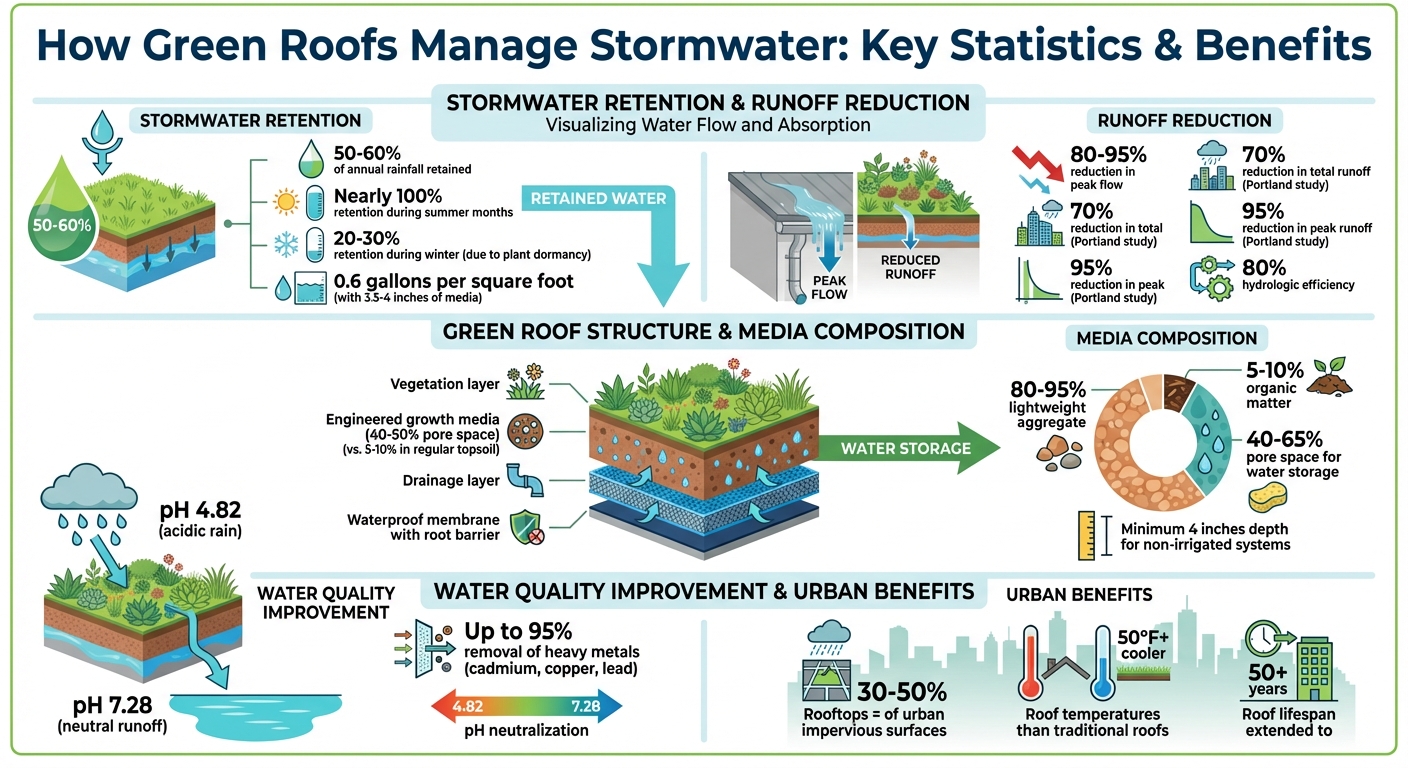
Green roofs function like layered sponges, capturing rainwater right where it falls. The vegetation on top intercepts the first raindrops, while the specially engineered growing media soaks up moisture with its 40% to 50% pore space – much higher than the 5% to 10% found in regular topsoil[3]. To put it in perspective, an extensive green roof with just 3.5 to 4 inches of media can hold about one inch of water, which equates to 0.6 gallons per square foot[1].
But the story doesn’t end with water just sitting there. Plants take up this moisture through their roots and release it back into the atmosphere via transpiration, while water also evaporates directly from the soil. This combined process, called evapotranspiration, reduces the amount of water that ever reaches the drainage system.
"Green roofs essentially act as sponges on a roof"
- Richard Hayden, Garden Roof Product Manager at American Hydrotech[3]
Thanks to this natural process, green roofs can capture and retain 50% to 60% of the annual rainfall, keeping it out of storm sewers altogether[1][5]. And when the roof reaches its retention limit, it shifts to managing the overflow through controlled detention.
Stormwater Detention
Retention is just one part of the equation – green roofs also slow down the release of excess water. When rainfall exceeds the media’s capacity, the extra water doesn’t immediately run off. Instead, it trickles through a drainage layer, often made of synthetic materials like "waffle boards" or gravel. This layer temporarily holds the water and gradually releases it to roof drains. This delayed release, called detention, is crucial for reducing urban flooding during heavy storms.
In contrast, traditional roofs shed nearly all rainfall instantly. Green roofs, on the other hand, can delay runoff by several hours, which makes a huge difference. Research shows that green roofs achieve 80% hydrologic efficiency, meaning 80% of the average annual stormwater runoff is managed within the system itself[3].
"This delay is a very important BMP feature. When properly acknowledged in the design process, green roofs can reduce the need for and size of downstream stormwater facilities"
- Richard Hayden[3]
Filtration and Water Quality Improvement
Green roofs don’t just manage water – they also clean it. As rainwater passes through the vegetation, growing media, filter fabric, and drainage layers, pollutants are trapped and filtered out. Plants absorb nutrients like nitrogen and phosphorus, while the mineral-based media binds heavy metals such as cadmium, copper, and lead. Studies have found that green roofs can remove up to 95% of these heavy metals from runoff[3][4].
Beyond filtering pollutants, green roofs help neutralize acid rain. In one study tracking five full-scale installations, local precipitation had an acidic pH of 4.82, but the runoff from green roofs averaged a much healthier pH of 7.28, nearly neutral[6].
"Sometimes people can get hung up on what concentration you’re discharging, but quite frankly mass is more important"
Since green roofs retain a large portion of total rainfall, they significantly reduce the overall mass of pollutants entering waterways, even if the remaining runoff appears more concentrated. This means cleaner water and a healthier environment overall.
sbb-itb-843f8be
Factors That Affect Stormwater Performance
Design and Layer Composition
The structure of a green roof plays a key role in how much water it can retain and how effectively it filters that water. A typical green roof includes four main layers: a waterproof membrane with a root barrier, a drainage layer, engineered growth media, and vegetation on top[1]. Each layer contributes to managing stormwater in its own way.
The engineered growth media, which is made up of 80–95% lightweight aggregate and 5–10% organic matter, provides 40–65% pore space for water storage[1][3]. The depth of this media is critical. Non-irrigated roofs should have at least 4 inches of media, while irrigated systems can function with 3 inches. These depths ensure plants thrive while also maximizing stormwater performance[1]. For example, a 3.5-inch deep green roof can cut runoff volume by about 55%[1].
For additional functionality, pollution control layers can be added. These layers, using materials like biosorption activated media (BAM) – such as "Bold & Gold" – are designed to target pollutants like phosphorus and nitrogen in runoff[3]. To avoid nutrient runoff that harms water quality, use media with 100% mineral content instead of high-compost mixes[1]. On roofs with slopes under 2%, a lightweight nonwoven geotextile filter fabric can prevent clogging in the drainage layer[1].
The performance of these design elements is heavily influenced by local climate conditions, which directly impact the system’s efficiency.
Local Climate and Rainfall Patterns
The performance of a green roof is highly dependent on the climate where it’s installed. For instance, in central Pennsylvania, a sedum green roof with a depth of 3.5 to 4 inches can retain about 50% to 60% of annual rainfall[2][1]. However, this retention rate changes with the seasons.
During summer, high temperatures drive plant transpiration and media evaporation, enabling the roof to retain nearly 100% of rainfall[2]. These processes help the roof quickly regain its water-holding capacity. In contrast, winter retention rates drop to 20% to 30% because plants go dormant and evaporation slows, leaving the media saturated for longer periods.
"In the summer the plants actively transpire, and evaporation from the media surface is high so the roof can effectively store and release most of the rain. In the winter, evaporation is slow and the plants are dormant so less retained water is returned to the atmosphere."
The timing of storms also plays a critical role. A 4-inch deep system can usually handle most of a 1-inch rain event during summer if the media has dried out from previous rainfall[2]. However, back-to-back storms can overwhelm the system if the media remains partially saturated.
In semi-arid regions like Nebraska, maintaining plant health may require supplemental irrigation, but overwatering can reduce stormwater performance by increasing runoff. Using sensor-controlled irrigation instead of daily watering can help minimize this issue[7]. In temperate areas like Maryland, understanding these factors is crucial for designing green roofs that can handle frequent, high-volume storms effectively.
Maintenance and Upkeep
The success of a green roof depends on regular maintenance. Without proper upkeep, even the best-designed roof will underperform. Healthy vegetation is key, as plants transpire water back into the atmosphere. To maintain dense plant cover, provide frequent care during the first 18 months and conduct biannual inspections of the vegetation and drainage system[1]. Clear drainage components such as pipes, gutters, and inlets regularly to prevent blockages caused by debris or overgrown plants. Clogged drains can render the entire stormwater system ineffective.
Fertilization should be limited to the first 18 months. Continued fertilization after this period can lead to nutrient runoff, which degrades the quality of the water leaving the roof[1]. Over time, green roofs tend to improve in pollutant removal, with efficiency peaking around five years after installation[8][1].
Well-maintained green roofs consistently deliver strong results, while neglected systems lose their ability to manage stormwater effectively. Routine care is often the deciding factor between a high-performing system and one that falls short.
Green Roofs for Stormwater Management: Learning the Basics & Benefits from Philadelphia Green Roofs
Benefits of Green Roofs for Urban and Suburban Areas
Green roofs do more than just manage stormwater – they bring a range of advantages to urban and suburban environments.
Runoff Reduction and Flood Prevention
One of the standout benefits of green roofs is their ability to absorb rainfall directly on-site, which significantly reduces runoff. This helps take the pressure off municipal drainage systems, especially in cities where rooftops account for 30% to 50% of impervious surfaces. By converting these hard surfaces into vegetated spaces, green roofs delay the "time to peak" runoff, giving overburdened sewer systems extra time to handle stormwater. This delay can prevent street flooding and even basement backups.
For example, a 15-month study in Portland, Oregon, found that a green roof with just 4 inches of growing medium cut total runoff by nearly 70% and peak runoff by an impressive 95% [3]. Similarly, at Ford’s Rouge River plant in Dearborn, Michigan, installing a green roof saved the company about $2 million in stormwater management costs by reducing the size of required treatment facilities [3].
"Green roofs – also known as vegetated or garden roofs – are key green infrastructure elements and are being increasingly recognized for their ‘valuable ability to absorb, reduce, and delay stormwater from reaching sewers or other grey infrastructure systems.’"
- Richard Hayden, Garden Roof Product Manager, American Hydrotech [3]
These reductions in runoff not only help manage stormwater but also contribute to improving water quality and mitigating urban heat.
Improving Water Quality
Green roofs don’t just slow down stormwater – they also filter it. Vegetation and engineered growing media trap particles and bind heavy metals, effectively removing up to 95% of pollutants from runoff [3]. Additionally, they help neutralize acid rain, raising pH levels from about 4.82 to a more neutral 7.28 [6]. This is especially important for regions like Maryland and the Mid-Atlantic states, where protecting ecosystems such as the Chesapeake Bay watershed from harmful stormwater pollutants is a priority.
Reducing Urban Heat Island Effect
Green roofs also combat the urban heat island effect by keeping rooftop temperatures significantly cooler. During the summer, vegetated roofs can be over 50°F cooler than traditional roofs [3]. This cooling happens through increased evaporation from the soil and transpiration from plants, which also helps the roof recover its water-holding capacity more quickly between rainstorms.
"As another major benefit, green roofs put more oxygen into the atmosphere and reduce temperature around the building site."
- Dr. Marty Wanielista, Director of the Stormwater Management Academy, University of Central Florida [3]
Integrating Green Roofs with Drainage Solutions in Maryland
Combining Green Roofs with French Drains and Dry Riverbeds
Green roofs are excellent at capturing rainwater right where it falls, serving as the first line of defense in stormwater management. However, during heavy storms, even the most efficient green roof will eventually reach its limit. That’s where ground-level drainage solutions, like French drains and dry riverbeds, come into play to handle the overflow.
The drainage layer of a green roof – made from materials like plastic netting, chambers, or pea gravel – directs excess water to downspouts that feed into ground-level systems. These systems, in turn, allow water to infiltrate the soil gradually. Essentially, green roofs act as "rooftop detention basins", delaying water release by several hours and helping to prevent secondary drainage systems from becoming overwhelmed. In Maryland, where summer storms can be intense, this delay significantly reduces runoff [1].
This combined approach also means you can scale down ground-level infrastructure. With less runoff to manage, smaller pipes, narrower French drains, or shorter dry riverbeds can do the job, cutting down on installation costs and materials. Together, green roofs and these ground-level solutions create a seamless system for managing stormwater effectively.
Pro Landscapes MD‘s Stormwater Management Services

Pro Landscapes MD specializes in integrating green roofs with advanced drainage solutions throughout central Maryland. Their services include installing French drains, creating dry riverbeds, repairing drainage systems, grading, and land leveling – all of which work in harmony with rooftop systems.
By leveraging green roofs’ ability to reduce runoff by 50–60% [1], Pro Landscapes MD ensures that ground-level features are precisely sized to handle the remaining water. Their team assesses structural requirements – keeping in mind that saturated green roofs add 15 to 30 pounds per square foot – and selects engineered growing media with 40–50% open pore space, which outperforms standard topsoil’s 5–10% [1]. This ensures that excess water flows smoothly into French drains or dry riverbeds, even during Maryland’s heaviest storms.
Custom Solutions for Maryland Communities
Every property in Maryland faces unique drainage challenges, depending on factors like soil type, local climate, and building structure. Pro Landscapes MD tailors its solutions for communities across Howard, Montgomery, Carroll, Frederick, Prince George’s, and Baltimore counties. For Maryland’s Mid-Atlantic climate, they use drought-tolerant, low-maintenance plants such as sedums, creeping phlox, and coral bells – plants that can handle both scorching summers and freezing winters.
Their designs also account for seasonal changes. For instance, green roofs can retain nearly all rainfall during the summer, but retention drops to 20–30% in winter when plants go dormant [1]. By connecting rooftop drainage to strategically placed downspouts and infiltration points, Pro Landscapes MD ensures efficient runoff management while minimizing pollutants entering the Chesapeake Bay watershed. Whether in Ellicott City, Bethesda, or Columbia, their tailored systems meet the specific needs of each property, combining functionality with environmental care.
Conclusion
Key Takeaways
Green roofs provide a layered approach to managing stormwater that far surpasses the capabilities of traditional roofing. These systems can capture between 50–60% of annual rainfall[1], and during summer storms, that number can climb to 100%[2]. By doing so, they reduce the strain on municipal sewer systems while simultaneously improving water quality. Through a process called evapotranspiration, green roofs gradually release water, functioning much like natural detention basins.
But their benefits don’t stop there. Green roofs also neutralize acid rain, raising runoff pH levels from 4.82 to 7.28[6], and filter out harmful pollutants like heavy metals before they reach local waterways. Additionally, they protect roofing membranes from UV exposure and temperature fluctuations, which can extend a roof’s lifespan to over 50 years[9]. In urban and suburban areas of Maryland – like Baltimore, Bethesda, and Columbia – green roofs help mitigate the urban heat island effect and cut cooling costs. This dual-purpose solution not only enhances water quality but also helps communities better manage urban flooding risks.
Pro Landscapes MD: Your Partner in Stormwater Solutions
Local experts are turning these benefits into real-world solutions for properties across central Maryland. Pro Landscapes MD specializes in stormwater management, offering services that integrate green roofs with advanced drainage systems. Their expertise includes French drain installation, dry riverbed creation, grading, land leveling, and drainage repair. These services are designed to complement rooftop systems, ensuring properties can handle Maryland’s heavy summer storms and seasonal rainfall.
Whether you’re in Howard County, Montgomery County, or nearby areas, Pro Landscapes MD customizes solutions to meet your property’s specific needs. Their team has a deep understanding of structural requirements, Maryland’s climate, and the importance of connecting rooftop drainage to well-designed ground-level systems. By using engineered growing media, drought-resistant vegetation, and carefully planned drainage, they create systems that protect your property while advancing water quality goals for the region.
Ready to protect your property? Visit Pro Landscapes MD to design a stormwater solution tailored to your needs.
FAQs
How much weight does a green roof add when fully wet?
A fully saturated green roof can weigh anywhere from 12 to 50 pounds per square foot, depending on its specific design. For extensive green roofs, the weight typically falls between 20 and 45 pounds per square foot when wet. The total weight is influenced by factors such as the depth of the soil and the types of vegetation used.
Do green roofs still work during winter storms?
Green roofs continue to perform well during winter storms, effectively retaining a substantial amount of water even in cold weather. That said, snow buildup might require attention. Monitoring and, if necessary, removing excess snow can help prevent any structural concerns. These roofs are specifically designed to handle stormwater throughout the year, including the challenges brought by colder months.
Do I need a French drain or other drainage for green roof overflow?
Green roofs help manage stormwater by retaining water, promoting evapotranspiration, and slowing runoff, which helps reduce peak flows and the overall runoff volume. However, they typically aren’t built to handle heavy storms, like those that occur every 2 or 15 years, unless specifically designed for such events. For these larger storms, adding features like a French drain can prevent water from pooling and ensure smooth water flow, working alongside the green roof’s natural abilities.
Chat with Us