









- bhavya gada
- No Comments
A deer-resistant natural barrier is a plant-based solution to protect your property from deer damage without relying on traditional fencing. By strategically planting dense, thorny, or unappealing shrubs and plants, you can safeguard your garden, trees, and landscape while enhancing its visual appeal. Here’s how to get started:
- Identify Deer Activity: Look for tracks, browsing damage, and high-traffic areas like woodland edges and garden perimeters.
- Choose the Right Plants: Opt for Maryland-native species that deer typically avoid, such as American Holly, Spicebush, and ferns. These plants are resilient and support local wildlife.
- Use Layers for Defense: Combine tall shrubs, mid-height grasses, and low-growing perennials to create a dense, multi-tiered barrier.
- Proper Planting & Maintenance: Space plants effectively, prune regularly, and avoid over-fertilizing to prevent attracting deer.
While no plant is entirely deer-proof, this approach reduces the likelihood of damage and creates a visually pleasing, functional landscape. Regular inspection and maintenance are key to keeping your barrier effective year-round.
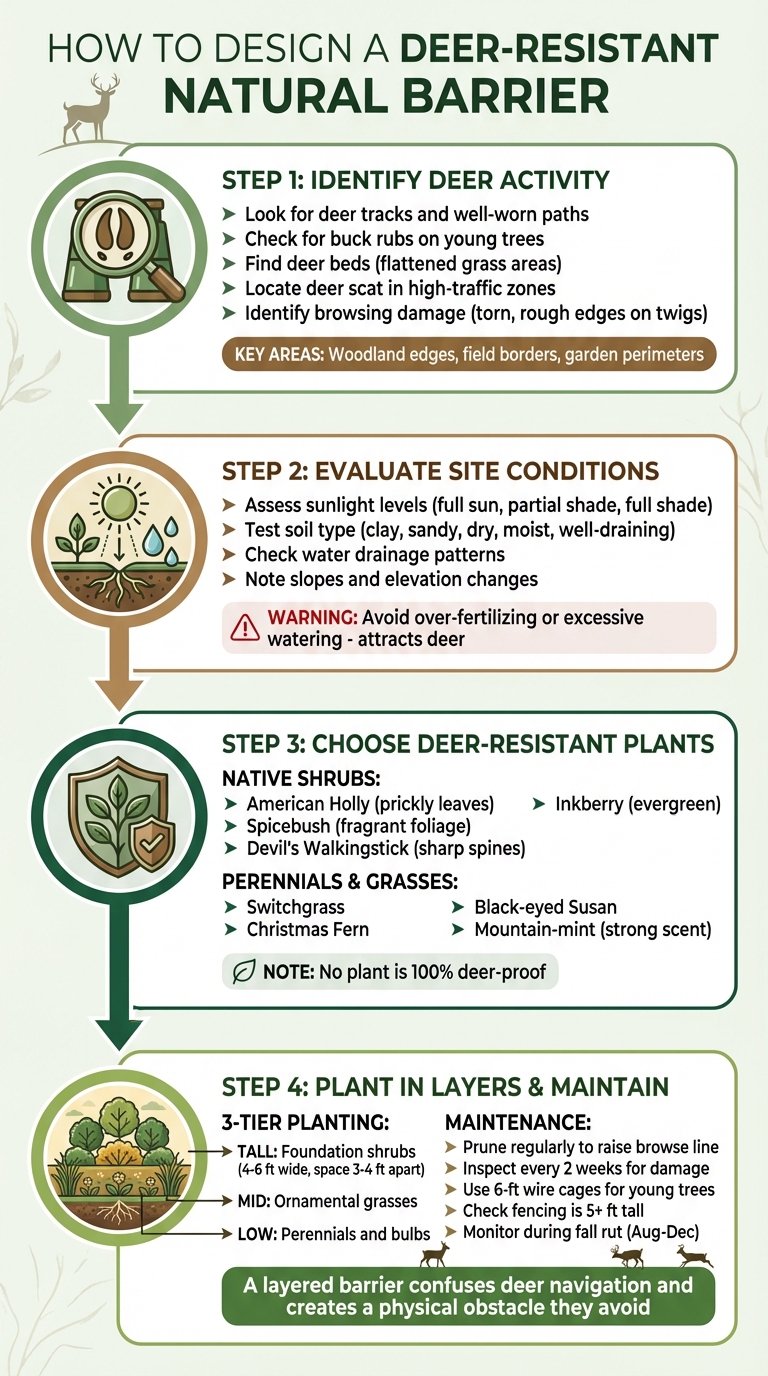
4-Step Guide to Creating a Deer-Resistant Natural Barrier
50 DEER RESISTANT Plants for a Deer Proof Garden & What Plants to Avoid
sbb-itb-843f8be
Evaluating Your Property
Before you start planting, take some time to assess your property for signs of deer activity. Keep an eye out for deer tracks and well-worn paths that show where deer frequently travel – these spots are ideal for placing a barrier. Examine young trees for signs of buck rubs, where male deer scrape off bark to mark territory or shed antler velvet. If you notice bark damage circling an entire trunk, the tree is likely beyond saving because it can no longer transport nutrients effectively[1]. Also, look for deer beds, which appear as flattened areas in tall grass where deer rest.
Deer damage is typically seen at eye level or above. Damage usually includes ripped branches, chewed trees, and empty spaces of flowering plants. – Accent Landscapes [4]
Finding High-Traffic Deer Areas
Deer scat is a surefire way to identify high-traffic zones. Another clue is browsing damage – look for nipped twigs with rough, torn edges (rather than clean cuts), which indicate areas where deer feed regularly. Focus on placing barriers along woodland edges, field borders, and garden perimeters. These are transition zones where deer naturally move from cover to open spaces. Identifying these areas will help you prioritize where to plant thicker vegetation to create an effective barrier.
Checking Sunlight, Soil, and Water Drainage
Once you’ve pinpointed deer activity, evaluate the site conditions for your barrier. Observe how much sunlight each area gets – whether it’s full sun, partial shade, or full shade – since deer-resistant plants thrive under specific light conditions. Next, assess the soil type: is it clay-heavy, sandy, dry, moist, or well-draining? Native Maryland plants are often adapted to certain soil types, so matching your plants to the existing soil will help them grow quickly and densely, making them more effective at deterring deer.
Be cautious about over-fertilizing or excessive watering, as this can lead to lush growth that actually attracts deer. Instead, opt for drought-tolerant plants with tough, fuzzy, or leathery leaves, which deer tend to avoid. If your property has slopes or elevation changes, use these features to your advantage – they can further discourage deer from venturing into your space. With this groundwork complete, you’ll be ready to choose plants that fit your property’s unique conditions and keep deer at bay.
Choosing Deer-Resistant Plants for Maryland
When planning your garden, focus on plants that deer tend to avoid. Keep in mind, though, that deer preferences can be unpredictable. As Dr. Sara Tangren, former Senior Agent Associate at the University of Maryland Extension, points out:
There is no deer-proof plant, and frustratingly, lists of which plants are deer-resistant vary so much they are sometimes in direct contradiction with one another. This is because deer food preferences vary depending on what else is available to eat at any particular time and location [2].
Maryland native plants are often a good bet because they naturally resist deer due to features like thorns, strong scents, or tough textures. Native plants bring an added advantage: they’re well-suited to Maryland’s environment, requiring less yard maintenance, and they support local wildlife, including pollinators and songbirds. By choosing native species, you also help combat the damage caused by deer over-browsing, which often clears the way for invasive plants to take over [2]. To avoid frustration, steer clear of deer favorites like Eastern ninebark or Pinxterbloom azalea in areas where deer frequently roam. Instead, focus on native plants with natural defenses.
Native Shrubs That Deter Deer
Shrubs can serve as the backbone of a deer-resistant landscape. Consider options like American holly (Ilex opaca), which has prickly evergreen leaves, and Spicebush (Lindera benzoin), whose fragrant foliage and preference for moist soil make it unappealing to deer. Inkberry (Ilex glabra) is another evergreen that retains its shape through winter, making it a reliable choice. For something more defensive, Devil’s Walkingstick (Aralia spinosa) has sharp spines along its stems that act as a physical barrier.
Other good options include Waxmyrtle (Morella cerifera), known for its aromatic leaves, and Summersweet (Clethra alnifolia), which thrives in shady, wet areas. Arrowwood Viburnum (Viburnum dentatum) is another tough, multi-purpose shrub that can handle a variety of conditions. Plant these shrubs in layers, using varying heights to create a dense barrier. This approach not only discourages deer but also fills in gaps as your plants grow. For even better results, pair these shrubs with deer-resistant perennials and grasses.
Perennials and Grasses Deer Avoid
To complement shrubs, add perennials and grasses that deer tend to ignore. Switchgrass (Panicum virgatum) and Little Bluestem (Schizachyrium scoparium) are excellent native grasses that bring height and movement to your garden while resisting browsing. In shaded spots, try ferns like Christmas Fern (Polystichum acrostichoides) or Hay-scented Fern (Dennstaedtia punctilobula), as most Maryland ferns are rarely on a deer’s menu [2].
For added color and pollinator appeal, go with Black-eyed Susan (Rudbeckia hirta) or Wild Columbine (Aquilegia canadensis). Mountain-mint (Pycnanthemum muticum) offers strongly scented foliage that deer dislike, while Eastern Prickly-pear (Opuntia humifusa) adds texture and a natural deterrent with its spiny pads. By interplanting these species, you can create a layered garden that not only looks great but also keeps deer at bay.
Planting and Spacing Your Barrier
Once you’ve assessed your property and chosen your plants, the next step is arranging and spacing them to create an effective barrier.
Creating Layers with Different Plant Heights
A layered approach works wonders when designing your barrier. Use three tiers for the best results:
- Tall foundation shrubs like Wayfaring Viburnum, Ninebark, or Spirea to create a hidden backdrop.
- Mid-height ornamental grasses such as Maiden Grass or Feather Reed Grass for added texture and movement.
- Low-growing perennials or bulbs like Hyacinths and Daffodils to complete the look up front.
This tiered design not only creates a strong physical barrier but also confuses deer, making it harder for them to navigate. As Nature Hills Nursery puts it:
"There’s nothing like a well-manicured hedge to burst curb appeal, especially when it looks like Fort Knox to a hungry deer." [1]
For an extra layer of protection, consider planting on berms and garden walls. Elevating your plants conceals the edges of your yard and makes it even more challenging for deer to jump into the area. Together, dense plantings and elevation changes create a formidable barrier.
Spacing Plants for Growth and Coverage
Proper spacing is key to ensuring your plants grow into a continuous, gap-free wall. To do this, space them based on their mature width. For instance, foundation shrubs that grow 4 to 6 feet wide should be planted 3 to 4 feet apart. This allows them to fill in over time, leaving no openings for deer to exploit.
Young trees need extra care to protect them from damage. Use physical guards like 6-foot wire cages or plastic tubing placed a few feet from the trunk to prevent buck rub. These guards should be replaced periodically to avoid moisture buildup. Additionally, spraying newly planted trees and shrubs with odor-based repellents right after installation adds another layer of defense.
Maintaining Your Deer Barrier
Taking care of your deer barrier is essential to keep it in shape and ensure it continues to deter deer effectively. Routine maintenance not only strengthens the barrier but also helps preserve plant health and close any gaps that deer might exploit.
Pruning and Soil Management
Regular pruning encourages healthy plant growth and helps push foliage out of a deer’s reach. Focus on trimming lower branches on trees and tall shrubs to create a "browse line" – a height deer can’t easily access from the ground [3].
Be cautious with fertilizing and watering. Overdoing it can make your plants more appealing to deer. As Casey Hentges, Host of Oklahoma Gardening, points out:
In many cases, plants in a home landscape have been fertilized and are well taken care of, which makes them especially attractive to wildlife [5].
Instead, aim for balanced soil moisture and use fertilizer sparingly. This approach keeps your plants strong without turning them into a deer buffet. It also aligns with the original design of your barrier, keeping plants resilient under deer pressure.
Another critical time for monitoring is during the fall rut season, which typically runs from August through December. Male deer often rub their antlers against tree bark to mark territory. Dwayne Elmore, OSU Extension Wildlife Specialist, explains:
Deer start to rub the dried velvet on a small tree or shrub in the fall and will continue to rub to mark territory for the next couple of months [5].
To protect young trees, consider using plastic or mesh tree guards. After pruning and managing soil, inspect your barrier regularly for signs of deer damage or weak spots.
Inspecting and Adjusting the Barrier
Check your barrier every two weeks for signs of deer presence, such as torn leaves, twig damage, shredded bark on small trees, or flattened areas where deer may have rested. Look for gaps in the planting that could allow entry.
Pay close attention to any fencing or wire cages. Ensure they are at least 5 feet tall and extend all the way to the ground, as deer can squeeze through surprisingly small spaces – just 7.5 inches wide [6]. If deer seem to be testing weak spots, try adding obstacles like large planters or birdbaths near the barrier. These objects can confuse their depth perception and discourage jumping [7]. As the UMN Extension advises:
A fence is only as strong as its weakest point. Ensure that gates are strong and well designed, and check the entire fence frequently for damage [6].
Conclusion
Creating a deer-resistant natural barrier takes careful planning and consistent effort. Start by assessing your property for deer activity, choosing native Maryland plants that deer are less likely to eat, and dedicating time to regular maintenance. This includes pruning, soil care, and periodic inspections to ensure your barrier stays effective throughout the year.
The key to success lies in understanding how deer behave and layering your defenses accordingly. Professional landscaping services can help refine your approach and optimize your design.
"It’s not just about a physical fence; it’s also about understanding deer behavior and being proactive in protecting your property" [8].
In practical terms, this involves selecting the right plants, using proper installation techniques, and keeping a close eye on potential weak spots. Combining these elements ensures not only effective deer deterrence but also a visually appealing landscape. Professionals can recommend plants well-suited to the Eastern U.S., like Honeylocust trees, Alberta Spruce, Oregon Grape Holly, and certain ornamental grasses. They can also protect young trees from antler damage by installing tree guards or metal cages that are at least 6 feet tall [1].
For property owners in central Maryland – covering areas like Howard County and Montgomery County – local experts such as Pro Landscapes MD can help take your barrier to the next level. Their team of horticulturists specializes in creating deer-resistant, aesthetically pleasing landscapes that provide lasting protection against wildlife.
FAQs
How wide should a natural deer barrier be?
Deer barriers need to be carefully designed to keep these persistent animals out. A natural barrier should ideally measure 4 feet wide and 6 feet tall to effectively deter deer. Another effective option is a double fence system: two fences, each standing 4 feet tall, placed 4 feet apart. The right combination of height and width is crucial for success.
How long does it take to become effective?
It can take a few months for a deer-resistant plant barrier to start working effectively. Early on, deer might test or nibble at the new plants. However, by consistently using deer-resistant species, placing them strategically, and maintaining them regularly, the barrier becomes more effective over time. Be prepared to wait several months to a year for noticeable results – patience and consistent care are essential.
What should I do if deer still get through?
If deer keep breaking through your natural barrier, you might want to add extra protection like fencing or tree guards – these are especially effective against larger bucks. Another option is to use repellents or plant strong-smelling herbs such as mint, chives, or lantana around areas that need safeguarding. By combining physical barriers, repellents, and plants that deer tend to avoid, you can help keep them away and protect your landscape.
Chat with Us