









- bhavya gada
- No Comments
Topiary shaping is easier than you think! Whether you’re aiming for classic spheres, spirals, or creative designs, this guide breaks down the tools, plants, and techniques you need to get started. Here’s a quick summary:
- Tools: Use sharp hand shears, bypass pruners, and hedge shears for clean cuts. Wire frames, string, and moss simplify shaping complex designs.
- Plant Choices: Boxwood and Yew are perfect for beginners, while advanced gardeners can experiment with ivy and fast-growing Privet.
- Techniques: Start with simple shapes like spheres or cones, and use guides like ribbons for precision. For spirals, begin with a cone base and trim carefully along a marked path.
- Maintenance: Trim 2–4 times a year depending on plant type, water deeply after pruning, and inspect for pests regularly.
With the right approach, your garden can feature living sculptures that impress year-round. Ready to shape your first topiary? Let’s dive in!
How to Prune a Topiary Ball | Complete Tutorial
sbb-itb-843f8be
Tools You’ll Need for Shaping Topiaries
The right tools make all the difference when it comes to shaping topiaries. Clean, sharp cuts not only look better but also keep your plants healthy. Dull blades can bruise the plant tissue, leading to discoloration and unsightly brown edges [4][6]. Regularly sharpening your tools and disinfecting them between uses – especially when working with Box (Buxus) – is a simple but crucial step to avoid spreading diseases [3][7]. A quick wipe with rubbing alcohol between plants can go a long way in protecting your greenery.
Hand Shears, Bypass Pruners, and Topiary Shears
For precise, detailed work, topiary shears (also known as topiary snips) are your go-to tool. Their small size and sharp blades are perfect for fine-tuning edges, adding finishing touches, and working on delicate foliage without causing damage [3][6]. These shears are ideal for creating clean lines and intricate designs.
When it comes to heavier tasks, bypass pruners (or secateurs) are indispensable. They’re great for cutting thicker stems, tackling woody growth, and making the initial structural cuts before you start shaping. Their scissor-like action ensures smooth cuts that heal quickly and keep your topiary looking polished [3][7].
Hedge Shears and String or Ribbon
For larger surfaces, hedge shears are the tool of choice. Their long handles and wide blades make it easy to shape globes, cones, or tall hedges. They allow you to trim large areas efficiently while also reaching awkward branches [3][7][6].
Simple tools like string, ribbon, or twine can act as guides to ensure symmetry. Wrap them tightly around a sphere to mark cutting lines or use them to outline spiral patterns. These guides are invaluable for achieving balanced designs, especially when precision is key [5][2].
Wire Frames, Sphagnum Moss, and Landscaping Pins
Wire frames are a beginner-friendly way to create consistent shapes, especially for complex designs like animals or geometric figures. You can place a frame over an existing plant to guide your cuts or use it to build a "stuffed" topiary by filling it with a growing medium [7][2][4]. Frames simplify the process, helping you achieve professional results even without years of practice.
For stuffed topiaries, sphagnum moss acts as the growing medium inside the wire structure. To train vining plants like ivy, use landscaping pins or even bobby pins to secure the vines to the frame as they grow [2]. Additional tools like orchid clips, garden velcro, or twist ties can help guide stems along the frame without hindering their growth [5][2][8].
Once you’ve gathered these tools, you’re ready to move on to selecting the best plants to bring your topiary visions to life.
Selecting Plants for Your Topiaries
When choosing plants for topiaries, consider the size of their leaves and their growth habits. Small-leaved evergreens create sharp, defined edges, while larger leaves suit simpler designs. Slow growers like Boxwood and Yew are easier to maintain, needing only two to three trims annually. On the other hand, fast growers like Privet require trimming every 4–6 weeks [3]. Opt for shrubs that naturally align with your desired shape – rounded shrubs for spheres and columnar ones for pyramids – to minimize heavy pruning and reduce plant stress [5].
As Mark Reaves, a topiary expert, advises:
"Never let it grow out of shape to the point where you cannot identify the original shape. Then it’s too hard to get it back" [6].
For designs like spirals or lollipop shapes, choose plants with a strong, single central stem to provide the necessary structure. Below are some plant recommendations for both beginners and advanced gardeners.
Best Plants for Beginners
Boxwood (Buxus) is a classic choice for beginners. Its small, dense leaves and steady growth make it predictable and easy to shape. Even if heavily pruned, it can regrow from older wood. Typically, it only needs two to three trims per year [3].
Yew (Taxus baccata) is another beginner-friendly option. Its slow growth rate means it requires just one or two trims annually to maintain its shape. Plus, it tolerates heavy pruning well.
For those wanting a fragrant alternative, Rosemary is a great pick. Garden writer Tasha Greer notes:
"Rosemary is one of the easiest, most forgiving plants to use to practice your topiary skills" [9].
Rosemary works wonderfully for training along wire frames or creating small standard tree shapes.
In areas with high rainfall, Japanese Holly (Ilex crenata) is a solid substitute for Boxwood. It offers a similar appearance with small leaves and is more resistant to box blight and pests [3] [4]. For cone or spiral designs, Dwarf Alberta Spruce is a top choice due to its naturally symmetrical conical form and very slow growth rate [1].
Plants for Advanced Projects
Once you’ve mastered the basics, you can explore plants that offer more creative possibilities. Duckfoot Ivy and similar small-leaved varieties are ideal for "stuffed" topiaries. These involve filling wire frames with sphagnum moss and training vines to cover intricate shapes. With pliable stems (at least 9 inches long), these plants are easy to work with [2] [4].
For gardeners who can commit to frequent upkeep, Privet (Ligustrum) is excellent for large geometric shapes. While it’s easy to shape, its rapid growth requires consistent trimming [3]. For tall spirals or pyramids, upright varieties like Thuja occidentalis ‘Emerald Green’ or Spartan Juniper provide the necessary height and flexible branches for intricate designs [1] [10].
How to Shape Topiaries Freehand
Shaping topiaries freehand takes a steady hand and a good eye for detail. Starting at the top of the plant and working your way down helps keep clippings from covering areas you haven’t trimmed yet. As Harrod Outdoors puts it, "Topiary shaping is as much about observation as it is about cutting" [3]. Work in small sections, moving around the plant instead of focusing on one side at a time. Always remember: it’s easier to trim more later than to fix an area that’s been cut too much. Below are techniques for shaping spheres, cones, and spirals.
Creating a Sphere Shape
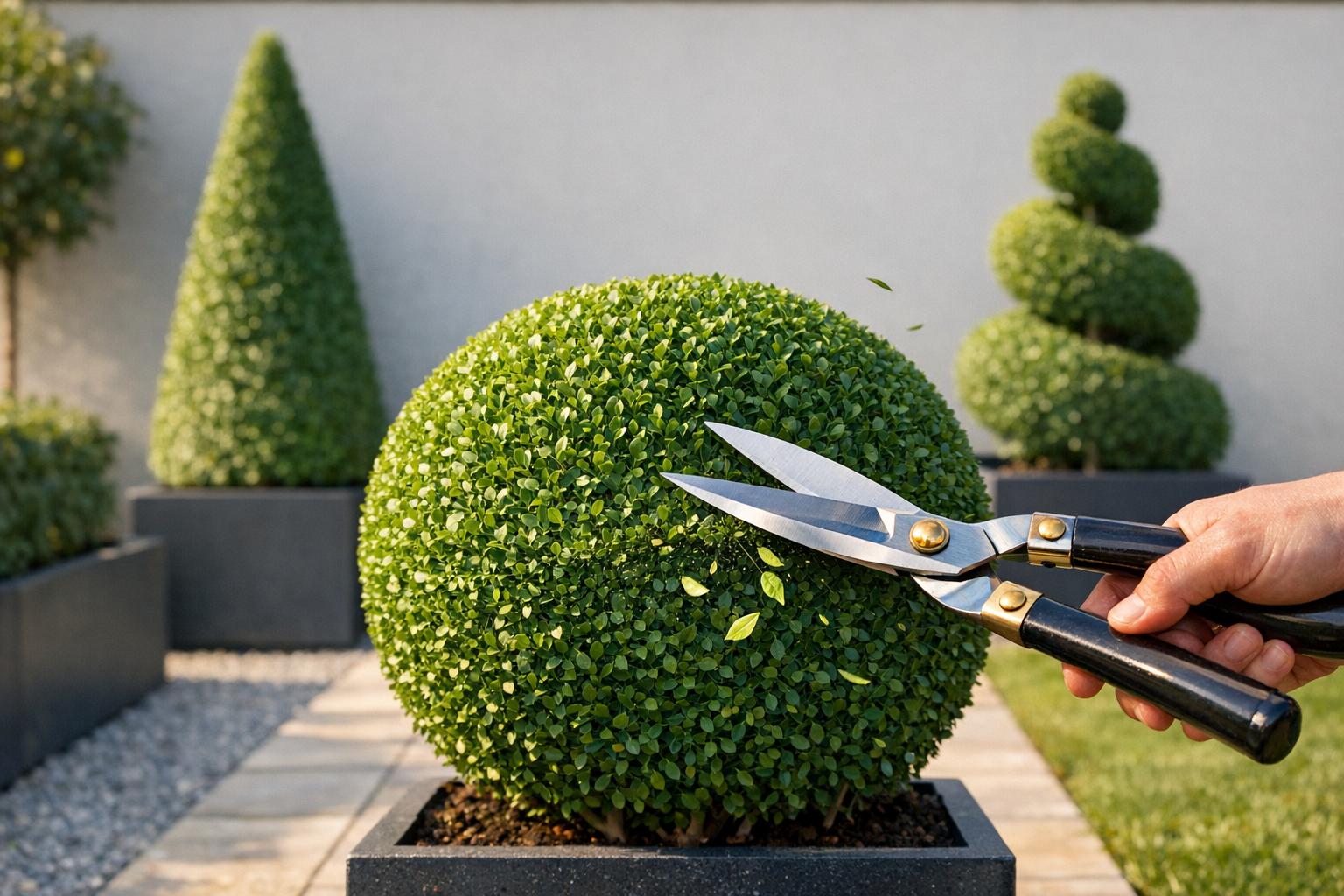
To shape a sphere, begin by pinpointing the top center of your plant. Mark this spot by cutting a cross into the foliage, dividing it into four quarters. For larger spheres, leave a small tuft of growth at the top as a reference point, removing it only when the sphere is fully shaped. Work slowly in horizontal sections, rotating the plant frequently to ensure an even cut. Roll your shears gently along the curve to create a smooth surface. Agnes Stevenson, Editor of Scottish Gardener, advises, "Stand back frequently to survey your handiwork. It’s better to cut too little than too much, but don’t worry too much about holes and gaps. These will soon be filled in by new growth" [11].
Creating a Cone Shape
Start by identifying the apex, or the highest point of your plant. If you’re new to this, tie a string from the apex to the base to guide you. Use the "opposite side" method: trim one side, then match the angle on the other. Once these anchor lines are set, fill in the sections between them for a uniform look. A straight edge, like a piece of wood, can help you achieve sharp, clean lines. Plants with natural upright or conical shapes, such as Arborvitae or Bay Laurel, are ideal for this design and require less drastic pruning.
Creating a Spiral Design
Begin by shaping your plant into a cone, which serves as the base for the spiral. Next, wrap a colored ribbon or string around the plant from top to bottom to outline the spiral grooves. Use small hand shears or scissors to make shallow cuts along the guide, then remove the string and deepen the grooves with bypass pruners. Round off the sharp edges of the remaining foliage to create a smooth, flowing look. William Mitchell from Sutton Manor Nursery shares, "Spiral topiary is actually fairly easy to create and maintain even for beginners" [12]. Fast-growing plants like Privet may need trimming every 4–6 weeks during the growing season, while slower-growing varieties like Yew often require just one or two touch-ups per year [3]. Regular maintenance will keep your spirals looking sharp and healthy.
Working with Wire-Framed Topiaries
Wire frames open up a world of possibilities for creating intricate shapes in your garden – think animals, geometric designs, or even custom forms. These frames build on basic topiary techniques and let you take your creativity to the next level. You can purchase pre-made frames or craft your own using materials like coat hangers or other sturdy, bendable wire. There are two main styles to work with: stuffed topiaries, where moss and soil fill the frame to create an immediate, solid structure, and open wire frames, which act as a skeleton that vining plants can grow around gradually. For stuffed frames, duckfoot ivy is a great choice, while open frames pair well with rosemary or other long-stemmed perennial herbs.
Building and Filling the Frame
Start by soaking sphagnum moss in water for several minutes until it’s fully saturated – this step is crucial, as dry moss won’t retain moisture or support plant roots effectively. Once soaked, pack the moss into the wire frame, leaving a hollow center that you’ll fill with potting mix to provide nutrients. If the moss feels loose or unstable, secure it by wrapping fishing wire around the outside of the frame. Once the moss and soil are firmly in place, your frame is ready for the next step: training plants to follow its shape.
Training Plants to Follow the Frame
Select young plants with flexible, non-woody stems. For vining plants, aim for stems that are at least 9 inches long so they can be wrapped around the frame right away. Use clips or wire ties to attach stems to the frame, ensuring they’re secure but not constricted. As the plant grows, weave new branches through the frame or wrap them around the exterior wires to help fill out the design. For stuffed frames, pin vining sprouts directly to the moss for added stability. To encourage growth, prune flowers as they emerge so the plant focuses its energy on filling out the frame. Keep stuffed topiaries hydrated by misting them, dunking the entire frame in water, or placing them in a saucer that you water once or twice a week. These steps will set you up for long-term success, laying the groundwork for ongoing topiary care, which will be covered in the next section.
Maintaining Your Topiaries Year-Round
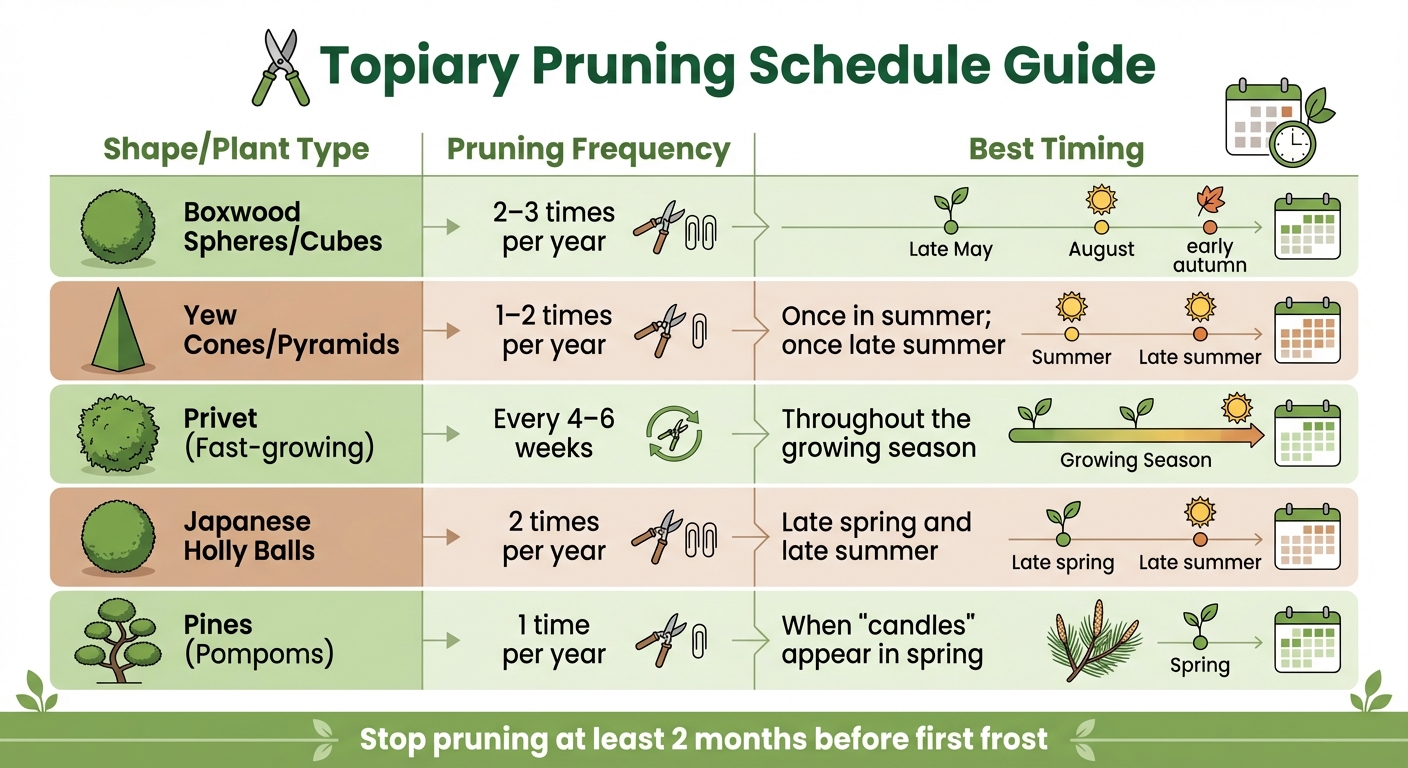
Topiary Pruning Schedule by Plant Type and Shape
Keeping your topiaries in shape and healthy requires consistent maintenance. For evergreen varieties, plan on trimming 2–4 times a year [7]. Typically, you’ll want to prune in late May or early June, again in July or August, and finish with a light touch-up in early to mid-autumn [4]. Fast growers like Privet may need trimming every 4 to 6 weeks during the growing season, while slower-growing plants such as Yew might only need 1 or 2 trims annually [3]. To avoid cold damage, stop pruning at least two months before the first frost is expected [7].
How Often to Prune
The frequency of pruning depends on the plant species and the shape you’re maintaining. For instance, Boxwood, often used for spheres and cubes, typically requires 2 to 3 trims per year – one in late May, another in August, and an optional touch-up in early autumn [3]. Mark Reaves, owner of Topiary Courtyard, stresses the importance of regular upkeep:
"Never let it grow out of shape to the point where you cannot identify the original shape. Then it’s too hard to get it back" [6].
For complex designs or fast-growing plants, more frequent pruning prevents the interior from becoming woody or hollow [7].
Watering, Fertilizing, and Pest Control
After pruning, water deeply to counteract moisture loss caused by the cuts [7]. Topiaries in containers dry out faster, especially in summer, so check daily during peak heat [1]. Use a slow-release fertilizer in early spring, but skip feeding in late summer or fall to avoid encouraging tender new growth that could be damaged by frost [10]. Adding a 2-inch layer of mulch around the base helps retain moisture and regulate soil temperature – just keep it away from the trunk [3].
Regularly inspect your plants for pests like box blight, box tree caterpillars, aphids, and scale insects. To prevent spreading diseases, disinfect your pruning tools between plants [3]. Adjust your care routine based on the specific needs of your topiary’s shape and plant type.
Pruning Schedule by Shape
Your pruning routine should align with the shape and species of your topiary. Here’s a quick guide:
| Shape/Plant Type | Pruning Frequency | Best Timing |
|---|---|---|
| Boxwood Spheres/Cubes | 2–3 times per year | Late May, August, early autumn |
| Yew Cones/Pyramids | 1–2 times per year | Once in summer; once late summer |
| Privet (Fast-growing) | Every 4–6 weeks | Throughout the growing season |
| Japanese Holly Balls | 2 times per year | Late spring and late summer |
| Pines (Pompoms) | 1 time per year | When "candles" appear in spring |
For precision, hand shears are better than power trimmers during hot summer months, as power tools can bruise leaves and cause browning at the tips [6]. If you live in a colder climate, protect your topiaries from winter burn by wrapping them in burlap or setting up windbreaks to shield them from drying winds and frozen soil [10].
Conclusion
Professional topiary shaping thrives on steady, simple techniques paired with consistent care. This guide has covered everything from choosing the right plants to shaping and maintaining them, giving you the tools to approach topiary with confidence. Start trimming from the top, check for symmetry frequently, and aim for light trims 2–3 times a year for the best results [7].
When precision is key, wire frames or string guides can be incredibly helpful. After significant pruning sessions, be sure to water deeply to support plant recovery [7]. Keep your tools sharp and sanitized, and avoid trimming during wet weather to prevent potential plant damage [3].
While topiary requires both skill and dedication, professional help is always an option for intricate designs or large-scale projects [1]. Experienced landscapers can bring expertise to more complex undertakings, ensuring exceptional results.
For those in central Maryland, Pro Landscapes MD offers specialized gardening and landscaping services. Their team of professional horticulturists can assist in crafting and maintaining stunning topiaries and other garden features. Learn more about their services at https://prolandscapesmd.com.
With patience and consistent care, your topiaries can become enduring works of art, adding sculptural beauty to your garden all year long.
FAQs
When is the best time of day to prune topiaries?
The ideal time to prune topiaries is during daylight hours, preferably in the morning or early afternoon, when the weather is dry and sunny. Late spring to early summer is the best season for pruning since plants are actively growing, and their leaves are sturdier and less prone to damage. Steer clear of pruning in wet or humid conditions, as this can increase the risk of disease or harm to the plant.
How do I fix a topiary that’s been trimmed too much?
If you’ve over-trimmed a topiary, the best approach is to let it recover at its own pace. Begin by carefully removing any damaged or diseased sections with clean, sanitized pruning tools. Skip any heavy pruning for now – stick to light, selective cuts to promote healthy regrowth. Make sure the plant gets enough water and nutrients by keeping up with regular watering and applying fertilizer as needed. Recovery can take time, often a season or two, so patience is key. Once it starts to regain its shape, maintain it with gentle, regular trims to keep it looking its best.
Can I shape a topiary in a pot, and what changes for care?
Shaping a topiary in a pot is a popular choice since it offers flexibility in placement. Start with a dense, pruning-friendly plant like boxwood or yew. Make sure it gets plenty of sunlight – ideally several hours a day – and water it regularly to keep the soil moist but not overly wet. During the growing season, fertilize once a month to promote healthy growth. Pruning is key to maintaining its shape, so plan to trim it periodically, usually in late spring or early summer. To prevent root binding, either repot the plant or prune the roots when necessary.
Chat with Us