









- bhavya gada
- No Comments
Modular filtration systems are transforming how stormwater runoff is managed, especially in urban areas. These systems treat pollutants directly at their source, reducing harmful substances like heavy metals, microplastics, and toxic tire chemicals. With compact designs, they fit into existing spaces like street gullies and curb inlets, making them ideal for cities. Key findings include:
- Pollutant Reduction: Removes up to 97% of road sediment, 90% of heavy metals, and 95% of toxic tire chemicals like 6PPD-quinone.
- Aquatic Life Protection: Improves water quality, preventing harm to species like salmon by filtering out toxins and reducing harmful algal blooms.
- Compact Efficiency: Requires minimal space, making it suitable for retrofitting in urban areas.
These systems are especially relevant for Maryland, where they support efforts to protect the Chesapeake Bay by reducing sedimentation and improving water quality. They also offer practical benefits like flood control and low maintenance, making them a smart choice for property owners.
Research Results: How Modular Filtration Helps Ecosystems
Pollutant Reduction Data
Modular filtration systems are highly effective at capturing pollutants. For example, these systems can retain up to 97% of road-deposited sediment [1]. They also reduce fine particulate matter (smaller than 63 micrometers) by up to 66% when using optimized designs [1].
Modular Bioretention Tree (MBT) systems are particularly efficient, removing over 90% of heavy metals like zinc, copper, cadmium, and lead [2]. A field study in Maryland at Campus Creek demonstrated that a step-pool structure reduced total nitrogen by 32%, phosphorus by 38%, and suspended solids by 59% over a 40-month period [5].
These systems also address tire-derived toxins, such as 6PPD-quinone, which is highly toxic to salmon. Bioretention cells reduce this toxin by a factor of 10, mitigating over 90% of it under normal storm conditions [3]. In July 2022, a full-scale bioretention cell tested in Vancouver (at Pine and 8th Streets) achieved a 95% mass reduction in 6PPD-quinone, lowering concentrations from around 4,300 ng/L to just 150 ng/L [3].
The impressive pollutant reductions achieved by modular systems not only improve water quality but also create healthier habitats for aquatic species, as seen in their impact on aquatic life.
Effects on Aquatic Life
Cleaner water directly benefits aquatic ecosystems. The removal of 6PPD-quinone is especially critical, as this chemical has a lethal concentration (LC50) as low as 95 ng/L for adult coho salmon and 41 ng/L for juveniles [3]. By filtering out this toxin, modular systems safeguard salmon populations and other vulnerable fish species in Maryland’s waterways.
"Stormwater filtered through laboratory-scale bioretention columns protected coho salmon from the acutely lethal effects of stormwater runoff." – Environmental Science & Technology Letters [3]
Reducing heavy metals, sediments, and microplastics also creates a more supportive environment for aquatic plants and fish. For example, the 92% retention rate for microplastics like polyethylene (PE) pellets and cigarette filters [1] means less plastic pollution in fish habitats. Additionally, significant reductions in phosphorus and nitrogen levels help prevent harmful algal blooms, which deplete oxygen and threaten aquatic life.
For Maryland property owners near the Chesapeake Bay and its tributaries, these improvements align with efforts to meet Total Maximum Daily Load (TMDL) requirements, ensuring healthier ecosystems and water quality for the region.
sbb-itb-843f8be
How Does Poor Water Quality Affect Conservation Efforts? – Ecosystem Essentials
How Modular Filtration Systems Work
Modular filtration systems combine mechanical, chemical, and biological processes to remove pollutants from stormwater. By layering these technologies, these systems achieve impressive pollutant removal rates, as shown in research data. This blend of natural and engineered methods boosts their overall effectiveness.
Plant-Based Filtration Methods
Plant-based methods are a key part of this multi-layered approach, focusing on nutrient absorption and heavy metal removal. Plants and their root systems play a significant role in filtering stormwater. In modular bioretention tree (MBT) systems, vegetation absorbs nutrients like nitrogen and phosphorus from infiltrated water. Meanwhile, roots capture heavy metals, preventing these contaminants from entering waterways.
The success of these systems often depends on root depth and spread. Deeper root systems allow for greater nitrogen removal by promoting microbial processes. For instance, a 15-month study at the National University of Singapore used the coastal tree species Talipariti tiliaceum in an MBT system with a 3.3-foot-deep engineered soil media. The results were striking: average effluent concentrations of just 4.8 mg/L for total suspended solids and 0.04 mg/L for total phosphorus [2].
"The MBT unique deep soil media helps to sustain a healthy tree and to provide extended stormwater runoff treatment." – MDPI Water [2]
Root growth and decay also play a role in maintaining the system’s hydraulic capacity. As roots grow and die, they create channels in the soil, preventing compaction and clogging. This natural process ensures consistent water flow through the filter media [8]. Studies show that vegetated systems outperform non-vegetated ones significantly. For example, vegetated filtration columns remove 63–77% of nitrogen, while non-vegetated versions can actually release nitrogen back into the water [8]. Engineered components work alongside these natural processes to further improve pollutant removal.
Filtration Technology Features
In addition to plant-based methods, modular systems include advanced engineered components that enhance their performance. These specialized modules target specific pollutants. For example, a funnel module reduces water turbulence, improving sedimentation rates and capturing fine particles through controlled flow dynamics [1].
One of the most important features is the engineered soil media. MBT systems use a proprietary mix of soil, sand, coconut fibers, and Water Treatment Residue (WTR) [2]. The WTR contains aluminum oxides that chemically bind dissolved phosphorus, preventing it from flowing downstream. Coconut fibers act as a carbon source, promoting denitrification – a microbial process that turns nitrates into harmless nitrogen gas [2].
In January 2023, researchers at the Technical University of Berlin tested a modular "mesh skirt and funnel" design using 22 pounds of road-deposited sediment. This setup achieved total suspended solid retention rates of up to 97% and effectively filtered microplastics, polyethylene pellets, and cigarette butts [1]. The combination of mechanical filtration and flow control proved far more effective than using a single component. For instance, an optimized leaf basket alone retained only 60% of total suspended solids [1].
Modular vs. Centralized Filtration Systems
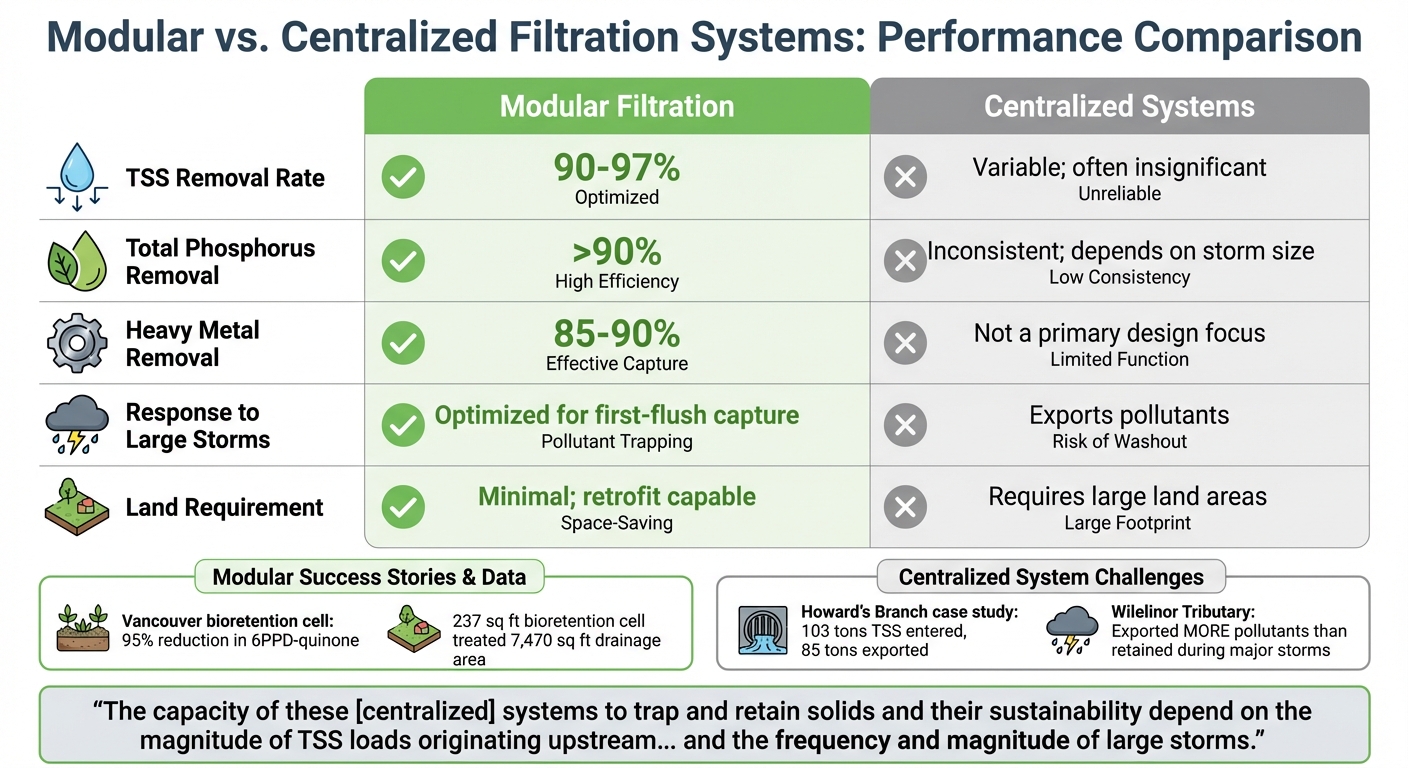
Modular vs Centralized Filtration Systems Performance Comparison
Modular systems focus on capturing pollutants directly at the source, while centralized systems treat water only after it has traveled through the watershed. This fundamental difference becomes especially apparent during storm events.
Between October 2008 and September 2011, researchers Solange Filoso and Michael R. Williams studied two stream-wetland complexes in Maryland: Howard’s Branch and Wilelinor Tributary. Their findings were striking. At Howard’s Branch, 103 tons of total suspended solids (TSS) entered the system, but 85 tons were still exported downstream. At Wilelinor Tributary, the centralized system performed even worse – it exported more pollutants than it retained during major storm events [7].
"The capacity of these [centralized] systems to trap and retain solids and their sustainability depend on the magnitude of TSS loads originating upstream… and the frequency and magnitude of large storms." – Solange Filoso [7]
This data underscores the advantages of modular systems, which have consistently shown better pollutant reduction capabilities compared to centralized approaches.
Performance Comparison Data
When comparing performance metrics, modular systems consistently deliver better results than centralized systems. A 2022 study by Timothy F. M. Rodgers and his team tested a 237-square-foot bioretention cell in Vancouver, Canada, designed to treat runoff from a 7,470-square-foot drainage area. The results? The modular system reduced 6PPD-quinone – a toxic chemical from tires that harms salmon – by over 90% [3].
"Stormwater bioretention systems can effectively mitigate >∼90% of 6PPD-quinone loadings to streams under most ‘typical’ storm conditions." – Timothy F. M. Rodgers [3]
These findings highlight the superior pollutant removal and resilience of modular systems.
| Performance Metric | Modular Filtration | Centralized Systems |
|---|---|---|
| TSS Removal Rate | 90–97% [1][2] | Variable; often insignificant [7] |
| Total Phosphorus Removal | >90% [2] | Inconsistent; depends on storm size [7] |
| Heavy Metal Removal | 85–90% [2] | Not a primary design focus [7] |
| Response to Large Storms | Optimized for first-flush capture [1] | Exports pollutants [7] |
| Land Requirement | Minimal; retrofit capable [1] | Requires large land areas [7] |
Modular systems not only excel in pollutant control but also offer practical benefits for property owners. They require less land, can be retrofitted into existing infrastructure, and provide targeted pollution management. For example, intersections – where tire particles are three to seven times higher than on straight roads – benefit significantly from modular systems [1]. In contrast, centralized systems depend on vast land areas and upstream watershed conditions, factors often beyond the control of individual property owners.
Using Modular Filtration in Maryland Landscaping
Maryland’s Chesapeake Bay watershed is highly sensitive to runoff from developed areas. Studies show that modular filtration systems not only reduce pollutants but also improve water quality, making them especially useful in regions like Maryland. These systems provide a practical solution that blends seamlessly into residential and commercial landscapes. The challenges of managing stormwater in this area highlight the need for effective solutions, as seen in the work of Pro Landscapes MD.
Pro Landscapes MD‘s Stormwater Management Services

Pro Landscapes MD incorporates modular filtration into its drainage solutions throughout central Maryland. Their French drain installations can include bioretention media, which combines biochar with native plants like common rush (Juncus effusus) and red fescue (Festuca rubra). Research has shown that this combination enhances nitrogen removal, particularly during the system’s early operation stages[6].
Dry riverbeds, another feature they offer, act as decentralized filtration systems, capturing pollutants right at the source. These can be strategically placed in high-traffic areas, such as driveways or near intersections, to maximize their effectiveness. Additionally, Pro Landscapes MD installs environmental pavers that allow water to seep into the ground while filtering out sediments and pollutants before they flow into storm drains.
By integrating modular filtration into projects like drainage systems, grading, land leveling, and yard repair, Pro Landscapes MD helps property owners comply with Maryland’s strict Environmental Site Design standards. These solutions not only manage stormwater effectively but also provide added value to property owners by protecting local waterways and enhancing functionality.
Advantages for Maryland Property Owners
For Maryland homeowners and businesses, modular filtration systems offer numerous benefits. These systems are up to 90% smaller than traditional bioretention setups, which means they save space – perfect for areas like patios, parking lots, or landscaped yards[10]. Their compact size also makes them ideal for retrofitting into existing properties without requiring major construction work.
Approved by the Maryland Department of the Environment, these systems are highly efficient at removing pollutants that are harmful to the Chesapeake Bay. For instance, they achieve a median removal rate of 89% for Total Suspended Solids (TSS) and 61% for total phosphorus[9]. This is particularly important in Maryland’s Coastal Plain, where the soil is prone to erosion[7], as it prevents sediment from reaching tidal tributaries.
Beyond stormwater management, these systems can boost property value. They handle heavy rainfall with flow rates exceeding 100 inches per hour, providing essential flood protection. Meanwhile, bioretention areas with native plants add aesthetic appeal and create inviting green spaces. Maintenance is simple and requires only basic tools[9]. For property owners looking for long-term water management solutions that also support local ecosystems, modular filtration offers a smart investment. By combining advanced filtration with thoughtful landscaping, these systems deliver both functional and ecological benefits, aligning with key findings from earlier research.
Conclusion: Modular Filtration’s Impact on Local Ecosystems
Modular filtration systems are making a real difference for Maryland’s waterways. These systems can retain up to 97% of road-deposited sediments and capture 66% of fine particulate matter smaller than 63 micrometers[1]. This is especially vital for the Chesapeake Bay, where sedimentation rates – driven by human activity – have increased 4 to 5 times their natural levels[7]. Such performance is a crucial step in helping the region’s ecosystems recover from these challenges.
Beyond sediment control, these systems also shield aquatic life from harmful pollutants. For example, they reduce 6PPD-quinone, a tire-wear chemical highly toxic to salmon, by approximately 95%. This is a game-changer for protecting vulnerable species in Maryland’s waterways. As Timothy F. M. Rodgers explains:
"Stormwater bioretention systems can effectively mitigate >∼90% of 6PPD-quinone loadings to streams under most ‘typical’ storm conditions"[3].
What makes modular filtration even more practical is its compact design, which allows for easy retrofitting. These systems are particularly effective in pollution "hot spots", like busy intersections, where tire-wear pollutants can be up to 7 times higher than on straighter road sections[1]. This targeted approach means property owners can address specific issues efficiently without requiring extensive construction.
In Maryland’s Coastal Plain, these systems strike a balance between ecological protection and practical use. Maintenance is straightforward – typically involving surface media replacement every two years[4] – while pollutant removal remains steady, helping to safeguard the Chesapeake Bay and local wildlife. By tackling both pollution and flood risks, modular filtration systems offer a well-rounded solution that aligns with Maryland’s environmental goals. Integrated into broader drainage strategies, they provide long-term benefits that reach far beyond individual properties.
FAQs
Do modular filtration systems work during big storms?
Modular filtration systems are highly effective for capturing microplastics and pollutants during stormwater runoff, even under heavy rainfall. These systems can trap particles as small as 10 µm, helping to minimize the release of harmful pollutants. However, their efficiency often depends on the specific design of the system and the severity of the storm.
Where should modular filtration be installed on a property?
Modular filtration units are best installed in areas with stormwater runoff, like bioretention systems or constructed wetlands. These strategic placements work to efficiently reduce pollutants and microplastics, ensuring cleaner water is returned to the environment.
How often do modular filtration systems need maintenance?
Modular filtration systems typically require maintenance every 12 to 24 months. During this time, components such as cartridge filters and drain-down filter media should be replaced to maintain peak performance and ensure high water quality.
Chat with Us