









- bhavya gada
- No Comments
Storm drain inlet protection is critical for managing runoff and preventing pollutants from entering waterways. However, common issues – like poor installation, lack of maintenance, and heavy rainfall – can lead to system failures, flooding, and environmental damage. This guide highlights the most frequent problems, practical solutions, and the importance of regular inspections and proper installation.
Key Takeaways:
- Common Problems: Poor installation, clogged filters, heavy rainfall overwhelming systems, debris blockages, and missing upslope controls.
- Solutions:
- Install devices securely with no gaps and proper materials.
- Inspect and maintain systems regularly, especially after storms.
- Use two-stage systems or overflow features for heavy rainfall.
- Combine multiple protection methods, such as upstream barriers and sediment controls.
- Partner with professionals for tailored solutions and regulatory compliance.
- Best Practices: Address runoff before it reaches inlets, replace clogged filters promptly, and use durable materials like HDPE guards.
By implementing these strategies, you can improve the reliability of stormwater systems, reduce flooding risks, and comply with local regulations.
Contruction BMPs 5 Temporary Inlet and Curb Protection
sbb-itb-843f8be
Common Problems with Inlet Protection
Even the best inlet protection devices can fail if they’re not installed or maintained properly. In Maryland, the challenge is even greater due to the region’s clay-heavy soils and intense summer storms that can drop 1–3 inches of rain in just half an hour [8]. Issues like poor installation, lack of maintenance, extreme weather, and missing upslope controls all contribute to stormwater management problems. Knowing these common pitfalls can help you catch problems early and prevent flooding.
Poor Installation Creates Sediment Bypasses
When inlet protection devices aren’t installed correctly, sediment can slip past them. Problems like shallow trenching, weak anchoring, or improper sealing against the curb allow water to bypass the barrier entirely. For these devices to work, they need to be buried at least 4 inches deep, securely tied or gripped by heavy grates, and sealed tightly to stop sediment from sneaking underneath or around the edges [2][4][5]. A good seal ensures water flows through the filter – not around it [3].
"If traffic is too close to the curb and you can’t use gravel bags, you can use wire ties to secure the units in place" [2].
Material choice also matters, especially in high-traffic areas. Gravel bags, for instance, often burst under the weight of vehicles, spilling their contents into the very drains they’re supposed to protect [4]. Beyond installation, consistent maintenance is essential to keep these devices working.
Lack of Maintenance Causes Clogging and Overflow
When filters get clogged with fine sediment, they stop working as intended. Instead of filtering water, they act as a dam, causing water to back up, flood surrounding areas, and eventually bypass the device, carrying sediment with it.
"Once the pores in the filter clog up, it then becomes a dam rather than a filter and you need to replace the filter fabric on the outside" [5].
Debris like leaves, grass clippings, and trash can also pile up, decay, and release unpleasant odors or harmful gases [3]. For catch basin inserts, neglecting maintenance allows pollutants to mix into the water, reducing their ability to trap hydrocarbons and heavy metals [3]. Filter fabric typically needs replacing when sediment reaches 50% of the device’s height, and urban catch basin inserts should be serviced at least three times a year [2][5]. After any heavy storm, immediate inspections are critical to remove silt and debris buildup [1][3].
Even with proper care, extreme weather can push these systems beyond their limits.
Heavy Rainfall Causes Ponding and Overflow
Maryland’s summer storms bring a unique problem. Unlike the steady, soaking rains of spring, summer storms unleash intense bursts of rain – sometimes referred to as "walls of water" – that can overwhelm systems designed for slower flows [8].
"Just because a system can handle a slow rain doesn’t mean it can handle a wall of water" [8].
Most inlet protection devices have flow rate limits between 40 and 200 gallons per minute [3][4]. When rain exceeds these rates, water backs up and ponds around the inlet. This issue is worse during dry summer months when compacted, clay-heavy soils become less absorbent, leading to faster and heavier runoff [8].
Without secondary overflow routes, systems fail quickly during extreme weather. For example, in 2014, Tacoma’s solid waste transfer station flooded when heavy rain clogged trench drains with sediment, causing water to spill over the grates [5]. By mid-summer, vegetation growth and shifted mulch can also block inlets, leading to ponding even during moderate storms [4][8].
Debris Blockages and Wrong Design Choices
Large debris like leaves, trash, and construction materials can block inlet protection devices entirely. This is especially problematic during the "first flush" of a storm, which carries the highest concentration of pollutants. Maryland’s dry summers make this initial runoff particularly heavy with debris [3].
Using the wrong device for the site can also lead to failure. In October 2014, Greg McCormick, Water Pollution Control Manager for Riverside Construction Co., shared an example:
"On a project where traffic was shifted close to the gutter, the gravel bags were frequently crushed, causing gravel to enter the drains" [4].
Switching to traffic-resistant synthetic guards solved the issue, reducing repairs and improving sediment capture [4]. Site-specific conditions play a big role in device performance. For instance, automatic retractable screens are calibrated to activate when water reaches about 3 inches of curb flow [4]. If the flow patterns don’t align with the device’s design, failure is almost inevitable, even with proper installation and maintenance.
Managing runoff before it even reaches the inlet can prevent many of these issues.
Missing Upslope Controls Reduce Effectiveness
Inlet protection devices can’t handle uncontrolled runoff from upslope areas on their own. When water rushes downhill without any speed control or sediment settling, it hits the inlet with too much force and sediment for the device to manage.
"To only address the efficiency of a practice without addressing the stormwater is a setup for failure" [5].
Without perimeter controls like barriers, berms, or vegetation, runoff reaches inlets too quickly and overwhelms even high-efficiency devices. ASTM field tests show that sediment barriers can retain up to 96.6% of sediment and reduce turbidity by 58% [5]. Using gravel infiltration trenches, breathable topsoil, and staged drainage systems can help manage runoff volume and speed before it reaches the inlet [8]. These combined measures allow inlet protection devices to do their job effectively, rather than being overwhelmed by excessive runoff.
Solutions to Fix Inlet Protection Problems
Install Devices Correctly
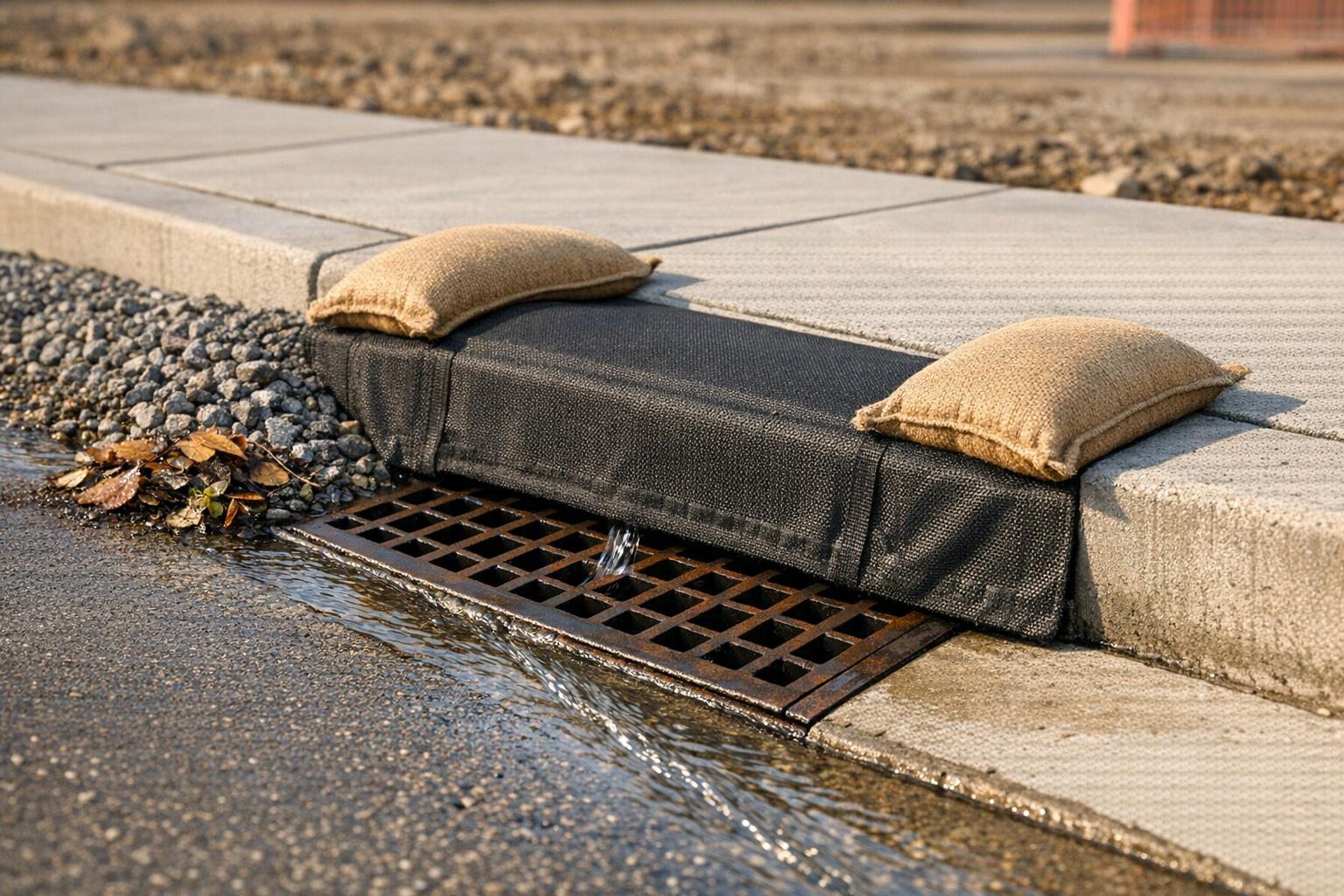
Getting the installation right is the first step to effective inlet protection. For frame-style filters, make sure there’s a secure, gap-free seal by using gravel, and tuck tail sections under grates on paved surfaces for added stability [5]. In unpaved areas, trench devices at least 4 inches deep and secure them with wood stakes to keep them in place [2][4].
In areas with heavy traffic, replace gravel bags with HDPE guards. These can be secured using zip ties or rebar, which helps prevent crushing [2][4]. For regions prone to heavy storms, choose devices with built-in bypass features, such as 2-inch gaps or overflow windows. These allow excess water to flow through while still capturing larger debris [2][4].
Inspect and Maintain Regularly
Regular inspections are key to keeping these systems working. Check devices weekly and after each rainfall [1][3]. If you notice standing water or "ponding" after light rain, it’s a sign that the filter pores might be clogged and need cleaning or replacing [5]. Sediment buildup should never exceed half the height of the device, as this can cause it to act more like a dam than a filter [5].
Reusable HDPE products make maintenance easier. Crews can swap out dirty units with clean ones on-site, knock off dried sediment with a shovel, and rinse them with a hose before reusing them [4]. For example, Greg McCormick, Water Pollution Control Manager at Riverside Construction Co., implemented this method in 2014 after switching to ERTEC Top Guard products. This switch significantly reduced labor costs and repair needs [4]. Catch basin inserts should be serviced at least three times a year, with filter media replaced annually [2]. Always dispose of collected silt and debris at approved facilities to avoid secondary pollution [1][2].
This consistent upkeep ensures the system can handle the challenges of heavy storms.
Adjust Design for Heavy Storms
When storms become intense, adjustments to the system design are crucial. Devices designed for normal flow rates can struggle to handle sudden surges of water. To address this, two-stage systems are effective – they filter during normal flows and bypass during high flows [5].
Automatic retractable screens (ARS) are another practical solution. These systems open up during heavy rain to prevent street flooding. Terry Flury, inventor at United Storm Water, emphasizes the importance of this feature:
"During a big storm or rain event – especially a big first-flush event – it’s absolutely 100% necessary that the screen opens up and lets everything in. Otherwise it’s going to cause some pretty bad street flooding and lead to some liability issues like you would not believe" [4].
Using ARS can cut down catch basin cleanouts by about 50% annually [4]. For residential properties, upgrading standard 3-inch drain pipes to 4-inch SDR-35 lines and maintaining a 2% slope can better manage high-volume water flow [7].
Use Multiple Protection Methods Together
Relying on a single device isn’t enough to address all challenges. Combining multiple strategies ensures better reliability. Start by using upstream pretreatment methods like rock bags or check dams in gutters and swales. These slow down runoff and trap heavy sediment before it reaches the drain. At the inlet, frame-and-filter assemblies are more effective than silt fences because their circular design evenly distributes water pressure, reducing the risk of collapse [5].
In 2014, Jim Nunn, Facilities Maintenance Supervisor at the City of Tacoma Solid Waste Management Facility, installed 300 feet of Heavyweight DuraWattle to protect trench drains used by 60 heavy trucks daily. By anchoring the system properly and scheduling monthly cleanings, they reduced silt infiltration and maintenance needs [5]. This layered approach allowed the facility to handle both daily sediment loads and intense storms effectively.
Control Runoff from Upslope Areas
Inlet protection devices alone can’t handle uncontrolled runoff from upslope areas. Supporting these devices with upslope controls is critical to their success [5].
Install perimeter controls like silt fences, fiber logs, or rock check dams upslope to slow water flow and allow sediment to settle before it reaches the inlet. ASTM field tests show that heavyweight sediment barriers can retain up to 96.6% of sediment and reduce turbidity by 58% [5]. On construction sites, stabilizing disturbed soil with erosion control blankets or breathable topsoil further reduces sediment in runoff [8]. These upslope measures act as a backup, ensuring the primary inlet filter isn’t overwhelmed [4].
Comparison of Inlet Protection Methods
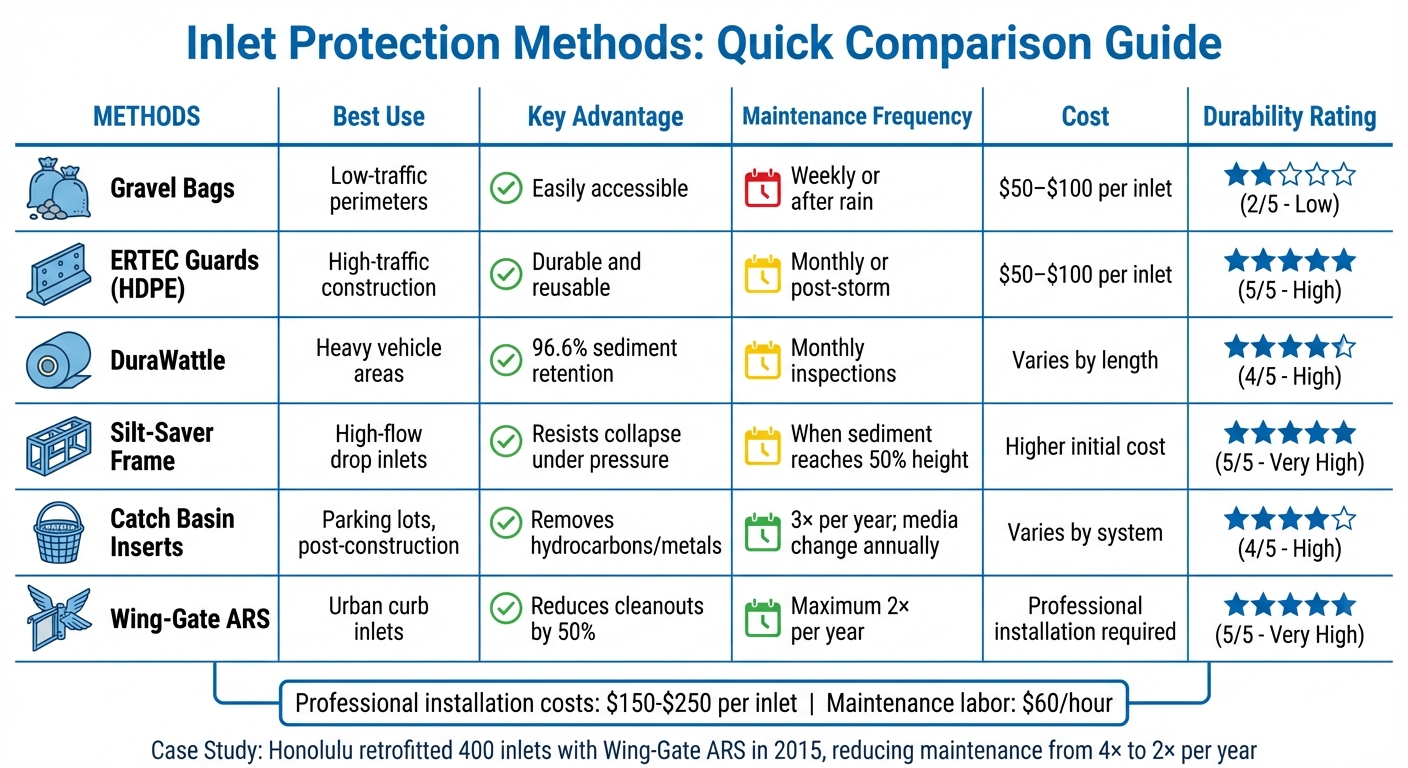
Comparison of Storm Drain Inlet Protection Methods: Cost, Maintenance, and Effectiveness
When choosing an inlet protection method, it’s essential to weigh the options based on your site’s specific conditions, traffic levels, and budget. Each method comes with its own set of trade-offs in terms of cost, durability, and maintenance. Here’s a breakdown of the main methods to help you decide.
Gravel bags are a common choice, costing about $50–$100 per inlet. However, they require frequent repairs – often weekly – since vehicles can easily crush them [4]. On the other hand, HDPE guards, like those from ERTEC, are similarly priced at $50–$100 per inlet but are far more durable. These guards can last through an entire project without constant maintenance. Greg McCormick, Water Pollution Control Manager at Riverside Construction Co., highlighted the difference when his team switched to HDPE guards in 2014: gravel bags needed weekly attention, while HDPE units stayed intact [4].
Frame assemblies, such as those from Silt-Saver, offer structural strength that silt fences lack. While silt fences collapse under just 10 inches of water pressure, frame systems maintain their shape even when water levels reach the top, thanks to their circular compression design [5]. These systems also boast impressive efficiency, handling 98% sediment retention at a flow rate of 180 gallons per minute per square foot for the first 12 inches of height [5].
For post-construction sites, catch basin inserts are an effective solution for targeting specific pollutants. For example, the Smart Sponge Plus system installed at Havens Beach in Sag Harbor in August 2013 reduced bacteria levels by over 92%, bringing counts down from 12,500 to below 1,000 [2]. These systems require servicing three times a year, with the media replaced annually [2].
| Method | Best Use | Key Advantage | Maintenance Frequency | Cost |
|---|---|---|---|---|
| Gravel Bags | Low-traffic perimeters | Easily accessible | Weekly or after rain | $50–$100 per inlet |
| ERTEC Guards | High-traffic construction | Durable and reusable | Monthly or post-storm | $50–$100 per inlet |
| DuraWattle | Heavy vehicle areas | 96.6% sediment retention [5] | Monthly inspections | Varies by length |
| Silt-Saver Frame | High-flow drop inlets | Resists collapse under pressure | When sediment reaches 50% height | Higher initial cost |
| Catch Basin Inserts | Parking lots, post-construction | Removes hydrocarbons/metals | 3× per year; media change annually | Varies by system |
| Wing-Gate ARS | Urban curb inlets | Reduces cleanouts by 50% [4] | Maximum 2× per year | Professional installation required |
The Wing-Gate ARS system stands out for its innovative approach to urban curb inlets. These automatic retractable screens open during heavy debris flow, reducing street flooding. Terry Flury, the system’s inventor, emphasized the importance of this feature:
"During a big storm or rain event – especially a big first-flush event – it’s absolutely 100% necessary that the screen opens up and lets everything in. Otherwise it’s going to cause some pretty bad street flooding" [4].
After successful testing in Honolulu in October 2014, the city awarded a contract in March 2015 to retrofit 400 inlets with Wing-Gate ARS units [4].
Working with Stormwater Management Professionals
Partnering with experienced professionals is a critical step in safeguarding your inlet system. Many inlet protection failures stem from improper installation or neglectful maintenance – issues that trained experts are equipped to address. By hiring professionals, you can ensure compliance with regulatory standards while avoiding costly risks like flooding or property damage. Terry Flury, manager at United Storm Water, highlights the importance of precision in these installations:
"They have to be put in just right and calibrated. In order to have a warranty on these items, we have to do it ourselves to be able to back up that warranty" [4].
Stormwater contractors begin by conducting a thorough site assessment, evaluating factors like drainage area size, soil type, pollutant sources, and flow rates. This process ensures adherence to NPDES and local codes [1]. For example, in central Maryland, where clay-heavy soils drain slowly and retain water, professionals design tailored systems to prevent issues like foundation damage and persistently soggy lawns [6]. These evaluations, paired with proper installation and maintenance, enhance the reliability of the entire system.
Professional services typically cost between $150 and $250 per inlet, with maintenance labor priced at $60 per hour [4]. A notable example is the City of Honolulu’s 2015 contract with United Storm Water to retrofit 400 inlets using Wing-Gate Automatic Retractable Screens. This upgrade reduced catch basin maintenance frequency from four times per year to just two, while also mitigating street flooding during heavy storms [4].
In central Maryland, companies like Pro Landscapes MD specialize in stormwater management solutions tailored to local conditions. Operating in areas such as Howard County, Montgomery County, Carroll County, Frederick County, Prince George’s County, and Baltimore County, they offer services like French drains, grading, land leveling, and custom stormwater systems. Their property surveys analyze water flow and soil conditions, enabling them to create solutions that combine drainage installations, grading, and strategic plantings to protect properties from water damage [6].
Beyond installation, professional teams handle the necessary regulatory and operational documentation. This includes managing the disposal of collected sediments as required by environmental agencies [2]. These efforts not only maintain technical performance but also support the erosion control practices discussed earlier, ensuring long-term system effectiveness.
Conclusion
Protecting storm drain inlets effectively requires careful installation, consistent maintenance, and knowledgeable oversight. These inlets serve as the last line of defense between runoff and public waterways, making their proper function essential for meeting regulations and safeguarding the environment [1].
The best results come from combining multiple Best Management Practices (BMPs). For instance, upslope controls help minimize the sediment load reaching inlet protection devices. Regular inspections – especially after heavy rain – are critical to avoid clogs that could turn these systems into overflow risks [1][5]. To keep them functioning properly, clean or replace filters when sediment builds up to half the filter’s height. This prevents ponding and ensures continued efficiency [5].
Professional installation plays a key role in system reliability. Securely anchored devices, installed with precision, not only meet manufacturer specifications but also help maintain warranties and comply with NPDES permit requirements [4][1]. Proper installation and calibration ensure these systems perform as intended and remain dependable over time.
For property owners in central Maryland dealing with stormwater issues, Pro Landscapes MD offers tailored drainage solutions that address local soil types and regulatory needs. Their services include French drains, grading, land leveling, and custom stormwater management systems. These solutions are designed to protect properties from water damage while ensuring compliance with environmental standards.
Reach out to Pro Landscapes MD today for a personalized property assessment and a stormwater management plan that fits your needs.
FAQs
How can I tell if my inlet protection is failing?
Signs that inlet protection is failing often include clogging with sediment or debris, which can disrupt its function. This can result in pollutants slipping into stormwater systems or even cause localized flooding. Another clear indicator is when the protection no longer effectively traps sediment or slows its flow, undermining its primary purpose.
What inlet protection works best in high-traffic areas?
Heavy-duty inlet protection solutions, such as StormCatcher or RockSock, are designed for areas with heavy traffic. These options are built to withstand intense water flow and vehicle impact, all while efficiently filtering out debris and pollutants.
Do I need upslope erosion controls too?
Upslope erosion controls are a smart choice for managing runoff effectively. By redirecting water flow away from disturbed areas, these measures help minimize sediment entering stormwater systems and prevent further erosion. This approach not only safeguards your landscape but also helps protect nearby waterways from potential contamination.
Chat with Us