









- bhavya gada
- No Comments
Deer causing havoc in your garden? Here’s how to stop them. Deer browsing can destroy plants, harm trees, and cost homeowners significant time and money. But with the right landscaping services and strategies, you can protect your yard without sacrificing its appeal.
Key steps include:
- Use deer-resistant plants like American Holly, Eastern Redcedar, and Black-eyed Susan.
- Layer your garden with tough, aromatic, or textured plants to act as natural barriers.
- Install fences or barriers – an 8-foot fence is the most effective option.
- Scatter attractive plants to avoid creating easy feeding zones.
- Protect young trees with wraps or guards during the fall rut.
Deer may adapt their diet based on seasonal food scarcity, so no plant is entirely safe. Combining plant selection, layout strategies, and physical barriers is the best way to minimize damage.
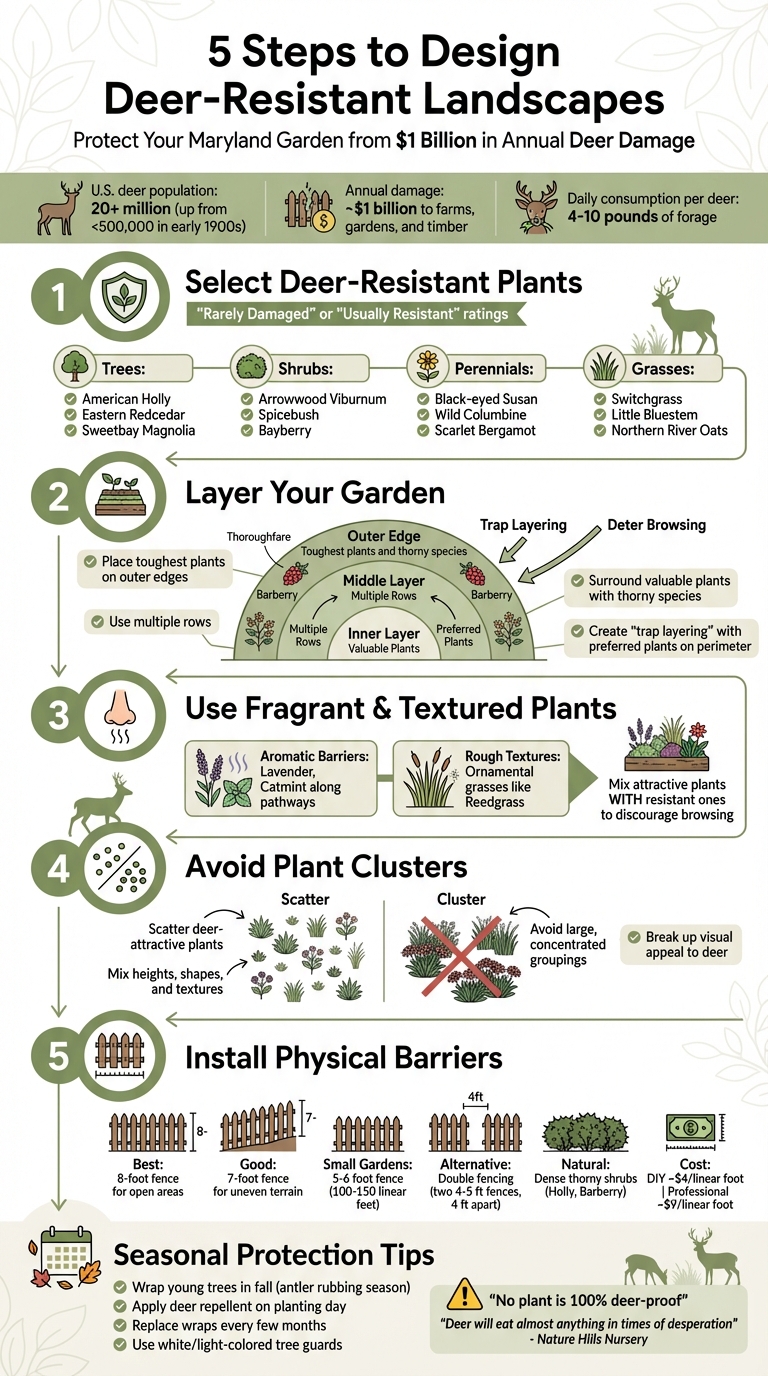
5 Steps to Design Deer-Resistant Landscapes in Maryland
Landscape Design Ideas-Deer & Rabbit Resistant| Before & After
sbb-itb-843f8be
How Deer Behavior Affects Your Landscape
To protect your landscape, it helps to understand why deer are drawn to certain properties. Residential yards with well-maintained, tender plants often replace natural forage, making them highly appealing to deer [2]. Unlike wild vegetation, cultivated plants are much more enticing.
Deer tend to establish consistent foraging routes, repeatedly visiting areas where they’ve had success [2]. Properties with fruit and nut trees or young trees with tender bark are especially inviting. Bucks, for instance, rub their antlers on these trees during the rut to shed velvet and mark their territory [2][3]. This behavior peaks in the fall, and if a tree’s bark is stripped entirely around the trunk, it can no longer transport nutrients, which often leads to the tree’s death [2].
Deer feeding habits also shift with the seasons. In spring and summer, they focus on nutrient-rich new growth and grasses. By autumn, they turn to acorns and other mast to build fat reserves for the winter [4]. When winter arrives and natural food sources diminish, deer will eat almost anything available, including woody plants and evergreens [4][5]. With the U.S. deer population now exceeding 20 million – up from under 500,000 in the early 1900s – these animals cause approximately $1 billion in damage annually to farms, gardens, and timber [5].
"There isn’t anything plant related that’s completely deer-proof because deer will eat almost anything in times of desperation." – Nature Hills Nursery [2]
You can recognize deer damage by the rough, torn edges on branches and leaves. Since deer lack upper incisors, they tear and jerk at plants rather than making clean cuts [4][5]. Common signs include peeled bark, broken branches, eaten flower heads, and perennials chewed down to the ground [2]. Male deer, consuming between 4 to 10 pounds of forage daily, can quickly devastate a landscape even in small numbers [5].
Selecting Deer-Resistant Plants for Maryland
While no plant can be guaranteed to be completely deer-proof, some species are far less appealing to deer and thrive in Maryland’s environment. Deer tend to eat whatever is available, and when their favorite foods are scarce, they may even consume plants considered undesirable or toxic, such as milkweed [1]. To minimize damage, opt for plants labeled as "Rarely Damaged" or "Usually Resistant." Choosing native Maryland plants not only supports local wildlife like insects and songbirds but also helps them endure deer browsing. Unfortunately, in many areas of Maryland, deer have decimated native plants, paving the way for invasive species that they typically avoid [1]. By understanding what deer prefer, you can make informed choices and build a landscape that is less likely to become their buffet, as part of your broader landscape projects in Maryland.
Trees and Evergreens
American Holly (Ilex opaca) is a standout evergreen option, rated "Rarely Damaged" and offering vibrant foliage and berries that provide year-round privacy. Another strong candidate is Eastern Redcedar (Juniperus virginiana), although it may develop a "browse line" on lower branches when deer pressure is high.
Additional choices include Sweetbay Magnolia (Magnolia virginiana), which features fragrant white flowers in late spring, and Pitch Pine (Pinus rigida), a resilient native that thrives in poor soils. For fall interest, Sweetgum (Liquidambar styraciflua) delivers stunning seasonal color, while Pawpaw (Asimina triloba) offers edible fruit and unique foliage, both of which deer typically avoid [1][6]. These trees and evergreens form a solid backbone for a deer-resistant landscape.
Shrubs and Woody Plants
Shrubs play a crucial role in creating layers of protection. Arrowwood Viburnum (Viburnum dentatum) and Blackhaw Viburnum (Viburnum prunifolium), both rated "Rarely Damaged", provide white blooms in spring and colorful berries in the fall. Spicebush (Lindera benzoin) is another excellent choice, featuring aromatic foliage and bright yellow fall leaves that deer tend to ignore.
For salt-tolerant options, Bayberry (Myrica pensylvanica), rated "Rarely Damaged", and Waxmyrtle (Morella cerifera), labeled "Usually Resistant", are practical for areas near salted roadways. Red Chokeberry (Aronia arbutifolia) adds visual interest with white spring flowers and vibrant red foliage in the fall, all while holding up well against deer browsing [1][6]. These shrubs enhance the depth and functionality of your deer-resistant garden.
Ornamental Grasses and Perennials
Native ornamental grasses bring texture and movement to your landscape while being less tempting to deer. Switchgrass (Panicum virgatum) grows 3–6 feet tall, with blue-green foliage that turns golden in the fall. Little Bluestem (Schizachyrium scoparium) features fine blue-green blades that transition to copper and burgundy by autumn, while Northern River Oats (Chasmanthium latifolium) stands out with its unique flat seedheads that last through winter.
For perennials, consider Black-eyed Susan (Rudbeckia hirta) and Eastern Coneflower (Rudbeckia fulgida), which brighten the garden with yellow blooms from summer to fall. Wild Columbine (Aquilegia canadensis) offers delicate red and yellow flowers in spring, and Scarlet Bergamot (Monarda didyma) attracts hummingbirds with its bold red blooms. Adam’s-needle Yucca (Yucca filamentosa) adds architectural flair with its sword-like leaves and tall white flower spikes [1]. Together, these grasses and perennials round out a thoughtful deer-resistant landscape design.
Designing Your Landscape Layout to Reduce Deer Damage
After choosing plants that deer tend to avoid, the next step is arranging them to create a natural defense. By layering and strategically placing these plants, you can form barriers that not only protect vulnerable areas but also make your garden less appealing to deer. The key is to use a combination of textures, spacing, and thoughtful plant placement to minimize the chances of deer venturing into your space – or at least make it harder for them to access their favorite plants.
Using Layered Planting
A layered approach to planting can significantly reduce deer activity. Start by positioning the toughest, least appealing plants along the outer edges of your property. Dense shrubs or thorny brambles work well here, creating a physical barrier that’s difficult for deer to cross. A single row won’t cut it – multiple rows are far more effective. This thick border of shrubs acts as a shield, protecting the more delicate plants inside.
For especially valuable plants, surround them with species that deer dislike. Thorny options like Barberry are excellent choices for creating localized protection. Another tactic is "trap layering", where you plant species deer prefer along the outermost edges of your garden. This draws their attention away from the interior plants you want to protect. As Nature Hills Nursery explains, "There’s nothing like a well-manicured hedge to burst curb appeal, especially when it looks like Fort Knox to a hungry deer" [2].
To boost your garden’s defenses even further, consider incorporating aromatic and textured plants.
Combining Fragrant and Textured Plants
Strongly scented and textured plants are natural deterrents for deer. Use fragrant varieties like Lavender or Catmint along pathways and property edges to create a scented boundary. Deer tend to avoid these strong-smelling plants, making them a smart addition to your landscape. For added protection, include tall ornamental grasses with rough foliage, such as Reedgrass, which deer generally steer clear of.
Nature Hills Nursery suggests mixing plants deer enjoy with those they avoid. "Group plants that taste good to deer with plants they are known to dislike, leading to nibbling on the wrong one will lead to them avoiding the entire grouping" [2]. This strategy ensures that even if a deer takes a bite, the experience may discourage further browsing in that area.
Lastly, avoid creating concentrated areas of deer-attractive plants by spreading them out thoughtfully.
Avoiding Clusters of Deer-Attractive Plants
To keep deer from zeroing in on their favorite plants, scatter these species throughout your garden. Avoid planting them in large, inviting clusters. Instead, surround them with resistant varieties to break up the appeal. A garden with a mix of plant heights, shapes, and textures not only looks more dynamic but also makes it harder for deer to focus on any one area. This diverse approach helps minimize visible browsing damage and keeps your landscape looking its best [2].
Installing Fences and Physical Barriers
When plant selection and strategic layouts fall short, physical barriers step in as a reliable way to keep deer at bay. While planting can create a psychological deterrent, a well-built fence provides a tangible solution. The best type of barrier for your situation depends on factors like property size, terrain, and local regulations, but proper installation is key for success.
Fencing Options
An 8-foot fence is often considered the most effective option for keeping deer out of open areas like fields or expansive lawns. For example, Pennsylvania requires 8-foot fencing on deer farms to ensure containment [9]. In areas with uneven terrain or dense landscaping, a 7-foot fence may do the trick since deer are less likely to jump when they can’t see a safe landing spot [7].
For smaller spaces – like gardens with 100 to 150 linear feet of fencing – a 5- to 6-foot fence can work. According to the LuEsther T. Mertz Library at the New York Botanical Garden, "Deer’s eye structure and placement give them excellent perception of movement at a distance, but poor depth perception. They will be less likely to jump even a low fence if a clear landing area is not visible" [8]. If zoning laws restrict fence height, you can try double fencing: install two fences, each 4 to 5 feet tall, spaced about 4 feet apart. Deer are unlikely to clear both barriers together [8][9].
When selecting materials, opt for durable, low-maintenance options like black or dark green metal posts paired with matching mesh. Be sure to check Maryland’s local standards for approved materials [10]. For new fences, attach white streamers at eye level during the first year to help deer recognize the barrier [7]. Secure the bottom of the fence tightly to the ground since deer often try to crawl underneath [7]. If you’re installing the fence yourself, costs start at about $4 per linear foot, while professional installations average around $9 per linear foot [7].
If a traditional fence doesn’t fit your aesthetic, natural solutions like stone garden walls can offer a more organic approach.
Natural Plant Barriers
For a more natural look, thorny shrubs can act as living barriers. Plants like Holly and Barberry not only deter deer with their prickly surfaces but also enhance the visual appeal of your property. These shrubs are most effective when planted densely along property lines or around vulnerable garden areas. Over time, they grow thicker and provide an increasingly strong defense, blending seamlessly with your landscape while adding both physical discomfort and visual deterrence. Unlike manufactured fencing, these natural barriers improve with age, giving you both protection and beauty in one solution.
Adapting Your Design to Maryland’s Climate and Conditions
Maryland’s changing seasons directly affect deer feeding habits. In challenging conditions like harsh winters, drought, or heavy snow, deer often resort to eating plants they usually avoid, including toxic ones like milkweed[1][11]. As the University of Maryland Extension notes, "There is no deer-proof plant, and frustratingly, lists of which plants are deer-resistant vary so much they are sometimes in direct contradiction with one another. This is because deer food preferences vary depending on what else is available to eat at any particular time and location"[1].
Maryland’s climate also plays a role in physical damage to landscapes. During fall, male deer rub their antlers against tree trunks, often harming or killing young trees and shrubs[1]. In areas with dense deer populations, this behavior can create a noticeable browse line where vegetation is stripped consistently[1]. Properties near water sources or wooded areas often experience more intense deer activity and may need stronger protective measures[11].
Given Maryland’s diverse terrain, plant performance can vary widely across the state. Choosing plants strategically is key. Ferns, grasses, and sedges are generally avoided by deer, regardless of the season[11]. Native woody plants like Eastern Redcedar, American Holly, and Spicebush not only resist browsing but also provide habitat for local songbirds and insects[1].
To protect young trees during fall, consider using white or light-colored tree wraps or perforated plastic tubing around thin-barked trees to prevent antler damage. Applying deer repellent on planting day can also make the plants less appealing[2]. Remember to replace wraps every few months to avoid moisture buildup and insect problems[2].
Working with Pro Landscapes MD

Addressing Maryland’s unique climate and deer-related challenges often requires professional insight. Pro Landscapes MD specializes in navigating the state’s diverse microclimates and deer pressures, tailoring solutions for areas from Bethesda to Ellicott City. They understand that deer-resistant plant lists can be inconsistent and interpret them to suit your specific location and conditions[1].
Their approach prioritizes native ferns, grasses, and woody plants that naturally resist browsing while supporting Maryland’s ecosystems. Beyond plant selection, Pro Landscapes MD provides practical solutions like protecting young trees during fall, managing drainage to reduce stress on plants, and designing layered plantings to handle high-traffic deer areas. Their comprehensive services – covering landscape construction, restoration, and maintenance – help create resilient, deer-resistant landscapes that avoid becoming overrun by invasive species[1]. With their expertise, your outdoor space can thrive despite Maryland’s unique environmental challenges.
Conclusion
Creating a deer-resistant landscape in Maryland means accepting that no plant is completely safe from deer browsing [2]. The most effective approach combines several strategies: selecting native plants like Christmas Fern and Spicebush that deer tend to avoid, designing layered plantings with fragrant or textured species to act as natural barriers, and using physical protections such as 8-foot fences or tree guards to minimize damage from activities like antler rubbing.
Start protecting your landscape right away by applying deer repellents to new plantings and wrapping young trees with light-colored tree guards. Be sure to replace these wraps periodically to prevent moisture buildup. Another useful tactic is grouping plants that deer dislike around more vulnerable ones to reduce the chances of heavy browsing.
Keep in mind that deer behavior can change with the seasons and local conditions. For instance, food scarcity during harsh winters or the fall rut can lead to increased damage. This means your landscape strategies should evolve over time. Working with experts like Pro Landscapes MD, who understand the local environment and specialize in deer-resistant planting and protective measures, can make a big difference. By combining thoughtful plant selection, smart design, and physical barriers, you can help maintain a beautiful and protected outdoor space in Maryland.
FAQs
Which fence style works best for my yard?
The best way to keep deer out is by using a fence that’s at least 8 feet tall and built with strong materials like high-tensile wire or welded mesh. Adding electric fencing can create a psychological barrier, making it even more effective. For extra protection, consider using double-fencing or integrating the fence with natural elements in the landscape. Focus on height and solid construction to stop deer from jumping over.
How do I protect new trees during the fall rut?
Protecting young trees during the fall rut is crucial, especially since deer can cause damage as they rub their antlers against the trunks. One effective method is using physical barriers, like paper bud caps, to safeguard the terminal buds – these are essential for the tree’s vertical growth.
Here’s how to make and use paper bud caps:
- Cut lightweight paper into small pieces.
- Fold each piece around the terminal bud.
- Secure the paper with three staples, ensuring they’re tight enough to hold up against wind and snow.
In addition to bud caps, you can also use tree guards, repellents, or fencing for extra protection. Each option adds a layer of defense to help your trees thrive.
What’s the best layout to keep deer away from favorite plants?
The best way to protect your plants from deer is by combining physical barriers with smart plant placement. Start with deer-proof fencing to keep them out entirely. For extra protection, surround at-risk plants with deterrents like motion-activated lights or pinwheels that startle deer. Additionally, use deer-resistant native plants in key spots to make your garden less appealing to them. This mix of methods helps safeguard your plants while keeping your garden looking great.
Chat with Us