









- bhavya gada
- No Comments
Retaining walls are essential for managing soil and preventing erosion, but neglecting them can lead to costly failures and even safety risks. Regular monitoring and maintenance are crucial to avoid issues like bulging, leaning, and water damage. Here’s what you need to know:
- Key Risks: Soil pressure, water buildup, and material wear are the main threats to retaining walls. Dry-stone walls are especially prone to shifting over time.
- Warning Signs: Look for bulging, leaning, cracks, water seepage, or missing stones. These can indicate serious structural problems.
- Monitoring Tools: Use simple tools like plumb bobs, laser levels, and cameras for regular inspections. Advanced sensors and LiDAR technology can detect subtle shifts.
- Drainage Maintenance: Clear weep holes and check drainage systems twice a year to prevent hydrostatic pressure.
- Professional Help: Call an expert if you notice horizontal cracks, significant leaning, or persistent water issues.
Proactive care extends the life of retaining walls and prevents expensive repairs. Regular inspections, proper drainage, and timely interventions keep your property safe and stable.
Retaining Wall – Annual Inspection
sbb-itb-843f8be
Visual Inspection Methods
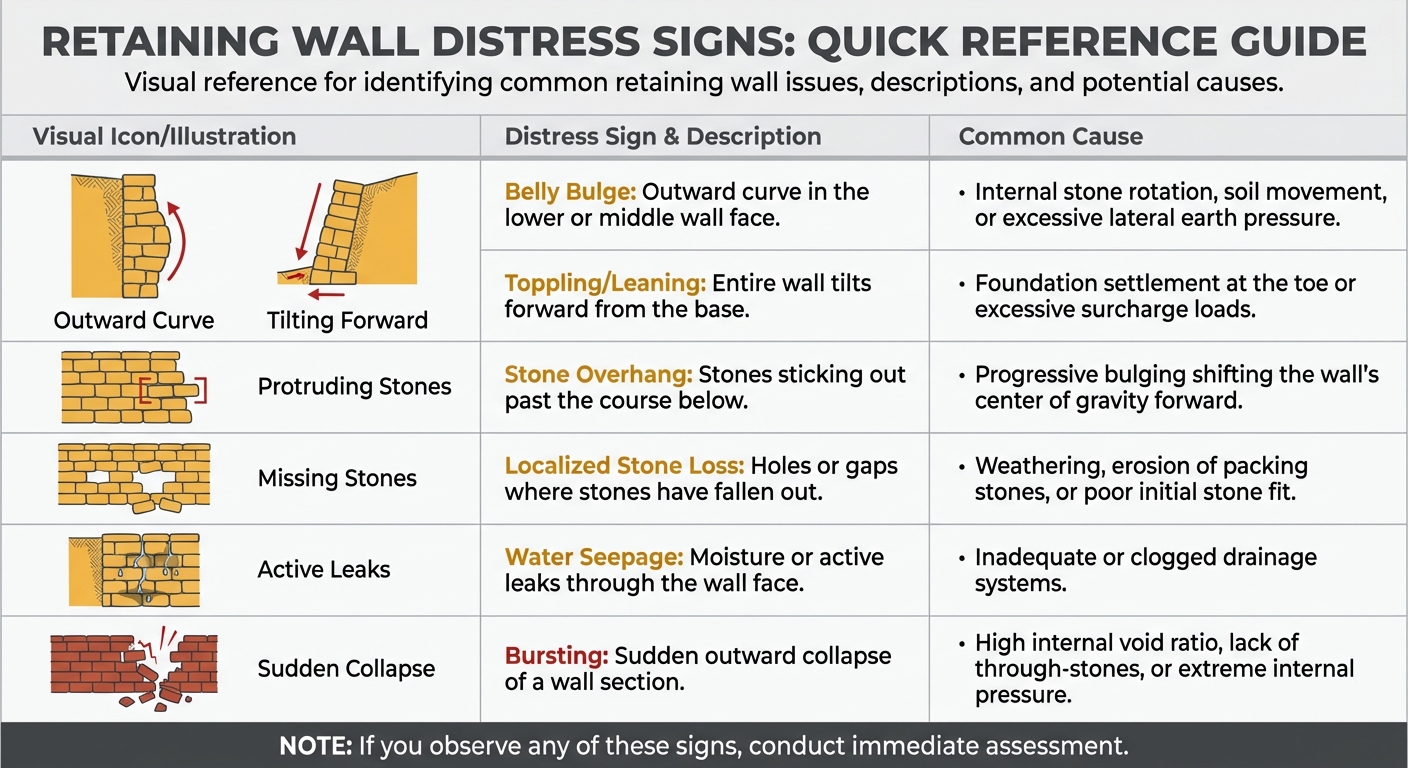
Retaining Wall Distress Signs: Visual Guide to Damage Indicators and Causes
Visual inspections are your first and best tool for spotting potential retaining wall issues before they spiral out of control. By knowing what to look for and understanding the causes behind visible damage, you can address problems early and avoid costly repairs. Below, we’ll break down common warning signs and what they mean for your wall’s stability.
Spotting Common Damage Indicators
Take a close look at your wall from different angles to identify any warning signs. One of the most frequent issues is belly bulging, which appears as an outward curve in the lower or middle section of the wall. Pete Walker, a professor at the University of Bath, explains:
Many walls have deformed or bulged and are regarded as potentially unstable [5].
Another red flag is toppling or leaning. This happens when the entire wall tilts forward from its base, pivoting around the toe (the bottom edge). To spot this, check for stones that overhang the course below, as these can indicate that the wall is on the verge of becoming unstable. Walker’s research highlights:
The bulging in the lower courses caused several blocks to move much further than those directly below… shifting the wall’s center of mass further and further forwards [5].
Localized stone loss is another concern, where individual stones fall out and leave gaps in the wall face. While the surrounding structure might seem stable, these gaps often point to weathering, erosion of smaller packing stones, or poor construction practices.
Also, keep an eye out for water seepage, which might show up as damp patches, visible moisture, or even active leaks through the wall. This often signals drainage issues that can lead to dangerous hydrostatic pressure behind the wall. Lastly, examine the wall’s internal packing through any gaps. Well-built dry-stone walls should have around 20% voids. If you notice significantly more, it could mean the wall was poorly constructed and is at risk of failure [5].
Determining Root Causes of Wall Problems
Identifying the root cause of damage is just as important as spotting the damage itself. For example, belly bulges often result from excessive lateral earth pressure, internal stone rotation, or shifting soil behind the wall. These are signs that the wall is under stress and needs immediate attention.
Toppling and leaning are usually linked to foundation issues, such as settlement at the toe or heavy loads (like vehicles or construction equipment) pressing on the ground behind the wall.
Water seepage, on the other hand, points to a failure in the drainage system. Causes might include clogged weep holes, missing drainage pipes, or improper backfill material. Meanwhile, localized stone loss and stone rotation can often be traced to weathering and poor construction methods. Walls built without enough through-stones or with poorly fitted stones are especially prone to these problems.
The key is to address the underlying causes, not just the visible damage. For instance, rebuilding a bulged section won’t solve anything if the soil pressure or drainage issues causing the bulge aren’t fixed. Use the table below for a quick overview of common distress signs and their typical causes.
Quick Reference Table for Wall Distress Signs
| Distress Sign | Visual Description | Common Cause |
|---|---|---|
| Belly Bulge | Outward curve in the lower or middle wall face | Internal stone rotation, soil movement, or excessive lateral earth pressure [5] |
| Toppling/Leaning | Entire wall tilts forward from the base | Foundation settlement at the toe or excessive surcharge loads [5] [2] |
| Stone Overhang | Stones sticking out past the course below | Progressive bulging shifting the wall’s center of gravity forward [5] |
| Localized Stone Loss | Holes or gaps where stones have fallen out | Weathering, erosion of packing stones, or poor initial stone fit [5] |
| Water Seepage | Moisture or active leaks through the wall face | Inadequate or clogged drainage systems [4] |
| Bursting | Sudden outward collapse of a wall section | High internal void ratio, lack of through-stones, or extreme internal pressure [5] |
Drainage System Inspection and Maintenance
A well-functioning drainage system is key to preventing water buildup, which can lead to hydrostatic pressure. This pressure can cause walls to bulge, lean, or even collapse. Pete Walker, Director of the BRE Centre for Innovative Construction Materials at the University of Bath, highlights this risk:
Elevated water pressures are certainly a factor in deformation and failure of dry-stone walls [5].
Properly directing water away from the wall prevents saturation and erosion, both of which are essential for maintaining the wall’s structural integrity.
Routine Drainage System Checks
To keep your drainage system in good shape, inspect weep holes and drainage outlets twice a year – once in spring and again in fall. Look for blockages caused by leaves, dirt, or other debris. A stiff wire or garden hose can help clear these obstructions. During heavy rain, observe how water flows; any signs of poor drainage could indicate a clogged or malfunctioning system.
Pooling water behind the wall is another red flag. This could mean that drainage pipes are blocked, missing, or improperly installed [1]. Addressing these issues promptly helps avoid long-term damage.
When blockages are not immediately visible, advanced tools can assist in diagnosing hidden drainage problems.
Tools for Finding Hidden Drainage Problems
Sometimes drainage issues lie beneath the surface, requiring specialized detection tools. One option is infrared thermography (IRT), which identifies moisture by detecting cooler areas caused by trapped water [6]. While professional infrared cameras are pricey, some smartphone attachments offer a more affordable way to access basic thermal imaging.
For more advanced monitoring, wireless tilt and humidity sensors can track wall movement and moisture levels in real time. These sensors attach directly to the wall and send automated alerts via email or text if movement or moisture exceeds safe limits. Built to withstand extreme temperatures ranging from -40°F to +150°F, these devices typically have a battery life of over 10 years [2]. After severe weather events like floods or heavy snowmelt, these tools can quickly assess whether your drainage system is overwhelmed and if hydrostatic pressure is threatening your wall’s stability.
Monitoring Tools and Inspection Schedule
Keeping your retaining wall in good shape starts with a solid monitoring plan. Using the right tools and sticking to a consistent inspection schedule can help catch potential problems early, ensuring the wall stays safe and functional for the long haul.
Basic Monitoring Tools for Homeowners
You don’t need fancy equipment to keep an eye on your wall – simple tools can do the job. A digital camera or smartphone works great for taking photos from the same angles over time, making it easy to spot changes [3]. A laser level is handy for detecting slight tilts or leaning that might not be obvious at first glance [1]. For checking if the wall is still vertical and free of bulges, a plumb bob is a reliable, old-school option [5].
How Often to Inspect Your Retaining Wall
Once you have the tools, setting up a regular inspection routine is key. Here’s a simple guide:
- Monthly: Do a visual check for cracks, bulges, or shifting.
- Quarterly: Inspect the drainage system by clearing weep holes and observing water flow during or after rain.
- Annually: Bring in a professional for a thorough assessment to catch any hidden issues.
- After severe weather: If there’s heavy rain, flooding, or snowmelt, inspect immediately, even if it’s outside your usual schedule [1] [2].
Professional-Grade Monitoring Equipment
For walls under higher stress or showing signs of trouble, professional tools can provide a deeper look. These advanced systems are designed for precision and long-term monitoring:
- Wireless tilt sensors: These measure wall inclination with extreme accuracy (down to 0.00016 degrees) and can send automated alerts if movement exceeds safe limits [2].
- Terrestrial LiDAR: This technology detects displacements as small as a few centimeters across large wall surfaces, offering detailed insights [3] [6].
- Close-range photogrammetry: Creates 3D models to track bulges or other changes over time.
- Target-Based LiDAR: Used by the Georgia Department of Transportation between April 2023 and October 2025, this tool proved effective for detecting centimeter-level shifts, helping to guide maintenance decisions [6].
While these tools require professional installation, they offer long-term benefits, with some systems boasting battery lives of over 10 years [2]. For walls with structural challenges, these solutions provide peace of mind and precise data to address potential problems before they escalate.
When to Call a Professional for Wall Assessment
Warning Signs That Require Expert Evaluation
Some wall issues go beyond DIY fixes and need a professional’s touch. For instance, horizontal cracks often indicate that your wall is struggling to handle soil pressure, potentially requiring structural solutions like tieback anchors. Similarly, stair-step cracks suggest foundation settlement or shifting, which might call for geotechnical testing to evaluate the soil beneath the structure [1]. If you notice your wall leaning outward or developing a bulge, it’s a clear sign that lateral forces are compromising its integrity, and immediate expert attention is necessary.
Problems with drainage are just as critical. Persistent water pooling at the base or behind the wall – even after clearing out weep holes – points to a failed internal drainage system. A cautionary tale is the March 2021 collapse of a retaining wall in Bellmawr, New Jersey, which followed heavy rain. Warning signs like soil loss, sinkholes, and cracks had been observed but left unaddressed [1]. Issues such as sinkholes, sudden stone movement, or stones rotating and falling out are all red flags that require professional evaluation [1] [5]. Professionals use tools like laser levels, inclinometers, and drones to identify subtle shifts that are hard to detect with the naked eye [1] [2].
When these warning signs appear, contacting an expert is essential for diagnosing the problem accurately and addressing it before it worsens.
How Pro Landscapes MD Can Help

While regular visual inspections are helpful, professional expertise is key when serious issues arise. Local knowledge can be especially valuable for tackling challenges unique to your region and ensuring durable solutions.
Pro Landscapes MD specializes in retaining wall inspections throughout central Maryland, serving areas like Howard County, Montgomery County, Carroll County, Frederick County, Prince George’s County, and Baltimore County. Their team can diagnose structural issues such as belly bulges caused by block rotation or horizontal cracks from soil pressure and recommend the right fixes.
Their services include advanced drainage solutions like installing weep holes, perforated pipes, and French drains to alleviate hydrostatic pressure. For walls needing reinforcement, they offer techniques like geogrid installation, tieback anchors, and soil nailing [1]. Pro Landscapes MD also handles stormwater management with services such as drainage installation, grading, land leveling, and creating dry riverbeds. Whether you’re in Ellicott City, Bethesda, Columbia, or nearby areas, their focus on quality ensures your retaining wall gets the care it needs for long-term safety and functionality.
Conclusion
Retaining walls quietly do the heavy lifting – protecting your property by preventing erosion, managing runoff, and keeping landscapes stable. But they need a little help to stay in top shape. Regular inspections can catch early signs of trouble, like cracks, bulges, or leaning, before they escalate into bigger problems.
Keeping drainage systems clear, including weep holes, is key to avoiding hydrostatic pressure buildup. Ignoring this can lead to costly repairs or even structural failure down the line.
If you notice horizontal or stair-step cracks, or water pooling near the wall, it’s time to call in a professional. The Wall 22 collapse in Bellmawr, NJ, serves as a stark reminder of what can happen when warning signs like soil loss or sinkholes are overlooked [1]. Professionals have tools like laser levels and inclinometers to detect subtle shifts that you might miss.
FAQs
How much wall lean is too much?
If a wall leans more than 2-3% of its height, it’s usually a sign of trouble. This kind of tilt might indicate instability or even a risk of collapse. In such cases, it’s crucial to bring in a professional to assess the situation and determine what corrective steps are needed to maintain safety and structural integrity.
What’s the best way to measure small wall movement over time?
To keep an eye on small wall movements, it’s smart to rely on precise tools like wireless tilt sensors or high-resolution deformation measurement systems. These tools offer accurate, round-the-clock tracking of even the tiniest tilts or shifts. For more localized movement, combining visual inspections with inclinometer readings or laser scanning can work well. Regularly using these methods helps catch potential problems early and keeps the wall stable over time.
When should I rebuild versus reinforce a stone retaining wall?
Reinforcement works well for addressing minor problems like small cracks, slight tilting, or surface imperfections that don’t threaten the structure’s stability. Keeping an eye on these issues through regular monitoring can help spot early signs of stress, making timely reinforcement possible.
On the other hand, rebuilding becomes essential when dealing with serious damage. This includes large cracks, severe tilting, or foundational failures. When stability is at risk, a professional evaluation can guide you in deciding whether reinforcement is enough or if full reconstruction is the safer route.
Chat with Us